
Tag: unschooling

  • I'm Throwing Out Fifty Things!

    I'm Throwing Out Fifty Things!

    I bought the book Throw Out Fifty Things a few weeks ago and it’s changed my life.

    My latest accomplishment – getting rid of 50 things from this (now neat) bookshelf!

    Of course, I haven’t read it – inspirational books like this only need me to purchase them to apply their basic principles.

    But I have thrown out multiples of 50 things in the past few weeks. All because of this book!

    “What’s that got to do with math?”

    Great question; I’m glad you asked.

    Well, for starters, “fifty” is a number. In particular a positive integer.

    And if you buy this book (adding one more thing to your pile of stuff, as Husband points out), then you probably have at least 50 things you can throw out.

    Which means you have way more than 50 things.

    How many things do you have?

    Take a quick inventory. No – not of everything. But just of what you see right in front of you at this very moment.

    Chances are you stopped counting and started estimating at around 50. Then you stopped altogether at around a few hundred.

    Even if you divide this by two (if you’re married or partnered) that’s still a ton of stuff.

    “Things” are more than what you see.

    Now take a quick peek at your email. How many things are clogging your inbox?

    If you’re online, I’ll bet you have a plethora of people you’re friends with and following.

    And if you write a blog… look at how many drafts you have.

    So throw out fifty things.

    Well, make sure to recycle them or donate them. But get them out of your world.

    If it helps, think of how many thousands of things you have. If you have 500 things in each room and you have ten rooms, that’s 5000 things.

    Throwing out 50 of those is 1% of your stuff. That’s practically nothing. And you’ll feel great!

    I’m throwing out 70 things in the next three weeks!

    I’ve pitched books, sold cloth diapers and donated socks – at least 50 pair of the cutest 1980’s socks you’ve ever seen!

    Shirts, pants and shoes… if I didn’t love them, I gave them to someone who would.

    And now it’s time for the e-throw-out.

    I have 70 articles on this site – in draft mode! So for the next three weeks, every one of them is getting published or pitched.

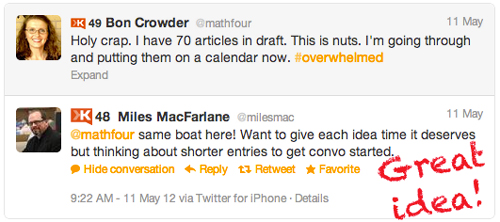
    Many will be conversation starters, as my twitter friend Miles MacFarlane suggested. Some might turn into full articles.
    And some drafts will meet their fate with the “File 13” button of death.

    And I’ll be free!

    Okay, there’ll certainly still be things that haunt me. Things I need to do, want to do and have to do.

    But I won’t have a mountain of “should-haves” sitting on my shoulders.

    So how about you? Share in the comments what kinds of things you’ll throw out for your first 50 things. And let others join the fun – tweet this out!

    Related Articles:
  • Time and Technology – Are we missing some math practice?

    Time and Technology – Are we missing some math practice?

    I’ve written before that teaching time isn’t only about telling time. And this morning I started thinking about it again.

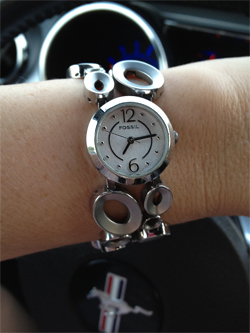
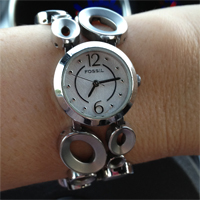
    I found my super fun circle watch from Fossil and put it on. I haven’t worn a watch in quite a while. So it’s fun wear it again.

    We don’t need to wear watches anymore.

    Well, except for fashion. Our mobile phones (even the “dumb” ones) keep time rather well.

    If you need the time, you dig out your phone. And if it’s too deep in your purse, you ask someone.

    And they tell you with words like, “It’s 8:23.”

    You never have to wonder.

    Do you recall this type of conversation:

    Kate: What time do you have?

    Wil: I show 10:15, but I’m usually about 5 minutes fast. So it’s really about ten after.

    Kate: Thanks!

    That phrase, do you have, is now obsolete. Everyone has the same time. It’s from Verizon, AT&T or TMobile. And they get it from the same place – the place that has the exact time.

    This means a lot for math.

    Nobody runs fast or slow. Also, we don’t have to add or subtract to get the real time.

    The time just is.

    20 years ago when your watch was six minutes fast, you had to do this to get the real time:

    1. Look at your watch.
    2. Figure out the time (the big hand’s on the …”).
    3. Subtract 6.

    You got to practice addition and subtraction – often!

    Which means our kids don’t get this benefit.

    Is it hurting them?

    What do you think? Share in the comments and don’t forget to tweet it out!

    Related articles
  • Teaching Time Isn’t Only About Telling Time

    Teaching Time Isn’t Only About Telling Time

    There are tons of great products out there to help with teaching time. White board clocks, clocks with movable hands, games, etc.

    But teaching time isn’t only about telling time.

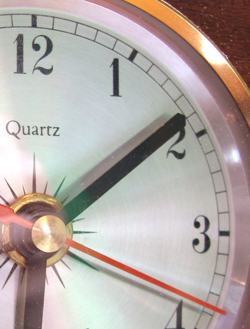
    When we teach children how to tell time, we are merely giving them another “reading” skill. We’re teaching them how to interpret the hands on a clock.

    We also teach them how to understand what time things happen during the day. With this we’re getting closer to giving them an appreciation of what time is. But we’re still not there.

    We “spend” time like we spend money.

    My friend, Paul Cunningham once told me he was, “time poor.” We all have the same amount of time in each day. So why would one person be “poor” with respect to time, while others are not?

    Time is relative to the “must do” work.

    Parkinson’s law is: “Work expands so as to fill the time available for its completion.”

    Which also means that if you have something that must be accomplished, and extremely limited amount of time, then you figure out a way to get it done. Which sometimes means to do it at a less than perfect quality.

    Grownups experience this all the time – with work and personal tasks.

    Must do it.
    Must do it fast.

    So do it as best as you can and be done.

    Kids are required to sleep. That’s about it. Daughter sleeps 10 hours each night and about 2 hours during nap. She’s got a whopping 12 hours every day to do just about anything else!

    Of course she’s corralled in various places against her (very strong) will. But nevertheless, her only “work” is to learn.

    Parkinson’s law allows her all the time she can to “perfectly” learn everything she can.

    Time is relative to our age.

    I remember as a child understanding that Christmas was two weeks away. As an adult I can calculate that two weeks to a five-year-old is equivalent to four months as a 40-year-old!

    See… I’m 14,600 days old. My nephew is 730 days old. For me, Christmas is about \(\frac{14}{14,600}\) of my life away. For my nephew, Christmas is \(\frac{14}{730}\) of his life away!

    There are two things going on when we anticipate something in the future. As shown above, there is the amount of time we have to wait as a fraction of the amount of time we’ve been alive.

    And there is also the “habit” of waiting that gets established over time. I can wait two weeks (or even four months) because I’ve done it many many times before. A five year old rarely waits two weeks for anything!

    Can we teach the full appreciation of time?

    These subtleties and intricacies make time a very slippery subject. Teaching all these strange bits might not be doable. But it’s important as grownups that we know that they exist for us – and they don’t exist for them.

    Some of us, like Paul Cunningham, have “less time” than others.

    So when you teach time – either telling time or knowing what time things happen – don’t forget that there’s so much more. And when your child is able to grasp it – share it!

    Oh, and share your thoughts on this in the comments. 🙂

    Related articles
  • A Human Interest Story Involving Math: The $100 Battery Charger

    A Human Interest Story Involving Math: The $100 Battery Charger

    My day job colleague told a beautiful story yesterday. He had been washing his car late at night, in the dark, and was approached for assistance. He is generous beyond belief, and apparently he made a real impact.

    Oh, and it involved a little math.

    I was washing my car the other night and really getting after it. I had the scrubbing brush going and was really making progress on getting the car clean. I was totally focused and I felt a tap on my shoulder. It startled me and I turned around to be faced with a large African-American woman who said, “I’m sorry, I don’t mean to interrupt, but we’re having car problems. Is it possible you can help us? I think we need the battery jumped.”

    I looked down the street and saw no other people and no car. Within a split second I remembered my latest purchase: a wireless battery charger that needs no people, no cables and no extra car to jump a battery. I got it out of my garage and handed it to her.

    “I’m in the middle of washing my car. Why don’t you borrow this? It should help.”

    She thanked me and walked away with the charger. I got back to washing my car.

    Five minutes later there was another tap on my shoulder. Another African American woman was standing there holding a five dollar bill. She offered it to me.

    “Oh my goodness, no,” I said. “I’m not taking your money. I’m just glad I could help.”

    Another 5 minutes went by and I saw one of the ladies put the battery charger close to my garage. I was really getting into the car washing at this point – suds everywhere – so I didn’t pay much attention.

    When I was returning my carwash supplies to the garage, I saw a crisp new $100 bill on top of the battery charger!

    That thing was only $40 – and they just gave me $100 to borrow it!

    This is a wonderful and touching story. These ladies were having difficulty finding someone to help them. Not only did my friend help, he also freely gave them something to use and trusted without question that they would return it.

    They, too, were moved by his generosity.

    The numbers don’t work.

    It looks like this:

    • Battery charger cost: $40
    • “Rental fees” offered: $5
    • Shown gratitude: $100

    The numbers don’t make sense. And in a way they shouldn’t. The $100 bill wasn’t really money. It was the biggest, fattest, loudest thank you note ever written. There’s no value you can place on someone being free and generous and trusting.

    It still goes in as $100 in the eyes of the bank. But what do they know?

    Notice the math and share the story.

    When you share this story, point out the math. Especially if you tell this in front of (or to) children. Making the connection of generosity and emotion to math will help everyone see how integral math is in our lives.

    How about you? Do you have a story of generosity that you’re just now realizing involves math? Share it in the comments!

    Related articles
  • Teaching Geometry with Pickles

    Teaching Geometry with Pickles

    Daughter is into pickles. Like way into pickles. If I were to start a blog just for her, it would be called www.PicklesAndPretzels.com. (She’s also into pretzels.)

    So when Husband grabbed two instead of one jar yesterday, it seemed natural.

    Unloading the groceries, I saw the two jars a little more closely.

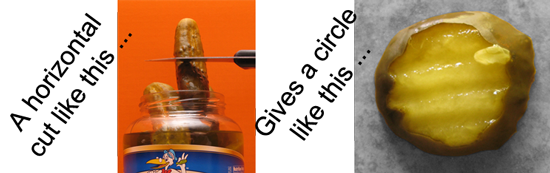
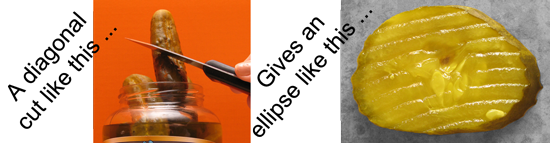
    “Holy cow,” thought I. They’ve made ellipses (pickle ovals) out of segmenting cylinders (the whole pickles)! And they’re marketing them!

    Math in action – via Vlasic!

    Interested in more about ellipses? Check out Wolfram MathWorld’s bit on it.

    Related articles
  • Unrecognized Math Conversations

    Unrecognized Math Conversations

    I had the pleasure of assisting Sarah Shah in her appearance on Great Day Houston yesterday.

    While preparing for the show, I observed Sarah and the host, Deborah Duncan, in the makeup room having a conversation about math.

    When I said to Sarah later, “that was an interesting math conversation,” she looked at me with anticipation, encouraging me to share what I heard. She had no idea I was referring to her conversation!

    The math conversation was fully on-topic.

    It was national thrift store day, and Sarah was going to share with GDH viewers some tips on shopping at resale shops. The topic of the show inspired their kibitzing behind-the-scenes about buying gold jewelry.

    Deborah was talking about how there’s a difference (sometimes big) between the cost of the gold in a piece of jewelry, and the sale price.

    The cost of craftsmanship should be close to its value.

    Deborah was making the point that there’s value on the design of an object based on the workmanship that went into it. And this goes only so far.

    Right now gold prices are around $1700 per ounce. Since an ounce is around 28 grams, gold is valued at about $60 per gram.

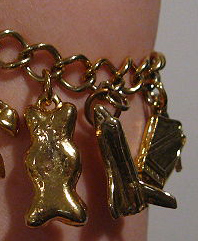
    The QVC bracelet in the picture is 9 grams. It’s selling for $530 – pretty much exactly the value of the gold contained within.

    If the value of gold for a 9 gram bracelet is around $530, charging $3000 for it means you’re paying about $2500 for the craftsmanship!

    Unconscious math is all around.

    Aqua And Gold Fractal by Sharon Apted

    It was a wonderful experience to see two intelligent, educated women having a lively and entertaining conversation about math. It was quite disheartening, though, that Sarah didn’t even recognize it. In a previous life she was a physicist.

    How many other conversations about math are ignored? How many people who claim they aren’t good at math have these conversations every day?

    Look around at your conversations this week. How many of them are about math? Share your conversations in the comments. And with your kids!

    Related articles
  • How to Teach Right Triangles when Crossing the Street

    How to Teach Right Triangles when Crossing the Street

    This morning Daughter and I went to the gym.

    When we crossed the street, I exposed her to undo risk by crossing at an angle.

    So on our way out, I explained to her that we were walking a little further to get to the car this time. And we would minimize the risk of getting hit by a car by taking the longer route.

    (Of course she’s not yet two, so she really didn’t care. But it was important for me to say.)

    Crossing at an angle is shorter than going straight across.

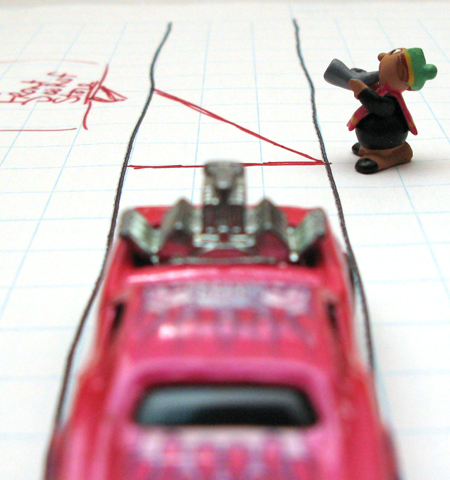
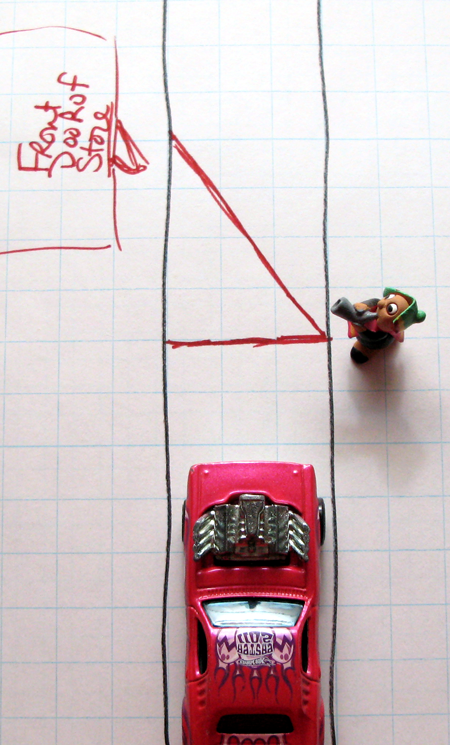
    People most often cross the street at an angle. Intuitively we know it’s shorter. Look at the tiny person in this picture. He needs to get to the front door of the store.

    It’s five yards to go at the angle, while if the little guy walked straight across then up, it would be seven yards.

    Suppose walking one yard takes 5 seconds. It will take the little guy 15 seconds to cross the street straight across. (And with a toddler, it does take 5 seconds to walk a yard.)

    Then he has to walk the four yards along the side to the door. Which means his total time is

    3 yards across at 5 seconds per yard = 15 seconds

    4 yards up at 5 seconds per yard = 20 seconds

    Total walking time = 35 seconds

    If he went at an angle, it’s 5 yards total (by the Pythagorean Theorem).

    5 yards diagonally at 5 seconds per yard = 25 seconds

    Total walking time = 25 seconds!

    Crossing at an angle puts you at risk for longer.

    For the pedestrian in a hurry (and wearing the shirt that reads “Safety Third”) the angled route is the way to go. But for a parent with toddler in tow, minimizing risk is a better option.

    If the little guy were to cross at the angle, he’d be in front of the oncoming cars for 25 seconds. If he were to take the route that is longer overall, he’d be in front of oncoming traffic for only 15 seconds.

    The car doesn’t care what angle you’re walking, it can squish you pretty easily either way.

    Not to mention he keeps the driver happy.

    Getting out of the driving area faster means keeping the driver happy. That might not be your goal, but adding some cosmic happy juice into the world of drivers never hurts.

    Plus, if someone were to “hypotenuse you” by taking the angled route when you were driving, wouldn’t you get a little annoyed?

    Next time you practice safety, practice math!

    So be safe. And tell your children why.

    It’s all about the math!

    Share your thoughts in the comments.

    Related articles

  • The 1-2-3 Song

    The 1-2-3 Song

    Part of the Count 10 Read 10 series to help parents connect with kids through math a little each day.

    Did you know that the alphabet song, Twinkle Twinkle Little Star and Baa Baa Black Sheep are all the same tune!?

    Well, now there’s another!

    Thanks to all the great folks who have public domain images out there that I could use for this.

    Specifically

    Related articles
  • How to Integrate Math into Geography

    How to Integrate Math into Geography

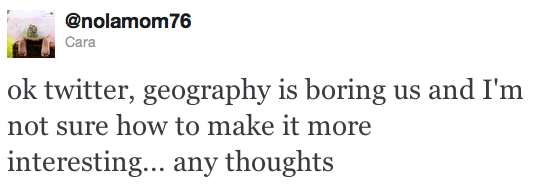
    Everyone’s getting back into the schooling groove. So twitter is filled with questions like Cara’s:

    And since my world revolves around math, here are my thoughts.

    Use the Four Color Theorem (but don’t say it out loud).

    The Four Color Theorem says that if you only have four crayons, you’re good to color your map and not have any colors touching. (That’s the he kiddo version of the theorem.)

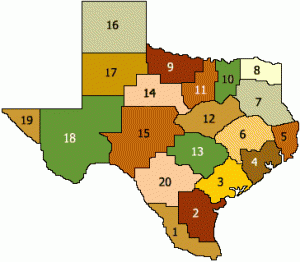
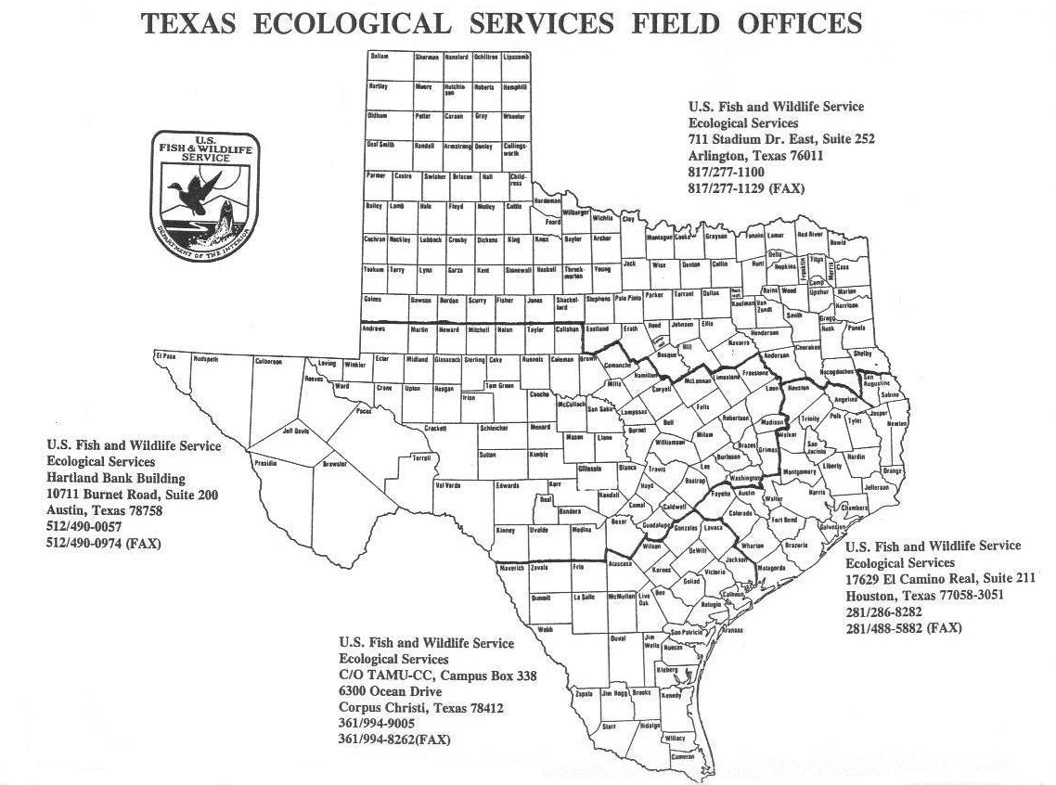
    So get out your google and print out some map coloring pages. Choose ones with lots of borders. (As fun as it is to color Texas as a whole, use a map of Texas’s counties.)

    Caution: don’t tell the children they’ll be using math. Let them figure it out.

    Now it’s coloring time!

    And here’s the challenge: color the map with as few colors as possible so that no two touching territories have the same color.

    While they color, you can talk about the names of the locations and some of the details. Even have them label them.

    Once they finish coloring, have them remember how few colors they used.

    Next time you talk about this map, ask them to use one less color than they did before. Continue labeling and discussing the locations.

    After a while they’ll figure out that they can’t do it with three, but they can do it with four.

    Shower, rinse, repeat.

    From the Texas Environmental Education Providers (how cool is that!)

    Kids are experimental. And they don’t believe that what works once, automatically works again (that’s why they drop Cheerios on the floor over and over and over again).

    So you can do this with the next map when you’re ready to go to another part of the world.

    Indeed, they’ll eventually figure out that four is the magic number. Then they can google it and learn all about the theorem!

    How about it? Did it work? Share your experiences in the comments.

    Related articles
  • Wordless Wednesday: An Example of Count 10 Read 10

    Wordless Wednesday: An Example of Count 10 Read 10

    In an attempt to join the Wordless Wednesday crowd, I’m sharing this photo. But as you can see, for MathFour.com, this is only a Somewhat Wordless Wednesday.

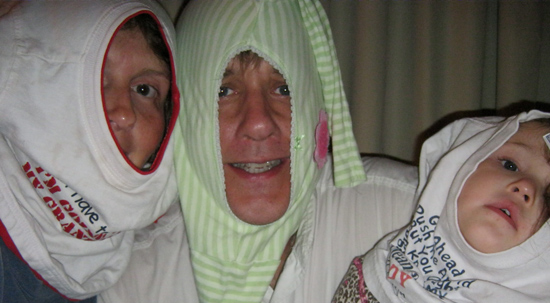
    Before this photo we were discussing size of shirts – a numeracy concept that is visually displayed through the inability for grownups to fit 4T nightshirts on their bodies. Count 10 Read 10 is part of our family’s afterschooling routine.

    Related articles