Tag: series

  • Playing with Algebra Concepts

    Playing with Algebra Concepts

    I’ve been itching to get into some basic abstract algebra goodies. With the help of the Cuisenaire Rods, Simply Fun Sumology number tiles and the Discovery Toys Busy Bugs, I’m able to do that.

    Start with wrap around addition.

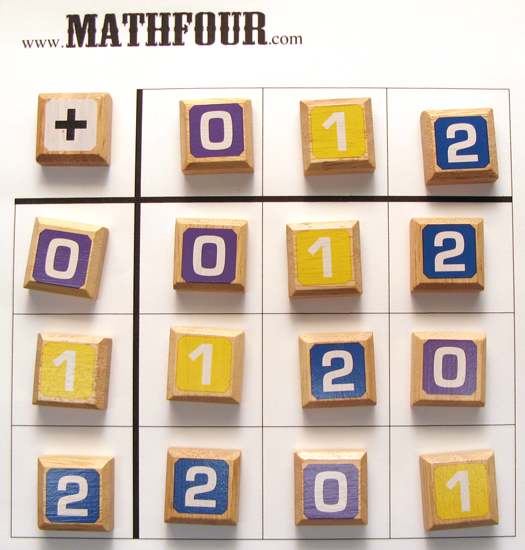
    This type of math is officially called “modular arithmetic.”  We are only going to use the numbers 0, 1 and 2.

    It begins as regular addition. And since we are only using those three numbers, all our answers have to be either 0, 1 or 2. So when we add 1+2, we wrap around.

    If we were to count in our system, we’d say: “0, 1, 2, 0, 1, 2, 0, 1, 2, 0, 1, …”

    The addition table looks like this:

    (Notice you could do this with numbers from 1- 12 and it would be clock addition!)

    Now things get buggy.

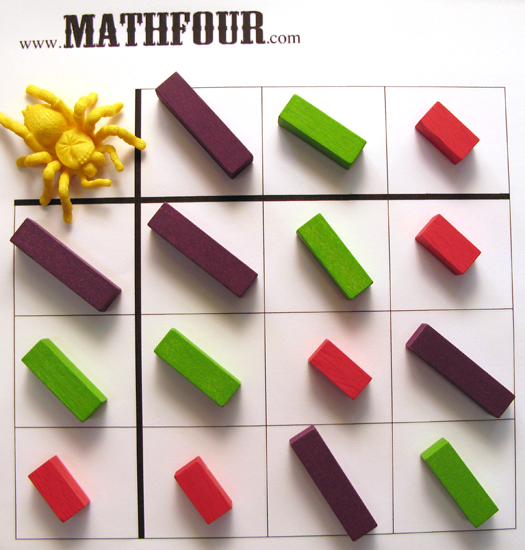
    Switch out all the number tiles with some pretty color Cuisenaire Rods. They don’t have to be the “right” rods. We’re only looking at the colors. Here’s the progression I did:

    The end result is a very abstract chart!

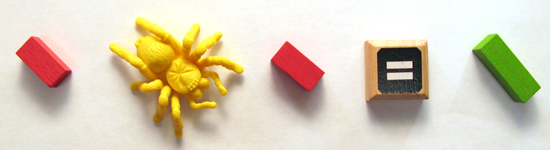
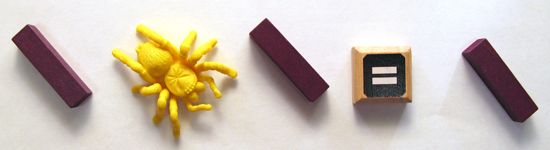
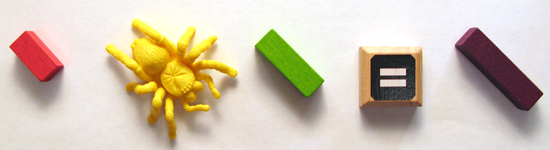
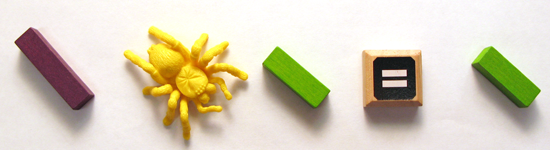
    You can “bug” two things together.

    Like this:

    (I know – a spider isn’t a bug. But run with me on this, okay?)

    Notice that each of these are directly from the “spider table” above.

    You can read this as, “Purple spider green equals green,” just like you would say, “Zero plus one equals one.”

    And then turn your child loose!

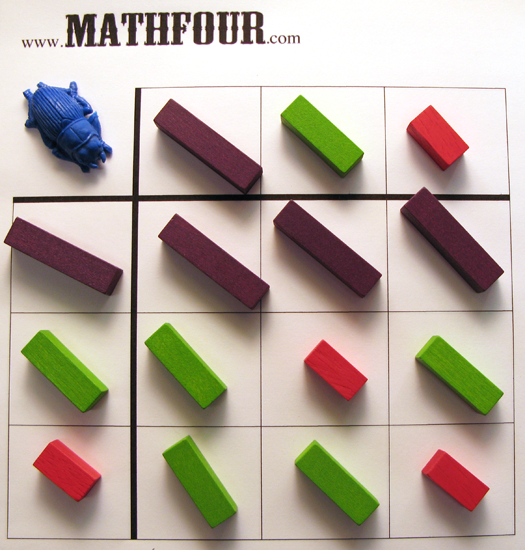
    First make a chart, or download this one.

    You can, but don’t have to, start out with numbers. The rules are this:

    • You can only use three colors.
    • All three colors must go across the top.
    • All three colors must go down the left.
    • Fill in the 9 spaces however you want, as long as it’s only those three colors.

    I did this one with the blue beetle as the “addition” piece:

    So what can you do with a goofy “blue beetle table”?

    Let your child play, for one. And experiment.

    You can also talk about commutativity and associativity, identities, inverses… but I’ll leave that for another article!

    What do you think? Does your child want to play like this? What else can you do? Share your thoughts in the comments.

    Related articles
  • Mathematician Parent: Jennifer Wilson

    Mathematician Parent: Jennifer Wilson

    Most parents aren’t professional mathematicians. But there are a few. This is the sixth in a series of interviews with mathematician parents with the goal of helping parents integrate math teaching into parenting.

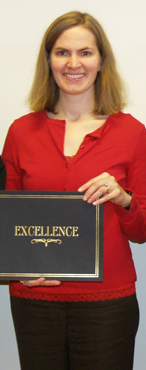
    Jennifer here shown receiving recognition for being a Mississippi finalist for the Presidential Awards for Excellence in Mathematics and Science Teaching!

    This week we visit with a high school math teacher in Mississippi. Jennifer Wilson, NBCT, teaches at Northwest Rankin High School, and is a Teachers Teaching with Technology (T3) instructor with Texas Instruments.

    MathFour: Thanks so much, Jennifer for giving us your time. First, can you share a little about your degree and career?

    Jennifer: I have a B.S. and an M.S. in mathematics. I have been teaching high school mathematics for 18 years.

    MathFour: Tell me about your family – how many kids do you have and how old are they? Are any of them more or less interested in math than the others in the family?

    Jennifer: I have two daughters who are 6 and 9. They are okay with math – but the 9 year old will tell everyone very quickly that her first love is reading.

    MathFour: Do you have any worries about your girls academically? In particular, do you think they will do better in math than in other subjects because of your influence?

    Jennifer: I feel very lucky to not be worried about my children academically. They love to learn. My husband and I both encourage their curiosity and try not to stifle their desire to ask why or come up with a different idea of how to do something, especially when the only good reason we can think of is “because I told you so”.

    I think they will do well in math – but not necessarily better than other subjects. My husband and I both love to learn, and so the girls definitely recognize that desire and enjoy learning as well.

    MathFour: That’s great! How do you play with your daughters? Do you view your playtime as different in any way than other “non-mathematician” parents?

    Jennifer: We play games. I probably view play differently than a lot of parents – but probably similar to many teachers, no matter their subject of expertise. I am all about learning, and it is hard to turn that off, even at home.

    MathFour: Do you think you speak with your daughters or behave differently than other parents because you have a math background?

    Jennifer: Yes. Anytime some kind of math problem arises, I always ask the girls about their thinking, because I am very interested in how they arrive at answers.

    At dinner, one daughter noticed that her tortilla chip was in the shape of a trapezoid, so we had a great conversation that night about trapezoids. We have a “pi” pie plate, so both girls already know a little bit about pi. They definitely call an “oval” an ellipse and a “diamond” a rhombus. They have called their blocks by the appropriate solid names, such as cylinders, prisms, and pyramids, since a very early age.

    When the 9 year old missed a question on her state practice test about perspective drawing, instead of just telling her the correct answer, I got out the stash of Unifix cubes at our house to make her build the drawing with the cubes. She completely understood after doing so – and asked me to make up some more questions for her because she enjoyed working through the problems with the manipulatives. Both daughters play with my TI-Nspire™ CX handheld. They love making shapes, measuring their parts, and making them different colors.

    MathFour: I had to google that one – fancy device!

    Have you ever had either of your girls express negative thoughts about math? If not, how do you think you will handle it if that happens?

    Jennifer: Not yet…I’m not sure I will handle it well. But I am hopeful that since my goal is not just calculating math but understanding math, they can at least appreciate my passion for it, and I will honor their passion for another subject, if the need arises.

    MathFour: How do you think you’ll handle it if you find your self in disagreement with one of your children’s math teachers?

    Jennifer: I’m not sure I will handle it well if it does happen, but so far, so good. I am lucky to teach in a great school district with great support for teachers at all levels, so I will keep my fingers crossed!

    MathFour: Now to change direction a little to a more worldview of math. What do you see as the biggest challenge in math education today?

    Jennifer: Having teachers who are experts in mathematics at all grade levels.

    MathFour: What do you see great happening in the world of math education?

    Jennifer: I see teachers who are willing to use technology to engage students in the learning and understanding of mathematics, teachers who are learning alongside students (often because of and through technology), and teachers who are willing to give up some of their control over the classroom to create a classroom that is truly interactive.

    MathFour: What advice can you give to non-mathematician parents that might help them raise their kids to like and appreciate math.

    Jennifer: I have been amazed at some of the mathematics that my students are learning in the computer games that they play. So while I realize that some students go overboard with the time that they spend in front of their electronic devices, find a way to encourage them to explore mathematics through tools that do interest them.

    MathFour: Wonderful, Jennifer, thank you so much!

    How ’bout You? It’s back to school time – do you have any questions for a super technology oriented math mom? Ask them in the comments!

    Related articles
  • Mathematician Parent: David Wees

    Mathematician Parent: David Wees

    Most parents aren’t professional mathematicians. But there are a few. This is the fifth in a series of interviews with mathematician parents with the goal of helping parents integrate math teaching into parenting.

    I am quite excited to feature David Wees who teaches at Stratford Hall in Vancouver. David and I have been on numerous #mathchats together and I’ve found him engaging, fun and knowledgeable. He publishes the website The Reflective Educator (formerly 21st Century Educator).

    MathFour: Thanks so much, David for taking the time to answer some questions. First, can you share some more about your degree and career? How long have you been in math?

    David: I have a bachelor of science in mathematics with nearly 60 credits in honors level mathematics. I finished my degree in 1998, but have never been officially a mathematician. Instead, I teach mathematics in middle school and high school, and have recently moved into a new position as a learning specialist for technology.

    MathFour: Tell me about your family – how many kids do you have and how old are they? How do your family members feel about math?

    David: I have a wife, and a nearly 5 year old son. My wife found math to be painfully difficult for her entire career, but hides it well around our son. My son loves math. He recently confided in me that he knows math only slightly less than me, but that I know more technology, and he knows more science.

    MathFour: How cute! And great that your wife tries to keep the math environment positive.

    Do you have any worries about your son academically? In particular, do you think he will do better in math than in other subjects?

    David: I have no concerns at all about my son academically. He is bright, creative, and independently minded. He will almost certainly do better in math than his other subjects. Today he ripped a book because the “binding was loose.” So we told him to find $11 dollars in his piggy bank. He pulled out five $2 coins and one $1 in about a minute, carefully counting by 2s for the first $10, and then adding another dollar.

    MathFour: How do you play with your son? Do you inject math a lot?

    David: I think we play ordinary games, with some exceptions. Certainly we include mathematical play in our sessions. We count everything, and introduce different ways of counting. We play dice games and practice adding small numbers. We stack blocks in patterns. I’ve also recently introduced a “how can we get this number game.” For example, “How can we get 5?” My son responded with “1 and 1 and 1 and 1 and 1 makes five. Hrmm. 2 and 3 makes five. 4 and 1 makes five.”

    MathFour: Great game!

    Do you think you speak with your son or behave differently than other parents because you have a math background?

    David: Definitely. We spend much more time talking about numbers than other parents do.

    MathFour: Has your son ever expressed negative thoughts about math?

    David: I’ve not noticed any negative thoughts from my son on math, with the exception that he thinks I know more math than he does. He did ask me today about the odd, even pattern. “Why does it matter if a number is odd or even?” I told him it helped us know quickly if we could split the number into two equal parts. I don’t think he was terribly impressed by that explanation.

    MathFour: LOL! I guess that is a little unimpressive.

    Your son is almost five, so I’m guessing he’s not had many math teachers. Do you anticipate you’ll ever disagree with any of his math teachers? And what do you think you’ll do if that happens?

    David: My son is just starting school. As I work at the same school as he will be attending, I will have to handle disagreements with his math teachers very carefully.

    MathFour: Now to change direction a little to a more worldview of math. What do you see as the biggest challenge in math education today?

    David: Mathematics, as it is usually taught, is neither interesting or relevant to students. Given that relevance and engagement are key to deep learning of a subject, it pretty much means that in most generations of people, the vast majority of them lack any functional numeracy.

    MathFour: What do you see great happening in the world of math education?

    David: These types of conversations are amazing in my mind. I love that I can speak my mind about problems in math education and not have everyone jump down my throat.

    MathFour: What advice can you give to non-mathematician parents that might help them raise their kids to like and appreciate math.

    David: Count lots. Play number games early. Treat learning mathematics as important as learning how to read. Spend time playing and learning early math with your kids. Don’t let your kids learn that worksheets and rote memorization are math.

    MathFour: Wow, that was awesome, David! Thanks so much for your time and sharing with us.

    How about You? What are your questions for David? Ask them in the comments. And don’t forget to check out all the great stuff on his website!

    Related articles

  • Mathematician Parent: Marilyn Curtain-Phillips

    Mathematician Parent: Marilyn Curtain-Phillips

    Most parents aren’t professional mathematicians. But there are a few. This is the fourth in a series of interviews with mathematician parents with the goal of helping parents integrate math teaching into parenting.

    I am honored to be able to interview one of math education’s leading minds, Marilyn Curtain-Phillips, author of Math Attack – How to Reduce Math Anxiety in the Classroom, at Work and in Everyday Personal Use. She also created the amazing playing card deck (also named Math Attack) where the numbers on the numbered cards are tiny expressions –  the 4 of diamonds has 22 on it!

    MathFour: Thanks so much, Marilyn for sharing some of you time with us. First, I’d like to ask about your background. What is your degree and career? How long have you been in math?

    Marilyn: My bachelor of science degree is in mathematics. My master degree is in education with a concentration in mathematics and then an additional 30 hours of mathematics. I have been teaching mathematics for 21 years. I have taught grades 6 through 12. In addition I am now teaching on the college level at a local university for the past three years in the evenings while teaching high school during the day. Prior to teaching, I worked in government and banking for 10 years in the area of accounting.

    MathFour: Wow, your life has been so full of math stuff! Tell me about your children. Are any of them more or less interested in math than the other children?

    Marilyn: I have two children ages 23 and 18. My son, the oldest, has a degree in graphic design. His interest since elementary school has always been in art. Therefore he never showed an interest in mathematics and it was a bit of a struggle. My daughter has just graduated from high school and is going to college with a major in early childhood education. She has been much stronger in mathematics than her brother. But she doesn’t want to teach mathematics, of which I think she is really capable of.

    MathFour: Did you have any worries about your children academically? In particular, did you think they will do better in math than in other subjects because of your influence?

    I encourage them to do what they enjoy. I feel they have adequate mathematics skills and a good foundation due to my additional help provided at home. As a high school mathematics teacher, I have grown more concerned at the foundation that students are coming to high school with.

    MathFour: How did you play with your kids? Did you incorporate math into your play?

    Marilyn: We enjoyed playing board games such as checkers, chess, uno, sorry, playing cards. I wanted to use games that help thinking and reasoning skills. This made great family discussion times while having fun.

    MathFour: Do you think you speak with your children or behave differently than other parents because you have a math background?

    Marilyn: I have always spoken positively about mathematics. Many parents will say in front of children that they dislike mathematics or is not good at it. To me this almost like telling children that mathematics is something that is tolerated and should be dreaded and avoided whenever possible. As a mathematician I know how much mathematics is a gateway to many
    opportunities. This is one of the reasons that I list careers in my book, Math Attack.

    MathFour: Have you ever had any of your children express negative thoughts about math and how did you handle it?

    Marilyn: Yes, my children have spoken negatively from time to time, mostly during test times. I offer advice and encouragement. It is important to stay positive and listen to their concerns and make suggestions.

    MathFour: Have you ever disagreed with one of your children’s math teachers? What happened and how did you handle it?

    Marilyn: Yes, I have had a different method of solving math problems. I talked with my children and let them know that many math problems can be done in different ways. Actually I prefer for my children elementary and middle school teachers not know that I am a mathematics teacher. I didn’t want my children to be graded on a tougher standard than other students.

    I experienced this growing up in a small town. My mother was a high school mathematics teacher, I felt looking back that I was graded on a tougher level and was expected to be extremely strong in mathematics. My sister experienced this also. She is an artist and doesn’t like mathematics.

    MathFour: Now to change direction a little to a more worldview of math. What do you see as the biggest challenge in math education today?

    Marilyn: I feel that many students do not have a strong foundation and understanding of mathematics. I have far too many high school students who do not have their times table and or addition facts memorized. Many mathematics textbooks cover too many topics. Studies have shown that the United States textbooks are thicker than other countries that are stronger in mathematics. It almost feels like a cram session.

    By the time students get comfortable with a concept it is time to move onto something else. I feel this makes students feel less confident about their mathematics abilities. I think these feelings continue throughout the rest of their adult lives. Which leads to many adults going into careers that require as little mathematics as possible.

    MathFour: What do you see great happening in the world of math education?

    Marilyn: I think that it is good that a more hands on approach to teaching mathematics is now being used. Teachers are teaching to the different learning styles. I think that it is good that more high schools are requiring students to have more mathematics credit before graduating from high school. Many states require students to have three or four credits of high school mathematics. Also many of the mathematics curriculum are teaching with everyday life application.

    MathFour: What advice can you give to non-mathematician parents that might help them raise their kids to like and appreciate math.

    Marilyn: I would suggest to non-mathematician parents to speak positively about mathematics. Let their children understand that mathematics is like anything else – it takes practice and patience. Just as parents tell their children to practice at playing sports, they should feel that mathematics takes the same time and effort. Also parents should show their children positive ways they use mathematics in everyday activities such as sewing, cooking, planning a family trip, budgeting and grocery shopping.

    MathFour: I noticed that you also have a new math workbook Who is This Mathematician/Scientist? Can you share with us a little about it?

    Marilyn: It is a workbook for grades 6 through 12, after reading the biography paragraph, students must solve the math problems to see who the bio is about. The activities can also be used as a way to promote multicultural awareness and appreciation.

    MathFour: I can’t wait to check it out! Thanks again for your time and sharing with us.

    How about You? Got any questions for this week’s mathematician parent? Ask them in the comments and we’ll drag her in here to answer them.

    Related articles

  • Perimeter and Area of Mommy’s Necklace

    Perimeter and Area of Mommy’s Necklace

    Written as part of the Count 10, Read 10 series.

    I noticed Daughter attempting to bejewel Husband with a strand of my faux pearls the other day. I watched, enthralled with the math learning taking place.

    She held the necklace in her hands – one on each side. Just about equal. So the space available for Husband’s head was almost non-existent. Like this:

    If she were to hold the necklace at two points that were closer together, she would create a “dip” in the necklace where his head could fit. Like this:

    There’s an extended learning opportunity here!

    This made me think of all the nifty things you can show about the relationship of perimeter to area and how you can have the same perimeter but change the area to all sorts of sizes.

    If you aren’t wearing a necklace, find some mardi-gras beads. Daughter has many strands, so I’m guessing your house might be littered with them as well. If not, join the club. Go buy some.

    Play with them in the bathtub or right before bed. (Make sure they give them up before going to sleep, though – it’s a strangulation hazard!)

    Move the necklace around on a flat surface (or on the bed) and let your child experiment with the ways the area changes. Ask questions like:

    • How much “stuff” can you fit inside the shape? (If there are blocks or other toys to act as “stuff,” use them.)
    • How much “stuff” can you fit inside the shape after you move it around?
    • Is that more or less “stuff” than you could fit inside it before?
    • Did the distance around the necklace change? (You can introduce the words perimeter and circumference.)
    • Can you make it into a square? A triangle?

    Be careful how much you do.

    Don’t forget, activities like this should be fun. For your child as well as you. So don’t get too in depth talking the math talk if it feels weird. Go with the flow.

    And let me know how that flow goes, would you? Share your thoughts in the comments.

    Related articles

  • Mathematician Parent: John Golden

    Mathematician Parent: John Golden

    Most parents aren’t professional mathematicians. But there are a few. This is the third in a series of interviews with mathematician parents with the goal of helping parents integrate math teaching into parenting.

    I had the privilege of interviewing John Golden, a university math professor and publisher of Math Hombre, a website with clever and fun math content that’s new every week!

    Just a sample: “As a bad beginning teacher, emulating David Letterman of all people, I realized that I loved teaching math.”

    MathFour: Thanks for taking the time to answer some questions, John. First, what’s your degree and career? And how long have you been in math?

    John: I have a PhD math in 1996, and am working as math ed faculty at GVSU a 25000 student public university in Michigan.

    MathFour: Tell us about your children and how they feel about math.

    John: Xavier – 11, a bit more positive about math than his sister, Ysabela – 12. Neither loves it.

    MathFour: Do you have any worries about your children academically? In particular, do you think they will do better in math than in other subjects because of your influence?

    John: They’re both decent problem solvers, but that doesn’t necessarily equip them to do school mathematics. Ysabela, for example, found out this year she wasn’t allowed to use her method to divide and had to use the standard algorithm.

    We encourage them to follow their passions. Both are quite artistic, and Ysabela is an amazing reader. I do worry that I’ve emphasized understanding over grades to the point where they have no interest in academic success.

    MathFour: How do you play with your kids? Do you play math things?

    John: Lots of games: card, board, table. No video games other than some flash games on the computer. I love games for their math like nature, or math for its game-like nature, so I see it as connected.

    MathFour: Do you think you speak with your children or behave differently than other parents because you have a math background?

    John: Definitely. Distinguish between what they’re asked to do and what math is, talk about cool and interesting math connections, do think alouds when doing homework, etc.

    MathFour: Have you ever had any of your children express negative thoughts about math and how did you handle it?

    John: More than occasionally. I take it with a grain of salt because I hated math at this age, too – for being boring and repetitive. I talk about the importance or confirm the irrelevance of what they’re doing, and try to emphasize making sense, and help them make sense.

    MathFour: Have you ever disagreed with one of your children’s math teachers?

    John: I always volunteer in their classrooms and bring games and such into it. This year, my daughter’s middle school classroom didn’t have me until the end of the year to do algebra tiles, but that was a positive experience. I strongly respect teachers, whether I agree or disagree, and never feel like they’re doing anything other than what they think is best.

    MathFour: Now to change direction a little to a more worldview of math. What do you see as the biggest challenge in math education today?

    John: Irrelevance of school mathematics, anti-math culture, misunderstanding of what math is, professional/governmental insistence on teaching junk, high stakes tests that preserve bad pedagogy…

    MathFour: Wow, that’s a lot. So what do you see great happening in the world of math education?

    John: Internet networking, slow but growing awareness among new math teachers about better ways, leveraging of new technologies and opportunities for change because of bad test results.

    MathFour: What advice can you give to non-mathematician parents that might help them raise their kids to like and appreciate math.

    John: Give it a go themselves. If it didn’t the first time, try to make sense of it along with your kids if they learn it. Value thinking and communication over the right answer. Play games!

    MathFour: Thanks so much, John! Great tips and insight.

    How about you? What are some questions you have for a mathematician parent? Share them in the comments – I’ll try to get John in here to answer them.

    If you want to connect with John directly, get with him on twitter, find his contact information here and make sure to check out his site, Math Hombre!

    Related articles
  • Cuisenaire Rods

    Cuisenaire Rods

    Cuisenaire Rods are brightly colored wooden sticks. Technically, they’re “proportionally sized rectangular parallelepipeds.” (But only say that if you want to hear your 3 year old repeat something really cute!)

    The “proportional” thing is important. The white ones are 1cm square, the red ones are twice as long and each color is 1cm more than the next color.

    I’m anticipating many articles and videos on how to teach with these (since  the possibilities with these things are virtually unlimited), so I thought I would start a running series. Here are the ideas and the links to the articles/videos that are ready:

    Creating Coordinate Pairs with Pictures

    Share your own ideas on how to use Cuisenaire Rods in the comments!

    P.S. I spent my hard earned money on these at Teacher Heaven. This small set was $15 in the store, but I see you can get it for less than $13 online

    This is also shared on Works for Me Wednesday.

    Related articles

  • Mathematician Parent: Caroline Mukisa

    Mathematician Parent: Caroline Mukisa

    Most parents aren’t professional mathematicians. But there are a few. This is the second in a series of interviews with mathematician parents with the goal of helping parents integrate math teaching into parenting. 

    I had the privilege of interviewing Caroline Mukisa, a math teacher and math blogger.

    MathFour: Thanks for taking the time to chat, Caroline. First, what’s your degree and career? And how long have you been in math?

    I’ve a Bachelors in Civil Engineering from Imperial College, University of London and a Post Graduate Certificate in Maths Education from Cambridge University. I taught maths to high school students in the UK, and I also ran a Kumon tuition centre before moving to the Middle East as an expat. I now run the Maths Insider website. My husband has a Bachelors in Maths also from Imperial and a Masters in Mathematical Modeling from Oxford University.

    MathFour: Tell me about your family – how many kids do you have and how old are they? Are any of them more or less interested in math than the others?

    Caroline: I’ve got four kids aged 11, 10, 4 and 2. My 10 year old son is very much the maths boffin, he’s memorized the first 300 digits of pi just for fun. His 11 year old sister is more of a problem solver. The younger two like counting and sorting but it’s too early to say if they’ve caught the maths bug yet!

    MathFour: Do you have any worries about your children academically? In particular, do you think they will do better in math than in other subjects because of your influence?

    Caroline: With maths, being a former maths teacher, I have a feel of how they’re each doing with that subject, whereas with the other subjects, it’s difficult to judge. For example, “Is that poem they wrote good for their age level?”

    MathFour: How do you play with your kids? In particular, what kind of math play do you do compared with non-math play?

    Caroline: We talk a lot about maths, we like showing them You Tube videos or Ted Talks related to maths or science, but we also try to expose them to different things like poetry, anthropology, and business.

    MathFour: Do you think you speak with your children or behave differently than other parents because you have a math background?

    Caroline: I’m not sure about that. I don’t talk about maths with my kids in front of other parents – I don’t want to appear to be “showing off” although my 10 yr old likes to “perform maths.”

    31 Days to Faster Times Tables

    MathFour: Have you ever had any of your children express negative thoughts about math and how did you handle it?

    Caroline: Of course! There’s always days when maths homework is not appreciated, and although my 11 year old finds maths easy, I wouldn’t say she loves it – she likes that maths can help her do the things she likes, like Design and Technology and Science. It’s not a problem – kids shouldn’t be carbon copies of their parents.

    MathFour: How is the interaction with your children’s math teachers?

    Caroline: I usually let my kids teachers know early on about my and my husband’s maths background. We try to work with the kids teachers to help extend their maths but in the end we can supplement and support their maths ourselves at home.

    MathFour: Now to change direction a little to a more worldview of math. What do you see as the biggest challenge in math education today?

    Caroline: With the move away from rote learning towards practical maths, kids mental maths skills are declining. Parents need to make sure that they’re reinforcing those skills at home, since there’s not enough time allocated to fully learning them within the curriculum.

    MathFour: What do you see great happening in the world of math education?

    Caroline: I love that kids get to explore different practical applications of maths, with many teachers, using technology to present real-life math problems.

    MathFour: What advice can you give to non-mathematician parents that might help them raise their kids to like and appreciate math.

    Caroline: I think the key things are to stay positive about maths even if you hate it, try to spot something related to maths as often as you can. If your child is having problems with maths, act early and make sure their basic skills are solid. And of course, read MathFour and Maths Insider!

    MathFour: Thanks so much for taking the time to answer our questions, Caroline!

    How about you? Do you have any questions for a mathematician parent? Share them in the comments – I’ll bet Caroline will be around to answer them!

    Related articles

  • Order of Operations Explained: Addition, Subtraction and Conclusions

    Order of Operations Explained: Addition, Subtraction and Conclusions

    This is the 6th and last in the series The Order of Operations Explained. For the other articles in this series, click here to visit the introduction.

    Cup Of Coffee by Petr Kratochvil

    I started this series over a month ago. In that time, I’ve gotten pretty deep in thinking, learning and reading about the order of operations. I’ve seen a variety of ways people view, use and teach it.

    Before I go too far into some conclusions, though, let’s look at addition and subtraction.

    Subtraction is the same as addition.

    Yup. You might remember that from the fourth article.

    Consider the problem . Moving from left to right, and doing both subtraction and addition as we come to them, we get 4. If we found a book, or person, that meant the full-on PEMDAS and wanted addition done strictly before subtraction, then we would end up with 0. The latter is because we would do the addition of 3 and 2 before we did the subtraction.

    Which is right?

    It depends on what you really mean. If you don’t know if you should go left to right or strictly addition before subtraction, either look in the textbook you’re using or demand parenthesis.

    The text will clearly outline the order of operations it’s following. Be careful, too because there isn’t always agreement among textbooks. I have seen some texts that instruct the learner to do multiplication first and then go back and do all the division signs. While others (and this is more common, today) have us do multiplication and division from left to right, simultaneously.

    If you compare contemporary texts to each other, you’re likely to find them all the same. But grab a math text from the 80s at Half Priced Books. I’ll bet you’ll find at least 50% of the time they put division strictly after multiplication. (I’ll verify this the next time I’m there.)

    The order of operations needs context.

    Jelly Donuts by Petr Kratochvil

    I have $5 in my bank account. Then I bought a coffee for $3 and a bagel for $2. I might accidentally write down . I still mean, “I need to add up the stuff I spent and subtract it from my balance.” I wrote it in error, though. What’s “mathematically” correct is .

    But you knew what I meant.

    This was a typo that was helped along by using the context.

    Until there’s a reason to do arithmetic, the order in which we do things is arbitrary. If we all agreed to do addition first, then multiplication, we would calculate  and come up with 35 (instead of 23).

    As long as we all come up with the same thing, we’re fine.

    “We” have agreed to do multiplication things before we do addition things. So “we” would come up with 23 in the example.

    Coach G noted it correctly: the order of operations is a convention. In other words, we’ve decided on it. We invented it.

    How can you use this to teach your children?

    The coolest thing is that you can let them play. Get dirty. Break it.

    Remember opposite day? Have that. Let your little one make new rules. Let them see what happens if you all decide one day to do multiplication before addition. If your child is older and doing some algebra, this will mean reversing the order in which you UNDO the operations too!

    This is a real brain stretcher. But it’s just math. You’re not building a bridge or balancing your checkbook. Let them break it. Let them see what happens if you make your own rules.

    And then they’ll really learn!

    Let me know how it goes – share your stories in the comments.

    Related articles
  • The Order of Operations Explained: Multiplication and Division

    The Order of Operations Explained: Multiplication and Division

    This is the 5th in the series The Order of Operations Explained. For the other articles in this series, click here to visit the introduction.
    Last week’s article on the order of operations included a quick mention that division is the same as multiplication – but different. Now’s the time to explain that a bit.

    The only thing mathematicians like to do more than create, is destroy. That’s how we get imaginary numbers, dividing by zero and raising things to infinity.

    Once we create with multiplication, we want to know what happens when we destroy with the opposite of multiplication.

    Enter Division, stage right.

    Multiplication is created from the need to quickly add a bunch of numbers that are all the same. They each must be equal to make this work:

    6 + 6 + 6 + 6 + 6 is shortcutted to 5 X 6.

    Division is the breaking up into pieces that are all equal.

    Technically we can break 30 up into these 5 pieces: 4, 8, 7, 6 and 5. But “division” requires (or implies) that we are dividing equally. So 30 would have to be broken up into 5 equal pieces of 6 each.

    Of course this is in a purely mathematical world. When you get into a toddler world, things will be different.

    How division is the same as multiplication.

    We represents multiplication with little x‘s or dots or stars. Like this:

    3 X 5 or 3 • 5  or 3 * 5

    We represent division with this cute little symbol: ÷\div

    But we can write it in many more ways. Notice the cute symbol ÷\divlooks like a fraction with dots on the top and bottom. That’s not a coincidence. A fraction means division.

    7÷37 \div 3 is the same as 7×137\times\frac{1}{3}.

    Remember the poem:

    When dividing fractions
    Don’t bat an eye
    Just flip the last
    And multiply!

    Well, you can change this to:

    When dividing numbers
    Don’t bat an eye
    Just flip the last
    And multiply!

    And “flipping” the last just means taking the “assumed 1” that’s underneath it and putting it on the top.

    Now go forth and divide…

    So when you’re teaching the MD in PEMDAS, the order of operations, remember that D is the same as M. And if things get a little confusing, demand some parenthesis before doing the problem.

    Share your thoughts in the comments!

    Related articles