Evaluating exponents of negative numbers, or raising a negative number to a power, can get weird. And it has to do with the order of operations.
Exponents come way before subtraction (PEMDAS). So something like
\(-3^2\)
has to take this into consideration.
Even though from left to right it seems the negative is on the 3, it’s really the tiny 2 that’s supposed to come first.
All that’s fine and dandy. But how about a nicer way to think about it?
Exponents are copying instructions. Parenthesis are paperclips.
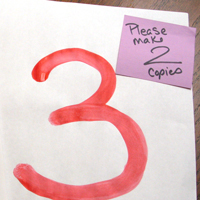
Imagine you’re heading to the copy center with two pieces of paper — one paper has only a “-” and the other a number (like 3).
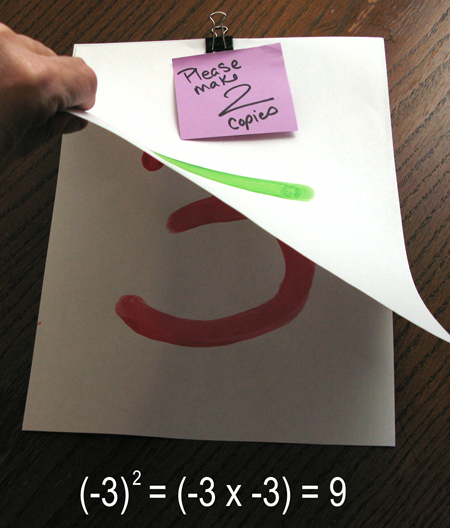
If you have the pages clipped together with the stickie note reading “Please make 2 copies,” it looks like this:
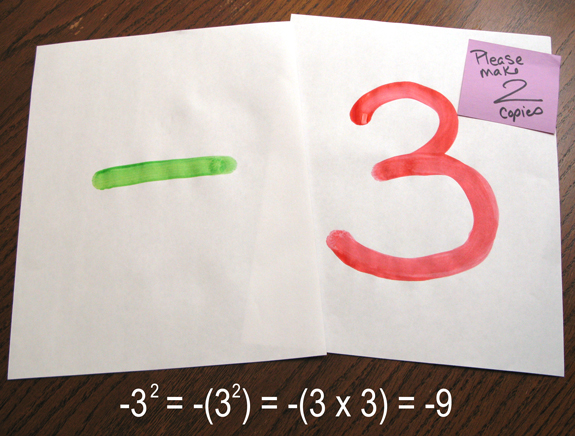
If you have the pages separate and the stickie is only on the page with the 3, it looks like this:
What will you get from the copy center?
Now think of what the copier-dude will do with your first set. He’s going to make two copies of the whole thing. He’ll likely give you two stapled sets.
On the second set, he’ll make two copies of the “3” page and put the “-” page to the side. He’ll think, “Hmm… I wonder what I’m supposed to do with this? Oh, well. I’ll just put it back on the stack after I’m done.”
But there’s an even better way.
If we would put parenthesis where we mean things to happen first, we could avoid all this.
Thanks to Molly for this question she left in the comments, “Why is a negative times a positive, a negative?”
“Sign – One Way” by Andrew Schmidt
It’s common to hear a child say, “They created this rule just to make me mad.”
And on the heels of that usually comes a frustrated teacher’s comment of, “No, this has a purpose.”
When then faced with, “Okay… so what’s the purpose?” a teacher or parent might become more frustrated. It’s not always clear the purpose of things like the rules for multiplying differently signed numbers.
It may also be that the grown-up secretly believes that this was all created just to make us mad. After all, when the last time you had to multiply a negative number times a positive number in the real world?
I, personally, can’t ever remember a time when that case has come up outside of a math class or tutoring session.
Then why create the rules at all?
The truth is that many math rules are created because we need a rule to continue working – something to agree on among peers working on the same project. We need everyone on the same page.
This agreement somehow gets filtered down to the kiddos as “this is the absolute way it is – do it because we said.”
So it very much looks like we created rules to make them mad.
Good deduction, kids.
How do they pick the rules?
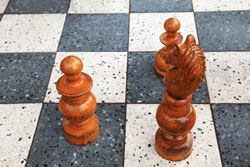
“Street Chess” by Petr Kratochvil
Some math rules are created arbitrarily just so we have something (anything) to agree to. Like the rules of a game. The order of operations is one such situation.
There is no natural reason why we’ve chosen to do multiplication and division before we do addition and subtraction. No more so than the people in the US have decided to drive on one side of the road whereas the people in England, Australia and the Bahamas drive on the other.
We’ve agreed to it.
It keeps us from crashing.
Sometimes, we agree to a rule because it is “less bad” than any of the other possible rules we can think of. The result of any number raised to the zero power is one of these. 30 feels like it should result in either zero or 3. But if you mess with all the other rules (in particular the one about subtracting exponents here ) you’ll see that 30 really needs to be 1. If it were anything else, it would mess up the rule of .
Why is a negative times a positive equal to a negative? Is it because it messes other things up or is it an arbitrary rule? Instead of explaining the reasoning to a child, allow them discover it.
Have a “King for a Day” day where the students get to rewrite a particular math rule. Allow them to sit as a class or family and decide on the rules for multiplying signs numbers.
Give them plenty of time to experiment and see if the new rule messes anything up. (If your administrators or math curriculum specialists fret about you allowing students this time, note to them that the students are behaving like real mathematicians. They are inventing a concept or rule and testing it out to see what happens.)
If the students discover that the new rule has dire consequences when applied to the rest of our number system, they then see the reason for the rule. And they’ve learned through experience and solidified the rule in their minds!
If the students discover that there are no consequences of the new rule, they can then determine that the rule was created arbitrarily and agreed upon for convenience. It is a rule for rules’ sake.
You can discuss with them how things would be different if they kept the new rule and everyone else in the world followed the old rule. Again experience and discussion will solidify the “real” rule.
So the next time you’re faced with “why?” regarding a math rule, give it a shot. Let the children be the rulers of their own math world!
Will it work? Did it work? Share your thoughts in the comments!
Counting is a big deal in our household these days. Daughter’s 21 months old so teaching advanced multivariable calculus takes way too long for her attention span.
Walking Steps and Counting Them
But we count everything. Things in books, steps, bobby pins, people… you name it.
We count in negatives, too.
If you’re following my tweets, you might know that I count to Daughter in the bathtub – from negative 30 to positive 30.
My neighbor suggested that early introduction to negatives might have helped her friend’s 14 year old son. He now has all sorts of difficulties with math. Not the least of which is arithmetic among positives and negatives.
This makes me even more excited about counting in negatives to Daughter.
Counting in negatives shows order.
You may not need 61 seconds of anything. But you can count from negative 5 to positive 5. The point in the counting of negatives is to introduce the order of the numbers – since negatives seem to go “backwards” when you list them in order.
And you can introduce distances with counting. You can show how distance is different than the number of points. Counting from -5 to +5 is actually 11 numbers. In this video you can see how I “rediscovered” this and then explained it:
Parents often focus on the alphabet and reading in the very early years. There’s some neglect of math things outside of counting to 10 (starting at 1). You can do so much with counting – counting negatives, counting distances, skip counting (2, 4, 6, 8, etc.), finger counting, counting backwards.
Counting is the foundation of all of math. And there’s tons of fun ways to use it in the early years.
Share your ideas about counting in the comments below!
When we teach math at home, we start with the counting numbers. Then we move to either the homeschool or classroom setting and build on those with negatives. And zero is sometimes left behind.
Zero seems to be an understood concept because it’s so much a part of our lives, as grownups. But zero is a very unusual bug.
Is Zero Positive?
We think of the numbers as either positive or negative.
But actually, all real numbers can be divided into three categories: positive, negative and zero.
This is one of the reasons zero can be forgotten in all this mix. With so many other numbers to be positive and negative, zero’s truly in a class by himself.
Notice I wrote “All real numbers can be divided into three categories.” Imaginary and complex numbers can’t be classified this way. You can order imaginary and complex numbers, but you have to do it without labeling them as positive or negative.
Why can’t we just say zero is positive?
I guess we could. But you might not want to when you see this…
In math, sometimes, we do things because if we didn’t, they’d mess everything else up.
This is one of those situations.
So let’s say 0 is positive, just for the minute.
Take the rule, “When multiplying, if the signs are different, the result is negative.” So then (positive) zero times negative 3 is (negative) zero. Like this:
0 x -3 = +0 x -3 = -0
But we determined that zero was positive!
So this messes things up. Therefore, zero needs to be in a class by himself.
But zero feels positive and negative, sometimes!
Indeed if a kid doesn’t owe his sister anything, that’s a positive feeling.
If you owe someone $3, then you can say you have negative 3 dollars. So if you owe them nothing, don’t you have a negative zero dollars?
This is more of a direction than a positive or negative sign. The “vector” (arrow in a direction) that has length zero can technically be pointing in any direction. It doesn’t matter. And that’s what’s going on when you think of zero as positive or negative. You think of owing (money going in a direction) nothing.
But remember, that’s only thinking of zero as positive or negative. He really isn’t either.
He’s just zero.
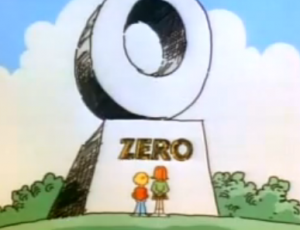
Check out the classic Schoolhouse Rock Multiplication Rock video and let me know what you think of all this zero talk.