Last minute shopping? Me too! How about some of these math gifts for your favorite folks…
For Kids
Numb ‘n’ Number by Peter Weatherall – A collection of fun math songs.
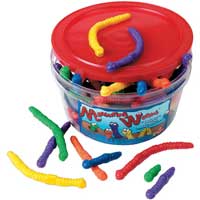
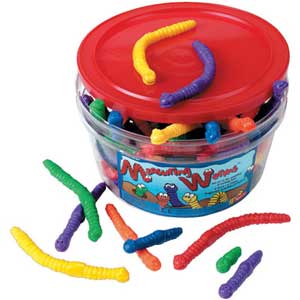
Worms! What kid doesn’t like worms? And these are measuring worms!
For Grownups
Math T-Shirts by ExBoyfriend Collection – Sad? Funny? These are cute for even the “non-math” people.
Want something a little more fancy? How about math jewelry like this Fibonacci necklace!
For Families
Math games are great for full family fun – and games like Uno… well, that’s math too!
For Math Geeks
Old math books! Husband found a College Algebra book from 1947 for me – gave it to me as a “just because” gift. Here’s a Trig book by the same guy. You probably can get an old math book for your favorite geek at any second hand book store!
Math Music! The Klein Four Group’s instant download Musical Fruitcake CD (I just downloaded it, myself!) To give you a sample of how cool these guys were (they are now professors all over the world), here’s a fun Christmas song from them:
How about it – what are you up to for last minute shopping? Are you done?
This post originally appeared on The HSBA Post on November 22, 2011.
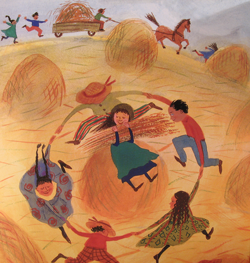
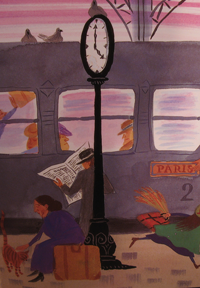
How to Make an Apple Pie and See the World by Marjorie Priceman is an “instructional” picture book that takes children on a journey through the world to pick up ingredients to make an apple pie.
Lots of great shapes!
An apple pie recipe is included in the back which has obvious math. But you can use the rest of the book for some math lessons as well!
Here’s a set of math stimulators to share with your kids. Don’t forget that math is a discovery process; if your children are compelled to answer a question or not answer a question, that’s okay.
Here are the questions and some hints and coaching tips for you, the parent.
Find the shapes in the pictures.
See if you can find circles, trapezoids, ovals and rectangles. Also identify the irregular shapes. Have your children trace them and see if they’re made up of regular shapes.
How far is it from your house to Europe?
Also ask: How fast will the ship have to go in order to get to Europe from your house in six days?
How many Italian words do you think you would need to learn each day in order to speak Italian?
How many words are there in an average Italian’s vocabulary? How many words do you need to be considered fluent in Italian?
What time does your train leave Italy?
Notice the time on the clock.
This one encourages children to look at the pictures as well as the text. Also ask, “How far is it to France from Italy?” And to take it farther, “What time would you arrive in France?”
How far is Sri Lanka from France?
Pull out an atlas or globe to get some geography lessons. Also ask, “Which route do you think is the fastest to get there? Which would be the most fun?”
If you were to make two apple pies, how many apples should you pick from the apple tree?
This is what many students would call a trick question. In the book, she picks 8 apples so that she and her friends can enjoy 3 and use 5 to make the pie.
It takes some thought for a child to realize you only need 5 apples for the pie, so you’re not doubling the amount you pick. You have to double the amount for the pie (2 x 5) then add the 3 apples for the friends to enjoy.
Looking at the recipe, how much of each ingredient would you need if you made two pies?
This question allows them to double everything on the recipe. You can also triple or quadruple or get into fractions by asking, “What if you made one regular sized pie and one mini pie – how much of each ingredient would you need then?”
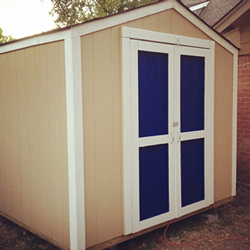
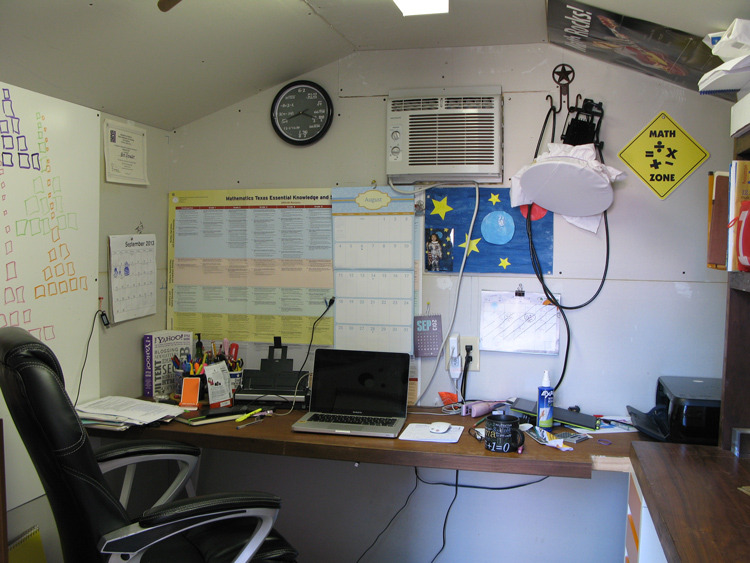
There was a math mom who wanted to help other moms be more math-y. She went into the garage to put together a website. Eight months later her husband was sick of her taking up garage space.
Introducing The Math Shack – safe haven for all things mom and math!
This post originally appeared on The HSBA Post on October 20, 2011.
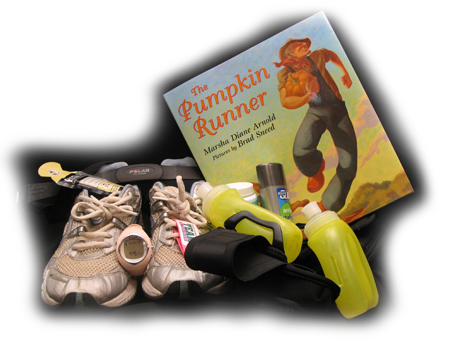
The Pumpkin Runner by Marsha Diane Arnold (illustrated by Brad Sneed) is a sweet story about a man and his dog on a 900 km race across Australia. What’s nifty is that you can use this story in your math lessons! Below is a list of some questions to try.
Filter all these questions before asking them of your children. Some children might find them more advanced and need some help and discussion. Others may dig right in.
Use this downloadable list of math stimulators, if you want to give them to your kids without the tips.
And keep in mind, math is a discovery process; you can get to the right answer in many ways.
How old is Joshua?
You can point out that he’d been running for 50 years and he started when he was 10 years old.
How many generations of dogs did Joshua run with?
When 10-year-old Joshua ran for the first time, he ran with an ancestor of Yellow Dog. The book says he started running with the “great-great-great-grandfather of Yellow Dog.”
How old did each dog get? Is it possible that Joshua ever ran with more than one dog at the same time?
How many pumpkins will Joshua need to run the race?
Children might think about it this way: If one pumpkin gave Joshua enough energy to run 40 km (his very first run) how many pumpkins might he need to run 900 km in the race?
Children can also count the number of pumpkins loaded in the Jeep. Allow your child to ponder, guess, speculate, or calculate the answer.
What’s up with Damien Dodgerelle?
He trained for the race for three months.
How many kilometers do you think he ran each day?
How many kilometers did he run total in this training time?
How long should it take him to run 900 km based on how he trained?
How long did it take Joshua and Yellow Dog to finish the race?
Joshua got to the finish line two days earlier than any previous winner. How many days do you think it took him? Why was he faster than everyone else?
How much did each person “win”?
When Joshua split the winnings, how much did each person get? If he only kept enough for new overalls and gum boots, how much do you think he might have given to Aunt Millie and Rancher Waudley?
What’s next?
You can use the book The Pumpkin Runner and the math stimulators in your Five in a Row math day or integrate it into any other math curriculum. Also try using the same line of questioning with other picture books you have.
Oh – and don’t forget to share how it went in the comments!
Thanks to Will Summer who inspired this post with a retweet to me.
Seems researchers have previously studied the differences in math skills among children vs. adolescents and grownups. Dr. Vinod Menon with has done new research on early math training that focused on kiddos who where merely one year apart.
Turns out that in one year of math, the brain changes quite significantly!
You can integrate early math learning into just about anything.
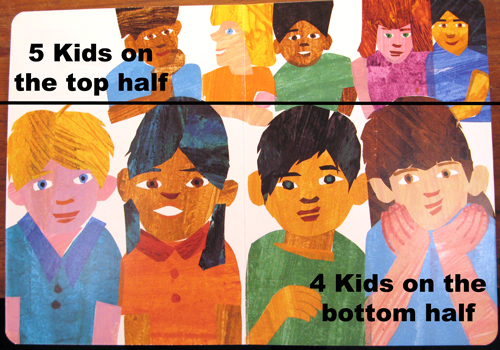
Daughter is heavy into Brown Bear, Brown Bear by Bill Martin, Jr. and Eric Carle. This is not a math book. Nor does it pretend to be. But I’ve found a way to use it to develop math skills.
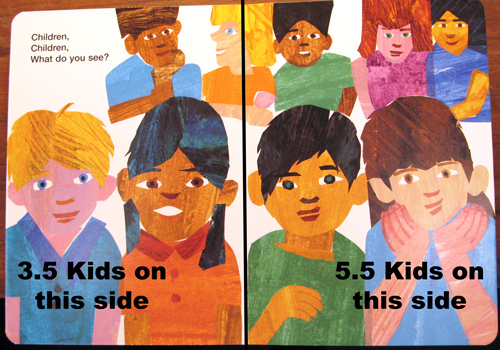
When we arrive at the page with the children, we practice counting the kids. First in one direction, then in the other – as direction matters to kids. It isn’t inherent that if you count one way you’ll get the same number as if you count the other way.
Sometimes we’ll count the top row of children and add it to the number of the bottom row. We can practice the commutative property by adding 5 + 4 = 9 and the adding 4 + 5 = 9.
As an alternative twist, we’ll count and add the kids on the left page to the kids on the right page. This one gets fun, because that little blond girl is half and half!
So we can now add fractions and practice the commutative property at the same time!
What else?
With Dr. Menon’s research, we now know how important it is to get started early with math learning. What other things can you do to start teaching math skills early?



![[50 Word Friday] Say Hi to The Math Shack!](http://mathfour.com/wp-content/uploads/2026/03/image-17.png)