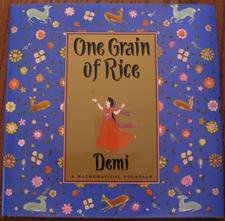
My musical friend Christi Gell sent K8 and me a delightful math picture book recently. One Grain of Rice, by Demi, is both visually and mathematically beautiful.
It’s exponentially better as you read it.
And that’s not a figure of speech! One Grain of Rice is the story of a girl that asks for a simple reward for a good deed. She asks for a single grain of rice on the first day and for 30 days, double the amount of rice given on the previous day.
I’ve heard this story told in a variety of ways, but the illustrations and scenario of this book make it appealing in ways that outshine all the rest.
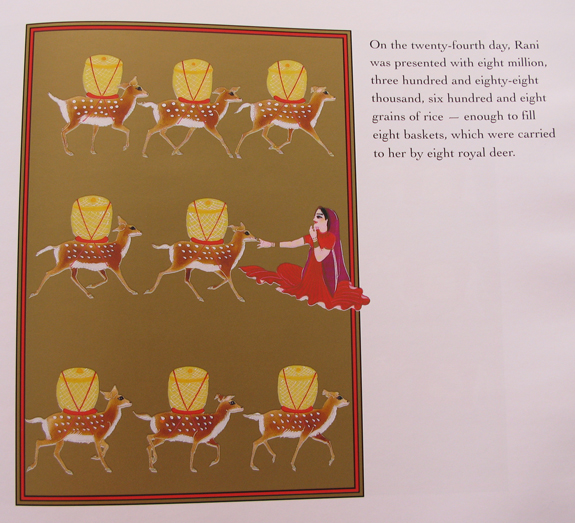
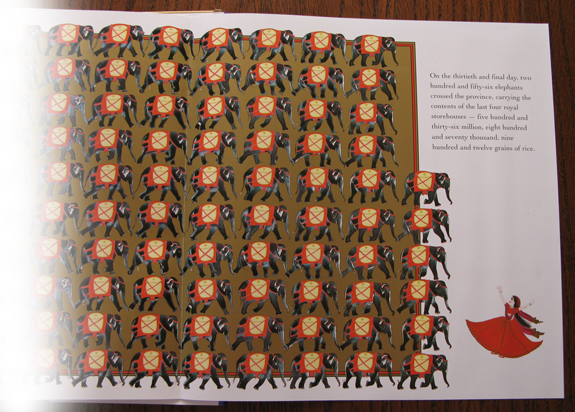
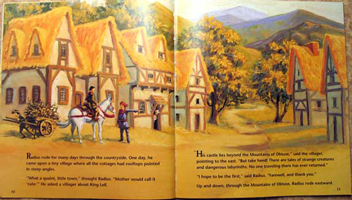
The illustrations have a gold-leaf feel about them. And Demi shows the quantity of rice very literally, down to multi-page foldouts showing exactly how many animals it takes to carry that day’s amount of rice!
It starts small.
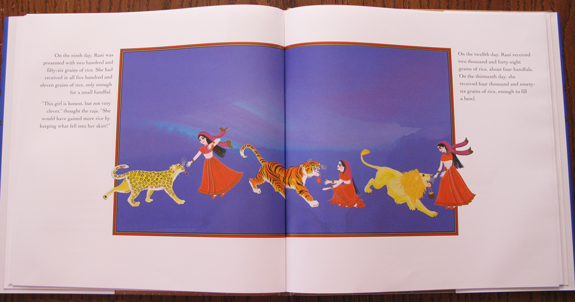
Here you see her getting “help” carrying the rice from various animals on the 9th, 12th and 13th days.
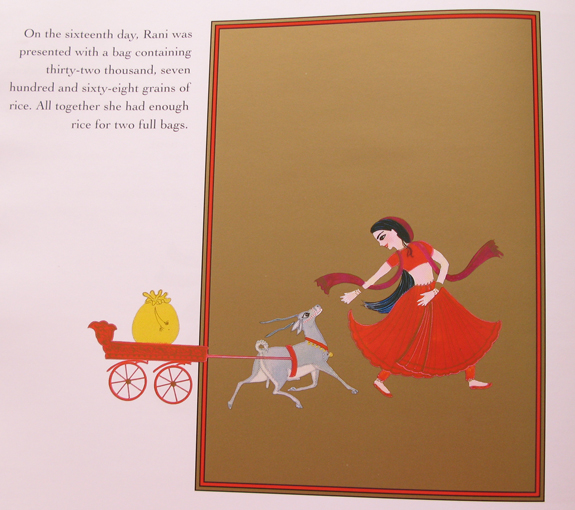
And on the 16th day, she really needs this help!
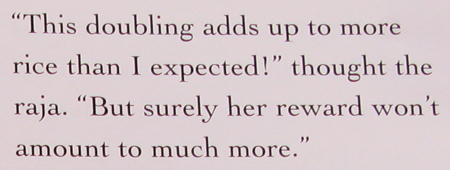
Soon the raja’s getting worried.
By the 24th day, she’s needing to borrow deer from the raja to carry it!
By the 30th day, she needs 256 elephants to carry it all. And all 256 of them are shown in a gorgeous 4-page foldout!
Don’t miss this math picture book!
One Grain of Rice is also the tale of a greedy raja that learns a lesson through the cleverness of a girl. The magnificient illustrations help kids (and grownups) see the magnitude of exponential growth, without even putting that label on it.
Head out now to get your own copy of the math picture book One Grain of Rice, by Demi. And send a copy to an artistic or mathematical friend too!
I’m substitute teaching 5th grade Language Arts today. I just found a handout with a set of questions titled “Peck’s Questions.” I quickly figured out (with my amazing powers of deduction) that they were questions you could ask about a novel.
After reading them, though, I thought, “Why don’t they have something like that for math?!”
So I did some research.
Before creating the super math list, I thought I would find out a little more about the original list.
Apparently this Richard Peck guy is pretty famous in young adult literature. The list is officially titled, “Ten Questions To Ask About a Novel” and was published in the The ALAN Review in the Spring, 1978 edition. Here it is:
What would this story be like if the main character were of the opposite sex?
Why is this story set where it is (not what is the setting)?
If you were to film this story, what characters would you eliminate if you couldn’t use them all?
Would you film this story in black and white or in color?
How is the main character different from you?
Why would or wouldn’t this story make a good TV series?
What’s one thing in this story that’s happened to you?
Reread the first paragraph of Chapter 1. What’s in it that makes you read on?
If you had to design a new cover for this book, what would it look like?
What does the title tell you about the book? Does it tell the truth?
The list allows students to dig in a little deeper to the novel. It helps them get creative and think about the story in ways they wouldn’t normally.
And it trains them to do this with novels throughout their lives.
Why a list of questions about math problems?
Before creating them, I decided the questions should do the following:
Allow the student to dig in deeper to the math problem, and the math behind the problem.
Help the student to think about the problem in ways they wouldn’t normally.
Let the student get creative in thinking about the problem.
And of course doing these things regularly will train them to continue to do this with all math problems through their lives.
Ten Questions to Ask About a Math Problem
Who do you think created this math problem? Was it a man or woman? How old were they?
Who do you think first figured out how to do a problem like this? How long ago?
Imagine this is a real problem asked by a real person. What is that person’s job? Why are they asking this question?
Why does this problem use the scenario that it does?
If you could rewrite the problem using the same numbers and getting the same numeric answer, what scenario would you use?
What numbers would you use in the problem to make it easier? What numbers would you use to make it funny?
Is there a story that can be created before or after this math problem that makes sense?
Has the situation in the problem ever happened to you or someone you know?
What about this math problem appeals to you? If nothing, why did you continue to work on it?
If you had to illustrate this math problem, what would it look like?
(UPDATE Nov 5 from suggestion in comments) Can you develop some sort of theory as a result of solving this problem?
(UPDATE Nov 5 from suggestion in comments) How does this problem relate to problems you have encountered before?
Will it work?
Try using it yourself first. Get a feel for what each question means and how it might be answered.
Then try it on your children. Which questions work? What questions should be changed — and to what?
Share what you find in the comments or on twitter/x so we can have a super solid list of Ten Questions to Ask About a Math Problem!
I rounded the corner at Barns & Noble one day and and this beautiful math picture book looked me in the eyes.
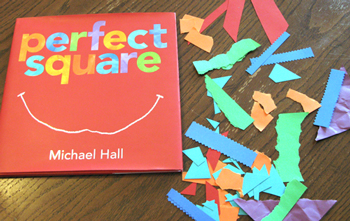
I just couldn’t resist buying Perfect Square by Michael Hall!
And what a treat it was!
It’s inspiration for math crafts, playing with color and patterns and talking about shapes — all in one neat little package!
A happy little perfect square gets cut, torn and shredded over the course of a week. But this optimistic shape uses the “abuse” to make itself into new and fun things each time.
Construction paper and scissors…
I made a bunch of squares from construction paper to start. With each page, I replicated the images.
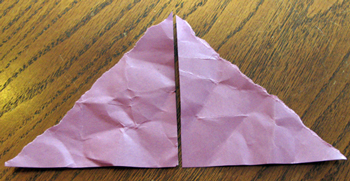
One day the square gets cut into two triangles and crumpled up. So it makes itself into a mountain. This one was fairly easy.
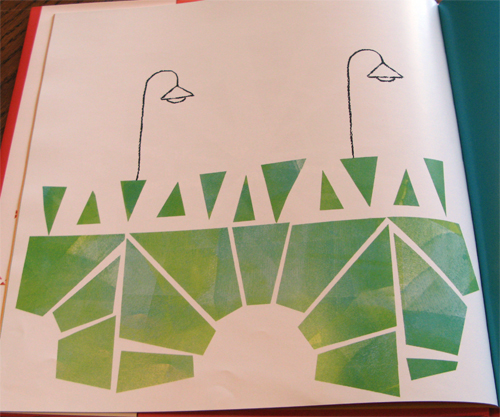
Another day it was shattered, so it made itself into a bridge. The shattering resulted in 24 pieces — each a triangle or trapezoid. It was especially hard to do, so I’m sharing a picture of the bridge in this math picture book.
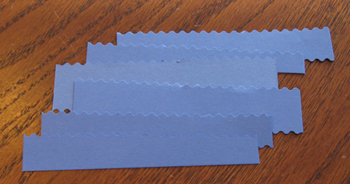
Another day, Perfect Square was cut into ribbons with crinkle shears and makes itself into a river. Long thin “mostly” rectangles were fun to do when I found my old scrapbooking scissors.
Are you ready to play?
I had a great time cutting each shape and seeing how I could replicate the images in the math picture book, Perfect Square. Some were easy, some were hard.
What can you do? What can your kids do? I’ll bet their creative minds go all over the place!
In Chapter 1 of What’s Your Math Problem?, Linda Gojak gives some initial thoughts on learning and teaching problem solving.
She introduces the concepts of routine problems and non-routine problems.
Routine problems are what you typically see at the end of a problem set in a traditional textbook. “In solving routine problems, the learner reproduces and applies a new procedure,” Gojak writes.
Non-routine problems, or rich problems, are the way of the world. They are the things grown-ups solve everyday effortlessly, and often don’t think of them as math problems.
Is solving non-routine problems teachable?
There is a divergence between the way traditional word problems are taught to kids and how grown-ups handle the rich problems in their lives. What’s Your Math Problem? attempts to distill and label each strategy of what grown-ups naturally do, so that we can teach these strategies to our children.
To make this work, knowledge of the various strategies is important. So Gojak labels, defines and gives examples of each strategy throughout the book.
This method of teaching problem solving to children will work if an instructor is careful not to force the use of a particular strategy.
Offer a strategy, but don’t force it.
The idea is to label and clarify each problem solving strategy so it can be one of the options in the toolbox of problem-solving for each child.
As students learn a strategy, teachers shouldn’t require it be used “so they can practice it.” Instead it should be offered and encouraged, but allowed to be tossed aside if the student prefers another method.
And caution should be used to ensure problem solving using these various strategies NOT turn into another algorithm.
Read more about it…
Don’t forget to check out Math Coach’s Corner for some other thoughts on Chapter 1 of What’s Your Math Problem? Make sure to scroll to the bottom, because others are linking up their thoughts and opinions!
I love how Linda Gojak calls juicy, meaty problems “rich problems.” A good, fun thinkable is indeed a math word problem rich with problem solving challenges.
But getting started on a rich problem can leave you feeling rather poor. So Chapter 3 gives, and is called, “Getting Started Strategies.”
What’s that problem about anyway?
The first question you (or your child) should ask when given a problem is, “What’s it all about, anyway?” This is the strategy of “Restate the Problem in Your Own Words.”
Ask
What’s happening — what does it look like?
What bits of this problem are useless to me?
If a normal person were to ask the question, how would it be written?
Now what the heck does it really say?
Restating the question in your own words means understanding what’s being asked and what’s happening.
Is this a trick question?
Sometimes textbooks (and even life) give you problems without giving you all the required information. This is grownup-talk for what kids call a trick question.
If there’s missing information, call that bluff! What info do you need to calculate the final answer?
Is that information contained in the problem?
Can you find that information online or in a library?
Can you figure out that information using other stuff in the problem?
Is it just a flat-out trick question — there can’t be an answer because there’s no way to get the information needed?
Calculate the information, if you can.
Now it’s time to do a little pre-work. Gojak calls it “identifying a subgoal.”
If you’re missing some numbers in the problem but you can get these from others, then start calculating.
I walked 30 feet and then walked another 24 inches. How many feet did I walk?
The subgoal here — figure out how many feet I walked the second time.
Figure out how to show your work — or not?
One of the strategies in chapter 3 is “Select Appropriate Notation” — which means determine how you’ll show your work.
But first ask the question, “Do you want to show your work?”
Here’s the big place where classroom schoolers and homeschoolers will diverge. It isn’t really necessary to show your work. Ever. And in homeschool, children don’t have to.
If you want to show your work that’s great. If you want to share your work, you have to show your work. If you want to be a famous mathematician or even a run-of-the-mill engineer, you have to show your work.
It doesn’t hurt to learn to show your work. But it’s not required to be a great problem solver.
In fact, if your child struggles with notation, and you push this too hard, their developing problem-solving strategies could be stunted.
But should you show your work for other reasons?
Gojak writes:
“…you use notation to help you reach a solution.”
This is not necessarily true. Some people do. I don’t. The problem-solving strategy that works for me is doodling pictures and trial and error, strategies covered later in the book.
I rarely solve a problem using x and y — or even crude representations of x and y like question marks or blanks.
If you feel the need to verify that your child is thinking properly, ask them to explain it out loud. Or give them another rich problem. Don’t force them to show their work because you want to see it.
Read more about it…
Don’t forget to check out Math Coach’s Corner for some other thoughts on Chapter 3 of What’s Your Math Problem? Make sure to scroll to the bottom, because others are linking up their thoughts and opinions!
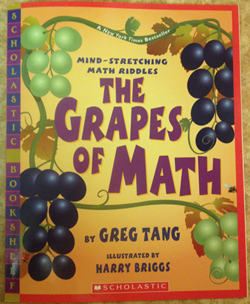
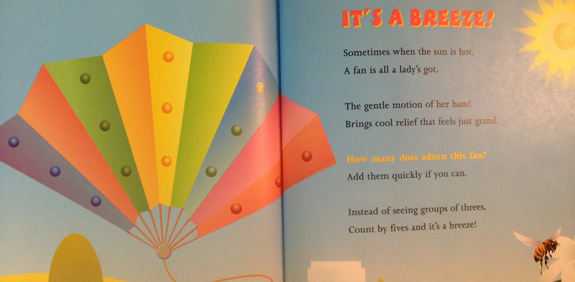
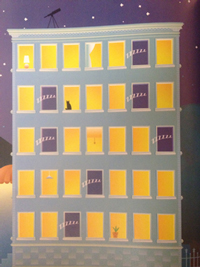
The first thing you see in this math picture book are the bright but simple images. Looking at them you feel like you’ve stepped into the surreal world of those old View-Master reels.
The rhymes are catchy and cute!
I’m all about iambic pentameter. Well, I really don’t know exactly what that is, but it sounds like it means bouncy poetry.
And that’s what this math picture book has!
While scallops on the beach look great, I’d rather see them on my plate.
Unfortunately it’s their loss, They swim their best in butter sauce.
Oh, but the counting’s even better!
Each page has objects (fruit, bugs, dice, etc.) spread out so that children can experiment with different ways to “see” how many there are. You can subitize, group, multiply, subtract – or do them all!
The answer key in the back helps you understand the intent of the authors.
But I recommend you try various ways yourself before turning to the back. Some of their methods were very different than what I came up with.
And you can try it at home!
There are 16 different pictures and riddles to practice on. But it doesn’t have to stop there.
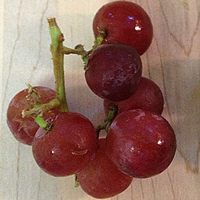
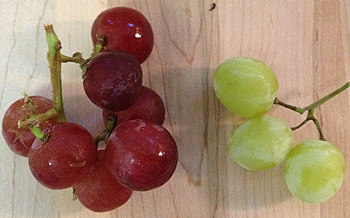
You can do your own playing at home. Check out the grapes I did here:
I put this list together on Amazon when I was teaching at the Art Institute of Houston back in October 2002. I wanted the library to purchase a few – but they bought them all!
It was fun to go through the list and see what I’ve read and haven’t read. And what’s still around!
This post originally appeared on The HSBA Post on February 28, 2012.
When I opened Katy & The Big Snow by Virginia Lee Burton to find some math, I was shocked. I didn’t have to look far at all – it was everywhere!
Math is disguised in all sorts of fun places in this beautiful book!
Katy includes graphing!
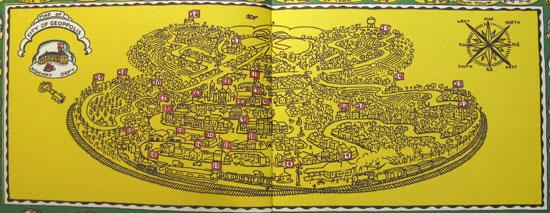
The book starts off with the map of the city. Maps are graphing.
And when the city is shown on other pages, if the orientation is different, a compass is shown to indicate direction. The compass represents the x-axis (N/S) and y-axis (E/W). It also shows the 360º in a circle.
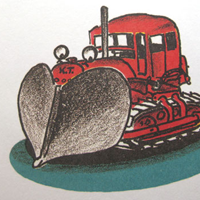
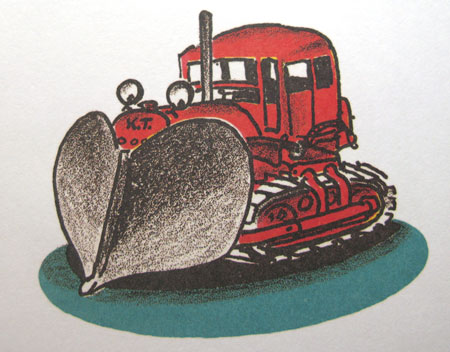
When Katy (the tractor) is introduced, you can see lots of symmetry – especially in her big snow plow. Symmetry is another important concept in graphing.
Factors and multiplication are in the book.
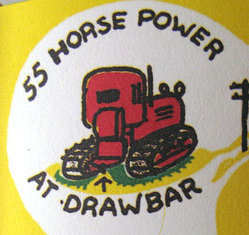
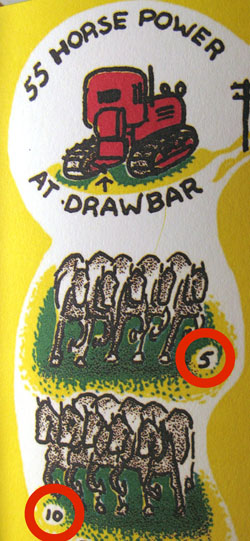
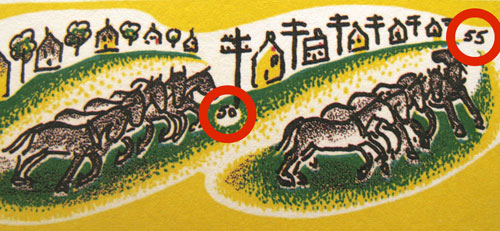
Katy’s features are outlined in the margins and include her horsepower. Instead of merely writing “55 horsepower,” Burton illustrates it with 55 horses, and they are counted in 5s.
Skip counting like this shows factoring as well as multiples (which are used in finding the GCF and LCM – remember those?).
And Burton doesn’t just stop at 5 and 10, she illustrates and counts all 55 horses.
(Note: I put the red circles on the images.)
So when you read Katy & The Big Snow with your children – you can support their math learning by seeing and saying the math in the pictures!
Share your thoughts and experiences in the comments!
This post originally appeared on The HSBA Post on December 29, 2011.
The Story of Ferdinand, by Munro Leaf, is a tale of mistaken identity: Ferdinand is a sweet bull who loves to smell flowers and has no interest in anything remotely violent. He is selected to be part of the Madrid Bullfights due to an unfortunate event with a bee.
I’ve enjoyed this book since I was very young. The nifty thing is the breadth of teaching opportunities Ferdinand gives us. There’s even math in it!
To integrate math in this wonderful tale, try using some of these questions when you read the story:
Distance
Where is Spain? Where do we live? How far away is Spain from us?
Height
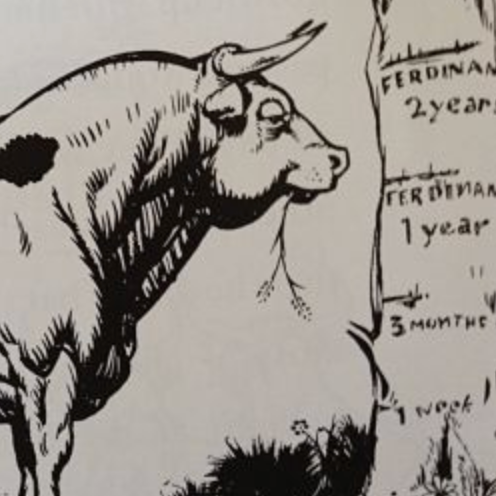
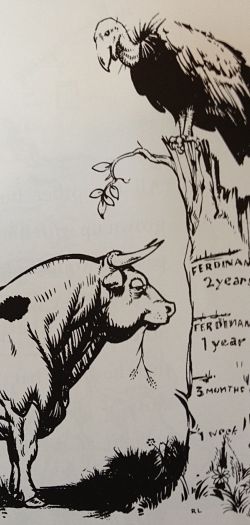
Look at the page where it shows how tall Ferdinand is. How many marks are there on the tree stump? How long was the time between each of the measurements? Is that equal? Would there be a better amount of time between each mark?
Suppose the marks for Ferdinand’s height were at 6 months, 1 year, 1.5 years and 2 years. Approximately where on the stump would those be?
Amount
Five men came to to pick the “biggest, fastest, roughest bull.” Why do you think there were five?
How many Banderilleros are there? How many Picadores?
Page Numbers
Most books have page numbers. Ferdinand doesn’t. Why do you think that is? How many pages is Ferdinand? Could the book be written in fewer pages? How would that be done?
What’s next?
You can use the book Ferdinand and these math stimulators in your Five in a Row math day or integrate it into any other math curriculum. Or do it just for fun! Also try doing math with other picture books you have.
Oh – and don’t forget to share how it went in the comments!