

Category: Logic

  • Logic Skills — Ornery Kids Develop them Naturally!

    Logic Skills — Ornery Kids Develop them Naturally!

    I got to see a natural use of logic yesterday — but it was disguised as an ornery kid!

    Parenting experts (and magazines) suggest that giving options to kids is a great idea — but only if they’re real. You’re not supposed to ask your little one if he wants to take a bath when you intend to give him a bath anyway.

    Instead, ask him which bathtub he wants to use. Or which towel he prefers when he gets out of the tub. Or even if he wants to take a bath alone or with a sibling.

    It’s a clever way of saying, “It’s time for your bath, but you get some autonomy in the activity.”

    Kids like this.

    And it’s formal math!

    Yup — in formal logic terms it looks like this: p∪q, where p and q are the options. And that little ∪ means “or.”

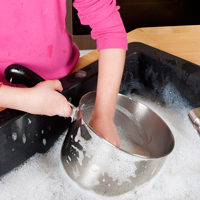
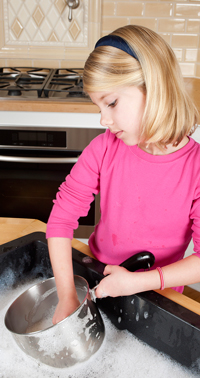
    For instance, I give K8 the choice of taking a bath alone or with me. So it looks like this:

    p = Take a bath alone.

    q = Take a bath with me.

    So pq = Take a bath alone or take a bath with me.

    But she’s more clever than I thought!

    Yesterday I gave her this option. She responded:

    I don’t want to take a bath alone and I don’t want to take a bath with you.

    Ornery little thing she is!

    But in our formal math lingo, this is

    ¬p∩¬q

    (Those little thingies in front of p and q are the “not” part. And the ∩ is the “and.”)

    If you look it up (or know formal logic) you can find out that ¬p∩¬q is exactly the same as ¬(p∪q).

    She was clearly saying to us that she does not want to take a bath at all!

    Math is built in.

    I’ve claimed before that we all have a built in ability to do math. Now it looks like that’s not just with numbers — it’s also with logical processing.

    She doesn’t get that she’s doing formal logic, but she understands in her gut that saying, “I don’t want to take a bath alone and I don’t want to take a bath with you” is negating the “take a bath” statement.

    Encourage it!

    I know it seems like she’s being a snot. And as she gets older it’ll get worse. I’ve seen my niece do it with my sister — play these logical games that feel like back-talk.

    But logic is the foundation of learning math. So instead of admonishing children, discuss it with them. Talk about a way to phrase your statements or rules so that there’s no logical loopholes.

    Allow them to argue with you on these little things — they’re building skills that will make them into super math thinkers!

    Your turn…

    What do you think? Has your child shown natural logic skills? How do you handle it?

    And how do I get K8 into the bath now!?

    Share your thoughts in the comments or on twitter/x.

    You might also like:
  • Logic and Reasoning Skills are Missing in ‘Drop Everything And Read’

    Logic and Reasoning Skills are Missing in ‘Drop Everything And Read’

    Here are some of the options I had for including in my RWAM Kit.

    I had the privilege of substitute teaching fifth graders last week. In that experience I was introduced to the D.E.A.R. program — Drop Everything And Read.

    Imagine my horror!

    Okay, I’m a little sensitive to how obsessed with reading to children grownups are (and how much they ignore building logic and reasoning skills like math). But this D.E.A.R. thing makes it clear to me that I’m right.

    Do you see a “drop everything and do a puzzle” program? Nope.

    Reading is passive.

    We’ve been brainwashed that reading is the most important thing in learning. But it has some serious downfalls.

    Reading is a passive activity. Granted, you can learn a great deal of grammar and vocabulary through reading. So it’s not without its merit.

    But stressing reading to the exclusion of other, more active, activities is doing your children a disservice.

    Math and writing are active.

    Math and writing are the active ones in the three categories of learning. You can’t passively do math — one of the reasons we often say math is not a spectator sport.

    And writing, well, that would be interesting to see someone do that passively, I’ll tell you!

    Math and writing both require logic and reasoning skills — thinking skills.

    So how about a Reading, Writing And Math Kit?

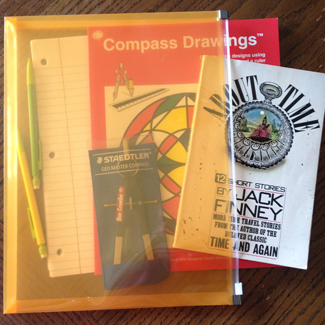
    This is my RWAM Kit — complete with my new compass!

    Teach your children to carry a “RWAM kit” everywhere they go (pronounced “ram”).

    Pick up a cheap zipper pouch (mine was $2.59 at Office Max) and let them decorate it.

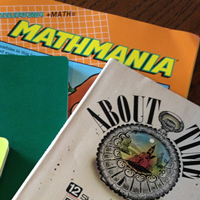
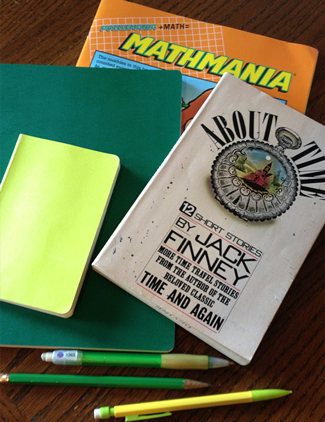
    It should always have a pencil or pen and a blank book or loose paper. They can also carry a book for reading and a drawing or puzzle book (like sudoku, Mathmania or GAMES Book for Kids).

    Reading — they can practice this necessary and helpful skill with the book or some of the instructions in the puzzle book.

    Writing — they can write journal entries or stories in the blank book. They can also play, “what will happen next” after each chapter or segment in the reading book.

    Writing this out is a fun and active exercise that provides children with a reading break, as well as a different way to practice logic and reasoning skills.

    Math — the puzzles provide the math skills here. If they’re doing a puzzle, they’re practicing the same logic and reasoning skills required for math. In fact, if a child does puzzles, he or she will get much better in textbook math than by using the textbook alone.

    What if they draw instead?

    Drawing can encompass any or all of the above three.

    Students can illustrate a part of the reading book. Or they can illustrate their own writing.

    And they can create tessellations or other geometric drawings. In fact, even if they draw racecars, they’re still practicing shapes, ratios and perspective — all math things!

    So don’t drop everything.

    Don’t fall prey to the brainwashing Drop Everything And Read campaign. Because you just might be depriving your children of actively growing their logic and reasoning skills!

    Help your child build his or her RWAM Kit today — and don’t let them leave home without it!

    P.S. You should do it too. Not only is it a great habit, but you’ll also be a good example.

    Share your thoughts in the comments or on twitter/x.
    You might also like:
  • Is Math a Language?

    Is Math a Language?

    I’m taking Keith Devlin’s course “Introduction to Mathematical Thinking” on Coursera for the next seven weeks. We’ve started with some thoughts and readings on set theory and logic.

    And the first big thing in set theory is the way the stuff is written.

    We invented shorthand to help us write stuff.

    You may be old enough to remember Gregg shorthand. They discontinued the class the very year I intended to take it in high school. But I remember seeing it and really wanting to learn it.

    The idea behind shorthand, both Gregg and any other, is that you have agreed upon symbols that allow you to write things quickly, or more concisely.

    Logic and set theory both use shorthand to do this. And in fact, you’re not a stranger to it either!

    We live in an age of texting shorthand.

    FYI and CC have been around for a long time. But LOL is relatively new. So is IMHO.

    And every now and then I come across a brand-new one that completely throws me.

    Logic and set theory shorthand works the same way. Consider the statement:

    For every number that’s a positive number, we know that that number is bigger than the number -13.

    That’s a math mouthful!

    So instead we have invented some shorthand to make that easier.

    We use variables like pronouns.

    The first shorthand we use is variables. If the number were a guy, we would say,

    If some number is positive, he’s bigger than the number -13.

    Unfortunately numbers aren’t people. So instead of using he and she, we use x and y. So we say,

    For every positive number x, we know that x is bigger than the number -13.

    Then we get freaky!

    Because math and set theory have been around a really long time, we have symbols that are easy to write with pencil and paper. But not so easy to write with typing!

    Let’s start with one of my fav’s: \(\forall\).

    That upside down A stands for “for all” or “for every.” If we were to invent that notation now, we would probably use FA or something easy to text.

    But we didn’t, so we’re stuck with it.

    Here’s how we would use it in our example:

    \(\forall\) x such that x is a positive number, then x is bigger than -13.

    You can also use it like this:

    \(\forall\) x such that x is a dish, you will wash x before you go to bed.

    How about some more…

    \(\exists\) means “there exists” and can be used like this:

    \(\exists\) a dish in the sink, so you’re not going to bed yet.

    \(\therefore\) means “therefore” or “thus” or “because of that, this will happen…” Here’s a way to use it:

    \(\exists\) a dish in the sink, \(\therefore\) you’re not going to bed yet.

    \(\land\) means “and” — to be used like this:

    \(\exists\) a dish \(\land\) a glass in the sink, \(\therefore\) you’re not going to bed and you just might lose your phone privileges tomorrow.

    Math isn’t a new language — it’s a shorthand of normal language.

    And it isn’t really hard. Give this sentence a shot. I’ll be you can figure out what the symbols mean!

    \(\exists\) a dish \(\lor\) a glass that isn’t washed \(\Rightarrow\) you’re getting into serious trouble!

    Want more? Check out this list of logic symbols. And make sure your share how you use them with your kids in the comments or on twitter/x.

    You might also like:
  • Can You Win Pioneer Woman's Big Fat Smartypants Quiz?

    Can You Win Pioneer Woman's Big Fat Smartypants Quiz?

    Well, I sure can’t. Unless I work the numbers.

    I’m a subscriber of Ree. Well, the homeschool part of Ree’s site The Pioneer Woman. And I just got the post titled Big Fat Smartypants Quiz in my email.

    I like to fancy myself as pretty smart. And I’m sometimes more confident that I should be.

    So I took the bait.

    Turns out, the only way I’m going to win this Smartypants Quiz is to work the numbers.

    How do I work the numbers?

    The first step to cheating (and let’s be honest, that’s what this is) is understanding the landscape.

    The questions on this quiz aren’t logical. They’re trivial. Which means you have to be knowledgable, not clever or intelligent.

    There are tons of things I am – but knowledgeable I’m not.

    How many ways can I answer?

    The first two questions are no-brainers. Name and email. Got it.

    Of the remaining 18 questions – 16 have four options. The other two (#14 and #16) are yes/no questions.

    Assuming I know my name and email address, the number of possible responses by one person (me) is

    \(1 \times 1 \times 4 \times 4 \times 4 \times 4 \times 4 \times 4 \times 4 \times 4 \times 4 \times 4 \times 4 \times 2 \times 4 \times 2 \times 4 \times 4 \times 4 \times 4\)

    Or 17,179,869,184.

    Ouch.

    Which means that the probability of randomly guessing and winning is 0.0000000000582076609.

    That’s, well… pretty small.

    And if I gave it a shot (to randomly guess) it would take 544 years to go through all the options (if I could submit a new answer set every second).

    By that time Ree would have given someone else the iPad and everyone involved would be dead.

    But… can I win anyway?

    No sense in guessing from the start. I’ve already decided that it would take too long. So I need another tactic.

    Thus, I need to know other things about this quiz.

    FACT: I get immediate feedback on what grade I make.

    That might be helpful.

    Doing some testing I can determine that…

    FACT: I get no points for entering my name and email address.

    Seems dumb, I know, but if I get points for name and email, then I have to keep putting them in while I do my experiments.

    There are some things I know!

    I know that the 10th letter in the Greek alphabet is kappa (it’s a math thing), so I go for answering only question #5 and find…

    FACT: I earn 6% for a correct answer on #5, with no other questions answered.

    I remember that Juliet gets mad that Romeo drank all the poison, so I go for #7 as “a dagger.”

    FACT: I earn 6% for a correct answer on #7.

    So it looks like each question (other than name and email) get 6 percentage points. But 18 * 6 = 108. Way more than 100.

    Curious.

    Now I do what all good mathematicians (and cheaters) do. I wonder…

    CONJECTURE: I’ll bet the two yes/no questions are only worth 2 percentage points.

    I recall Katherine Hepburn being married to just about everyone. So I answer “true” to #14. I get ZERO percentage points. So I try again with the opposite.

    FACT: Strangely, my conjecture was wrong. I got all 6% for answer “false” on #14.

    So I do more experiments!

    It takes me less than two hours to experiment and get a 100% on the quiz. Significantly less than 544 years.

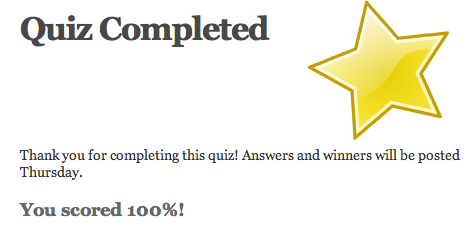
    I gave myself the gold star!

    “How can I use this with my kids?” you ask?

    Ah… there’s the kicker!

    Math isn’t just about numbers and books and getting the right answer. Math is about figuring stuff out.

    It’s about wondering, guessing, playing. It’s about conjecturing and getting stuff wrong.

    And it’s sometimes about brute force – getting your hands dirty and finding out what the heck is gonna get you to success.

    Play a game or take a quiz.

    The next time you and the kids have an opportunity to play a game or take a test or quiz, see how you can do it without really doing it. Point out that the logic behind things is really just math.

    And enjoy it!

    Share your thoughts in the comments or on twitter/x.
    You might also like:
  • HELP – Logic Puzzle Announcing The Homeschool Blog Awards

    HELP – Logic Puzzle Announcing The Homeschool Blog Awards

    Okay, y’all, I’m in over my head. I’m trying to create a logic puzzle as a nifty way to announce The Homeschool Blog Awards. Having never created a logic puzzle before, I thought, “How hard can it be?”

    Well, pretty darn hard.

    So I thought I’d put my start out there, as well as the solution, and see if I can get some help from y’all.

    Read the puzzle, try to figure out the solution, then suggest in the comments one or more clues that I should add (or get rid of).

    The Puzzle

    The Homeschool Post is the sponsor of The Homeschool Blog Awards every year. Writers of The Homeschool Post aren’t allowed to win, nor be nominated. So some of the writers of thought it might be fun to do a “within the family” blog award for themselves.

    After all was said and done, they decided to pass all information over to me, the math mom in the team, and let me figure out the winner. Alas, the information wasn’t well organized. So I had to figure out which blog went with which person, who voted for whom and who was the winner.

    The Clues

    Six of the writers decided to participate. They were

    • Lana (like Banana)
    • The writer of OK Homeschool Mom
    • Heather
    • The writer of Knit 1 Kids 4
    • Gidget
    • Rachel
    1. Heather said, “I love everyone. I’m just voting for them all!”
    2. Someone suggested that nobody should vote for themselves. So they agreed on that.
    3. The writer of Finding Joy voted for three people, including Heather and Kristal.
    4. Everyone who voted for Rachel also voted for the blog I Love My 5 Kids.
    5. Everyone but Gidget voted for the author of the blog SprittiBee.
    6. The author of  Homeschooling Unscripted only got two votes.
    7. Donnetta and Gidget got the same number of votes. As did the authors of SprittiBee and Knit 1 Kids 4. Also, Rachel and the author of I Love My 5 Kids had the same number.
    8. The author of Finding Joy is very popular – everyone voted for her.

    The Solution

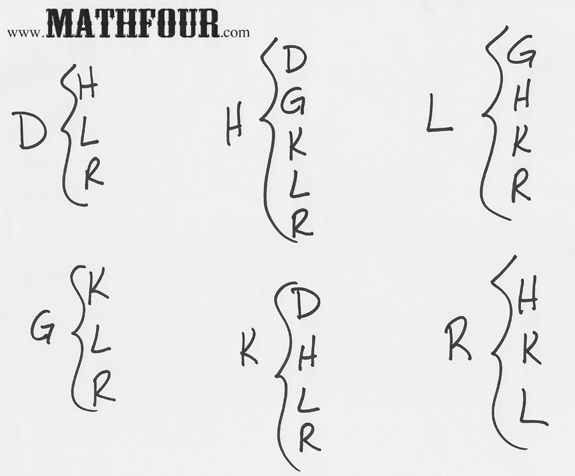
    Here is the solution of who voted for whom. The initial of the person is on the left and the initial of the people for whom they voted is in the curly brackets. Click on the picture to enlarge.

    Owners/writers of the blogs are here:

    • Donetta publishes OK Homeschool Mom
    • Gidget publishes Homeschooling Unscripted
    • Heather publishes SprittiBee
    • Kristal publishes Knit 1 Kids 4
    • Lana publishes I Love My 5 Kids
    • Rachel publishes Finding Joy

    Don’t forget…

    Suggest a clue in the comments!

    Related articles
  • Some Fun Ways to Teach Counterexamples

    Some Fun Ways to Teach Counterexamples

    This post is inspired by a discussion with Betty Ann on the www.Teachers.net math chatboard. She writes:

    I’ve got a high school student doing a very basic geometry course. She’s having trouble with the concept of a counterexample. I’m writing a worksheet on counterexamples and would love to have some more simple conjectures for her to work with.

    A counterexample is a special kind of example that disproves a statement. We start using these in Geometry because that’s the first course that really teaches proving things.

    Counterexamples are an essential part of logic.

    They don’t really need to be associated with math (or even philosophy) to be applicable. Which is the cool thing about them.

    Suppose someone says, “I always get to school on time.” It only takes one day when he isn’t on time at school to negate this statement. That one day would be considered the counterexample.

    We do this all the time and never use the fancy math term “counterexample.” So when we teach it, it’s helpful to tap into these everyday uses.

    Counterexamples are everywhere.

    Here are some statements for which students can come up with easy counterexamples.

    In the house:

    • Any four legged piece of furniture is a table.
    • If something has a knob on it, it’s a faucet.
    • Everything in the house with hands is a clock.
    • If a living being has eyes, it’s a human.

    In the grocery store:

    • Everything that costs $2.99 is a gallon of milk.
    • Everything that’s hot is fried chicken.
    • If something is white, then it is mayonaise.

    In the classroom:

    • If it’s a book, it has words. (Make sure there are blank journal books around.)
    • All books teach arithmetic.
    • Anything on the wall is a whiteboard.
    • If it’s full of pencils, then it’s a coffee mug.

    You can make your own statements for counterexamples.

    Choose a noun. Notice a feature about it. Then put it together using this MadLibs format:

    • Everything that has <feature> is a <noun>.
    • All <plural noun> have <feature>.
    • If it <has this feature>, then it’s a <noun>.

    You can also reverse them like this:

    • Every <noun> has <feature>.

    For instance:

    • Every cow is brown.
    • Every lightbulb is 60 watt.
    • Every hammer has a wooden handle.

    Which counterexamples or counterexample building method do you use?