Category: Arithmetic

  • Can every number be written as a palindrome in some base?

    Can every number be written as a palindrome in some base?

    My muse, Bartholomew, visited me this weekend with a question:

    Can every number be written as a palindrome in some base?

    What’s that mean!?

    Okay — first thing’s first. A palindrome is something that can be written the same way forward as backward. Like mom or 1001. Typically we ignore punctuation, so things like, “Go hang a salami, I’m a lasagna hog,” also count as a palindrome.

    And base means the number system — in our normal world we use base 10. Computers use base 2 (all ones and zeros) and hexadecimal (like the color codes you sometimes see on a computer — hex #ff9900 is the MathFour orange).

    Notice in hexadecimal — using 16 digits — we have to use letters as numbers. I did a video on base 12 arithmetic here — base 12 also uses some letters as numbers.

    So what’s the question again?

    Take any number — say 85. Can you convert it to some other base (like base 2 or base 7 or base 61) so that it looks like a palindrome?

    You can work hard converting numbers — or you can have a spreadsheet or Wolfram Alpha do it for you.

    If you use Wolfram Alpha, put in the statement “convert NUMBER base 10 to base NEW_BASE” — change the blue things, but leave the black ones the same.

    Notice if you convert 85 base 10 to base 84, the result is 1184 — which means every number can be written as a palindrome in the base that is one less than it.

    So 27810 is 11277. And 11 is a palindrome!

    So yes — every number can be written as a palindrome in some base.

    That’s a lame answer!

    You’re right. That’s what mathematicians call a “trivial” solution. It’s true, but it’s pretty lame.

    So let’s rewrite the question to be more interesting.

    Can every number be written as a palindrome in a base less than or equal to 10?

    This lets us use our “normal” digits — and it makes it more natural.

    I put together a spreadsheet to calculate some conversions. The yellow highlights are palindromes. The blue rows — those have no palindromes!
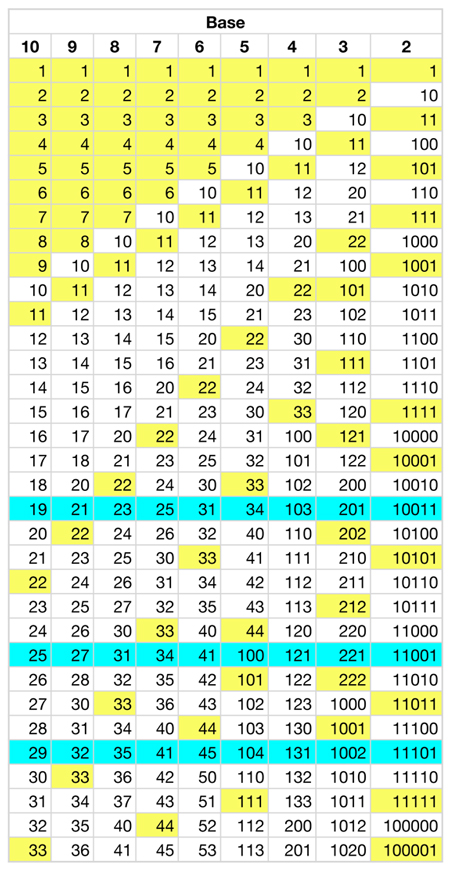
    Not every number can be written as a palindrome!

    That answers the question — but any good mathematician will ask the next question:

    What’s up with the numbers that can’t be written as palindromes?

    I did up to 100 and these numbers didn’t have palindrome conversions:

    19
    25, 29
    39
    47
    53, 58, 59
    69
    75, 76, 79
    84, 87
    90, 94, 95, 96

    Some are primes, some not. One’s even a perfect square!

    I leave the question with you…

    Any thoughts? What happens if you change the question again? Can you ask your children this question?

    Share in the comments — and don’t forget to tweet it!

    You might also like:
  • Multiplication Facts — Sevens

    Multiplication Facts — Sevens

    I was working with a tutoring client yesterday and we were focusing on the multiplication facts with seven.

    Instead of doing the basic chanting and quizzing, I decided to go a different route.

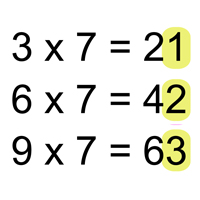
    We looked at the patterns.

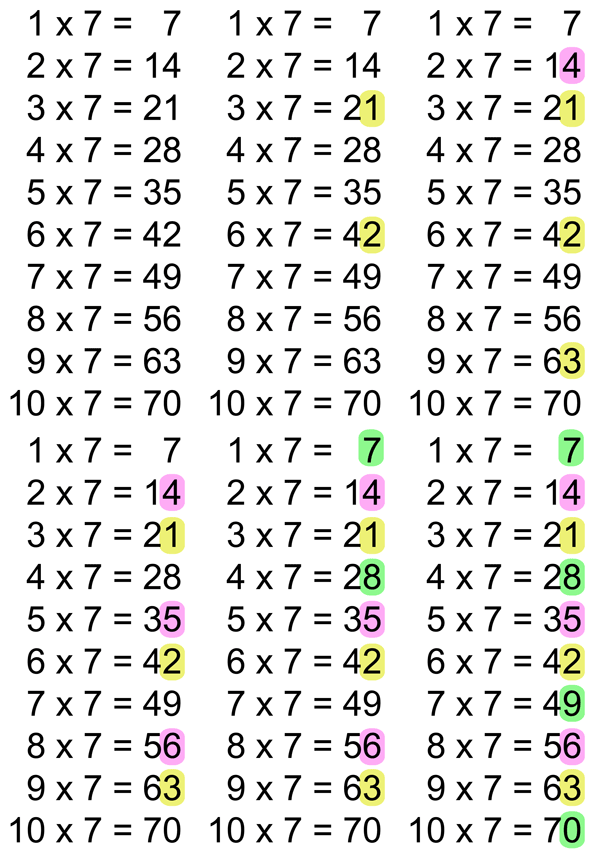
    If you look at the last digit in the answers, you’ll see that every digit is represented:

    We continued to play with the answers and watched for patterns for the first digits.

    Then we looked at the multiplication facts from 11 through 20 using seven. The last digits on those followed the same pattern!

    Does this help memorization of the multiplication facts?

    Children feel the pressure of memorizing math facts. You can reduce this pressure by moving toward something more familiar or fun — like patterns.

    My client will still have to perform well on the multiplication facts test. But hopefully the fun we had with them will stick with her through it.

    How about you?

    Do you play with numbers and math facts? Do you help your children see the fun?

    Share your thoughts in the comments — and don’t forget to tweet it out too!

    You might also like:
  • Adding Decimals — All Wrong!

    Adding Decimals — All Wrong!

    Part of Wordless Wednesday

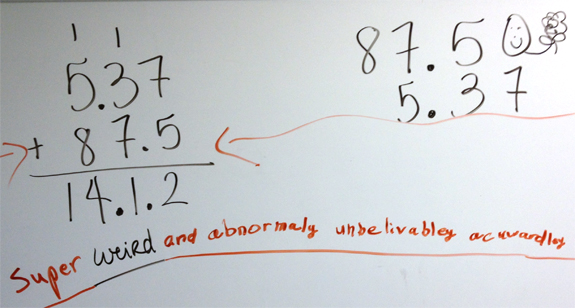
    When substitute teaching 5th grade math today, I had the opportunity to incite a riot.

    The students were calmed when I finally listened to their screams of, “line up the decimals.” And some of the girls stayed after class to add some adverbs to my comment of “two decimals in a number is weird.”

    Share your thoughts in the comments or on twitter/x.

    You might also like:
  • Exponents of Negative Numbers

    Exponents of Negative Numbers

    This is an add-on in the series The Order of Operations Explained. For the other articles in this series, click here to visit the introduction.

    Evaluating exponents of negative numbers, or raising a negative number to a power, can get weird. And it has to do with the order of operations.

    Exponents come way before subtraction (PEMDAS). So something like

    \(-3^2\)

    has to take this into consideration.

    Even though from left to right it seems the negative is on the 3, it’s really the tiny 2 that’s supposed to come first.

    All that’s fine and dandy. But how about a nicer way to think about it?

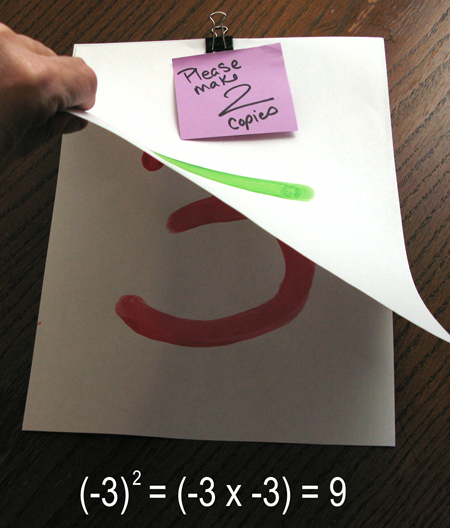
    Exponents are copying instructions. Parenthesis are paperclips.

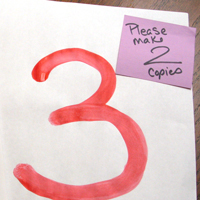
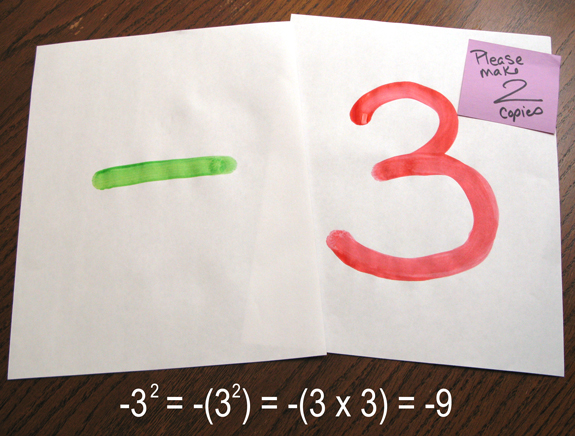
    Imagine you’re heading to the copy center with two pieces of paper — one paper has only a “-” and the other a number (like 3).

    If you have the pages clipped together with the stickie note reading “Please make 2 copies,” it looks like this:

    If you have the pages separate and the stickie is only on the page with the 3, it looks like this:

    What will you get from the copy center?

    Now think of what the copier-dude will do with your first set. He’s going to make two copies of the whole thing. He’ll likely give you two stapled sets.

    On the second set, he’ll make two copies of the “3” page and put the “-” page to the side. He’ll think, “Hmm… I wonder what I’m supposed to do with this? Oh, well. I’ll just put it back on the stack after I’m done.”

    But there’s an even better way.

    If we would put parenthesis where we mean things to happen first, we could avoid all this.

    Using

    \((-3)^2\)

    and

    \(-(3^2)\)

    would solve this whole issue, right?

    Share your thoughts in the comments or on twitter/x.

    You might also like:
  • Teaching Times Tables with a Number Stick

    Teaching Times Tables with a Number Stick

    My friend Shawn from #mathchat shared a video about teaching times tables with a number stick. It’s been haunting me ever since!

    I have to learn to use one!

    I just had to learn how to teach with this thing, and get me one! So I looked around to find out how to do it with other numbers. I found this video of how to do it:

    Where do you get one?

    As far as I can tell, you gotta rob your mop of its handle, get some tennis grip tape and make one. I can’t find a place to just buy one – anywhere!

    So I’m off to buy a mop.

    What do you think? Have you used a number stick? Do you own one? Wanna sell it to me?

    Share your thoughts in the comments.

    Related articles
  • Times Tables Bootcamp

    Times Tables Bootcamp

    This is a guest article by Caroline Mukisa who publishes Maths Insider.

    Does your middle- or high-schooler know their times tables? If the answer is a resounding “Yes” then, great, have a great day, and read the other great tips here at MathFour.

    I also have some great tips and advice on how to guide your child to maths success on my Maths Insider site.

    If not, then it’s time to help your teen develop their own times tables boot camp.

    Why are times tables important at all?

    Well it’s used loads in algebra, and those geometry questions usually need a fair bit of multiplication or division. It’s also great for those grown-up things that they’re going to be doing in the years to come, working out payment plans, home remodelling, calculating sale prices and just plain making sure that they’re not ripped off in life.

    Of course we’ve got computers and calculators, but who wants to be fiddling about to open a smartphone app, just to work out the price of a pair of jeans. And if they press the wrong buttons, how will they know the answer is wrong?

    Yep, they’re important!

    Why are times tables a problem for older learners?

    It’s like spending years trying to pass a driving test. Or still not being able to conjugate Spanish verbs after studying them for ages. Or trying to lose those last few pounds of weight. It sucks, and it gets to the point where it’s easier to develop a work-around: catch the train everywhere, just get by with a few Spanish phrases, or buy bigger clothes.

    Of course, your teen can “get by” and may even do rather well at maths without knowing their times tables. But before you give up, try some of the following strategies to help your teen make their own times tables bootcamp to fix those essential times tables facts in their heads. It’s never too late!

    Times tables boot camp strategies

    1) Figure out what they know, and what they don’t know. Are they fine with their 2’s, 3’s and 4’s and 5’s but shaky after that? Then focus on quickly reviewing the easy tables before some concentrated repetition of the harder tables.

    2) Use incremental steps. Make sure the 5’s are solid before moving on to the 6’s and the 6’s are fast before moving onto the 7’s.

    3) Give your teen a fixed target. It’s completely possible to learn the times tables from 2-9 in a month with just 5-10 minutes of daily study.

    4) Let them choose their own activities. Worksheets won’t be a popular option – iphone apps, You Tube videos, online games are all things that teens are more likely to tolerate.

    5) Be encouraging – don’t say, “That’s easy, you should know it” instead say, “I can see you’re working hard on this, keep it up.”

    Use these strategies to help your child plan their own successful times tables boot camp, so they won’t have to just “get by” in maths any longer.

    Caroline Mukisa is a homeschooling mom of 4, who publishes at Maths Insider.

    Related articles
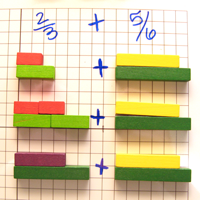
  • Adding Fractions with Cuisenaire Rods

    Adding Fractions with Cuisenaire Rods

    Christine asked me via twitter for some resources for Cuisenaire Rods and teaching fractions.

    Of course I can’t pass the opportunity up to do some fun things with my rods!

    Christine, I hope this helps. Let me know what’s next.

    Anyone else? What would you like to see done with fractions and/or Cuisinaire rods?

  • How to Use the Senses in Teaching Math

    How to Use the Senses in Teaching Math

    Today’s article is from Beth McKeon, founder and principal of Bright Brain Studio. 

    Fingers of the left hand.
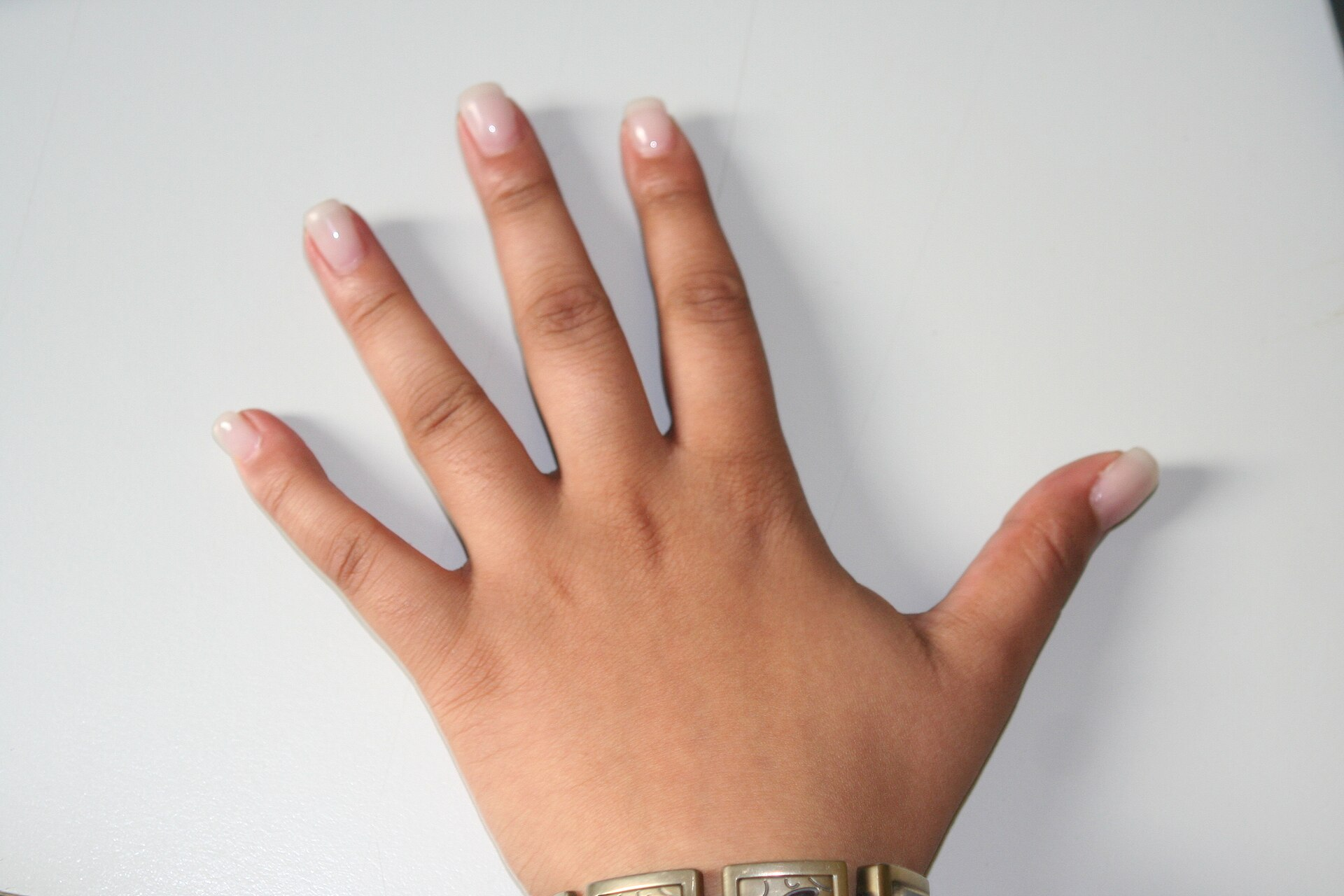
    Image via Wikipedia

    Does your child know all of her addition and subtraction facts?

    Recent research by Dr. David Geary, of the University of Missouri, concludes that early numeracy and math reasoning skills are critical for math success.

    Why?

    Math knowledge is cumulative.

    Children need a strong foundation in beginning math skills, like counting and basic addition and subtraction, in order to succeed with higher level math operations.

    You probably already know this, but it’s easy to feel pressure to move your child on to the next level in math even when these basic foundational skills are stabilized. It’s easy to assume she’ll just “get it” with enough exposure.

    Except that isn’t true.

    Children that don’t pick up basic math skills with a decent amount of exposure and practice likely need a different kind of math stimulation.

    Take basic addition and subtraction. Learning facts like 3+4=7 requires both a strong understanding of the concept of addition as well as a strong picture for the fact itself. In many ways, math facts are like sight words. Even when we understand the meaning of 3+4=7, we still need automatic fluency with recognizing and remembering it.

    If you treat basic facts like sight words, it’s possible to help your child develop a strong mental picture for the fact – just like you can close your eyes and picture the letters in the word ‘teach.” (There are five symbols – letters or numbers/signs – in each!)

    You can develop imagery for basic facts using sensory processing by using a “see, say, feel” multi-sensory approach.

    1. After looking at a fact flash card, have your child write the fact horizontally in the air with her dominant pointer finger. Encourage her to really watch her finger and focus on picturing the equation as she writes it
    2. As she writes the numbers and signs, have her say what she is writing out loud. “Three plus four equals seven.” This should happen simultaneously as she writes.
    3. After she writes the equation, ask imagery questions like: “What number do you see in the middle?” or “What sign do you picture after the three?”

    This simple process stimulates your child’s sensory processing in three fundamental ways all at the same time.

    • It stimulates her visual processing as she focuses on creating a mental image for the fact.
    • It stimulates her auditory processing as she says and hears the equation out loud.
    • It stimulates her kinesthetic processing as she literally feels her finger drawing the equation and develops muscle memory for writing it.

    Using a multi-sensory approach to teaching basic math facts benefits all math students.

    For children who really need to strengthen their visual, auditory, or kinesthetic processing for learning, this technique fills a need that additional worksheets, timed tests, and more flash cards games just can’t. For kids who don’t necessarily need the multi-sensory stimulation, it serves to accelerate learning. They are more engaged in each problem.

    Now if only they made scratch-and-sniff flash cards – that would probably really get their attention!

    How did it work for you? Please share your experiences in the comments.

    Beth McKeon, of Bright Brain Studio, is a brain-based educator on a mission to demonstrate that every child has the capacity to learn. She has spent the past ten years customizing instruction for individual students and teaching teachers and parents how to engage the whole brain in the learning process. Her workshops and coaching provide practical techniques parents can use to reduce the frustration and resistance around homework assignments.

    Related articles
  • Long Division with Sumology Number Tiles

    Long Division with Sumology Number Tiles

    A few articles back, I published a video called Long Division with Playing Cards.  I did it super-fast in response to a comment at  Living Math Forum.

    I’ve pondered this a bunch since then and decided I like the idea, but the playing cards are too cumbersome. I ran across a game called Sumology (from Simply Fun) at the Texas Home School Coalition Convention. The heavens parted and angels sang.

    Or at least my heart started beating and my head started spinning.

    So here’s the same teaching method, but with a little more pizzazz and a couple of free downloads:

    What do you think? Will your child like it? Please share your thoughts in the comments.

    Related articles
  • Long Division with Playing Cards

    Long Division with Playing Cards

    I have since shot another video showing this with number tiles instead of playing cards.

    In response to a post on the Living Math Forum, here’s a way to teach long division with playing cards.

    Whatcha think? Will it work? Let me know if it does!

    Related articles