I’ve been teaching and tutoring the slope intercept form of the equation of a line for 25 years. That whole time I’ve wondered, “Why is the y-intercept called b?”
Just today I discovered the answer!
We teach it backwards.
As is typical, we teach things in reverse of how we create them. The standard (or general) form of a linear function is
f(x) = ax + b
But this crazy f(x) notation isn’t really needed when you first learn to graph. We use y instead. So we have
y = ax + b
The nifty thing about this equation is that the number next to the x (in this case a) is the slope — or the measurement of how much the line tilts.
The fancy letter for the slope is m. So we change the basic equation to include the slope notation…
y = mx + b
Turns out that the b here is also exactly where the line smacks into the y-axis — AKA the y-intercept. But there’s no fancy letter for that, so we just leave it as b.
And we present that first!
We tell early students of algebra that the slope intercept form of the equation of a line is
y = mx + b
where m = slope and b = y-intercept. But we don’t bother to tell them why we’re using such crazy letters!
But now you have it. That’s the answer to the question, “Why is the y-intercept called b?”
(If only we could figure out why they called the slope m!)
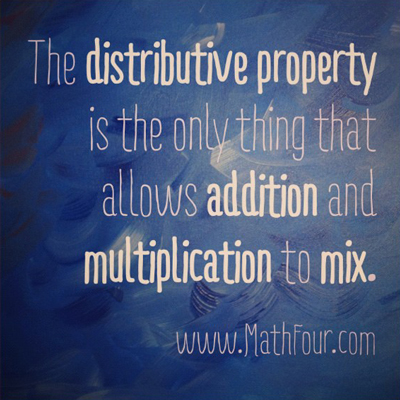
The two most commonly used operations in math are addition and multiplication.
And although we intermingle addition with multiplication (along with division and subtraction), these two can only mix using the distributive property.
How the distributive property works
Multiplication, in a crude sense, is a shortcut of addition. Like 3 x 8 is the number 8 added to itself three times. Or 8 + 8 + 8.
Look at 3 x (6 + 2). This is the number (6 + 2) added to itself three times. (Refrain from adding those two together, no matter how tempting. Leave them separate as 6 + 2.)
So we have (6 + 2) + (6 + 2) + (6 + 2).
And we know that when it comes to only adding, we don’t need any parenthesis. Which gives us
6 + 2 + 6 + 2 + 6 + 2
Also, addition is commutative. So we can scramble these numbers around.
6 + 6 + 6 + 2 + 2 + 2
And if we want, we can squish them together in parenthesis (seems lame, but stay with me…)
(6 + 6 + 6) + (2 + 2 + 2)
And, hey! We know that 6 + 6 + 6 means 3 x 6 (and the same with 2’s) so we have:
(3 x 6) + (3 x 2)
Remember what we started with. Put it together with what we ended with. And we’ve just demonstrated (the long way) that
3 x (6 + 2) = (3 x 6) + (3 x 2)
or, more visually…
3 x (6 + 2) = (3 x6) + (3 x2)
This is the Distributive Property of Multiplication Over Addition. (That’s the fancy name for the distributive property.)
It works with something else, too…
Since exponents are a shortcut of multiplication, we can play the same game.
Consider (6 x 2)3
This is (6 x 2) x (6 x 2) x (6 x 2)
And we can get rid of parenthesis and scramble:
6 x 6 x 6 x 2 x 2 x 2
And re-group:
63 x 23
Showing that:
(6 x 2)3 = 63 x 23
This, by the way, is the Distributive Property of Exponentiation Over Multiplication!
Yes — this IS useful.
Seems ridiculous, right?
But when learning algebra, students often get lost when faced with 3(y + 2). “What do I do now?” they think, going into panic mode.
If they know that y is just a number with lipstick on (as a disguise), they can think about the above example.
Remembering what it means is the key to knowing what to do with the algebra stuff!
What do you think? Share your thoughts in the comments or on twitter/x.
I struggle with factoring polynomials, myself, so I wanted to give it a try.
It started out easy.
I started factoring polynomials with 1 as the leading coefficient (i.e. x2 has no messy number in front of it).
I factored:
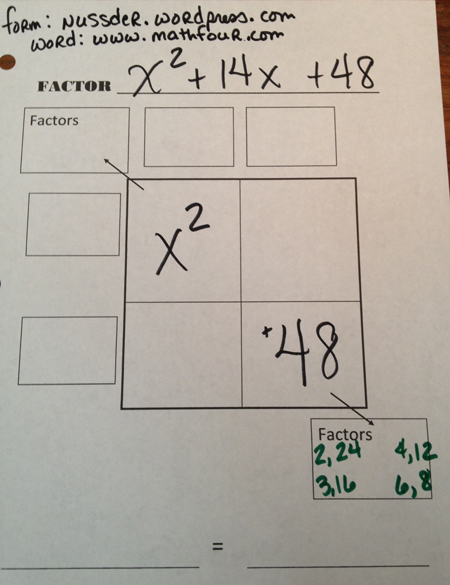
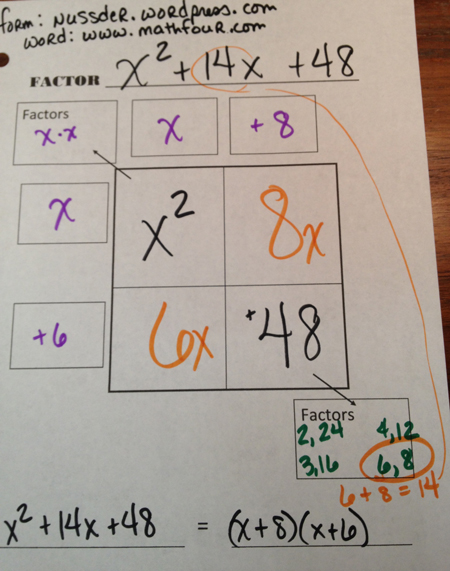
\(x^2 + 14x + 48\)
First, I put the first and last terms in the boxes. (Note that this graphic organizer works the same way as a multiplication table.)
Then I factored those two in the given “factors” boxes. I determined which factors of 48 would add up to 14, and filled in the chart appropriately.
I was done with that factorization.
Yay me!
Then I got into harder stuff.
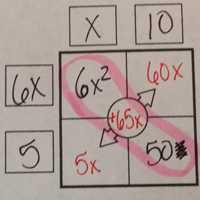
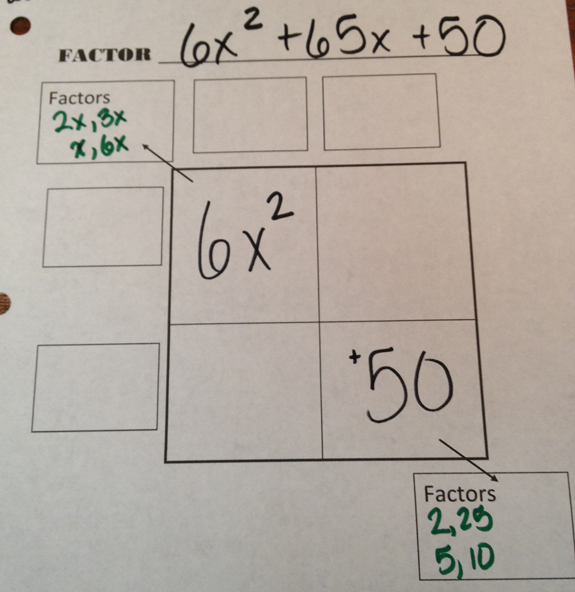
Lisa put in an extra “Factors” box to handle non-unit leading coefficients. So I went for a big dog:
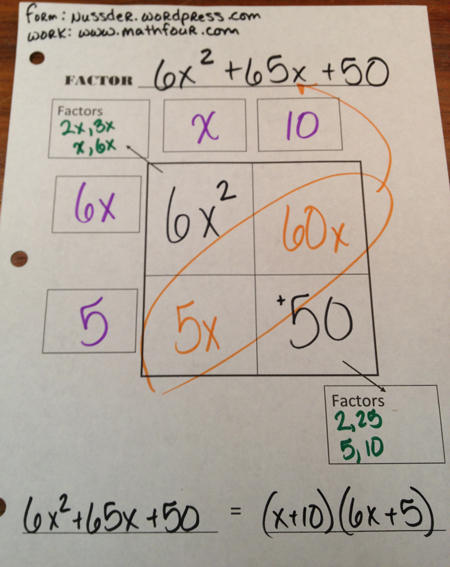
\(6x^2 + 65x + 50\)
Here’s how far I got before the breaks squealed:
Factoring polynomials like this one shouldn’t be too much of a problem. Especially if you use a page protector and a dry erase pen to do the trial and error work, as Lisa suggested.
But I don’t have such fancy technology.
And I don’t like to erase my work. I want to see everything I’ve tried. For me, it’s very likely that I make a mistake and have to go back. And it’s a real pain to have to re-create everything.
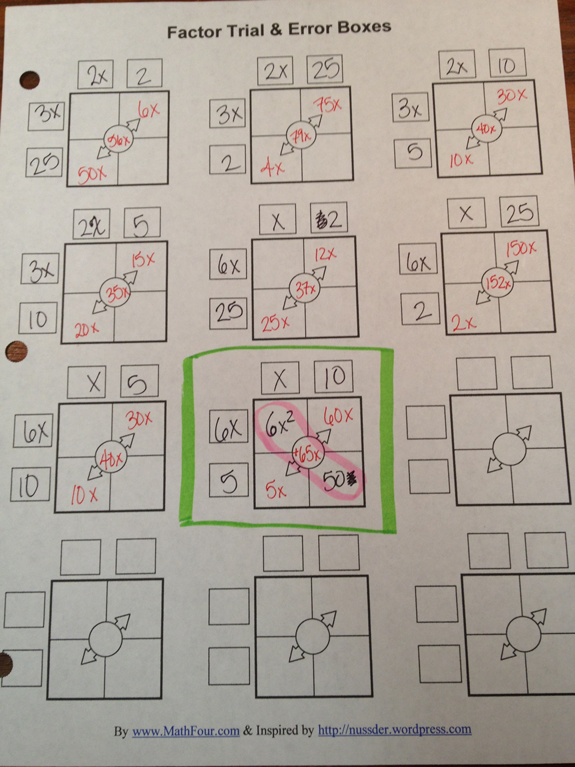
So instead of playing trial and error with the one big sheet of paper, I created a Factor Trial & Error Boxes worksheet (or in Lisa’s terminology: a graphic organizer).
Here’s what my work looked like:
(It was a coincidence that the right answer was last, by the way.)
With that info, I could go back to my big graphic organizer and finish the problem.
This was very pleasing. I was able to use Lisa’s graphic organizer and mine to make sure I didn’t lose any options in my my trial & error.
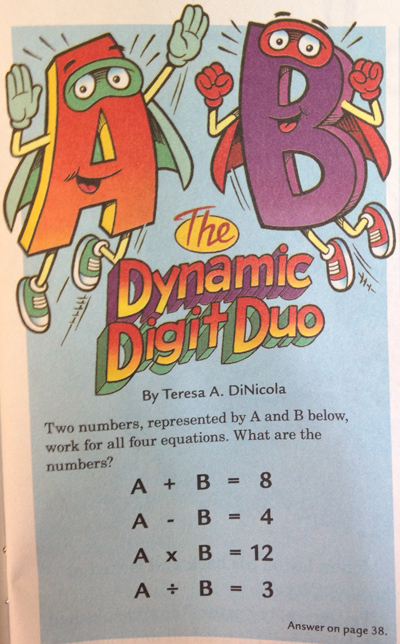
The March 2012 edition of Highlights magazine for kids fell in my lap this morning. Thumbing through it, I found a fun little algebra puzzle.
After looking at the equations and discovering my solution, I began to wonder some things. Then I realized that these ponderances of mine were good for kids to consider as well.
Let the curiosity flow!
Here are the extra questions you can offer your children in case they’re curious:
Did you use all four equations to decide your answer?
Could you have used three, two or only one of the equations to decide your answer?
Try to use only one equation to decide an answer. Did you discover anything?
Try to use only two equations. What did you discover now?
How about three – what happens when you choose three equations?
Can you make a puzzle like this of your own?
How about you?
As a grown up, what do you discover about math in this Highlights puzzle? What do you see your children doing with these extra questions?
We’ve trained kids to know that math is a set of specific, discrete rules that, when followed, yield the correct answer.
They memorize math rules like:
Whatever you add to one side, you must add to the other.
FOIL
Distribute
PEMDAS
Plug in 1 for x (then 0, then -1)
The rub is, that they don’t understand why the rules work. Which might not be a big deal – but the rules don’t always work!
We got to see The Math Rules in action.
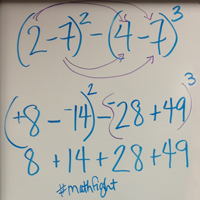
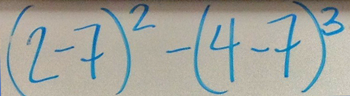
For two days, in my #PowerMath class (officially Developmental Math – the class two levels below College Algebra), we’ve been working on this problem:
The goals were these:
Practice and understand the order of operations.
Compare this to working with variables.
Learn to experiment with the math rules to discover how things work.
What I saw was mind-boggling. I knew the skill level was low. But I had no idea the blind following of math rules was so widespread and detrimental.
Goal #1: Practice and understand the order of operations.
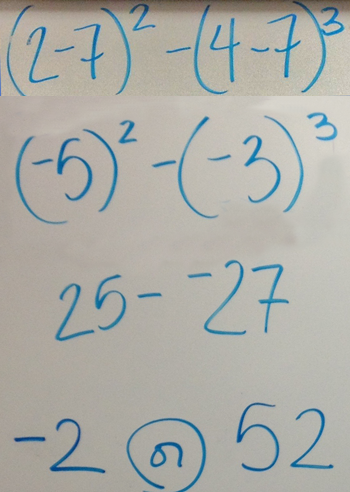
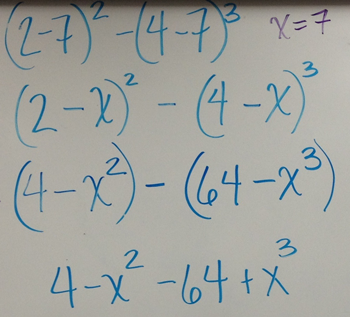
When given the problem, and asked to coach me on various ways to do it, someone requested we use the order of operations and “do inside the parenthesis first.” So we did. They instructed me to write it like this:
All was cool until the end when there was a bit of an argument on the final answer. So we listed them both as possibilities.
Although the act of doing the arithmetic inside the parenthesis is valid, we had much discussion on the positive and negative signs running around.
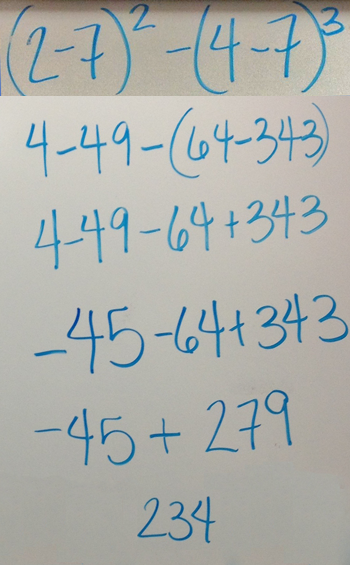
I had encouraged everyone to chime in with their own ways to find the answer, and someone suggested that I do the exponents first. They coached me to write this:
Alas, we had yet a different answer than the first two.
This is a common mistake. But I was hoping that through other experimentation they would see how we could fix this.
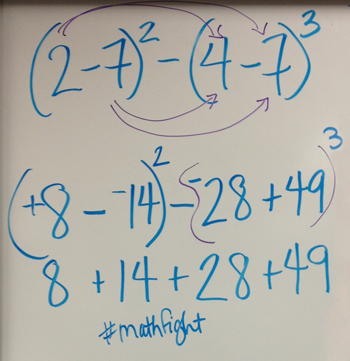
Someone else pointed out that we could FOIL. I asked them to explain exactly what they meant by it and they told me how to draw the arrows:
By the time we stopped, the class was in a full out #mathfight. Some students believed we needed to handle the exponents first, then do FOIL and others thought we should keep the exponents on the bits after we used FOIL. We decided to postpone this version until we worked out some of the others.
The use of FOIL here doesn’t work because the two binomials are being raised to a power. Furthermore, they are being subtracted, not added.
Goal #2: Compare this to working with variables.
The comparison of real numbers to variables has three main points:
Variables represent numbers.
Any math rules you can apply to numbers you can also apply to variables.
Any math rules you end up using on your variables, must also work with numbers.
To help illustrate this, I removed the 7’s in the problem and replaced them with x’s. Our initial tries were interesting.
This experiment, as suggested by the students, applied the same “method” of squaring the inside pieces as one of the purely number versions above:
At which point, someone suggested that we subtract 4 from both sides.
Line #3 here is incorrect. Also, there is no “both sides” because there is no equals sign.
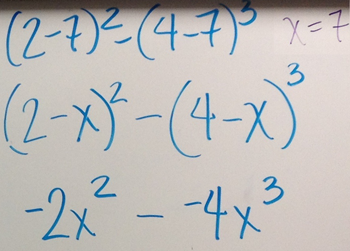
We went to another part of the board to start over and give it a try like this:
Here it was suggested that we set x=1.
Since x=7 (by the design of the problem) it doesn’t follow that x=1. I believe the student was remembering graphing an equation where x is the dependent variable. Also, note that the last line is merely a permutation of the symbols in the expression – it is not equivalent to the previous line.
Goal #3: Learn to experiment with the math rules to discover how things work.
We have a rule in class:
Until you decide differently, everyone is wrong. Even the teacher and textbook.
So I don’t tell them when the answer is right. The skills they are learning are the middle of problems they’ll be solving in the future. They’ll never get confirmation that what they are doing is right or wrong.
There’s no back-of-the-book solutions for the middle of a calculus problem.
Checking themselves, and having confidence in the answers that they have confirmed, are vital.
And yet they get highly frustrated with this.
Why? Because they’ve been trained that they should follow the rules and the teacher or back-of-the-book will tell them if they’re right.
And I’m refusing to play that game.
The full and complete math rules, that go with those above, are:
Whatever you add to one side, you must add to the other, when you have an equation, not just an expression with no equals sign.
FOIL when you are multiplying two sums, not subtracting them.
Distribute exponents over products, not sums.
PEMDAS works only when you know what each term really means and how to use them.
Plug in 1 for x (then 0, then -1) when you are graphing an equation where x is the dependent variable.
But those last bits – the ones in bold-italics – those are ignored. They see an exponent outside of a set of parenthesis, they want to put the exponent on the inside pieces. They see two sets of parenthesis, they want to FOIL.
Handing out rules don’t work. Because students aren’t ever allowed to understand the rules in their entirety.
The #PowerMath classes and I were taken with the videos done by Westerville South High School in Westerville, Ohio. Especially the polynomial factoring one called “Teach Me How to Factor.”
The students asked that I put together some optional homework for them on the videos. No sense in watching something that fun and not getting to practice it!
Check out the video. Below it, there’s a free downloadable collection of “homework” problems that match each of the polynomial factoring examples in the video.
And right below that, parents and teachers can get the teacher cheat sheet I created to get a whole bunch of fairly easy polynomial factoring examples.
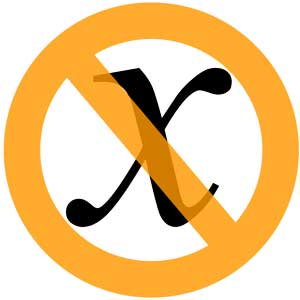
Ever tried to teach someone how to remember this math rule:
\(x^2 \times x^3 = x^5\)
Or tried to remember it yourself? Do the letters trip you up? Or your students?
How about this one:
\((x^2)^3 = x^6\)
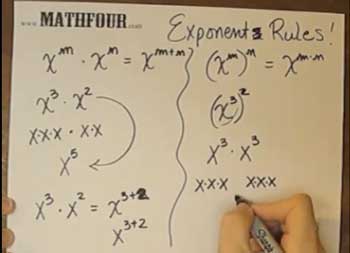
I did a video on this some time ago. It has more Xs than an adult movie theatre. Here’s a still from the video:
In general, it’s a good way to remember the rule.
But what if variables freak out your students?
I’m the only person I know that teaches a kid to count, “1, 2, 3, x, 5, 6, …” (And I’m saving both for Daughter’s college fund and her psychiatrist.)
Most people aren’t even told about letters in math until they’re well established in doing stuff with numbers.
So why do we use letters to explain stuff?
A tiny detour…
I just geeked out and bought a course on google analytics through App Sumo. Andrew Warner with Mixergy, in the first video, was interviewing Justin Cutroni.
In less than two minutes I had to pause, rewind and listen hard to what Justin said:
Actual data makes a huge difference when you’re teaching.
Wow.
Rewind. Re-listen.
What I heard was, “Hey! Knock it off with the letters already! Use some actual numbers when you’re teaching stuff!”
Hey! Use some numbers!
Theory is great. If you’re into that kind of thing.
But when we’re learning, we need something to hold on to. That’s both “we” as grownups in Justin’s Web Analytics class, and “we” as kids in Miss Kelly’s Algebra class.
We need data. Numbers.
Something that feels good, makes sense and is easy to wrap our brains around.
So what’s up with the letters?
Math books and math courses are written by mathematicians. Folks who are as comfortable with letters as they are with numbers. People who can take theory to new heights of abstractness. And never need a beer doing it.
Everyone else, well, they’re just unfortunate casualties.
But you can change that!
You don’t have to be a mathematician to teach math. In fact the less of a mathematician you are, the more likely you are to succeed in teaching math.
Pull yourself out of “teach like a mathematician” mode and think about what a variable is.
It’s a number. It’s data. Just an average ordinary thing that you can represent on your fingers.
So now, what does this mean:
\(x^2 \times x^3\)
Maybe this:
\(4^2 \times 4^3\)
Or this:
\(7^2 \times 7^3\)
Or even this:
\(9^2 \times 9^3\)
And after you and your child play around with these and other examples using regular old numbers, your kid will say out loud:
You just gotta add up those number that are flying in the air.
The order of operations includes two types of rules: those that are based on the way the operations work, and those that are arbitrary. My friend @harrisonalg from the Twitter chat #mathchat and I have been discussing this.
You can explain the truly arbitrary elements of PEMDAS (the left to right of AS and MD) through an experiment. Allow students, independently, to do these two problems any way they want, ignoring any stupid arbitrary rule they might have previously memorized:
3 – 2 + 8 – 3 + 4
2 x 7 ÷ 2 x 6 ÷ 3
The idea is that they will come up with many different answers:
3 – 2 + 8 – 3 + 4 could be any of -14, 0, 10 or others
2 x 7 ÷ 2 x 6 ÷ 3 might be 7/18, 7/2, 14, etc.
If they were on a team building a bridge with these calculations, things wouldn’t work so well.
Enter the Stupid Arbitrary Rule (SAR).
Because we need to all come up with the same answer, we need a rule to follow. Really, it can be any stupid arbitrary rule (SAR). But we agreed, at some point in history, to all follow the “left to right” thing once we were down to addition & subtraction or multiplication & division.
It’s important to note that kids didn’t get to be part of that agreement we made. Just like they don’t get to vote in elections.
Is it fair? Probably not. They would probably do a better job of choosing leaders as well as determining the order of operations. But that’s the way things likes SARs work.
PEMDAS doesn’t cover it all!
To throw a few more kinks into it, check out how wikipedia explains some special cases of the order of operations. . Factorials aren’t covered in PEMDAS, neither are the order of exponents.
Here’s another fun one: even calculators do things differently (and arbitrarily). Check out the way the the TI-92 and the TI-30XII handles exponents. Clearly you get to make up your own order of exponents!
Let them play king: they create the rules!
Let your students determine the order of operations for addition & subtraction and multiplication & division – just for the class. Make sure to write the rule down and tack it to the wall so everyone remembers what they decided. In your class, and your class only, they are to follow that rule.
Remember the back of the book, as well as your answer keys or teacher edition textbook, will now be totally wrong. But it’s worth it.
Doing it this way they might start to understand which pieces of PEMDAS are dependent upon the way the operations are constructed () and which pieces of PEMDAS are arbitrary (left to right).
Once the class determines their special arbitrary rule, practice creating expressions whose result is some important number. Some options could be:
The age of one of the kids
Someone’s favorite number
Your age (be careful)
The age of some other grown-up they know
The last four digits of their phone number
The number part of their street address
Create the expression using the Class Rule as well as the stupid arbitrary rule. Then translate and have a good laugh. I just did my age with my “Bon Rule.”
Bon Rule: addition and subtraction go from left to right, and multiplication comes before division.
My age is 120 ÷ 2 x 3.
If I did this according to the SAR, I’d be dead. Or really famous.
Your turn!
Can you teach the order of operations like this with your kids? If you classroom school, how much trouble are you going to get in when you become the math teaching rebel?
It’s part of our DNA to assess the world around us. As soon as a baby sees Mommy different from Daddy (or smells the difference), she starts comparing. When she figures out that there are more than one of something, things get even more interesting.
Give each of two toddlers a ball. Then stand back and watch. If they aren’t exactly the same ball, one of them will want to switch, and the other will say no. It won’t matter which ball is truly superior, only that one child will soon perceive inequity in ball ownership.
If they are given the same color and size ball, you can watch their little brains calculate this and work to discern some difference.
And it doesn’t stop at kids. Women do it all the time. Is my bottom as big as hers? Do we wear the same size shoes (and will she let me borrow hers if we do)? Is my dress more expensive than her dress?
Comparison in math corresponds to comparison in the world.
Some things are really exactly the same.
Your two crystal champagne flutes you bought for your wedding are likely the same. Not only is one interchangeable with the other, but you couldn’t tell the difference if you were to switch them.
This can get a little sticky for math. There is only one number 3.
But when I write 3 = 3, there are really 2 threes running around. (Math friends: I realize two champagne flutes are not the same as two number 3s. But making analogies in the real world is tough if you don’t take a little poetic license.)
Sometimes things have the same value.
Have you ever traded a dollar bill for 4 quarters? Those aren’t exactly the same (you would be able to tell the difference if you replace one with the other) but they have the same value.
If you return a blouse to a department store that your weird uncle Zeno gave you, and get a blouse that fits your style much better, these will have the same value. Monetarily speaking, of course.
If you ship your G7 back to Canon when it’s under warranty, and they return a G10, the value to them was equivalent (while the value to you has increased).
Some things have the same size and shape.
When you replace the transmission in your car, you’re doing so with an equivalent copy that’s better than what you already have. If you replace the engine in your 1969 Mustang with a souped-up model, you’re playing the same game.
In both these situations, the replacement version, although superior in functionality, is the same in size and shape.
Sometimes things are interchangeable.
Like in the example above, with the cars, as long as one thing works equally as well as the other, you can compare them and call them “equal.”
If you reach for a pen from the pen jar on your desk, any pen will work as well as any other.
The two pens may not be exactly the same, have the same value or even be the same size and shape. But you can interchange one for the other when writing a check.
And sometimes equality is merely perceived.
Like the toddlers with the balls from above. Different people will put different value judgments on items. So there is the case that equality is in the eye of the holder. Or wanter.
What does equality mean to you?
As we progress through this series, we’ll see how equality and the equals sign in mathematics relate to equality in the real world. And thinking about how equality in the real world works is the first step.
So what do you think of when you think about two things being equal? Share your thoughts in the comments.
I mailed out the bulk of the thank you notes for Daughter’s 2nd birthday party gifts. And wouldn’t you know it, it involved algebra!
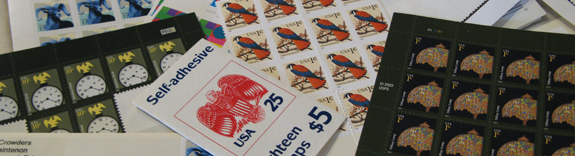
I have so many stamps from the last 20 years, in every denomination you can imagine. I’m trying to use them up because I only save full sheets of stamps. (I’m a bit of a stamp collecting snob.)
Rule #1: No more than the required postage on any letter.
It has to be exact.
As of this writing, postage in the US is $.44 per letter.
I have $.33 stamps, $.37 stamps, $.41 stamps, etc. And I’ve purchased $.01, $.02, $.03, and on up to supplement and make my postage exact.
Rule #2: No more than 2 stamps of the same kind on a letter.
I like variety.
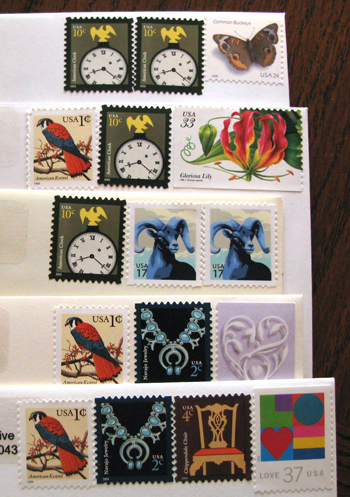
With these requirements, here are some of the combinations that I’ve come up with:
So how is this algebra?
Here is an algebra equation from the stamps in the picture:
10x + 17y = 44
The equation means x number of 10 cent stamps plus y number of 17 cent stamps will give me the exact total of 44 cents! So x=1 and y=2.
And here’s another:
10x + 24y = 44
The equation means x number of 10 cent stamps plus y number of 24 cent stamps will give me the exact total of 44 cents! So x=2 and y=1.
It would make it a better set of algebra problems if I allowed more than two types of stamps. But I’m sticking with my variety rule. 😀
How about it – will it make writing thank you notes with your kids more fun? More challenging? More annoying? Share your thoughts in the comments!