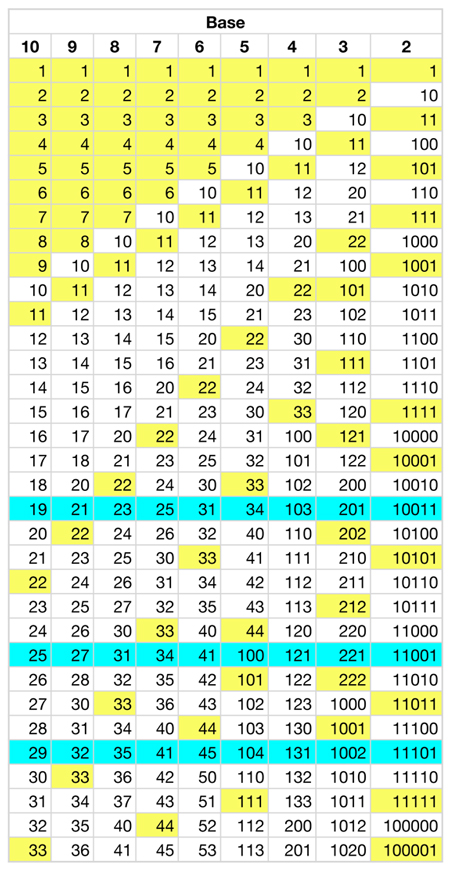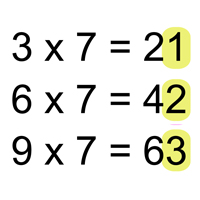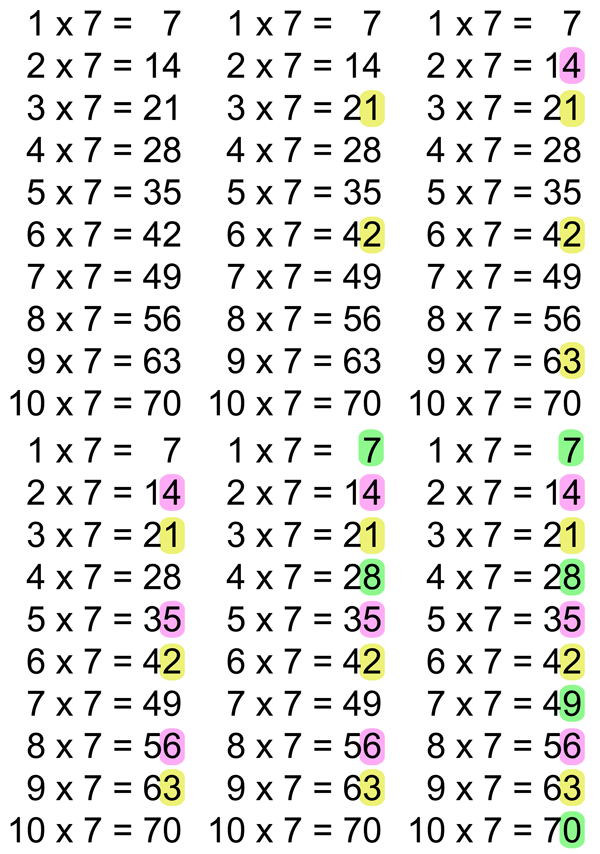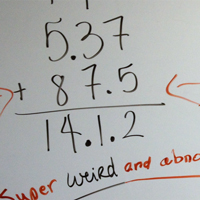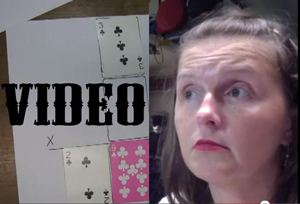
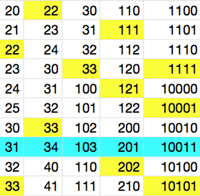
I’ve pondered this a bunch since then and decided I like the idea, but the playing cards are too cumbersome. I ran across a game called Sumology (from Simply Fun) at the Texas Home School Coalition Convention. The heavens parted and angels sang.
Or at least my heart started beating and my head started spinning.
So here’s the same teaching method, but with a little more pizzazz and a couple of free downloads:
Thanks to Molly for this question she left in the comments, “Why is a negative times a positive, a negative?”
“Sign – One Way” by Andrew Schmidt
It’s common to hear a child say, “They created this rule just to make me mad.”
And on the heels of that usually comes a frustrated teacher’s comment of, “No, this has a purpose.”
When then faced with, “Okay… so what’s the purpose?” a teacher or parent might become more frustrated. It’s not always clear the purpose of things like the rules for multiplying differently signed numbers.
It may also be that the grown-up secretly believes that this was all created just to make us mad. After all, when the last time you had to multiply a negative number times a positive number in the real world?
I, personally, can’t ever remember a time when that case has come up outside of a math class or tutoring session.
Then why create the rules at all?
The truth is that many math rules are created because we need a rule to continue working – something to agree on among peers working on the same project. We need everyone on the same page.
This agreement somehow gets filtered down to the kiddos as “this is the absolute way it is – do it because we said.”
So it very much looks like we created rules to make them mad.
Good deduction, kids.
How do they pick the rules?
“Street Chess” by Petr Kratochvil
Some math rules are created arbitrarily just so we have something (anything) to agree to. Like the rules of a game. The order of operations is one such situation.
There is no natural reason why we’ve chosen to do multiplication and division before we do addition and subtraction. No more so than the people in the US have decided to drive on one side of the road whereas the people in England, Australia and the Bahamas drive on the other.
We’ve agreed to it.
It keeps us from crashing.
Sometimes, we agree to a rule because it is “less bad” than any of the other possible rules we can think of. The result of any number raised to the zero power is one of these. 30 feels like it should result in either zero or 3. But if you mess with all the other rules (in particular the one about subtracting exponents here ) you’ll see that 30 really needs to be 1. If it were anything else, it would mess up the rule of .
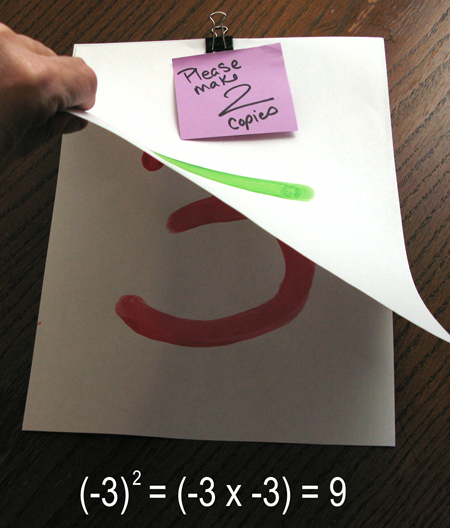
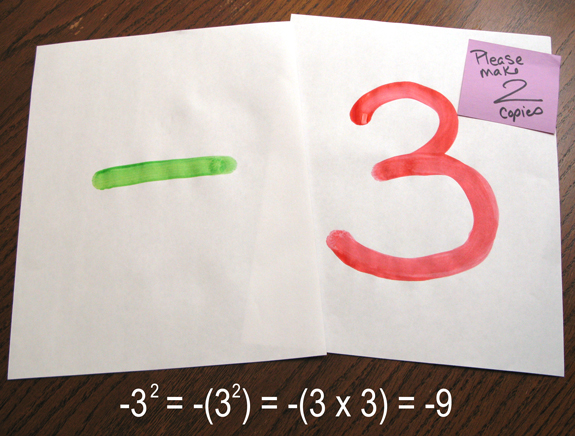
Why is a negative times a positive equal to a negative? Is it because it messes other things up or is it an arbitrary rule? Instead of explaining the reasoning to a child, allow them discover it.
Have a “King for a Day” day where the students get to rewrite a particular math rule. Allow them to sit as a class or family and decide on the rules for multiplying signs numbers.
Give them plenty of time to experiment and see if the new rule messes anything up. (If your administrators or math curriculum specialists fret about you allowing students this time, note to them that the students are behaving like real mathematicians. They are inventing a concept or rule and testing it out to see what happens.)
If the students discover that the new rule has dire consequences when applied to the rest of our number system, they then see the reason for the rule. And they’ve learned through experience and solidified the rule in their minds!
If the students discover that there are no consequences of the new rule, they can then determine that the rule was created arbitrarily and agreed upon for convenience. It is a rule for rules’ sake.
You can discuss with them how things would be different if they kept the new rule and everyone else in the world followed the old rule. Again experience and discussion will solidify the “real” rule.
So the next time you’re faced with “why?” regarding a math rule, give it a shot. Let the children be the rulers of their own math world!
Will it work? Did it work? Share your thoughts in the comments!
A mom on the Living Math forum was asking for advice on how to teach adding numerators and not adding denominators in fractions. So this topic is again in the front of my mind.
First note, that you can add both numerators and denominators – this is called piecewise addition – but then you are getting into a whole new world of stuff. Actually, you’ll be experimenting with some goodies from Abstract Algebra (my field of study). We’ll talk about how and why this is good in a few paragraphs.
What is adding fractions, anyway?
For us in the “real world,” adding fractions is adding values that can’t be counted with fingers. It’s adding bits of things together – maybe whole things with bits, even.
We have agreed to use things that look like
to represent fractional pieces of a whole.
When we add we have said that our total is
Total: 3/4 of a “pizza” is blue.
Quantity over value is important to young children.
I remember taking money from Little Brother when we were kids. You might think I was stealing, but it was more of conning the innocent. He would have 3 dollar-bills. I would have 20 pennies.
He would quite willingly trade his 3 monies for my 20 monies. For him, this was a matter of quantity. I knew the value, though. (Bad girl – sorry, LB I owe you. xo)
This measuring of quantity, rather than value was important in LB’s development. Instead of someone teaching him how to measure value, he learned it through experience.
This is why we should allow kids to add the denominators.
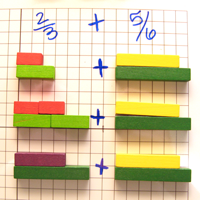
Let’s use the example above and add the numerators and the denominators to see what that means.
Adding means that our total is
Notice here you can’t “reduce” the fraction – because this isn’t the value as we know it.
If you teach adding fractions using manipulatives or toys and allow adding denominators, soon your children will see that your (on the top in the picture below) is very different than having their, on the bottom.
We have six total pieces.
This will inspire them to work toward equality – and invent fractional addition (correctly) on their own!
I love finding nifty ways to use tools for teaching math. Especially tools that aren’t supposed to teach math. Or at least the math I’m trying to get it to teach.
I have this very cool balance that I got from Discovery Toys that would normally be a science toy. But, alas, I’m a mathematician, Jim, not a doctor. So I’ve taken the fancy science toy and turned it into a way to teach subtraction.
You can, of course, use it to teach addition and later I’ll do a post on using it to teach multiplication and division.
If you have children who struggle with math concepts, teaching them with hands on bits (manipulatives) sometimes helps. Here’s how to teach subtraction using a balance:
This nifty trick can be done with any balance as long as you have weights appropriately sized. Sometimes that’s not so easy to find. Order a colorful balance that’s similar to the Discovery Toys one in video here.
Did it work? How did your children receive this method of learning arithmetic? Please share your experience with it in the comments!
When we teach math at home, we start with the counting numbers. Then we move to either the homeschool or classroom setting and build on those with negatives. And zero is sometimes left behind.
Zero seems to be an understood concept because it’s so much a part of our lives, as grownups. But zero is a very unusual bug.
Is Zero Positive?
We think of the numbers as either positive or negative.
But actually, all real numbers can be divided into three categories: positive, negative and zero.
This is one of the reasons zero can be forgotten in all this mix. With so many other numbers to be positive and negative, zero’s truly in a class by himself.
Notice I wrote “All real numbers can be divided into three categories.” Imaginary and complex numbers can’t be classified this way. You can order imaginary and complex numbers, but you have to do it without labeling them as positive or negative.
Why can’t we just say zero is positive?
I guess we could. But you might not want to when you see this…
In math, sometimes, we do things because if we didn’t, they’d mess everything else up.
This is one of those situations.
So let’s say 0 is positive, just for the minute.
Take the rule, “When multiplying, if the signs are different, the result is negative.” So then (positive) zero times negative 3 is (negative) zero. Like this:
0 x -3 = +0 x -3 = -0
But we determined that zero was positive!
So this messes things up. Therefore, zero needs to be in a class by himself.
But zero feels positive and negative, sometimes!
Indeed if a kid doesn’t owe his sister anything, that’s a positive feeling.
If you owe someone $3, then you can say you have negative 3 dollars. So if you owe them nothing, don’t you have a negative zero dollars?
This is more of a direction than a positive or negative sign. The “vector” (arrow in a direction) that has length zero can technically be pointing in any direction. It doesn’t matter. And that’s what’s going on when you think of zero as positive or negative. You think of owing (money going in a direction) nothing.
But remember, that’s only thinking of zero as positive or negative. He really isn’t either.
He’s just zero.
Check out the classic Schoolhouse Rock Multiplication Rock video and let me know what you think of all this zero talk.
When teaching math, whether in the home or in the classroom, having the multiplication facts memorized speeds things up. If you allow a calculator, you’re still reducing the speed of doing other math calculations or thinking.
But is there some way to memorize these and make them fun?
I scrounged the web and found some resources for multiplication tricks.
Poems as Multiplication Tricks
Inspired by @Leighbra at Hearth to Heart, I found a list of math poems that can help kiddos (and grownups) remember some of the facts. My favorite: I ate and ate and got sick on the floor. Eight times eight is 64.
This one shows a way to multiply 9s without using your fingers. Which means you don’t have to waste time putting down and picking back up your pencil! Tricks to Multiply by 9
Using Fingers
This article gives three tricks to multiply using your fingers. Not my favorite, only because I hate to put down my pencil. But if you are doing purely mental multiplication, this article’s a great resource! Three finger tricks for multiplying
Multiplication Tricks for Other Numbers
Here’s a couple more that give multiplication tricks for many numbers:
I created this while in class one day. I have a hard time remembering the difference between 7 x 8 and 9 x 6. So I thought about it and saw that 56 = 7 x 8, which is 5, 6, 7, 8 in order!
I learned my math facts by “singing” them while looking at flashcards.
Having these facts ingrained with chanting or singing isn’t a bad idea. It might not “feel right” because we’re so into experiential learning these days. But if a kid can’t immediately access and use things like 8 x 7 = 56, he’s going to be slower than if he can.
And if he’s slower, he might get frustrated and start to think that he’s not good at math.
Also, knowing these cheap and dirty math facts helps with confidence. Even if a kid’s struggling with other things in math, knowing that he has this one thing (the “facts”) will help out.
I fight this battle often. Some people feel that math facts shouldn’t be memorized. But there’s so much value in it.
How about you? Which side of the fence are you on?
Want to give your kiddos a jump start on multiplication and division? What to help the ones struggling with division to grasp it better?
The Discovery Toys Measure Up Cups can do just that. They are built as a curriculum tool, in the proper ratios, so that the #6 cup holds exactly twice as much as the #3 cup. This allows for engaging and beneficial play that gives kids a grasp on how numbers relate to reality.
For example, in this video, kids can compare the numbers 3, 6 and 9 to see how they relate:
You don’t have to say out loud, “three plus 6 is 9” or, “9 divided by 6 is one with three left over.” But these concepts are ingrained into the child’s brain as they see this work.