This past Monday we had a great #mathchat via Twitter. The topic was: “If you could clear one misconception about mathematics and/or teaching it, what would it be?”
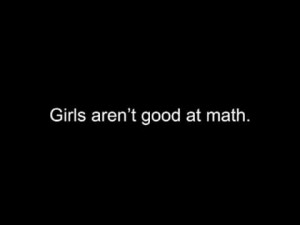
I was getting a bit frustrated that a couple of people kept bringing up the misconception that girls aren’t good at math. Even to the point of creating their own hashtag #girlsaregoodatmath2.
In my life, I’ve never heard anyone say this – in any other form than somebody complaining that people say it.
So here’s my response to everyone who keeps saying to me, “I wish people would stop saying, ‘Girls aren’t good at math.’”
What do you think? What will you say from here on out?
I was at my dad’s house the other day and decided to pull out my new Math’d Potatoes game to see how my super-gaming family liked it.
The kids in the house were too young to play, so my sister and I asked Aunt Linda and our stepmom to play with us.
They quickly claimed they were “math Neanderthals” but agreed to play anyway. My dad, an engineer, was asleep.
The game has simple rules.
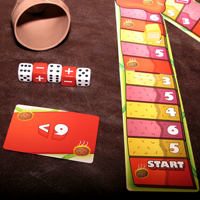
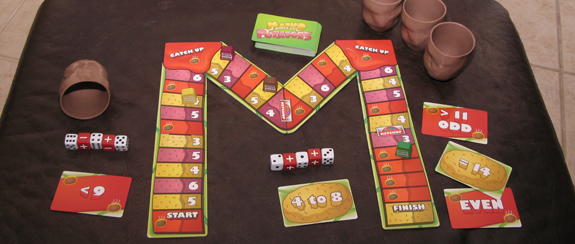
You play Math’d Potatoes by drawing a card, rolling five dice and making an expression that “satisfies” the card.
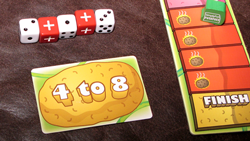
The card requests various types of “answers”:
Even or odd
Equal to a certain number
Between two numbers
Less than/greater than a certain number
Everybody got into it.
Aunt Linda and Louise (my pet name for my stepmom) both agreed that it was a fun math game. This is in spite of the fact that neither one of them like math, and Aunt Linda doesn’t even like to play games at all!
My dad saw the game the next morning.
I had intentionally not waken up my father to play with us the night before. My decision was validated the next morning.
My dad is an engineer, and as such tends to use the phrase “all you have to do is,” and the word “just.” He’s a very smart man, and I’ve learned lots from him through the years. And one of those lessons is: “Keep an engineer away from sensitive math learners.”
Sure enough, when he saw the game, he eagerly said, “What’s this? Are we going to play it?”
When I explained we played the night before he responded with, “Why didn’t you wake me? I totally would’ve won.”
Math learning is slowly build, and quickly destroyed.
When we were playing, Aunt Linda and Louise were both starting to warm to the idea of math. They were enjoying the game. My sister and I were holding back just a little to give them an opportunity to discovery their own skills. (We both experienced the engineer–math–dad super push growing up.)
So by the end of the game that night, they were excited, confident, and enjoying themselves.
Had I woken up my father to play the game, he certainly would have won. He might’ve turned it into a competition, or he might have tried to help a little too much.
Either way they would’ve lost interest. Their confidence would have been destroyed. And two beautiful, smart and happy women would have their, “I’m a math Neanderthal” thoughts validated.
You can use this with your children.
If you or your spouse are in a math related field, or was “always good at math,” be aware of your potential intimidation factor. Hold back. Don’t help. Allow discovery and confidence to come at its own slow and natural pace. Your children will learn math, in their own time.
Don’t force it, or you might destroy it.
Note: They sent me this game for free. This is not a review, per se, but still – you should know how I got it.
It’s part of our DNA to assess the world around us. As soon as a baby sees Mommy different from Daddy (or smells the difference), she starts comparing. When she figures out that there are more than one of something, things get even more interesting.
Give each of two toddlers a ball. Then stand back and watch. If they aren’t exactly the same ball, one of them will want to switch, and the other will say no. It won’t matter which ball is truly superior, only that one child will soon perceive inequity in ball ownership.
If they are given the same color and size ball, you can watch their little brains calculate this and work to discern some difference.
And it doesn’t stop at kids. Women do it all the time. Is my bottom as big as hers? Do we wear the same size shoes (and will she let me borrow hers if we do)? Is my dress more expensive than her dress?
Comparison in math corresponds to comparison in the world.
Some things are really exactly the same.
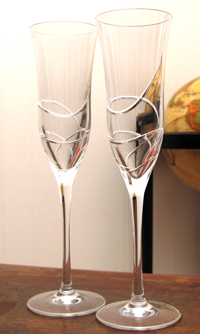
Your two crystal champagne flutes you bought for your wedding are likely the same. Not only is one interchangeable with the other, but you couldn’t tell the difference if you were to switch them.
This can get a little sticky for math. There is only one number 3.
But when I write 3 = 3, there are really 2 threes running around. (Math friends: I realize two champagne flutes are not the same as two number 3s. But making analogies in the real world is tough if you don’t take a little poetic license.)
Sometimes things have the same value.
Have you ever traded a dollar bill for 4 quarters? Those aren’t exactly the same (you would be able to tell the difference if you replace one with the other) but they have the same value.
If you return a blouse to a department store that your weird uncle Zeno gave you, and get a blouse that fits your style much better, these will have the same value. Monetarily speaking, of course.
If you ship your G7 back to Canon when it’s under warranty, and they return a G10, the value to them was equivalent (while the value to you has increased).
Some things have the same size and shape.
When you replace the transmission in your car, you’re doing so with an equivalent copy that’s better than what you already have. If you replace the engine in your 1969 Mustang with a souped-up model, you’re playing the same game.
In both these situations, the replacement version, although superior in functionality, is the same in size and shape.
Sometimes things are interchangeable.
Like in the example above, with the cars, as long as one thing works equally as well as the other, you can compare them and call them “equal.”
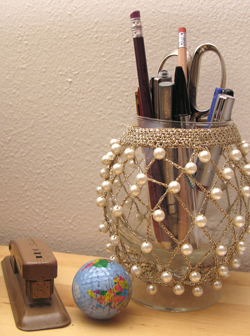
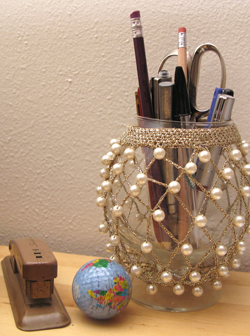
If you reach for a pen from the pen jar on your desk, any pen will work as well as any other.
The two pens may not be exactly the same, have the same value or even be the same size and shape. But you can interchange one for the other when writing a check.
And sometimes equality is merely perceived.
Like the toddlers with the balls from above. Different people will put different value judgments on items. So there is the case that equality is in the eye of the holder. Or wanter.
What does equality mean to you?
As we progress through this series, we’ll see how equality and the equals sign in mathematics relate to equality in the real world. And thinking about how equality in the real world works is the first step.
So what do you think of when you think about two things being equal? Share your thoughts in the comments.
My day job colleague told a beautiful story yesterday. He had been washing his car late at night, in the dark, and was approached for assistance. He is generous beyond belief, and apparently he made a real impact.
I was washing my car the other night and really getting after it. I had the scrubbing brush going and was really making progress on getting the car clean. I was totally focused and I felt a tap on my shoulder. It startled me and I turned around to be faced with a large African-American woman who said, “I’m sorry, I don’t mean to interrupt, but we’re having car problems. Is it possible you can help us? I think we need the battery jumped.”
I looked down the street and saw no other people and no car. Within a split second I remembered my latest purchase: a wireless battery charger that needs no people, no cables and no extra car to jump a battery. I got it out of my garage and handed it to her.
“I’m in the middle of washing my car. Why don’t you borrow this? It should help.”
She thanked me and walked away with the charger. I got back to washing my car.
Five minutes later there was another tap on my shoulder. Another African American woman was standing there holding a five dollar bill. She offered it to me.
“Oh my goodness, no,” I said. “I’m not taking your money. I’m just glad I could help.”
Another 5 minutes went by and I saw one of the ladies put the battery charger close to my garage. I was really getting into the car washing at this point – suds everywhere – so I didn’t pay much attention.
When I was returning my carwash supplies to the garage, I saw a crisp new $100 bill on top of the battery charger!
That thing was only $40 – and they just gave me $100 to borrow it!
This is a wonderful and touching story. These ladies were having difficulty finding someone to help them. Not only did my friend help, he also freely gave them something to use and trusted without question that they would return it.
They, too, were moved by his generosity.
The numbers don’t work.
It looks like this:
Battery charger cost: $40
“Rental fees” offered: $5
Shown gratitude: $100
The numbers don’t make sense. And in a way they shouldn’t. The $100 bill wasn’t really money. It was the biggest, fattest, loudest thank you note ever written. There’s no value you can place on someone being free and generous and trusting.
It still goes in as $100 in the eyes of the bank. But what do they know?
Notice the math and share the story.
When you share this story, point out the math. Especially if you tell this in front of (or to) children. Making the connection of generosity and emotion to math will help everyone see how integral math is in our lives.
How about you? Do you have a story of generosity that you’re just now realizing involves math? Share it in the comments!
I mailed out the bulk of the thank you notes for Daughter’s 2nd birthday party gifts. And wouldn’t you know it, it involved algebra!
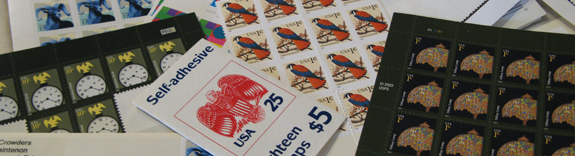
I have so many stamps from the last 20 years, in every denomination you can imagine. I’m trying to use them up because I only save full sheets of stamps. (I’m a bit of a stamp collecting snob.)
Rule #1: No more than the required postage on any letter.
It has to be exact.
As of this writing, postage in the US is $.44 per letter.
I have $.33 stamps, $.37 stamps, $.41 stamps, etc. And I’ve purchased $.01, $.02, $.03, and on up to supplement and make my postage exact.
Rule #2: No more than 2 stamps of the same kind on a letter.
I like variety.
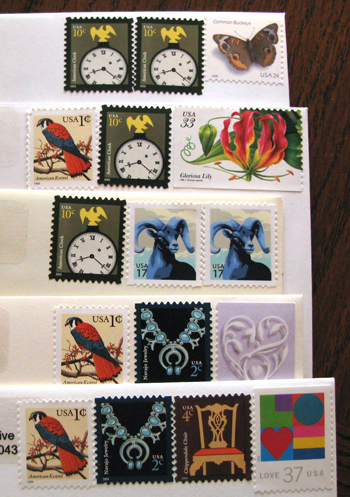
With these requirements, here are some of the combinations that I’ve come up with:
So how is this algebra?
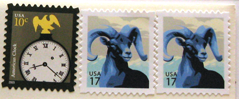
Here is an algebra equation from the stamps in the picture:
10x + 17y = 44
The equation means x number of 10 cent stamps plus y number of 17 cent stamps will give me the exact total of 44 cents! So x=1 and y=2.
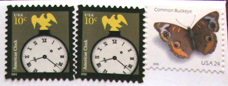
And here’s another:
10x + 24y = 44
The equation means x number of 10 cent stamps plus y number of 24 cent stamps will give me the exact total of 44 cents! So x=2 and y=1.
It would make it a better set of algebra problems if I allowed more than two types of stamps. But I’m sticking with my variety rule. 😀
How about it – will it make writing thank you notes with your kids more fun? More challenging? More annoying? Share your thoughts in the comments!
To mix things up a little, this month’s Math Teachers at Play Blog Carnival is a love story – between two people and then their new cute daughter. It’s a story of the coolest carnival of all – having kids.
The Story of Bernice and John, Mathematician Parents
by Bernice Abel
When John and I decided to have children, I knew we would be Making More Math Geeks. And I was okay with that. I was actually quite excited about it.
“How many kids do you want?” he asked before we were married. I thought about it a bit and said, “I probably want an odd number of kids.”
“What base is that in?” He asked me. I swooned. Could it be that he knew about Odd Numbers in Odd Bases? One thing was for sure, I knew he was Asking Good Questions. Especially when he asked me to marry him!
“You know,” he said, “We should have just the right number of girls and just the right number of boys. The Golden Ratio of our own, so to speak.”
There were so many things to be in love with in this man!
The day daughter was born was a life scalar multiple.
“I don’t know,” I said, “I just gave birth to a math geek, so I’m feeling like I should be eating 1/8, 1/4, or even 1/2 of something. I really don’t want our new daughter needing Fraction Help. And I know this hospital has pizza cut into 8 slices.”
He said, “You know, The (Mathematical) Trouble with Pizza is…” And then I glared at him. “Get me some pizza!” I screamed. The love of a math guy was wearing off.
“What took you so long?” I asked when he finally got back with my pizza. “You didn’t have to calculate any tip, and even My New Percent Lessons wouldn’t have helped you figure out the tax – the cash register does it all!”
I said, “My idea of math and fun is some Tesseracts and Factor Lattices. And I didn’t have either to keep me entertained while you were gone.”
I didn’t mention my desire for a iPad even though I had heard of the new fad of iPad Gaming in Math and Science. Money was tight and Clementine was already proving to be an expensive bundle of cuteness.
We had a fun little discussion via email at the day-job. Someone changed the code on the combination lock and the discussion around combinations, permutations, cryptography and all things sneaky-math cranked up.
It reminded me of this neat fact I learned about credit card security.
Not all digits on a credit card are created equally!
A credit card is made up of 16 numbers. But only the first 15 are “random,” according to NRich Math. The last number – the 16th number – is the “check digit.” It’s calculated using a fancy formula using the first 15 digits.
This check digit helps a computer system quickly determine if a credit card number is fake. Now, it can’t confirm that it’s real – it just can help determine if it is fake.
The digit is created using a method called Codabar.
First, let’s define some things.
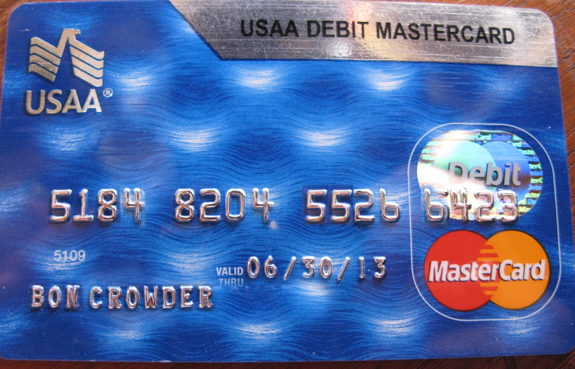
An odd digit is a digit in the credit card number that is in an odd position. For the photo of the card here, the number is: 5184 8204 5526 6423:
The odd digits are 5, 8, 8, 0, 5, 2, 6, 2
An even digit is a digit in the credit card number that is in an even position. For the photo of the card here, even digits are 1, 4, 2, 4, 5, 6, 4, 3
The check digit is the last digit – it gets calculated and isn’t considered in either odd or even position. It’s a super special digit.
The method is weird – and kinda fun!
Here’s what you do:
Add up all the odd digits, or the digits in the odd positions: 5 + 8 + 8 + 0 + 5 + 2 + 6 + 2 = 36
Double that number: 36 × 2 = 72. Save this number, 72, for later…
Add the even digits together, or the digits in the even positions: 1 + 4 + 2 + 4 + 5 + 6 + 4 + 3 = 29. Save this number, 29, for later…
(This is a freaky step.) Count the number of odd digits that are greater than 4. The odd digits are 5, 8, 8, 0, 5, 2, 6, 2. Of these, 5, 8, 8, 5 and 6 are bigger than 4. There are 5 of those total. Save this number, 5, for this next step…
Add up the results you saved from steps #2, #3 and #4. 72 + 29 + 5 = 106
Take the answer from step #5 and figure out how many you need to add to get it to the next multiple of 10 (or the next number that ends in zero). The number after 106 that ends in zero is 110. So we need to add 4. 106 + 4 = 110. 4 is the super important number.
That final super important number – well, that’s the check digit! That’s the last number that should be on the credit card – if it were a real card!
For the picture, the check digit should be a 4. And it’s a 3. So I can tell instantly that this is a fake credit card number.


![[50 Word Friday] Cars Driving in Circles](http://mathfour.com/wp-content/uploads/2026/02/image-18.png)