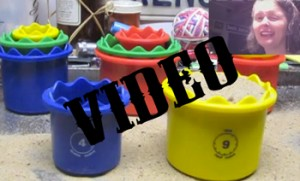
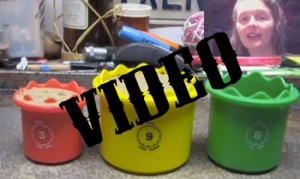
Other than being the most feared f-word in math teaching, a “function” is a question with only one answer.
Take the question: “How tall are you?”
We can change this to: “What’s the height of you?”
And if we wanted to compare your height to other people’s heights we can ask: “What’s the height of <insert person’s name here>?” This is the question template – the formula.
You can answer this question in inches, feet or cm, but the value of the answer remains unique, based on the person.
And that last little piece of the sentence is what makes the difference, based on the person.
The question changes with this little change. <cue music> This is the variable in the equation.
And we say, “Height is a function of the person.”
So where’s the fear come in?
As always, the notation is the kicker when it comes to teaching math.
Let’s change the question a little.
What’s the height of Enrique tomorrow if he grows three inches tonight?
Rather contrived, but work with me…
The question template is
What’s the height of <insert person’s name here> if he/she grows three inches tonight?
Which becomes
<height> = <height now> + 3
Or
H = N + 3
Egad!
And we haven’t even started with the f(x) stuff!
What’s this “domain” thing about?
I wrote the first sentence of this post a little too hastily. A function has only one answer if there’s a valid question.
If you ask, “How tall is love?” someone will laugh at you. Or think you’re from California.
Our question template included some specifics that you don’t normally get:
What’s the height of <insert person’s name here>?
If we instead ask, “What’s the height of x?” we would then have to ask: what kinds of things can we put in for x? Can we put concepts, like love? Or just objects? The kinds of things that you can put in for x is called the domain.
For our question, we would need to specify that x is a person.
What do you think? How does this feel when explaining it to your kids?
In the last post I discussed cardinal and ordinal numbers. I gave definitions but not much in the way of examples.
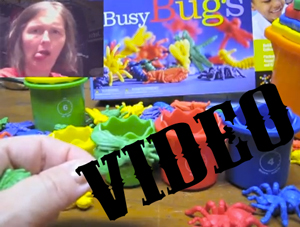
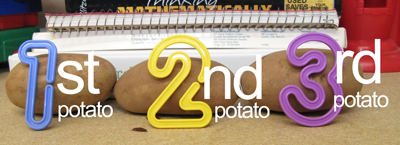
Here’s an example of using ordinal numbers to count up to arrive at the final cardinal number. Oh – and I’m using the fun little critters from Discovery Toys!
Whatcha think? Does it make you want to count some bugs?
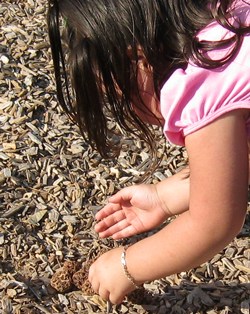
We were hanging at the playground on Mother’s day. Daughter had taken up with a cute little girl – a good playmate for the teeter-totter. I watched Daughter’s new friend do something interesting. She was “counting” some gumballs that had fallen off the sweetgum tree.
Here’s what she said: ONE TWO THREE FOUR FIVE SIX SEVEN EIGHT
I looked and there were ten gumballs. I watched her more and saw that while she was reciting the terms and pointing at the gumball pile, she wasn’t associating each number word with the next gumball in the pile.
Developmentally, I’m not sure if this is okay or not. I wonder.
Mathematically, I know that there’s still a disconnect with this girl and what numbers mean to her.
There are two types of numbers.
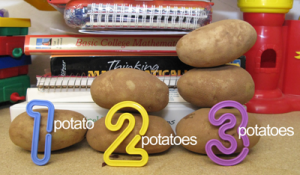
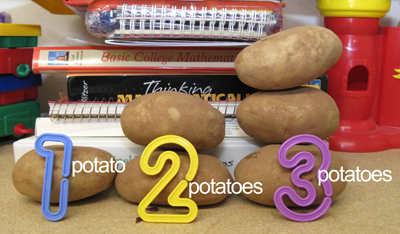
In the realm of counting numbers, there are two types. Cardinals and ordinals. A cardinal number tells us how many we have. Like this:
And ordinal number tells us the order:
When we count, we use both types of numbers.
The group of gumballs has the cardinal number of 10. But to arrive at that cardinal number, to determine how many there are, the friend had to “order” them. She was trying to point to each one and assign it a position. “YOU, I label 1st, you are 2nd … and since you are 10th, I know I have 10 gumballs.”
We grownups take advantage of this procedure. Indeed most people don’t know what cardinals and ordinals are.
But knowing this when you teach counting is quite helpful. At home you can do something similar to the potatoes in the pictures above. At school, you can buy some great posters (I found one at Teacher’s Heaven last night) that demonstrate this.
Will you change the way you think and talk about numbers?
Remember the ol’ “if A equals B and B equals C, then A equals C” deal? At parties it’s a great line to drop. In math, it’s officially called … cue music…
The Transitive Property
Saying it is fun, teaching it is curious, learning it can be weird.
Grownups think it’s intuitive. But to a kid, it isn’t. It takes experience and experimentation to learn all the bits that we think are “common sense.”
The transitive property is really thinking things through. Starting from one place and moving along through another and then arriving at a third place.
There are many ways to help kids with this learning. Word problems simulate thinking stepping stones. But they can be rather stressful. If you do it through play, you reduce the stress that they face and give them skills they need to tackle advanced thinking, forever.
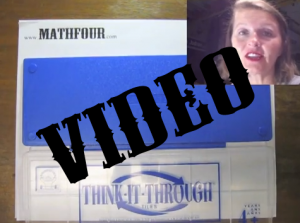
This video shows a nifty “toy” from Discovery Toys that can get kiddos using those brain stepping stones.
Notice the flow is
Choose the number tile with the question number.
Read and answer the question.
Correspond the answer to the letter in the answer box.
Put the number tile with the question number in the corresponding letter box.
Thinking through from question number to answer letter while avoiding the pitfalls is the challenge.
Have you played with these? How do you train your kids’ brains for the transitive property?
I’ve got a high school student doing a very basic geometry course. She’s having trouble with the concept of a counterexample. I’m writing a worksheet on counterexamples and would love to have some more simple conjectures for her to work with.
A counterexample is a special kind of example that disproves a statement. We start using these in Geometry because that’s the first course that really teaches proving things.
Counterexamples are an essential part of logic.
They don’t really need to be associated with math (or even philosophy) to be applicable. Which is the cool thing about them.
Suppose someone says, “I always get to school on time.” It only takes one day when he isn’t on time at school to negate this statement. That one day would be considered the counterexample.
We do this all the time and never use the fancy math term “counterexample.” So when we teach it, it’s helpful to tap into these everyday uses.
Counterexamples are everywhere.
Here are some statements for which students can come up with easy counterexamples.
In the house:
Any four legged piece of furniture is a table.
If something has a knob on it, it’s a faucet.
Everything in the house with hands is a clock.
If a living being has eyes, it’s a human.
In the grocery store:
Everything that costs $2.99 is a gallon of milk.
Everything that’s hot is fried chicken.
If something is white, then it is mayonaise.
In the classroom:
If it’s a book, it has words. (Make sure there are blank journal books around.)
All books teach arithmetic.
Anything on the wall is a whiteboard.
If it’s full of pencils, then it’s a coffee mug.
You can make your own statements for counterexamples.
Choose a noun. Notice a feature about it. Then put it together using this MadLibs format:
Everything that has <feature> is a <noun>.
All <plural noun> have <feature>.
If it <has this feature>, then it’s a <noun>.
You can also reverse them like this:
Every <noun> has <feature>.
For instance:
Every cow is brown.
Every lightbulb is 60 watt.
Every hammer has a wooden handle.
Which counterexamples or counterexample building method do you use?
I learned my math facts by “singing” them while looking at flashcards.
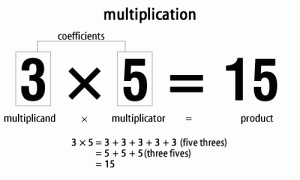
Having these facts ingrained with chanting or singing isn’t a bad idea. It might not “feel right” because we’re so into experiential learning these days. But if a kid can’t immediately access and use things like 8 x 7 = 56, he’s going to be slower than if he can.
And if he’s slower, he might get frustrated and start to think that he’s not good at math.
Also, knowing these cheap and dirty math facts helps with confidence. Even if a kid’s struggling with other things in math, knowing that he has this one thing (the “facts”) will help out.
I fight this battle often. Some people feel that math facts shouldn’t be memorized. But there’s so much value in it.
How about you? Which side of the fence are you on?
Have you seen the kid that isn’t getting the attention he needs at home? Wonder what’s going to become of him?
Well, the “it takes a village” concept isn’t far off. You might not be able to change his world, but sharing a little about math might help with one corner of it.
Share math in small bites.
Every time you see the child, pose a fun puzzle. It doesn’t have to be blatantly mathematical. Anything to get his logic working helps. I love the Childcraft Mathemagic book for puzzle ideas.
Ask her random math facts. Tell her you’ll give her something for each one she gets right – or each 10 she gets right in a row. Find out what’s important to her that you can’t get in trouble sharing. Like money, chocolate, baubles, etc.
Tell him that when you were growing up you wanted to be a mathematician. Ask him to find his favorite mathematician online. Find one yourself that you can discuss – I’m partial to Abel and Galois.
Be positive about math.
There might be many things wrong in a child’s life. Let math be the one that isn’t. Be positive. Help make math the thing a kid can hold on to.
Be the village because it takes a village. Share your stories in the comments!
This post is an answer to a question Michelle, a high school math teacher, sent. She writes:
I explain a new concept then give an example and finally do an example with the class directing me on how to solve. What I have noticed is that the bulk of the questions occur during or after the chapter assessment. Most of the students’ questions are great questions. It’s just that the questions they are asking are ones they should have asked much earlier.
Think of knowledge as a bag of shapes – all of which have different colors and textures. Once you get the bag, you have to sort through them. Some people want to count them, some people want to sort them by color, some by shape. Some people need to sort by texture. Some people need to sort by all three or just lay all of them out in rows to get a good look at them.
Everyone sorts the bag of shapes differently. Likewise, everyone sorts information differently.
Turns out, the bag of shapes isn’t the knowledge. It’s merely the information. And it takes each person “sorting” it in their own way to turn the information into knowledge.
In teaching and learning math, I’ve noticed a cycle. I’ll use the bag of shapes to illustrate it:
1. Exposure
Exposure is usually in the form of lecture and examples done by the instructor. It can be the first time the student has seen it or the first time in a long while.
This is where the student receives the closed bag of shapes.
2. Activity
Any activity following the exposure. This typically is in the form of homework or classwork practicing the concept and problems.
This is the “peeking into” the bag of shapes. The student gets to remove a few of them and start looking at them.
3. Settling
Allowing the subconscious to work. The brain does this all on its own.
Often mathematicians will go for long walks, go to the movies, hang out with their kids, talk to non-math people or do any number of non-math things to force the settling phase.
Children don’t know how to force the settling phase, nor do they need to. It just happens between when they do the homework and when they start to study for the exam.
In the bag-o-shapes analogy, this is where the students dumps all the shapes onto the floor and sorts them in various ways. It takes a while to get through all the shapes and see what kinds of sorting can be done.
4. Re-engagement
This is typically in the form of studying for the test and taking the test. It can be a heightened emotional situation where the learner is under stress.
This is a revisit of the concepts. It becomes easier because the settling has occurred and the information (the bag of shapes) is already organized.
The learner at this point will attempt to modify some of the conscious thinking to best fit with what the subconscious has done. The added stress will allow them to connect with what they’ve done better – as the “feeling” state induces a different type of learning.
5. Application
This is using the concepts for something else. This will often be the next class or next term of the math curriculum. If you learned graphing functions, you will likely use graphing functions in the future.
To wrap up the analogy, this might be a student realizing that the bag of shapes is needed for something – not just a random bag of shapes. Therefore he can re-organize them to be of use in the new situation.
Let the learning flow.
This flow of learning is natural. It will happen and has to happen. The only thing you can do to artificially speed it up is cycle it more often.
The students ask the good questions, as Michelle said, “during or after the chapter assessment.” This is in phase 4 – Re-engagement.
Instead of going through a single cycle, do it two or three times. Like this:
Monday: Lecture, chapter 1 (exposure)
Monday: Classwork and homework, chapter 1 (activity)
Friday: Test, chapter 1 (re-engagement)
Monday: Lecture, chapter 2 (initial exposure to chapter 2 and application of chapter 1)
Monday: Classwork and homework, chapter 2 (activity)
Monday: Lecture, chapter 3 (initial exposure to chapter 3 and application of chapters 1 and 2)
Monday: Classwork and homework, chapter 3 (activity)
Wednesday: Test, chapters 1 and 2 (re-engagement again)
Friday: Test, chapter 3 (re-engagement)
Monday: Lecture, chapter 4 (initial exposure to chapter 3 and application of chapters 1, 2 and 3)
Monday: Classwork and homework, chapter 2 (activity)
Wednesday: Test, chapters 1, 2 and 3 (re-engagement again)
Friday: Test, chapter 4 (re-engagement)
What do you think? Share your experiences with the cycle below in the comments.
Thanks to Michelle for requesting this tip. Michelle is one of only two math teachers in a rural private school. She teaches Algebra I, II, Geometry and Calculus.
Do you have a question? Ask it in the comments section.
Want to give your kiddos a jump start on multiplication and division? What to help the ones struggling with division to grasp it better?
The Discovery Toys Measure Up Cups can do just that. They are built as a curriculum tool, in the proper ratios, so that the #6 cup holds exactly twice as much as the #3 cup. This allows for engaging and beneficial play that gives kids a grasp on how numbers relate to reality.
For example, in this video, kids can compare the numbers 3, 6 and 9 to see how they relate:
You don’t have to say out loud, “three plus 6 is 9” or, “9 divided by 6 is one with three left over.” But these concepts are ingrained into the child’s brain as they see this work.