
Category: General

  • Inquiry-based Math Instruction

    Inquiry-based Math Instruction

    Inquiry-based math instruction is the opposite of performance-based math instruction. And the research shows that inquiry-based math instruction is more effective than performance-based.

    But performance is required if you’re teaching anywhere other than a homeschool. So what do you do?

    You have to balance the requirement of performance with the need for discovery and inquiry-based learning. Which means you have to integrate discovery and inquiry-based elements into your math teaching.

    You can do this formally or informally. You can say it out loud, or just do it. And which method you choose will depend on how much you are supported.

    Set aside time for inquiry-based instruction.

    Bring inquiry-based math instruction into your lessons by breaking up class time into “performance-for-tests learning time” and “discovery/inquiry-based learning time.”

    You can have specific topics for the discovery learning time or even a “free math time” where there is no specific topic.

    Make sure you keep the discovery topics independent from test based/performance-based topics. As much as you’re tempted, don’t connect the two. If the students connect them, acknowledge it briefly and keep moving.

    Keeping them separate keeps the “must get the right answer” attitude out of the discovery time. This is very important.

    For example, if you’re teaching multiplication this week in class, set aside the discovery time as patterns or geometry. This can be 5-10 minutes at the beginning of each class period or one day of the week devoted to it.

    Create a safe discovery/inquiry zone.

    If you want to include discovery in the regular curriculum, you have a little bit more of a challenge. Children learn early that performance is required in math classes. So they avoid being creative and asking questions. (See the research paper on that here.)

    Which means you have to undo years of creativity-destruction to get them to participate in inquiry based activities. Depending on the students’ ages, you might have to start with introducing really goofy stuff to break them out of their comfort zone.

    Let them wear fuzzy red hats and crazy glasses and tell tall math tales for the first few times. They’ll get warmed up to dig into some creative math inquiry. Anything’s easy when you’re wearing fuzzy red hats!

    After a while they’ll be used to the safe environment and the inquiry-based math learning will start to flow from them.

    Do both.

    Ideally, you can have a “fun” time – where the math you have to do is set aside and you let the students dream about crazy math stuff. In addition, all your lessons involve the safe zone.

    If you can make it work – do it. You’ll grow confident, adventurous, smart kids – the research supports it!

    Will you try? Tell us in the comments.

    * Inquiry based math instruction is really the wrong term. Instruction means giving of something – in this case knowledge. It really should be inquiry based math learning. Teachers and parents are inquiry-based facilitators.

    Feature image by philcampbell | Flickr.com | CC BY

    Related articles
  • Break the Rules and Get Fired!

    Break the Rules and Get Fired!

    I was reading a research paper about math teacher shortages by D.R. Sterling. Turns out that less than 12% of math teachers leave the profession through retirement.

    So 88% of the time math teachers quit, get fired or die!

    So why not be a math teacher?

    Are you good at teaching math?

    Have you avoided the profession because it doesn’t pay anything near what you make now?

    Could you use a 9 month vacation to do something totally different, worthwhile and exciting?

    Can you afford a 70% cut in pay for 9 months to really make a difference?

    If you want to change things in math education, you can!

    You can give 9 months to make a difference in the lives of 100 kids!

    Is that do-able?

    In Texas, and I’m guessing lots of other places, there is an emergency teaching certification some schools are allowed to offer when they can’t find any certified teachers. You go through an interview process and if the school decides you’re qualified – then you get to teach.

    It expires after three years, but hey – you’ll probably be gone by then anyway!

    Find one of these schools – it shouldn’t be hard. Go to work making a difference for a lot of kids – and making a difference in the system!

    Why would you do this?

    I just finished Seth Godin’s book Tribes. The premise is that a tribe (a group of people with common thinking) needs a leader – and you are that leader. So get up off your tooshie and lead, already! (That’s not a quote – it’s just what I got from the book. But it should be a quote.)

    If you can afford it, and you’re passionate about helping kids learn math, then you have an obligation to help. Teachers in the system won’t risk getting fired to make change. You can!

    But really, WHY would you do this?

    Tons of people – teachers and parents – know beautiful and encouraging ways to teach math.

    But there’s a group of people who have put together these nutty rules of what performance in math should look like each step of the way (the Common Core Standards and NCLB). Those rules prevent teachers from doing what they do best – teaching. Instead they fear for their jobs and teach the tests. All the while struggling to fit in a little learning here and there.

    If you jumped in there, with no intent on following the rules, think of what would happen:

    • You’d teach. Not some crazy set of rules, but you’d teach math the way only you know how. And that’s probably a beautiful, experiential, exciting way.
    • You’d change the lives of the kids. They would see what real math might look like. They would see someone not paralyzed by fear of having your students fail the latest standardized test.
    • You’d inspire the teachers. Sure, some of them would call you a heretic. And so what – you would be! The ones who really want kids to learn math would follow your lead.
    • You’d be giving of yourself in the most valuable way there is. Talk about donation – you’re likely to need an extra $40K to make your bills. Is it tax deductible? If you consider that it puts you in a seriously lower tax bracket – yes!
    • You’d get fired. Yup – and isn’t that the point? Then you could go back to your high paying job, hire an attorney to sue the state and make big news. Show the public what it means to teach math!

    Are you in?

    I’ve put in notice at my day-job. I’m fixing to hit the pavement as full time Math Education Advocate at MathFour.com. Last year I made $16 in Amazon.com affiliate sales from this website, so I’m not falling back on any income here. I’ve also picked up teaching two community college developmental math classes. Which means I’m going to be gaining 32 hours a week to work on math ed advocacy – and taking a 90% pay cut.

    I’m scared out of my mind.

    But Daughter is 2 years old. I can’t afford to not go at this full time.

    Will you join me?

    Feature and post images by ewen and donabel | Flickr.com | CC BY

    Related articles
  • Math Anxiety Research

    Math Anxiety Research

    My business partner, William Devine, a licensed professional counselor, has been doing lots of research these past few weeks. He’s been reading up on math anxiety and the effects of adults’ attitudes and behavior on children’s math performance.

    He started looking into this because I was basing the That’s Math product we’re developing on my experiences with student math performance – both high and low.

    Of course I’ve been watching student math performance some 20 years. But he still wasn’t about to spend hundreds of hours building a product based on my soap-box rantings.

    Indeed, what I was offering was merely…

    Proof by Blatant Assertion.

    I’ve been using the standard proof by blatant assertion method on MathFour.com for a year. So it seemed that building That’s Math on the same premise would work.

    Everyone knows that the things grownups say in front of kids about math has a huge impact.

    When I brought Wil in as a partner, the first thing he said was, “You can’t just say it’s true.”

    “Well, it is true,” I said.

    “You may be right, but saying it really loud doesn’t make it true. And pushing it on people doesn’t make them believe it.”

    Proof by Research.

    So here we go. Off into research world – finding out what causes math anxiety. Or at least what pieces we can help change to relieve math anxiety.

    Thankfully Wil’s great at it. And I’ve managed to convince him to share a little with y’all – even before we launch That’s Math.

    I’m officially introducing William “Wil-with-one-L” Devine, MA, LPC, CART, as a writer on MathFour.com.

    We’ll be sharing what he finds, each week. And of course I’ll give my two cents when I’m inclined.

    What do you want to know?

    If you’re interested in knowing more, let us know in the comments. And what do you think is true about math anxiety and its effect on math performance? What about the effect of adults on the math performance of children?

    Feature image by xb3 | Flickr.com | CC BY

    Related articles
  • ‘I Hate Math’ – It’s Okay to Say It!

    ‘I Hate Math’ – It’s Okay to Say It!

    Gary commented on an article I wrote called, How to Get People to Stop Saying “I Hate Math”.

    He spent tons of energy defending his position, explaining how “math people” really anger him and his fellow “math haters.”

    My initial reaction was to type out a response demonstrating where he does math, how he does it, and even the parts in his comments where he admitted he does math everyday.

    But I stopped. It seemed… wrong somehow. So I’ve been thinking about his comments for a couple of weeks now – wondering how I should respond.

    I learned something new about learning math.

    Gary has taught me something about learning and teaching math: when we push, others push back.

    For so long I’ve told people to stop saying, “I hate math.” I’ve tried to convince them they can’t hate math because they do math everyday. Clearly (I see now) this helps people say it more.

    When told they don’t really hate math – they find reasons that they do. They work very hard at digging up all the experiences that support it. They can’t remember the experiences that might have been good. Everything they’ve got is poured into defending their stance.

    When we invalidate feelings, they push more.

    Every time I tell someone they don’t hate math, I’m invalidating their feelings! How is this fair?

    It isn’t. It’s yukky and hurtful.

    If you hate math, good for you! That’s the way you feel.

    I hate magic – something that lots of people think is stupid. But that’s the way I feel. And I don’t want those turds invalidating those feelings.

    People have the right to feel the way they feel. And if they hate math, that’s okay.

    People do math everyday.

    The fact is that people do math. Everybody. Everyday. Even Gary.

    Gary writes in his comments: “this isn’t to say that I can’t perform basic math or even a few not-so-basic mathematical/arithmetic disciplines.” He does math everyday, but I’ve given him reason to dig out all the horrid things about it.

    My business coach, Sarah Shah, has a really cool way of handling things like this. She gets people to open up. But not by telling them what they should think or feel. Instead she yields and acknowledges the other person. She validates their feelings.

    Up until now I’ve been doing just the opposite. And I feel terrible about it.

    I apologize to you.

    So Gary, and everyone else in Gary’s shoes, please accept my apology. You hate math. And I’m not going to push you on that anymore.

    And from here out, when someone says “I hate math,” I’m going to open up. I’m going to say, “You hate math,” and I’ll wait for them to offer more.

    I’m not going to give the “mom look” ever again.

    Back to you…

    What happens when someone says, “I hate math” in front of you? What happens when you say it to others? Will you do anything differently now? Share your thoughts in the comments.

    And a huge thanks to Gary for his honesty!

    Feature image by Alesist | Flickr.com | CC BY SA

    Related articles

  • 2012 MathFour Manifesto

    2012 MathFour Manifesto

    I gave up New Year’s resolutions years ago. I never kept them, so I figured they were pointless.

    Instead I took up creating a yearly manifesto – a short declaration of my current life stance. This year I’m going to do a professional manifesto as well. This is it.

    The MathFour.com Mission

    The mission of MathFour.com is to enhance the effectiveness of student math programs by helping every adult have a more positive influence on children with respect to math.

    In less fancy terms – I want all the programs like Mathnasium, TenMarks, Stinky Kid Math, Sokikom and ABC Mouse to be successful. Negative math-talk from parents can diminish the effects these wonderful programs can have. MathFour.com’s goal is to help parents turn off negative math-talk and turn on helpful and effective math influences.

    I will follow the research.

    I have partnered with a licensed professional counselor. He is currently reading through the social science and psychological research and discovering the value of positive adult influences on children’s success in math. He is presenting a paper on the subject at the Western Social Science Association Conference this year.

    The programs in development at MathFour.com will be based on this research.

    I will broaden the reach.

    The Facebook fan page isn’t working for the mission anymore. I will turn it into something useful. @MathFour on twitter is strong, so I will continue to interact there and be helpful.

    I’ll also up the quantity and quality of articles posted here on MathFour.com– making them helpful for parents and teachers and maximizing SEO so they can be found easily.

    I will increase the scope.

    The target of the mission is parents. And parents who access MathFour.com must be able to read English and have access to a computer.

    These two assumptions could eliminate much of the world’s population from this content.

    I’m in the process of forming a non-profit organization so MathFour.com can reach those parents. I have a grant writer on standby ready to get the ball rolling as soon as it’s formed.

    I will work more efficiently.

    In 2011 I diluted the efforts with various projects. This year holds only one project. And it speaks directly to the mission.

    That’s Math! is launching March 1, with a soft launch for MathFourTicians on January 23. Over the course of the year my partner and I will be creating new content, managing the social learning aspect of the project and promoting it like crazy.

    MathFour.com will continue as a foundation of robust and helpful content, free from outside advertisements.

    I will find “competitors.”

    There are hundreds, maybe even thousands, of student math programs in existence: on the web, software-based, speakers, books, workbooks, kits, summer camps, tutoring companies…

    There are also many websites, books and programs to help adults with math.

    MathFour.com is not one of these. MathFour.com is for parents. Not adult students. It’s for parents who are uncomfortable with math. It’s also for parents who are comfortable with math – because even engineers who are parents sometimes use negative math-talk!

    The goal is not to turn grown-ups into lovers of math. It’s to increase the effectiveness of parents who are trying to positively influence their children in math.

    The research indicates that student math programs could be much more effective if students’ adult influences in math were positive.

    Parents need to know that. And I can’t get the word out alone. The world is large and this is a global problem. I need to find websites and organizations with a similar mission.

    I will help.

    I will solicit questions from parents and teachers so I can be sure MathFour.com is the resource they need. It’s not helpful if I’m not helping.

    So here’s my first solicitation: As a parent, what would you like to see MathFour.com do for you this year? If you are a mathematician and/or math teacher, how can I help you and the parents of your students?

    Please let me know in the comments.

    Feature image by storebukkebruse | Flickr.com | CC BY

    Related articles
  • Why I Believe in Santa Claus

    Why I Believe in Santa Claus

    This post originally appeared on The HSBA Post on December 25, 2011.

    I’m not sure how I discovered that my parents acted as Santa Claus. But I distinctly remember the sinking feeling. I also remember quickly making the connection for the Easter Bunny and the Tooth Fairy. Within five minutes all mysticism in my life had vanished.

    Ten years later, it all came back.

    It was the middle of the 80s. My parents were recently divorced. My dad was in oil and gas and had been laid off. We had no money. Mom said we were broke — not poor. But it sure felt like we were poor.

    We had Christmas lights and ornaments from all the past years. We lived in the country so we got a tree from the “backyard.” It required a couple of long needle East Texas pines wired together, but it worked.

    And we were told not to expect to find much underneath it on Christmas Day.

    Strange Phone Calls

    I remember overhearing a conversation my mom was having on the phone in mid-December.

    “We have water and electricity and food. It’s not much, but we’ll be okay. <pause> Really? But I’m sure there are many other families in more need than we are. <pause> I see. Well if that’s the case, yes. We would appreciate it very much. Thank you.”

    My best friend called with an interesting question. “We’ve exchanged names for family Christmas, and I’ve drawn the name of a cousin that’s about your little brother’s age. I don’t have any idea what to get for him. Can you ask him what he likes, and maybe that will help me?”

    Looking back, there were many other strange and unusual phone calls the two weeks leading up to Christmas.

    A Christmas Eve Like No Other

    On Christmas Eve we had a constant flow of visitors. A local car dealership showed up offering a bag filled with wrapped presents. Some people from my best friend’s church came by with three bags of gifts. Another church sent a handful of representatives with a huge basket of turkey and dressing and all the fixings. Friends and churches from all over the neighborhood, and even people we’d never met, were showing up to share with us.

    2011 Christmas Tree
    Stlll in the same house, this is what the 2011 Christmas tree looks like. (We can afford to buy one now, but we still like a non-standard shape.)

    It was so amazing to see such love and caring — and for it to come our way. I was too young to really understand the generosity, but I knew it was special. Very special.

    We went to midnight mass, as we always did, and mom was crying just a little more than normal.

    A Magical Christmas Morning

    Christmas day was insane. Santa Claus had really come.

    I remember opening presents and seeing mom’s face. In years past her look was of excitement to see if we liked what she had given. This year, she had a different look. She was truly curious. And she was excited and amazed that her young children wouldn’t have to know the heartache of an empty Christmas morning.

    I’m quite sure it didn’t occur to her, though, that the gifts the community had shared included one more: believing that people really can love one-another. The very heart of Christianity.

    The Gifts of God

    Jesus gave us a gift with His death. We get to live in Him forever. But with His birth, He also gave us a special gift, one that we get right now. He gave us generosity and love to share with each other. And at Christmas, that comes out in the shape of a fat, old, hairy, jolly character we call Santa Claus. A man who’s famous for his generosity.

    I hope that no one ever has to be poor or even broke. While it wasn’t easy going through that part of my childhood, I am thankful for the lessons we learned. I am grateful that I was able to see first hand the generosity and love of my fellow man that Christmas.

    Merry Christmas… and may we all be filled with the Christmas spirit!

  • 6 Ways Learning Math Is Like Being in a Casino

    6 Ways Learning Math Is Like Being in a Casino

    The view from my window at the Aria.

    I’m in Las Vegas for the DevLearn conference this week. Since I’m always thinking math teaching and now I’m seeing casinos, I’m noticing some comparisons between the two. Here they are:

    1. You don’t know if you’ll be successful when you sit down at the table.

    We think math is something kids can just learn if they sit down and focus. But learning math is as squirrely and unpredictable as the gambling table.

    2. Sometimes it’s exciting and sometimes it’s stressful.

    When a kid’s totally getting it, it’s very exciting. And when they’re not, they’re pretty stressed.

    3. Everyone has a preference.

    Just like some people prefer slots over blackjack, kids will tend toward liking one type of math over the other. Even grown-ups do this – I can’t stand calculus.

    4. It’s not about who you think it’s about.

    When you’re in a casino, you think it’s about you. But it’s not. It’s all about the house.

    When a kid’s doing math, it should be all about them. But it’s not.

    Often it’s about the bureaucracy, politics and laws surrounding education. Luckily in Texas, where I live, homeschoolers don’t have to satisfy any official requirements. But often parents will impose guidelines similar to the state.

    Once a child is asked to follow the book, or keep to a schedule that isn’t their own, it’s no longer about them. It’s now all about the house.

    5. There are plenty of distractions to get your mind off the real goal.

    In the casino it’s noise, lights and fast images that keep you from making sensible decisions with your money.

    At the study desk, it’s the clock ticking away as a child isn’t learning fast enough. It’s the textbook with so many pictures and words designed to appeal to every learning style – instead of just that child’s learning style. It’s the pressure of, “If I don’t get this, I’m totally going to be in trouble.”

    So many ways to keep a kid from just relaxing and learning.

    6. If you play according to the house rules, the house always wins.

    Casinos aren’t able to afford the opulence by chance. They make a ton of money because the statistics are in their favor.

    The rules of learning math are set by the house these days. Very few people allow children to discover, experience and enjoy math without quickly stacking the deck against them with things like the Common Core Standards.

    Play the house rules, and the house wins. Play the Common Core Standards rules, and the government wins.

    And then we’re back at #4, above.

    Your thoughts?

    Related articles
  • 3 Words to Improve Your Child’s Success in Math

    3 Words to Improve Your Child’s Success in Math

    Yup – only three. Said by you, the parent and grownup. Say them loud, say them often. And contact me when you wonder where math is in your world – or leave a comment here!

    Related articles
  • We Use Math and Grammar Rules – They Don’t Use Us!

    We Use Math and Grammar Rules – They Don’t Use Us!

    I got engaged in a twitter fight about grammar with Chiew from @aClilToClimb (now @Chiew_Pang). Yes, I’m the math mom, but my college minor is English. And I tend to be a sharpie carrying, sign correcting, grammar vigilante.

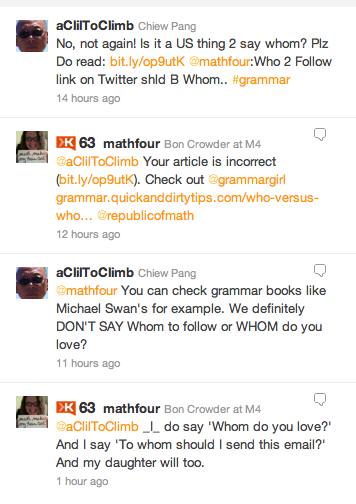
    I complained that Twitter has the link “Who To Follow” when it should be “Whom To Follow.” Here’s an excerpt from the fight:

    The fight raged on.

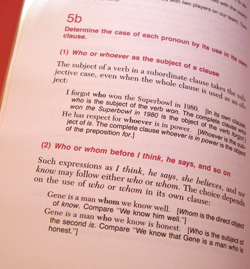
    This guy was so adamant that you could use “who” as the object in a sentence (clearly wrong), and just wouldn’t let it go. After quite a few tweets I got curious. “What’s this guy’s deal? All he has to do is pull out the Little Brown Handbook and read it in plain black and white.”

    So I went and looked at his site. Holy cow! He’s a grammar blogger!

    I couldn’t find his “About” page, but from what I could gather in his fervor in our twitter fight, he’s trying to do for grammar what I’m trying to do for math. Demystify, take away the “have to” rules, and make it accessible, acceptable and appreciated by everyone.

    We make the rules!

    The rules of grammar, like the rules of math, are created by humans and used by humans. They are changeable.

    Of course the difference is that, in grammar, if you deviate slightly from the rules that others follow, you’ll most likely be understood. In math, you really have to define how you’re using things before you begin to work.

    For instance, if I wanted to have a conversation with someone about a new way of adding fractions I was inventing, I could totally do it. As long as I started the conversation with, “Here’s how we are going to talk about adding fractions for the next hour…”

    Make it your own!

    Teaching math and teaching grammar are two of the fundamental things we do for our children. And neither should be hard, creepy or frustrating. They should be a normal, natural flow of who we are as people.

    Another great math mom says, “Make math your own, to make your own math.” I’d bet Chiew would say something similar for grammar.

    And for this, I respect him. </fight>

    Related articles
  • Math Teacher Interview Questions

    Math Teacher Interview Questions

    At 8:30 PM CST tonight, October 20, 2011, Natural Math is hosting a presentation about a new book called Modern Math for Elementary Schoolers by Oleg Gleizer. It’s a Creative Commons book on advanced math for elementary school children! (So it’s free! Get it here.)

    Gleizer’s inspiration is from a similar situation in which I currently find myself: To what school should I send my child? Of course my answer is The Bon Crowder School at Home. Alas, Husband believes there’s no reason to fully homeschool if there great schools out there.

    So are there great schools out there?

    I started reading the book and stopped on page 4. Gleizer is explaining his method of finding math teachers. He asked math teachers of potential schools these two questions in the interviews:

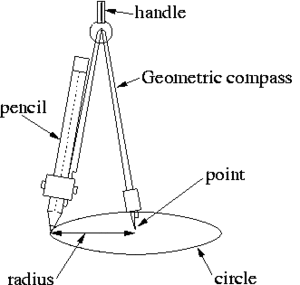
    1. Given a straight line and a point away from it, how would you draw another straight line passing through the point and parallel to the original line, using a compass and straightedge as tools?
    2. How would you draw a four-dimensional (4D) cube?

    Of course, I immediately began to wonder if I was good enough to answer these questions myself!

    I got the answer to #1 after some thought, and am pondering #2. I’m refraining from reading on, as I want to come up with my own answer before I read anything else. But I’ll be attending the presentation this evening.

    What about you? Can you join us?

    P.S. I’ll  have to wait to post the answer to #1 tomorrow, as I have discovered that I don’t have a compass. How on earth can you teach math without that?! How embarrassing! So I’m off to Walmart right now to get one.

    Related articles