For a while, a long while, I let this math blog just sit. I didn’t want to delete it. I spent too much time on it and I knew it was full of great stuff that was still being used. But I wasn’t in love with writing on it.
In my lethargy, the hackers and jerks managed to infiltrate and completely take it down. That was on October 23, 2025.
Today is December 30, 2025. I rescued all the posts and will gradually get all the good ones reposted. But I have to start over, creating the whole website from scratch.
Luckily the wayback machine (internet archive) has a nice snapshot of the images and layout. It’ll take me a while, but I’ll get it all back up. Maybe even with some improvements!
If you are looking for a specific post – something you remember from long ago or something you want to know about – leave it in the comments. I’ll hunt it down and get it posted.
I’m looking forward to having all those great math stories, thoughts and tips live again – I hope you are too.
I’m in Las Vegas for the DevLearn conference this week. Since I’m always thinking math teaching and now I’m seeing casinos, I’m noticing some comparisons between the two. Here they are:
1. You don’t know if you’ll be successful when you sit down at the table.
We think math is something kids can just learn if they sit down and focus. But learning math is as squirrely and unpredictable as the gambling table.
2. Sometimes it’s exciting and sometimes it’s stressful.
When a kid’s totally getting it, it’s very exciting. And when they’re not, they’re pretty stressed.
3. Everyone has a preference.
Just like some people prefer slots over blackjack, kids will tend toward liking one type of math over the other. Even grown-ups do this – I can’t stand calculus.
4. It’s not about who you think it’s about.
When you’re in a casino, you think it’s about you. But it’s not. It’s all about the house.
When a kid’s doing math, it should be all about them. But it’s not.
Often it’s about the bureaucracy, politics and laws surrounding education. Luckily in Texas, where I live, homeschoolers don’t have to satisfy any official requirements. But often parents will impose guidelines similar to the state.
Once a child is asked to follow the book, or keep to a schedule that isn’t their own, it’s no longer about them. It’s now all about the house.
5. There are plenty of distractions to get your mind off the real goal.
In the casino it’s noise, lights and fast images that keep you from making sensible decisions with your money.
At the study desk, it’s the clock ticking away as a child isn’t learning fast enough. It’s the textbook with so many pictures and words designed to appeal to every learning style – instead of just that child’s learning style. It’s the pressure of, “If I don’t get this, I’m totally going to be in trouble.”
So many ways to keep a kid from just relaxing and learning.
6. If you play according to the house rules, the house always wins.
Casinos aren’t able to afford the opulence by chance. They make a ton of money because the statistics are in their favor.
The rules of learning math are set by the house these days. Very few people allow children to discover, experience and enjoy math without quickly stacking the deck against them with things like the Common Core Standards.
Play the house rules, and the house wins. Play the Common Core Standards rules, and the government wins.
Yup – only three. Said by you, the parent and grownup. Say them loud, say them often. And contact me when you wonder where math is in your world – or leave a comment here!
I got engaged in a twitter fight about grammar with Chiew from @aClilToClimb (now @Chiew_Pang). Yes, I’m the math mom, but my college minor is English. And I tend to be a sharpie carrying, sign correcting, grammar vigilante.
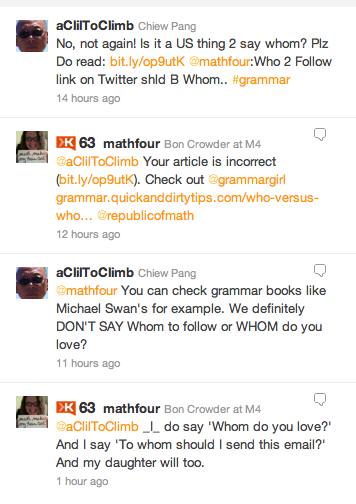
I complained that Twitter has the link “Who To Follow” when it should be “Whom To Follow.” Here’s an excerpt from the fight:
The fight raged on.
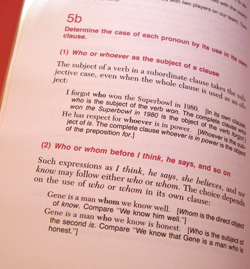
This guy was so adamant that you could use “who” as the object in a sentence (clearly wrong), and just wouldn’t let it go. After quite a few tweets I got curious. “What’s this guy’s deal? All he has to do is pull out the Little Brown Handbook and read it in plain black and white.”
So I went and looked at his site. Holy cow! He’s a grammar blogger!
I couldn’t find his “About” page, but from what I could gather in his fervor in our twitter fight, he’s trying to do for grammar what I’m trying to do for math. Demystify, take away the “have to” rules, and make it accessible, acceptable and appreciated by everyone.
We make the rules!
The rules of grammar, like the rules of math, are created by humans and used by humans. They are changeable.
Of course the difference is that, in grammar, if you deviate slightly from the rules that others follow, you’ll most likely be understood. In math, you really have to define how you’re using things before you begin to work.
For instance, if I wanted to have a conversation with someone about a new way of adding fractions I was inventing, I could totally do it. As long as I started the conversation with, “Here’s how we are going to talk about adding fractions for the next hour…”
Make it your own!
Teaching math and teaching grammar are two of the fundamental things we do for our children. And neither should be hard, creepy or frustrating. They should be a normal, natural flow of who we are as people.
At 8:30 PM CST tonight, October 20, 2011, Natural Math is hosting a presentation about a new book called Modern Math for Elementary Schoolers by Oleg Gleizer. It’s a Creative Commons book on advanced math for elementary school children! (So it’s free! Get it here.)
Gleizer’s inspiration is from a similar situation in which I currently find myself: To what school should I send my child? Of course my answer is The Bon Crowder School at Home. Alas, Husband believes there’s no reason to fully homeschool if there great schools out there.
So are there great schools out there?
I started reading the book and stopped on page 4. Gleizer is explaining his method of finding math teachers. He asked math teachers of potential schools these two questions in the interviews:
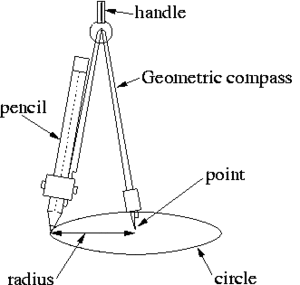
Given a straight line and a point away from it, how would you draw another straight line passing through the point and parallel to the original line, using a compass and straightedge as tools?
How would you draw a four-dimensional (4D) cube?
Of course, I immediately began to wonder if I was good enough to answer these questions myself!
I got the answer to #1 after some thought, and am pondering #2. I’m refraining from reading on, as I want to come up with my own answer before I read anything else. But I’ll be attending the presentation this evening.
What about you? Can you join us?
P.S. I’ll have to wait to post the answer to #1 tomorrow, as I have discovered that I don’t have a compass. How on earth can you teach math without that?! How embarrassing! So I’m off to Walmart right now to get one.
In order to see what the difference is between motivation and inspiration when teaching math, I’m going to start with a quick story…
You have a dog named Herman. Herman is cute, fuzzy, has a pink nose and loves you unconditionally. You think he’s great. So you want to share him.
You put a bow around his neck, and hand him to your children, Abby and Dirk.
“Here is Herman. He’s cute, lovable, and a perfect pet. Isn’t he fabulous?” you tell them.
Abby looks at Herman and is so excited. She thinks he’s fabulous, wonderful and sees in him everything that you do. Inspiration hits her – she loves him like you do!
Dirk, on the other hand, wants a cat. He’s not sure how to voice this. But since you’re so excited about Herman the dog, he rolls with it.
He wants to please you, so he feigns interest in Herman.
Herman’s not a dog.
Herman is your curiosity. Herman is what you find interesting and inspirational.
And just because Herman is wonderful for you, doesn’t mean Herman is perfect for everyone else.
Abby loves Herman. And Dirk loves Herman, but only because loving Herman pleases you.
We offer Herman, and they take him. Because they want to please us.
Lots of educators these days are talking about helping children connect with math through real life experiences. They want to give children curiosity about math in the real world.
Some children like to build things. Give them a stack of Legos and they’ll work for hours.
There are kids who are outdoor people, always running around and wanting to see what next thing they can find in nature.
Some kids want to be in the kitchen, helping their parents cook dinner.
Some kids are quite happy connecting math just to math.
Some children are gamers, enjoying puzzles, riddles and games just for the fun of it.
And the list goes on…
Grownups take their connection to the real world, their own curiosity, and pass it on to children. We take everything that we find fascinating, our own personal Herman, and hand it to the child.
And they take it. Some because they are excited about it, and some because they want to please us.
Motivation is not inspiration.
The growing thought among educators is that children need to be curious in order to learn math. So we’re creating ways to get children curious.
But are we doing it right?
The child will happily take Herman, your form of curiosity. This could mean they are truly inspired by what you give. And it could mean that they are merely motivated.
Motivation isn’t a bad thing, for sure! But if we mistake motivation for inspiration we are doing the children a disservice.
If they’re motivated, they’ll only do what’s next to get praise. It’s about you, the grown-up, and how much they can please you.
If they’re inspired, they’ll want to take their learning to the next level – even when you’re not around. They’ll want to see and do things to enhance their understanding without needing your praise and attention. It’s about them.
And when things are about them, they own it. They succeed because they can, not just because we want them to.
What’s your Herman?
And have you passed him along? Was he inspirational or motivational? Share your thoughts in the comments!
This past Monday we had a great #mathchat via Twitter. The topic was: “If you could clear one misconception about mathematics and/or teaching it, what would it be?”
I was getting a bit frustrated that a couple of people kept bringing up the misconception that girls aren’t good at math. Even to the point of creating their own hashtag #girlsaregoodatmath2.
In my life, I’ve never heard anyone say this – in any other form than somebody complaining that people say it.
So here’s my response to everyone who keeps saying to me, “I wish people would stop saying, ‘Girls aren’t good at math.’”
What do you think? What will you say from here on out?
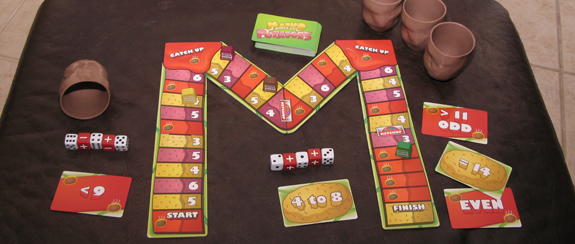
I was at my dad’s house the other day and decided to pull out my new Math’d Potatoes game to see how my super-gaming family liked it.
The kids in the house were too young to play, so my sister and I asked Aunt Linda and our stepmom to play with us.
They quickly claimed they were “math Neanderthals” but agreed to play anyway. My dad, an engineer, was asleep.
The game has simple rules.
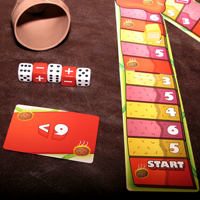
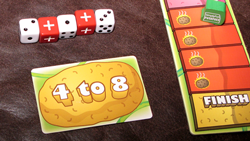
You play Math’d Potatoes by drawing a card, rolling five dice and making an expression that “satisfies” the card.
The card requests various types of “answers”:
Even or odd
Equal to a certain number
Between two numbers
Less than/greater than a certain number
Everybody got into it.
Aunt Linda and Louise (my pet name for my stepmom) both agreed that it was a fun math game. This is in spite of the fact that neither one of them like math, and Aunt Linda doesn’t even like to play games at all!
My dad saw the game the next morning.
I had intentionally not waken up my father to play with us the night before. My decision was validated the next morning.
My dad is an engineer, and as such tends to use the phrase “all you have to do is,” and the word “just.” He’s a very smart man, and I’ve learned lots from him through the years. And one of those lessons is: “Keep an engineer away from sensitive math learners.”
Sure enough, when he saw the game, he eagerly said, “What’s this? Are we going to play it?”
When I explained we played the night before he responded with, “Why didn’t you wake me? I totally would’ve won.”
Math learning is slowly build, and quickly destroyed.
When we were playing, Aunt Linda and Louise were both starting to warm to the idea of math. They were enjoying the game. My sister and I were holding back just a little to give them an opportunity to discovery their own skills. (We both experienced the engineer–math–dad super push growing up.)
So by the end of the game that night, they were excited, confident, and enjoying themselves.
Had I woken up my father to play the game, he certainly would have won. He might’ve turned it into a competition, or he might have tried to help a little too much.
Either way they would’ve lost interest. Their confidence would have been destroyed. And two beautiful, smart and happy women would have their, “I’m a math Neanderthal” thoughts validated.
You can use this with your children.
If you or your spouse are in a math related field, or was “always good at math,” be aware of your potential intimidation factor. Hold back. Don’t help. Allow discovery and confidence to come at its own slow and natural pace. Your children will learn math, in their own time.
Don’t force it, or you might destroy it.
Note: They sent me this game for free. This is not a review, per se, but still – you should know how I got it.
To mix things up a little, this month’s Math Teachers at Play Blog Carnival is a love story – between two people and then their new cute daughter. It’s a story of the coolest carnival of all – having kids.
The Story of Bernice and John, Mathematician Parents
by Bernice Abel
When John and I decided to have children, I knew we would be Making More Math Geeks. And I was okay with that. I was actually quite excited about it.
“How many kids do you want?” he asked before we were married. I thought about it a bit and said, “I probably want an odd number of kids.”
“What base is that in?” He asked me. I swooned. Could it be that he knew about Odd Numbers in Odd Bases? One thing was for sure, I knew he was Asking Good Questions. Especially when he asked me to marry him!
“You know,” he said, “We should have just the right number of girls and just the right number of boys. The Golden Ratio of our own, so to speak.”
There were so many things to be in love with in this man!
The day daughter was born was a life scalar multiple.
“I don’t know,” I said, “I just gave birth to a math geek, so I’m feeling like I should be eating 1/8, 1/4, or even 1/2 of something. I really don’t want our new daughter needing Fraction Help. And I know this hospital has pizza cut into 8 slices.”
He said, “You know, The (Mathematical) Trouble with Pizza is…” And then I glared at him. “Get me some pizza!” I screamed. The love of a math guy was wearing off.
“What took you so long?” I asked when he finally got back with my pizza. “You didn’t have to calculate any tip, and even My New Percent Lessons wouldn’t have helped you figure out the tax – the cash register does it all!”
I said, “My idea of math and fun is some Tesseracts and Factor Lattices. And I didn’t have either to keep me entertained while you were gone.”
I didn’t mention my desire for a iPad even though I had heard of the new fad of iPad Gaming in Math and Science. Money was tight and Clementine was already proving to be an expensive bundle of cuteness.