Part of Wordless Wednesday…
Share your thoughts in the comments or on twitter/x.



Part of Wordless Wednesday…
Share your thoughts in the comments or on twitter/x.
This is the 5th in the draft purge series where I’m throwing stuff out over a three week period.
One month after starting MathFour.com, I came across an article about GeoGebra. I was quite taken by the software, but a little overwhelmed.
I’m not much into technology — at least when it comes to math. So the power of the tool was much more inhibiting for me than it was empowering.
Indeed this article was first “drafted” back in March of 2011 — more than a year ago. It only had the link to that article in it. Not much of a draft.
Lucky for us, math is math. It doesn’t change much over a year (or even a few hundred years).
So GeoGebra is pretty much as useful (and as scary) as it was a year ago.
But like all good heros, leaders and people stupid enough to think they might be either, I’m diving in. Regardless of my fear.
So I found the GeoGebra Quickstart guide and started reading. I downloaded GeoGebra and cranked it up.
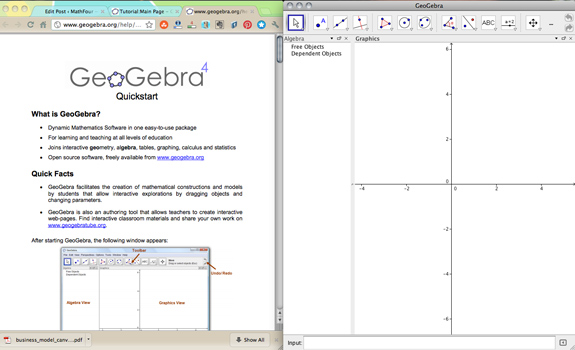
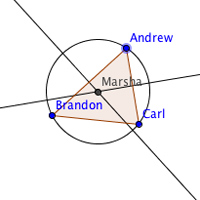
The Quickstart has three examples to try. The first one is un-intimidating — merely involving a triangle and a circle.
So I did it.
Turns out you can “share” your work on GeoGebra — those guys are pretty clever, I must say!
Click here to see my first ever attempt at GeoGebra goodies. Notice I named my triangle vertices and the center of the circle with real names — fun!
Following the directions, I learned about the Move Tool. Which means you can move just about anything — the whole triangle, the circle or any of the vertices!
Check out the “dance” I did with my circle and triangle:
I’m looking forward to playing some more. But I still have my concerns.
I’ll share those tomorrow. For now, I’m just going to enjoy the tool!
Have you played with GeoGebra? Will you? How do you use it? Tell us in the comments.
Don’t forget to tweet it out, too!

This is part of the Teaching Math with Picture Books series.
Check out this activity you can do with What’s Your Angle Pythagoras?
Will you do it? What else can you do? Tell us in the comments.
And share this on Twitter!
This is part of the Teaching Math with Picture Books series.
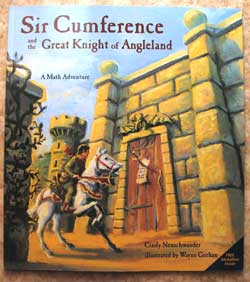
The math picture book Sir Cumference and the Great Knight of Angleland appealed to me because of the punny title – and the promise of wordplay was certainly fulfilled!
This fun little gem of a book is only one in a series of Sir Cumference books by Cindy Neuschwander.
Radius is the son of Sir Cumference and Lady Di of Ameter. (See what I mean – the puns start on page one of this picture book!)
He decides he’s old enough to take a quest and learns from his mentor, Sir D’grees (it’s side splitting, I tell ya!) about the missing King Lell.
Radius is given a “medallion” by his parents to help him on his quest. No one really knows what the medallion is for, but it seems it might be helpful.
Or at least cool to have while on a quest.
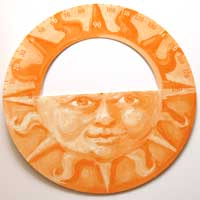
As a treat to the reader, a laminated version of this medallion is included in the back of the picture book. It looks like this:
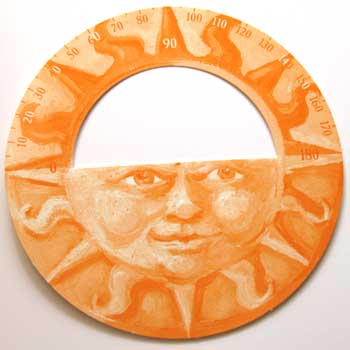
Angles, degrees and all things geometry show up. And Neuschwander doesn’t write them out loud until the end, when Radius starts naming them.
Here you see the steep “cute” roofs of the village in the valley near the Mountains of Obtuse.
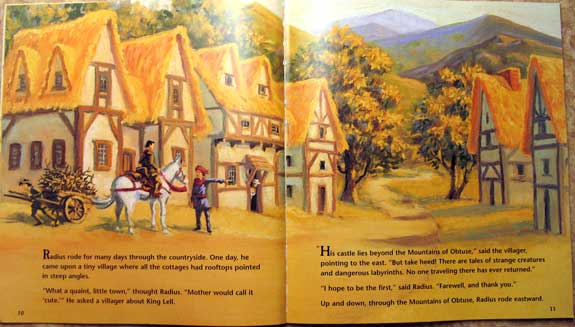
Husband enjoyed paying attention, looking at the pictures, and trying to guess which person or thing would end up as a namesake for a geometry term. I think he enjoyed it more than K8!
Read this picture book to enjoy (as we did) or use it to introduce or enhance your geometry lessons.
I won’t spoil it for you, though. Get it at the library or find Sir Cumference and the Great Knight of Angleland online. Read it. Enjoy it. You’ll see I’m right. (No pun intended!)
Share your thoughts in the comments and make sure to tell your PLN on twitter!
I have been working with eHow.com to get some common math questions answered. One of the questions was, “How are the areas of a rectangle and triangle with the same base and height related?”
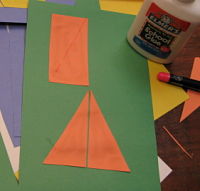
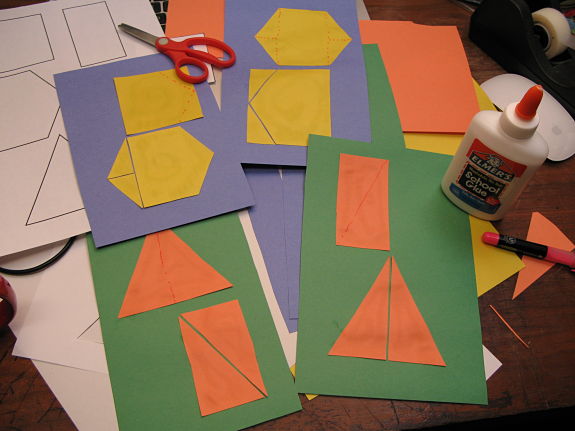
Curiously, all rectangles can be cut into triangles. And all triangles can be doubled to make a rectangle. Watch this video – and then get out the construction paper, scissors and glue.
Grab a kid and have some fun watching them discover!
Have thoughts on this? Share them in the comments. And don’t forget to share it on twitter/X.
This morning Daughter and I went to the gym.
When we crossed the street, I exposed her to undo risk by crossing at an angle.
So on our way out, I explained to her that we were walking a little further to get to the car this time. And we would minimize the risk of getting hit by a car by taking the longer route.
(Of course she’s not yet two, so she really didn’t care. But it was important for me to say.)
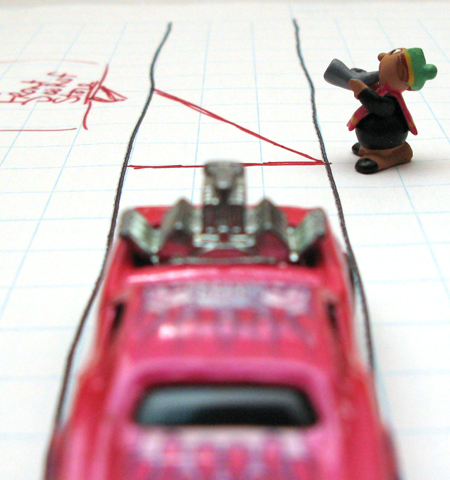
People most often cross the street at an angle. Intuitively we know it’s shorter. Look at the tiny person in this picture. He needs to get to the front door of the store.
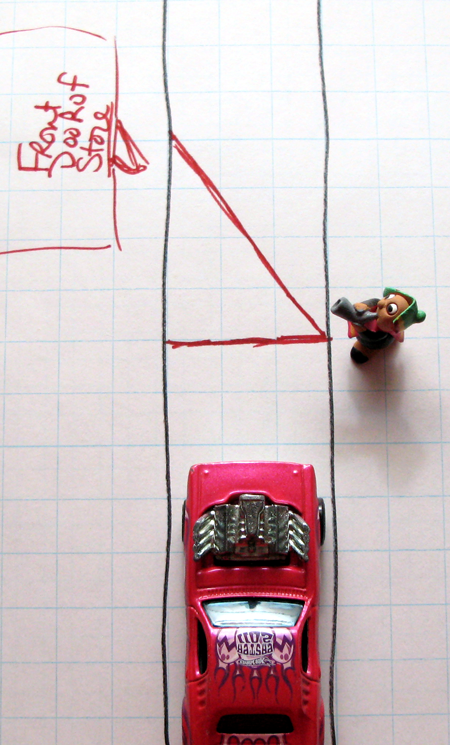
Suppose walking one yard takes 5 seconds. It will take the little guy 15 seconds to cross the street straight across. (And with a toddler, it does take 5 seconds to walk a yard.)
Then he has to walk the four yards along the side to the door. Which means his total time is
3 yards across at 5 seconds per yard = 15 seconds
4 yards up at 5 seconds per yard = 20 seconds
Total walking time = 35 seconds
If he went at an angle, it’s 5 yards total (by the Pythagorean Theorem).
5 yards diagonally at 5 seconds per yard = 25 seconds
Total walking time = 25 seconds!
For the pedestrian in a hurry (and wearing the shirt that reads “Safety Third”) the angled route is the way to go. But for a parent with toddler in tow, minimizing risk is a better option.
If the little guy were to cross at the angle, he’d be in front of the oncoming cars for 25 seconds. If he were to take the route that is longer overall, he’d be in front of oncoming traffic for only 15 seconds.
Getting out of the driving area faster means keeping the driver happy. That might not be your goal, but adding some cosmic happy juice into the world of drivers never hurts.
Plus, if someone were to “hypotenuse you” by taking the angled route when you were driving, wouldn’t you get a little annoyed?
So be safe. And tell your children why.
It’s all about the math!
Share your thoughts in the comments.
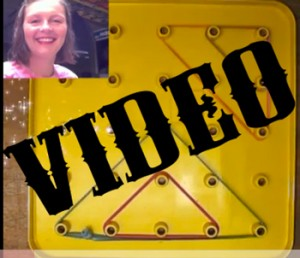
How about some similar triangle work on the Discovery Toys Giant Pegboard?
Not only is this video about triangles that are similar, but this video about triangles is similar to other videos! (Is that fun to say or just annoying?)
Here it is:
What do you think? What other triangle things can you do with a pegboard?
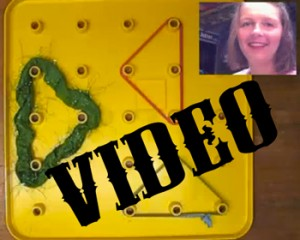
Do your kids get confused between congruent and similar triangles? Do you?
In a previous post, I made this mistake when discussing right triangles on the Giant Pegboard. If a mathematician can make the error, then it is easy for a kid to, also.
In the video I said “congruent” when I meant “similar.” Two triangles are congruent if they are the same size and shape. They are similar if they are the same shape (and maybe or maybe not the same size).
One way to show that two triangles are congruent is to use the SSS Theorem or the “side side side” theorem. This says, essentially, that…
This ensures that your two triangles are congruent – or as a kid might say it “exactly the same.”
Here’s how to use the Discovery Toys Giant Pegboard to play around with congruent triangles:
What do you think? Can you use this? Give it a shot!
Check out the next post for a video discussion on similar triangles.
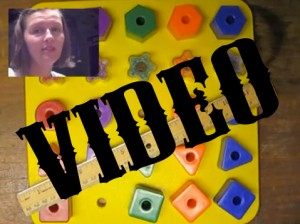
I hosted a Discovery Toys party the other day and ended up explaining how to use many of the toys for teaching math.
Alas, here I am now doing videos of the same. I can’t get over these toys. They are designed proportionally (the cups and weighing ones) and always with the thought “How can this be fun at the same time it’s teaching something.”
Of course, all toys teach. But the designers of these toys put the extra oomph into the thinking process so that when a kid asks “why?” there’s an easy way for the parent to answer.
Oh – and they are guaranteed for life!
So from here out, I’ll be doing occasional videos on how to use them.
The first is about right triangles on the Giant Pegboard. Notice in the video that when I say “congruent triangles” I really mean “similar triangles“.
See what you think:
Have you played with triangles and pegboards? What other ways can you use them to teach and learn?
Disclaimer: I tried to become an affiliate of these toys to help pay for this blog. Alas, they don’t have an affiliate program. The only way was to become an official consultant. These toys are so cool and helpful, that I have done it.