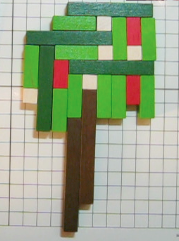
Cuisenaire Rods are brightly colored wooden sticks. Technically, they’re “proportionally sized rectangular parallelepipeds.” (But only say that if you want to hear your 3 year old repeat something really cute!)
The “proportional” thing is important. The white ones are 1cm square, the red ones are twice as long and each color is 1cm more than the next color.
I’m anticipating many articles and videos on how to teach with these (since the possibilities with these things are virtually unlimited), so I thought I would start a running series. Here are the ideas and the links to the articles/videos that are ready:
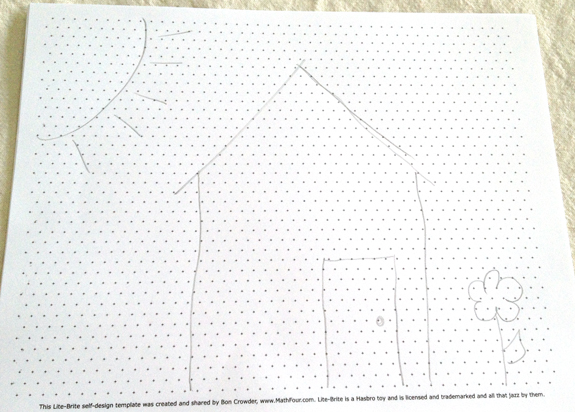
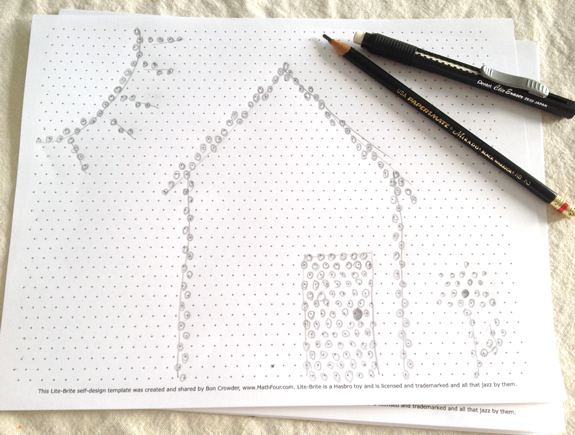
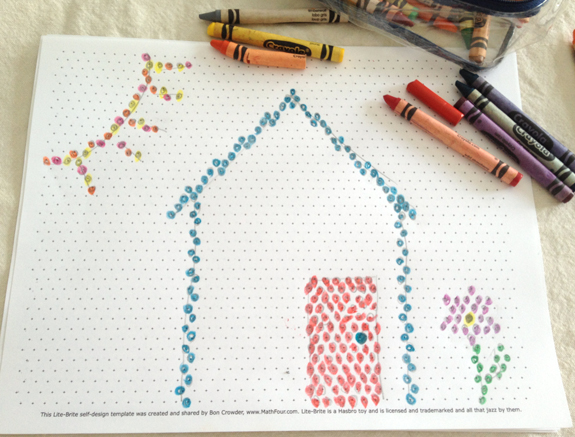
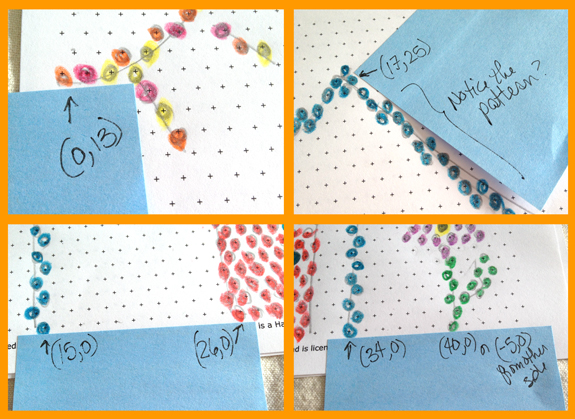
Cuisenaire Rods – (this one) graphing and practicing coordinate pairs (see video below)
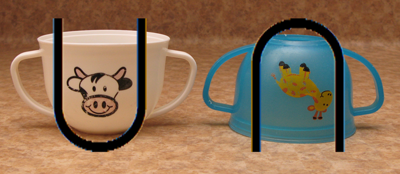
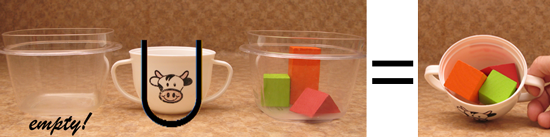
The union is on the left and the intersection is on the right.
I discussed empty sets in a previous article. I hadn’t yet listened to the recent podcast of The Math Dude, Jason Marshall, in which he introduced sets and subsets. Such a curious coincidence; I thought I would continue down our united path.
This week, the sweet Math Dude talked about union and intersection of sets. So I’m heading there too – and incorporating the empty set.
Union and intersection have symbols.
These symbols represent “operations” (like addition or multiplication) that you do to a pair of sets. They are called the cup and cap and look like, well, a cup and a cap. Or a U and an upside down U. The Union is the U and the intersection is the other one – that’s how I remember it and teach it.
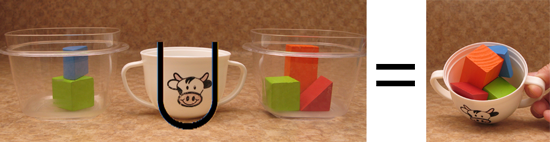
For the sake of illustration, I’ll use Daughter’s handy SnackTraps like in the picture above.
The union is everything.
The sets I’m using are
L ={green cube, blue half circle thingie}
R = {green cube, red triangular prism, orange rectangular prism}
I’m using the letters L and R for left and right in the picture.
The union of the two sets results in all the pieces from each set, all crammed together. (And if there is a repeated item, you only take it once.)
The union of the two sets is everything combined (without duplicates).
Let’s take the set of all states that border Texas and the set of all states that border Oklahoma, like this:
T = {Louisiana, Arkansas, Oklahoma, New Mexico}
O = {Arkansas, Colorado, Kansas, Missouri, New Mexico, Texas}
Then the union of the two would be “The set of all states that border both Texas or Oklahoma or both” and would be T U O = {Louisiana, Arkansas, Oklahoma, New Mexico, Colorado, Kansas, Missouri, Texas}
Notice we don’t keep duplicates.
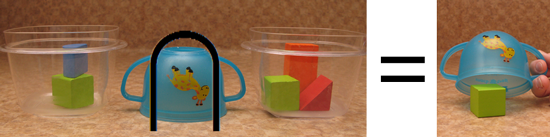
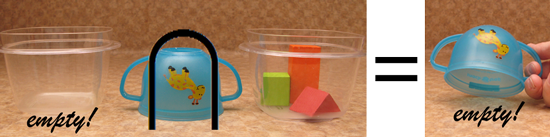
The intersection is only the common stuff.
Using the same L and R sets from above, I can take the intersection.
The intersection is only the stuff they have in common (we get rid of the duplicates here, too).
Let’s go back to our set of all states that border Texas and Oklahoma:
T = {Louisiana, Arkansas, Oklahoma, New Mexico}
O = {Arkansas, Colorado, Kansas, Missouri, New Mexico, Texas}
Then the intersection of the two would be “The set of all states that border both Texas and Oklahoma, at the same time” and would be T ∩ O = {Arkansas, New Mexico}.
What happens with the empty set?
When you start throwing the empty set into the mix, you follow the same rules.
For the union, you throw everything in both sets into one bag. Well, since there’s nothing in the empty set, “everything” is the original other set!
The union of the empty set with anything… is that same set back!
For the intersection, you take only the stuff that’s in common between the two. Since the empty set has nothing – there’s nothing in common.
The intersection of the empty set with any other set it just the empty set – there’s nothing in common at all!
Think about it…
Does this remind you of anything? What similarities do you see between this and addition or multiplication (or subtraction or division)? Ask your children these questions too.
Get out some snack traps and blocks (or a map) and go for it! Let me know how it goes in the comments.
I love finding nifty ways to use tools for teaching math. Especially tools that aren’t supposed to teach math. Or at least the math I’m trying to get it to teach.
I have this very cool balance that I got from Discovery Toys that would normally be a science toy. But, alas, I’m a mathematician, Jim, not a doctor. So I’ve taken the fancy science toy and turned it into a way to teach subtraction.
You can, of course, use it to teach addition and later I’ll do a post on using it to teach multiplication and division.
If you have children who struggle with math concepts, teaching them with hands on bits (manipulatives) sometimes helps. Here’s how to teach subtraction using a balance:
This nifty trick can be done with any balance as long as you have weights appropriately sized. Sometimes that’s not so easy to find. Order a colorful balance that’s similar to the Discovery Toys one in video here.
Did it work? How did your children receive this method of learning arithmetic? Please share your experience with it in the comments!
In the last post I discussed cardinal and ordinal numbers. I gave definitions but not much in the way of examples.
Here’s an example of using ordinal numbers to count up to arrive at the final cardinal number. Oh – and I’m using the fun little critters from Discovery Toys!
Whatcha think? Does it make you want to count some bugs?
Remember the ol’ “if A equals B and B equals C, then A equals C” deal? At parties it’s a great line to drop. In math, it’s officially called … cue music…
The Transitive Property
Saying it is fun, teaching it is curious, learning it can be weird.
Grownups think it’s intuitive. But to a kid, it isn’t. It takes experience and experimentation to learn all the bits that we think are “common sense.”
The transitive property is really thinking things through. Starting from one place and moving along through another and then arriving at a third place.
There are many ways to help kids with this learning. Word problems simulate thinking stepping stones. But they can be rather stressful. If you do it through play, you reduce the stress that they face and give them skills they need to tackle advanced thinking, forever.
This video shows a nifty “toy” from Discovery Toys that can get kiddos using those brain stepping stones.
Notice the flow is
Choose the number tile with the question number.
Read and answer the question.
Correspond the answer to the letter in the answer box.
Put the number tile with the question number in the corresponding letter box.
Thinking through from question number to answer letter while avoiding the pitfalls is the challenge.
Have you played with these? How do you train your kids’ brains for the transitive property?
Want to give your kiddos a jump start on multiplication and division? What to help the ones struggling with division to grasp it better?
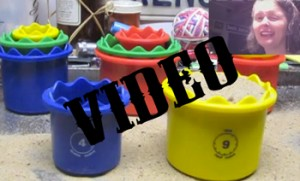
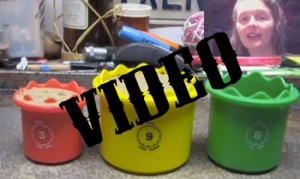
The Discovery Toys Measure Up Cups can do just that. They are built as a curriculum tool, in the proper ratios, so that the #6 cup holds exactly twice as much as the #3 cup. This allows for engaging and beneficial play that gives kids a grasp on how numbers relate to reality.
For example, in this video, kids can compare the numbers 3, 6 and 9 to see how they relate:
You don’t have to say out loud, “three plus 6 is 9” or, “9 divided by 6 is one with three left over.” But these concepts are ingrained into the child’s brain as they see this work.
Differentiation is the foundation of learning. Curiosity comes in the form of “Why is that different?” And right behind it is “Why is that the same?”
So patterns – and the lack of patterns – are essential in the development of a child.
The picture below is a collection of Discovery Toys (not all of them because they live in a house with a 19mo child).
While in the tub, I encourage Daughter to see which ones are the same color. You can label the bathtub tiles with soap crayons so you can discuss the patterns more easily. Use the Cartesian Coordinate plane or Excel cell names like I did in Photoshop.
Here are some things to talk about to encourage pattern discovery and learning. Or click here to download this as a printable MSWord Document.
Which shapes are kind of the same (similar, but not in the official math sense of “similar”)
Put shapes together that “go together” – these could be same shape, color, “feel” (like B6 and B7 are both angled).
Compare shape A5 to the shapes A3, A4, A6, A7 and A8.
What do cells B3 and B8 have in common?
How are C3 and C4 different?
What’s in common in cells A2 and B2?
How are shapes C1 and C2 different?
How are C2 and B3 similar?
And then look at the world!
When you’re out of the tub, make sure to encourage observations – of everything. For something like the gate trim in the picture you can ask questions like:
What is similar?
What pieces are different?
Do you see spots that are kind of the same but mirror imaged?
If you were to make this symmetric, what other parts would you have to add to it?
Not only is this video about triangles that are similar, but this video about triangles is similar to other videos! (Is that fun to say or just annoying?)
Here it is:
What do you think? What other triangle things can you do with a pegboard?
Do your kids get confused between congruent and similar triangles? Do you?
In a previous post, I made this mistake when discussing right triangles on the Giant Pegboard. If a mathematician can make the error, then it is easy for a kid to, also.
In the video I said “congruent” when I meant “similar.” Two triangles are congruent if they are the same size and shape. They are similar if they are the same shape (and maybe or maybe not the same size).
One way to show that two triangles are congruent is to use the SSS Theorem or the “side side side” theorem. This says, essentially, that…
If you can show all three sides of two triangles are the same, then the angles must also be the same.
This ensures that your two triangles are congruent – or as a kid might say it “exactly the same.”
Here’s how to use the Discovery Toys Giant Pegboard to play around with congruent triangles:
What do you think? Can you use this? Give it a shot!
Check out the next post for a video discussion on similar triangles.