Tag: teaching math

  • Math Skills in a Math Toolbox

    Math Skills in a Math Toolbox

    We don’t teach each new math skill just to have something to do during the next math lesson. And yet textbooks make it look like we do.
    Math skills are presented in bubbles called sections. The section doesn’t show how the math rule being taught connects to past or future lessons. Nor does it point out what previously learned skills or rules are currently being employed.

    Okay, it might note that this section is similar to the others in the chapter. But how often do you see a section point out how you’re going to use the skills you learned in a previous course?

    Kids rarely understand that each level of math is taught so that the tool that’s being practiced can be used later – in another math lesson or math situation.

    They don’t see the long term growth of math skills and math maturity – their math toolbox.

    Math skills are tools.

    Take a look in any man’s garage and you’ll see a plethora of tools.
    Point one out and ask the owner these things:

    1. What is this?
    2. Under which situations will it function (and under which won’t it)?
    3. In what situations would it be helpful to use?
    4. Do you have the confidence and ability to use it when you need to?
    5. Have you ever used it when there was something else that would’ve worked better?

    Chance are, he’ll have thorough answers for 1, 2 and 3. And for number 4 – he’ll look at you like you’re nuts and say, “Well, yeah!”

    For number 5, he’ll say, “Well, of course. Sometimes I’m not sure what will work best, so I just pick a tool that I know can work. If it turns out to not be the best tool for the job, it’s no big deal. It might have taken a little longer, but it still got the job done.”

    Tools accumulate – and add to each other.

    Mr. Garage Owner didn’t collect a whole bunch of tools that he’s clueless about. He likely wanted to build one thing and realized a tool could help. So he bought it.

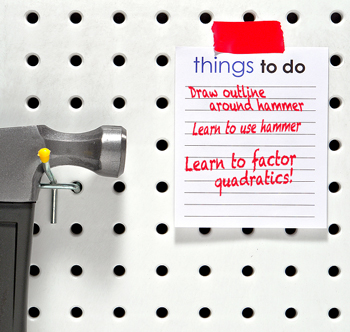
    He learned how to use it, then hung it on the wall. Probably on a pegboard with the shape of the tool outlined.

    Then he wanted to fix something else. He could have used his tool, but if he had another tool as well, it would make it even easier.

    So he bought another tool.

    Together with the first tool, he fixed his gadget then hung the new tool on the wall.

    He continued this way until his pegboard was full and he was building more tool storage space in the back yard.

    Now he knows each tool, when and how to use them, and confidently pulls them out each time it’s necessary.

    And if he chooses the wrong tool for the job, he gets over it quickly.

    Teach math like the kids are accumulating tools.

    When you start a new section in your math lesson, review the math rules that they previously learned. Show how the newest problems may (or may not) be solved with the old math skills alone.

    Present the new skill or math rule thoroughly. Be clear on what it is, how it can be used and under what circumstances. Also point out where it can’t ever be used. Like “adding to both sides” can’t work when there’s no equal sign.

    Point out some areas where the new math rule might be helpful. Point out some areas where the new rule might not be the best for the job, but it would still work.

    Show how to use the new math rule along with the old rules (pointing them out everywhere) to achieve results.

    Have them make a list of all the math skills they’ve learned – a pegboard outline – so they can be kept handy.

    Let them play.

    Math is typically thought of as the subject where “there’s only one way to do it.”
    BAH!

    Just like Mr. Garage Owner, using the non-optimal tool for the job still gets the job done. As long as it works (can’t run an electric drill in the rain, after all).

    So let them play. Turn your math lesson into a time where they can use any math rule they want. Let them discover their own confidence in choosing tools.

    And let them try out tools that might not be the best for the job.

    As they grow their math toolbox, they’ll grow in math maturity and confidence!

    Share your thoughts in the comments or on twitter/x.

    You might also like:
  • Why You Should Give Your Phone Number to Students

    Why You Should Give Your Phone Number to Students

    This is the 3rd in the draft purge series where I’m throwing stuff out. I’m down to 56 drafts – down from 70! (not factorial)

    I’ve taught in the classroom for over 17 years. I never hesitated to give my phone number out. In all those years, with all those kiddos, I got one drunk call. And that was an accident – he meant to call Ben and not Bon.

    It was a good idea. And I’ve had good results.

    So why should you do it?

    To show you’re human.

    If you teach math, you just might be viewed as supernatural. Or inhuman, depending on the student. Famous, important or supernatural people don’t just give out their phone numbers willy-nilly.

    If you give yours, you’re showing your human side. You have to keep the authority, but you can give a little. Let them in.

    To offer a ray of hope.

    They will probably be nervous about calling, but they’ll text. And they’ll understand if it takes you a while to get back to them. If they have this lifeline, they won’t lose the confidence

    they have gained in your presence.

    I’ve heard hundreds of students say, “I was doing okay in class, but when I got home, I just couldn’t understand what I’d been doing.”

    There’s a magic of the teacher standing there. It’s a safety net. And it gives many students the confidence they need to keep going.

    It’s a fake net, but it works.

    If they know they can text you, they maintain this safety net at home.

    To show trust.

    For some reason, classrooms have gotten into the “us vs. them” mentality. Teachers are the bad guys to the students. Teachers may label kids unfairly, too.

    Show your students you’re not a label maker. Let them know that you have trust and faith in them. Give them your number!

    Will you do it?

    How do you show you’re human? How do you give hope and show trust? Will you try the phone number sharing?

    Let me know in the comments and don’t forget to share this on twitter!

    You might also like:
  • Math Rules & Their Destruction of Education

    Math Rules & Their Destruction of Education

    We’ve trained kids to know that math is a set of specific, discrete rules that, when followed, yield the correct answer.

    They memorize math rules like:

    • Whatever you add to one side, you must add to the other.
    • FOIL
    • Distribute
    • PEMDAS
    • Plug in 1 for x (then 0, then -1)

    The rub is, that they don’t understand why the rules work. Which might not be a big deal – but the rules don’t always work!

    We got to see The Math Rules in action.

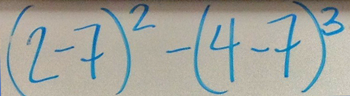
    For two days, in my #PowerMath class (officially Developmental Math – the class two levels below College Algebra), we’ve been working on this problem:

    The goals were these:

    1. Practice and understand the order of operations.
    2. Compare this to working with variables.
    3. Learn to experiment with the math rules to discover how things work.

    What I saw was mind-boggling. I knew the skill level was low. But I had no idea the blind following of math rules was so widespread and detrimental.

    Goal #1: Practice and understand the order of operations.

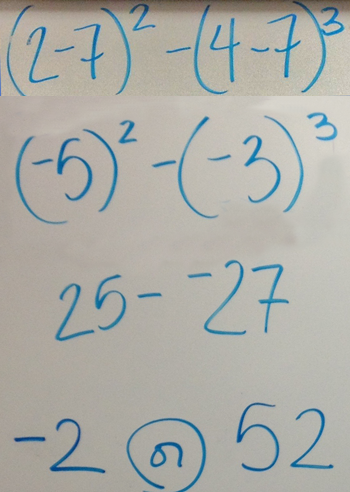
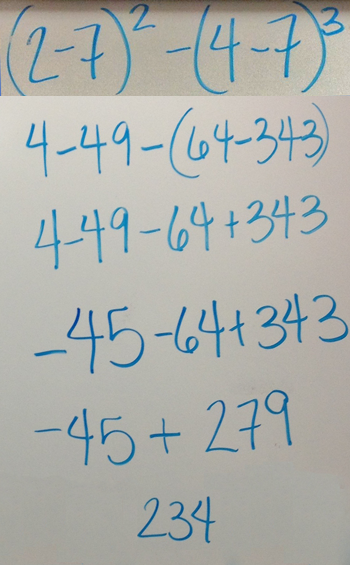
    When given the problem, and asked to coach me on various ways to do it, someone requested we use the order of operations and “do inside the parenthesis first.” So we did. They instructed me to write it like this:

    All was cool until the end when there was a bit of an argument on the final answer. So we listed them both as possibilities.

    Although the act of doing the arithmetic inside the parenthesis is valid, we had much discussion on the positive and negative signs running around.

    I had encouraged everyone to chime in with their own ways to find the answer, and someone suggested that I do the exponents first. They coached me to write this:

    Alas, we had yet a different answer than the first two.

    This is a common mistake. But I was hoping that through other experimentation they would see how we could fix this.

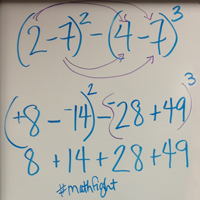
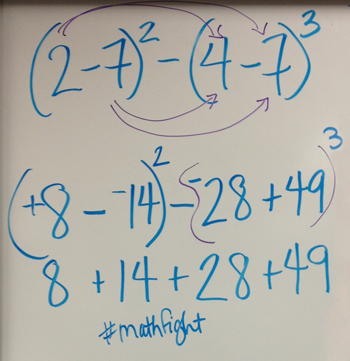
    Someone else pointed out that we could FOIL. I asked them to explain exactly what they meant by it and they told me how to draw the arrows:

    By the time we stopped, the class was in a full out #mathfight. Some students believed we needed to handle the exponents first, then do FOIL and others thought we should keep the exponents on the bits after we used FOIL. We decided to postpone this version until we worked out some of the others.

    The use of FOIL here doesn’t work because the two binomials are being raised to a power. Furthermore, they are being subtracted, not added.

    Goal #2: Compare this to working with variables.

    The comparison of real numbers to variables has three main points:

    1. Variables represent numbers.
    2. Any math rules you can apply to numbers you can also apply to variables.
    3. Any math rules you end up using on your variables, must also work with numbers.

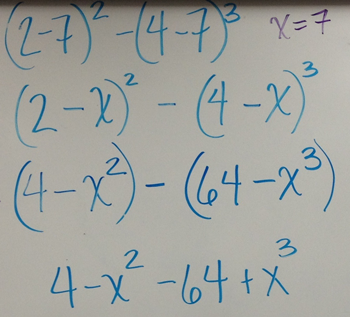
    To help illustrate this, I removed the 7’s in the problem and replaced them with x’s. Our initial tries were interesting.

    This experiment, as suggested by the students, applied the same “method” of squaring the inside pieces as one of the purely number versions above:

    At which point, someone suggested that we subtract 4 from both sides.

    Line #3 here is incorrect. Also, there is no “both sides” because there is no equals sign.

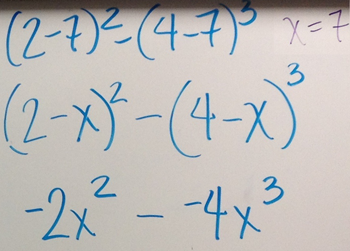
    We went to another part of the board to start over and give it a try like this:

    Here it was suggested that we set x=1.

    Since x=7 (by the design of the problem) it doesn’t follow that x=1. I believe the student was remembering graphing an equation where x is the dependent variable. Also, note that the last line is merely a permutation of the symbols in the expression – it is not equivalent to the previous line.

    Goal #3: Learn to experiment with the math rules to discover how things work.

    We have a rule in class:

    Until you decide differently, everyone is wrong. Even the teacher and textbook.

    So I don’t tell them when the answer is right. The skills they are learning are the middle of problems they’ll be solving in the future. They’ll never get confirmation that what they are doing is right or wrong.

    There’s no back-of-the-book solutions for the middle of a calculus problem.

    Checking themselves, and having confidence in the answers that they have confirmed, are vital.

    And yet they get highly frustrated with this.

    Why? Because they’ve been trained that they should follow the rules and the teacher or back-of-the-book will tell them if they’re right.

    And I’m refusing to play that game.

    The full and complete math rules, that go with those above, are:

    • Whatever you add to one side, you must add to the other, when you have an equation, not just an expression with no equals sign.
    • FOIL when you are multiplying two sums, not subtracting them.
    • Distribute exponents over products, not sums.
    • PEMDAS works only when you know what each term really means and how to use them.
    • Plug in 1 for x (then 0, then -1) when you are graphing an equation where x is the dependent variable.

    But those last bits – the ones in bold-italics – those are ignored. They see an exponent outside of a set of parenthesis, they want to put the exponent on the inside pieces. They see two sets of parenthesis, they want to FOIL.

    Handing out rules don’t work. Because students aren’t ever allowed to understand the rules in their entirety.

    Thoughts? Share them in the comments.

    Related articles
  • How to Teach Adults Math

    How to Teach Adults Math

    Today is my first day of teaching Developmental Math. I picked up two classes in the “late start session” at Lone Star College.(Yup – in Texas. How’d’y’guess?)

    And I’m so excited about teaching again!

    But how do I do it?

    A year ago the answer to that question would have been, “Duh!” Having taught for so many years I’ve gotten the art of explaining math on the chalkboard (and later whiteboard) down to a science. I’m good. Real good.

    But this past year, writing on MathFour.com, has changed things. I’ve connected with wonderful moms, dads, teachers of math and teachers of… well… just about everything. My philosophy on teaching math has been shattered.

    In the past, I’ve taught content. We’ll do the slope-intercept formula, talk about graphing and test over things like “Section 1.3 to 2.5.”

    But I’m not sure if that’s the right thing to teach. In fact, I’m not sure there’s anything to “teach” at all.

    I have to remember what they’re up against.

    This class is the most “remedial” of the classes offered in the math department. But the “gaps” they have in the math may not have anything to do with ability.

    I’m going to forego a syllabus – at least at first. Instead, their first assignment will be to read a research paper on math anxiety.

    From there, I’m going to let them guide what we do. We’ll likely get to content, but we’re not doing to push it.

    We’re going to get ready for whatever is next.

    They aren’t done after this class. In fact, this is the first of at least four math classes they’ll have to take. So whatever we do here lays the foundation for how they handle the other classes.

    The next math class they take might be inspirational and based on understanding, exploration and learning. Or it might be another content driven, talk-at-you-while-you-take-notes semester full of processes and methods to arrive at a RIGHT answer.

    Either way, I hope that by the end of this semester, they will feel empowered to take on their own learning. To demand learning facilitation instead of teaching. And join the teachers that have been leading the math revolution.

    Will I get fired?

    I hope not. But it’s possible. There’s no telling what’s fixing to happen.

    The only thing I know is that I’ll no longer sacrifice students for the sake of the system again.

    What are your thoughts? Please share them in the comments.

    Feature image by ralph and jenny | Flickr.com | CC BY

    Related articles
  • Teach a Man to Fish… Really?

    Teach a Man to Fish… Really?

    This idea was inspired by something Tom with Leaving Work Behind wrote in an article about success months ago. He wrote:

    Principles are timeless – techniques are not. Would you rather I give you a fish, or teach you to catch your own?

    Here’s a week in the lives of Tom and me… “fishing”…

    Monday

    Bon: Hey, whatcha doing?

    Tom: I’m fishing.

    Why?

    Because I’m hungry. You can eat fish.

    Bon: I’m hungry too. Will you share your fish?

    Tom: Sure!

    Tuesday

    Bon: I wonder where Tom is. I’m hungry.

    Wednesday

    Bon: Hey Tom!

    Tom: Hi Bon!

    Bon: I’m hungry. I haven’t eaten in two days. You weren’t here yesterday.

    Tom: Well, I’m fishing now. Watch how I do it and if you ever need to, you can do it yourself.

    Bon: Swell!

    Thursday

    Bon: I wonder where Tom is. I’m hungry. Good thing I watched him yesterday. Now I can catch my own fish.

    <pause>
    Bon: What’s going on. I’m not catching any fish. And I’m doing it exactly as Tom did! I’m so hungry!

    Friday

    Bon: What’s up, Tom!

    Tom: Hey Bon. How are you?

    Bon: I’m SO hungry. I tried to fish yesterday but I couldn’t catch anything. And I was doing it exactly like you did.

    Tom: That’s strange. How about this. I’ll let you do the fishing today. Together we’ll see what you’re doing and adjust it so it works for you.

    Bon: That sounds great!

    Saturday

    Bon: Bummer. Tom’s not here. But I was successful catching fish yesterday so I’ll have no problem catching fish now!

    Sunday

    Bon: Hey Tom!

    Tom: How’s it going Bon?

    Bon: Excellent! Hey – wanna join me for lunch? I’ve caught enough fish for both of us!

    Do you really want to teach someone to fish?

    There’s a difference between teaching someone to fish and helping them learn to fish. In the case of Tom’s teaching medium – his website – he can only teach. Likewise, here at MathFour.com, my writings can merely teach.

    But when you’re face to face with a student, teaching isn’t nearly as valuable as helping them discover.

    Indeed, if you’re going to teach a child who really needs help learning, you might as well just give them the fish.

    Do you teach your kids to fish – or help them learn?

    Share your thoughts in the comments.

    Images by Tony the Misfit on Flickr, CC BY.

    Related articles
  • Math Education Revolution – The Last Piece Is Easy & Cheap!

    Math Education Revolution – The Last Piece Is Easy & Cheap!

    The math education revolution has been growing. Last year Salman Khan and the Gates Foundation brought Khan Academy to everyone in the world with a computer.

    Dan Meyer jumped into the ring with his math class makeover. With his Any Questions? and Three Acts, he’s fighting the good fight to get kids to learn math.

    Social learning math games like Sokikom, iPhone apps like Motion Math and face to face programs like Mathnasium have joined the math education revolution, too. Thousands of tutors are taking part.

    Experts all over are helping kids understand that math is important, necessary and valuable to learn.

    Kids still resist math homework and avoid participating in math class. Why?

    Because everyone knows that math is boring, hard and has nothing to do with real life. Nobody really likes it – unless they’re an engineer or accountant.

    Math teachers are mean and professors write math books just to mess people up.

    Everyone knows this.

    Who is this “Everyone”?

    Grownups.

    Yup – you and me.

    When you hear people talk about math or math education, what do they say? Anything positive?

    The best I’ve ever heard was, “Actually, I kinda like math.”

    Which means, “I know it’s not cool, and I’m sorry for saying it, but I like math.”

    Would you do something nobody liked?

    No! Of course you wouldn’t. At least not on a regular basis.

    If everyone you knew and respected avoided something – you would too. If all your friends jumped off a cliff – so would you.

    We’re human. That’s what we do. We stick together.

    So we’re losing the math education revolution.

    By the very design of our society, Khan Academy, Sokikom, teachers, tutors and everything designed to help kids learn math are failures. The math eduction revolution is bust.

    We want kids to learn math because it’s important. Math is necessary and valuable to learn.

    But since nobody really likes math, or even does math, kids aren’t buying it.

    And I can’t blame them.

    Is it fixable?

    At this point it’s easy to throw in the towel. Give up. Quit. Decide that the world is going to end up like that movie Idiocracy.

    But we’re so close to the solution.

    The solution involves something that’s very cheap – and research based!

    Ready for it?

    The missing piece of the math education revolution is that we need to teach parents positive influence skills to encourage math.

    What? Will that work?

    We have seen this happen with reading – remember the Reading is Fundamental campaign of the 80s? It’s still going strong along with other programs like the “Read 3” program from HEB. Parents are encouraged, even pushed, by teachers to read to their children every day.

    These efforts have changed the culture in our world so that reading is viewed as something “everybody does.” Parents now have positive influence skills in encouraging reading.

    And those skills have extended across our entire culture!

    That’s the missing piece!

    Parents can develop the same skills for encouraging math. And when we do, everything will change.

    Just like it did with reading.

    When parents start talking about math in a positive way, all of society will.

    The math education revolution will succeed!

    It’s your turn…

    If you’re a parent, learn how to use some positive math talk. Join a program like That’s Math, read articles on Math for Grownups or any other math blog that strikes your fancy.

    If you’re a math teacher, blogger, tutor or developer of math products – make something teaching parents how to talk positively about math. We’re developing That’s Math, but there needs to be more of these.

    Feature image by woodleywonderworks on Flickr.com, CC BY.

    Related articles
  • Break the Rules and Get Fired!

    Break the Rules and Get Fired!

    I was reading a research paper about math teacher shortages by D.R. Sterling. Turns out that less than 12% of math teachers leave the profession through retirement.

    So 88% of the time math teachers quit, get fired or die!

    So why not be a math teacher?

    Are you good at teaching math?

    Have you avoided the profession because it doesn’t pay anything near what you make now?

    Could you use a 9 month vacation to do something totally different, worthwhile and exciting?

    Can you afford a 70% cut in pay for 9 months to really make a difference?

    If you want to change things in math education, you can!

    You can give 9 months to make a difference in the lives of 100 kids!

    Is that do-able?

    In Texas, and I’m guessing lots of other places, there is an emergency teaching certification some schools are allowed to offer when they can’t find any certified teachers. You go through an interview process and if the school decides you’re qualified – then you get to teach.

    It expires after three years, but hey – you’ll probably be gone by then anyway!

    Find one of these schools – it shouldn’t be hard. Go to work making a difference for a lot of kids – and making a difference in the system!

    Why would you do this?

    I just finished Seth Godin’s book Tribes. The premise is that a tribe (a group of people with common thinking) needs a leader – and you are that leader. So get up off your tooshie and lead, already! (That’s not a quote – it’s just what I got from the book. But it should be a quote.)

    If you can afford it, and you’re passionate about helping kids learn math, then you have an obligation to help. Teachers in the system won’t risk getting fired to make change. You can!

    But really, WHY would you do this?

    Tons of people – teachers and parents – know beautiful and encouraging ways to teach math.

    But there’s a group of people who have put together these nutty rules of what performance in math should look like each step of the way (the Common Core Standards and NCLB). Those rules prevent teachers from doing what they do best – teaching. Instead they fear for their jobs and teach the tests. All the while struggling to fit in a little learning here and there.

    If you jumped in there, with no intent on following the rules, think of what would happen:

    • You’d teach. Not some crazy set of rules, but you’d teach math the way only you know how. And that’s probably a beautiful, experiential, exciting way.
    • You’d change the lives of the kids. They would see what real math might look like. They would see someone not paralyzed by fear of having your students fail the latest standardized test.
    • You’d inspire the teachers. Sure, some of them would call you a heretic. And so what – you would be! The ones who really want kids to learn math would follow your lead.
    • You’d be giving of yourself in the most valuable way there is. Talk about donation – you’re likely to need an extra $40K to make your bills. Is it tax deductible? If you consider that it puts you in a seriously lower tax bracket – yes!
    • You’d get fired. Yup – and isn’t that the point? Then you could go back to your high paying job, hire an attorney to sue the state and make big news. Show the public what it means to teach math!

    Are you in?

    I’ve put in notice at my day-job. I’m fixing to hit the pavement as full time Math Education Advocate at MathFour.com. Last year I made $16 in Amazon.com affiliate sales from this website, so I’m not falling back on any income here. I’ve also picked up teaching two community college developmental math classes. Which means I’m going to be gaining 32 hours a week to work on math ed advocacy – and taking a 90% pay cut.

    I’m scared out of my mind.

    But Daughter is 2 years old. I can’t afford to not go at this full time.

    Will you join me?

    Feature and post images by ewen and donabel | Flickr.com | CC BY

    Related articles
  • 9 Ways Teaching Math is Like Giving Birth

    9 Ways Teaching Math is Like Giving Birth

    Now that school’s officially in session, I’m really thinking about all the homeschooling moms who are taking on teaching math. I can’t help but see the similarities to something they’ve already done – given birth.

    For each, I noticed that…

    It’s darn scary.

    Giving birth is pretty freaky. Especially if you’ve never seen or done it before. If you have the privilege of seeing another arrive in this world, it makes it easier. (I watched both my sisters and my best friend give birth!)

    Teaching math might be a whole new world – and pretty strange if you’ve never done it. Dig back to some good math experiences you had as a child and draw on those.

    It’s gonna happen no matter what.

    Kids get born. They must. And they do. So you might as well make the best of it and enjoy the process the best you can – with a happy and positive pregnancy!

    Kids learn math. They must. And they do. So you might as well make the best of it and encourage them in the best way – with a happy and positive math environment!

    You get to choose how you do it!

    You can give birth at home, in a hospital, with a doctor, with nobody, with drugs, without drugs… pretty much any way you want.

    We’ve got more freedom now that we ever had. In Texas, where Betsy and I live, a homeschool is an independent private school. We get to teach in an unschooling way with lovely things like Math on the Level.

    It may not go the way you want,

    You’ve got a great plan. You know what to do and how to do it. You’ve taken the classes and my goodness! You’re in hard labor for 32 hours and you’re still at labor station -4.

    You might think you have the best curriculum in the world. You’re all prepared. You start teaching an holy cow! Your sweet student couldn’t be less interested in everything you’re presenting.

    …so be flexible.

    Yes you’re frustrated. Remember the goal – a healthy child. Put away the frustrations and go for the C. Make it up by being a breastfeeding champion.

    Likewise, you’re wanting a happy, healthy child. Choose a different curriculum. Let your child choose a different one. Experiment. Make it up by taking the crew to a great museum.

    There are professionals for this.

    Get a good ob/gyn, doula or midwife. You don’t have to go-it alone.

    Get a tutor, enroll in a program like Kumon, join a homeschool co-op. You don’t have to go-it alone.

    There is lots of information online.

    With books like Betsy Dewey’s Birthright and sites like this one, there’s no reason to go into either blind.

    It’s hard,

    Giving birth is no piece of cake. However you choose to do it, you’re gonna have pain – in some way. Not to mention the nine months of puberty-like hormone swings!

    Teaching math is a challenge. It’s not about conveying information, it’s about following a child’s natural curiosity and pointing out the math that happens along the way. Which means having to recognize math and the learning/curiosity style of another human. Not an easy task.

    …and it’s worth it.

    AH, the prize! When you are presented with a slimy little mini-human, you can’t help but think how cool it is!

    And when a munchkin comes to you and says, “Did you know…” your heart fills with the glee of knowing that she extrapolated to get that – not just memorized it.

    Are there more?

    Any other similarities that I missed? Share them in the comments!

    Betsy Dewey, my cousin, was a huge help and resource when I was pregnant with Daughter. She was pregnant with her second at the same time – that made it even cooler!

    Betsy is an advocate of natural home birth and homeschooling. This article is written in honor of her and everyone else that listens to the beat of their family’s drum – and marches to it!

    Related articles
  • Unrecognized Math Conversations

    Unrecognized Math Conversations

    I had the pleasure of assisting Sarah Shah in her appearance on Great Day Houston yesterday.

    While preparing for the show, I observed Sarah and the host, Deborah Duncan, in the makeup room having a conversation about math.

    When I said to Sarah later, “that was an interesting math conversation,” she looked at me with anticipation, encouraging me to share what I heard. She had no idea I was referring to her conversation!

    The math conversation was fully on-topic.

    It was national thrift store day, and Sarah was going to share with GDH viewers some tips on shopping at resale shops. The topic of the show inspired their kibitzing behind-the-scenes about buying gold jewelry.

    Deborah was talking about how there’s a difference (sometimes big) between the cost of the gold in a piece of jewelry, and the sale price.

    The cost of craftsmanship should be close to its value.

    Deborah was making the point that there’s value on the design of an object based on the workmanship that went into it. And this goes only so far.

    Right now gold prices are around $1700 per ounce. Since an ounce is around 28 grams, gold is valued at about $60 per gram.

    The QVC bracelet in the picture is 9 grams. It’s selling for $530 – pretty much exactly the value of the gold contained within.

    If the value of gold for a 9 gram bracelet is around $530, charging $3000 for it means you’re paying about $2500 for the craftsmanship!

    Unconscious math is all around.

    Aqua And Gold Fractal by Sharon Apted

    It was a wonderful experience to see two intelligent, educated women having a lively and entertaining conversation about math. It was quite disheartening, though, that Sarah didn’t even recognize it. In a previous life she was a physicist.

    How many other conversations about math are ignored? How many people who claim they aren’t good at math have these conversations every day?

    Look around at your conversations this week. How many of them are about math? Share your conversations in the comments. And with your kids!

    Related articles