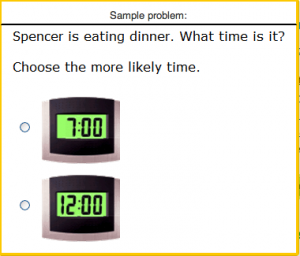
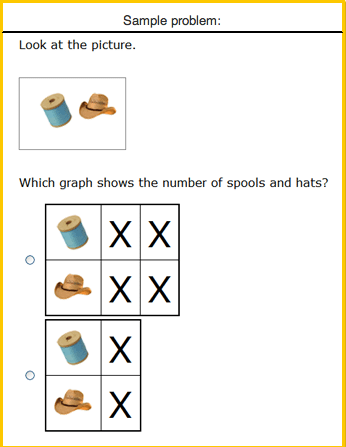
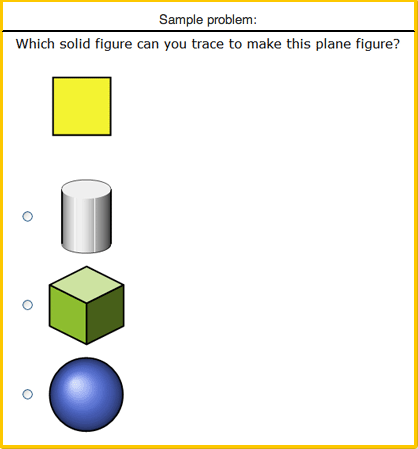
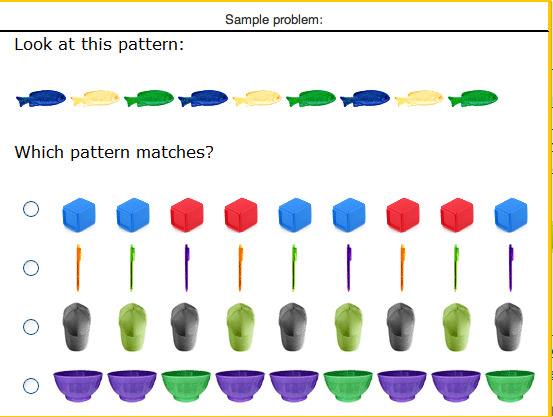
When looking at the IXL sample page, I started having some concerns. Here are some screenshots that I’m running into, as well as my thoughts:
Kindergarten Skills
Some people say “dinner” for “lunch.” They reserve the word “supper” for the evening meal. Instead of using terms that might be cultural, perhaps they could have used breakfast.
I was so confused by this one. I’ve never seen a graph made of two objects. Nor have I seen graphs made with giant Xs. I think a graph with lines or bars instead of Xs would be clearer. As well as having a few of the objects, not just one of each.
These suitcases appear to be the same but zoomed in. A reference object would certainly help this.
I didn’t know what plane geometry was until college. I’m pretty sure that five-year-olds and their parents will figure out what the answer is, but the question stem is written at a really high level.
Grade 2 Skills
The right answer (the pens) are very very hard to see here. And the various colors and objects are confusing. Better would be the same objects, or bigger or with more space between the lines.
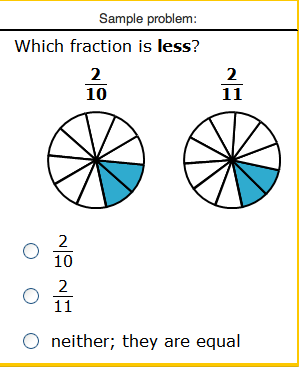
These pies really look the same to me. If I look and count really, or look at the fractions, I can see they’re different. This might be more effective without the pictures. For a seven year old (and for me), if you had 2/10 of that pie and he (or I) had 2/11 of that pie and it looked like these pictures, they could easily be perceived as the same.
Stopping Now
Of course I haven’t really gotten into the curriculum. These are merely samples. I don’t know how they teach this in the IXL Math Practice program. I worry, though, that these examples might be representative of the way it is taught.
I welcome a view into the curriculum, if they’re interested in more thoughts on their offering.
Update March 29, 2012: IXL has communicated to me that they’ve been making changes – including some based on this article. They’ve also hired me to take a deeper look at their product and give them feedback. I look forward to seeing what they’ve got.
The comparison of numeracy to literacy is curious.
Learning math is the opposite of learning to read. When you read, usually simultaneous to learning a language, you sound out words and then put meaning to them. When you learn to count and do math, you know the meaning inherently and then put a language to it.
At some point we learn to recognize words without sounding them out. And at some point we learn to recognize quantities without counting them out. This is called subitizing.
The Your Baby Can Read program uses the concept of subitizing to teach reading – you show your baby the word alongside the object. So the shape of the word car is as recognizable as a car itself.
The children using Your Baby Can Read don’t learn to sound out words. They don’t understand the concept of letters any more than babies not using the program. But they instantly recognize the shapes of the words – giving them an (assumed) advantage.
Aside: We didn’t use the “Your Baby Can Read” program, not because it was gimmicky (I love anything that looks gimmicky), but because there is a huge DVD element to it. We decided not to put Daughter in front of the TV for her first 2 years. A decision we stuck with, but sometimes was a struggle!
This article contains a “your baby can count” type program. (And it’s a free download!)
How did we learn subitizing?
I don’t recall having been taught it directly. Although I could be wrong. The research on it has been happening since the early 1900s, so it might have been taught without being labeled “subitzing.”
I wonder how many of us do that. Are grownups so adept at subitizing that they forget that’s how we assess quantity? Maybe we’re taught to chant-count because that’s the way we think counting is.
But it isn’t!
How do you teach subitizing?
Images are accompanied by the written numeral as well as the number spoken aloud. The images would be printed on cards, done via video or “live” with 3D objects.
I’m still working on the numbers 5-10 and up, but for the numbers 1-4, the following 8 styles of image sets would be done twice. Once using the same objects for each image set, and once using different objects for each image set.
Organized in a row vertically.
Organized in a row horizontally.
Organized in a row diagonally.
Organized in a row other way diagonally.
Organized in a regular shape (triangle, square).
Organized in a differently oriented regular shape.
Organized in an irregular shape.
Organized in a different irregular shape. (There will be more of these for 4 than 3, etc.)
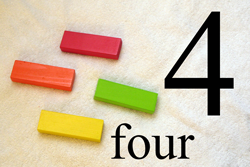
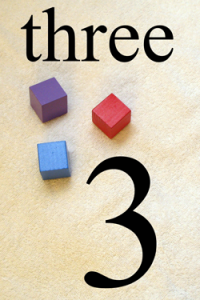
The objects could be blocks, cars, little dolls, just about anything. I created the set below from blocks I found left in Daughter’s block set.
Each zip file contains a few .jpg files with 4″ x 6″ pictures. You can print them at home or ship them to Walmart, Target, CVS, etc. for printing. I left off the MathFour.com logo so the kiddos wouldn’t get distracted. Please share them along with links back here.
Previously, I gave a definition and some resources for subitizing – assessing quantity without counting. The questions I posed in the previous article were
Having thought a great deal about it, I wondered if it was even relevant to teach it. And Husband asked the question, “Don’t they need to count and know their numbers before learning to subitize?”
You don’t have to learn to count to know “how many.”
Although evidence indicates that subitizing and counting happen in the same part of the brain, you don’t have to know how to count to subitize.
Subitizing up to 4 or 5 using recognition bypasses the “counting” of numbers.
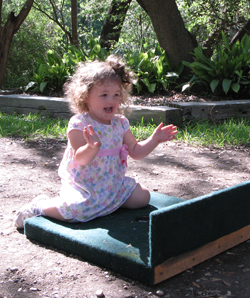
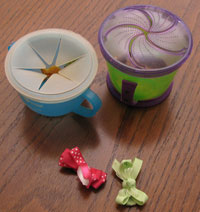
Daughter is currently subitizing 2 – without counting. I haven’t taught her how to count objects at home and they don’t do it at school yet. So she has no concept of one. But “two bows” (one for my hair and one for hers) is very important to her. Likewise “two bowls” (one with goldfish and one with Rice Chex) is an amazing thing.
This article by Ernst von Glasersfeld explains how number words can be associated with the quantity without ever counting. Children give the appearance of counting because they’ve memorized the number words and they use the cadence to tap their finger on objects. But they’re usually doing this to be rewarded with praises and cheers. They don’t really understand the concept of counting. This is what I saw the little girl doing at the playground.
It IS important for kids to subitize.
What’s the point, anyhow? If I can quickly see 8 things – does it matter? And is it important to tell the difference between 8 things and 9 things? If there are 8 hungry tigers heading for me and I subitize that there are 9, will it make a difference in how fast I run from them?
I researched more and found out that subitizing does matter to the understanding of numerical concepts.
Subitizing 2 items and putting it with a subitzed 3 items can yeild the perceived 5 without ever knowing what addition is. And having the group of 4 items and seeing within it a group of 3 or 2, leads quickly to subtraction and division.
Thus subitizing “teaches” various mathematical concepts without ever getting into the language or construct that grownups have put on it.
So how did we learn it?
My initial guess was that we’ve learned to do it the same way we’ve learned to read without sounding out the words. Over the years we’ve seen and counted many hundreds of bundles of 3 things that when we see another bundle of 3 things, we know there’s 3 of them.
Upon further research I’m now of the opinion that I learned it from Ma saying to me “there’s three of them” while I looked at a collection of three objects. I bypassed the counting and went straight to learning the cardinality – with the help of grownups.
The cliffhanger…
So I’ve yet to answer the question, “How do we teach subitizing?” Alas, it’s coming. (UPDATE: it’s here, complete with downloadables!)
In the meantime, where do you observe subitizing and does it seem important?
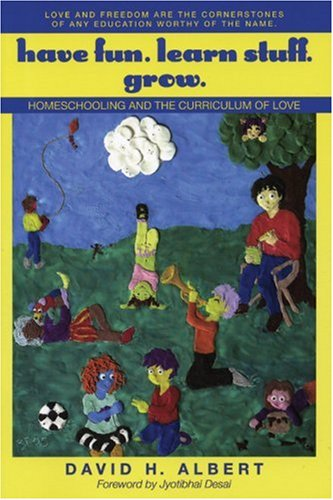
Reading through it, the thought that came to mind over and over was, “Finally.”
Here was my favorite part:
…the subject matter itself isn’t all that hard. What’s hard, virtually impossible, is beating it into the heads of youngsters who hate every step.
Indeed there is a gracious sufficiency of beating – and resistance – when teaching math.
But everyone already knows math!
In the book, Albert wrote:
If you never teach a stitch of math, in a mathematical culture your kids will learn heaps of it anyway. …learning math along the journey is a difficult thing to avoid.
You can’t not do math and exist. It’s like not breathing. Impossible.
We survived for a very long time without the written word. But we’ve never existed without math.
Early humans knew that to divide a chunk of meat between two people would yield too little:
He might not have have had the fancy way to write it – but he could learn how to write it in 8 weeks.
Daughter playing with washers: counting them and learning math in her world.
Can you teach all of K-12 math in 8 weeks?
The short answer – it depends on to whom. In Albert’s article, he’s teaching children. You can totally do this with kids. And cavemen, I suspect.
Grownups are a different story. Innumerate adults already have anxiety, anger or fear associated with math. There’s a whole lifetime of un-doing that would have to take place.
But once you undo this, then the 8 weeks would work.
The way I teach college classes is this: we’re going to spend 48 contact hours together – I’m going to wow you in ways you’ve never expected. When we’re done, you’ll be much calmer. You’ll be able to learn math much better, both on your own or in a classroom.
I don’t force learning. I don’t even require learning. I let it happen. It’s the closest I can get, in the classroom, to what Albert is saying.
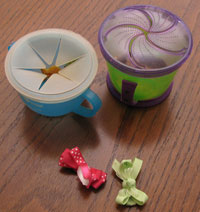
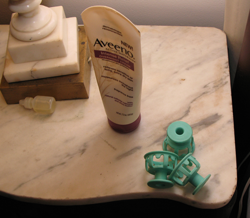
I used perceptual subitizing to “know” that there were three green hair curlers here.
Alas, I had never heard this term. So I did some research and thought I’d share what I’d learned.
Subitizing is a way of instantly counting. In fancy math terms it would be getting to the cardinal number of a set (how many) without without going through the ordinals (counting each one’s position).
There are two types, perceptual and conceptual. Perceptual is perceiving the number of objects immediately. Conceptual is putting a little effort into it.
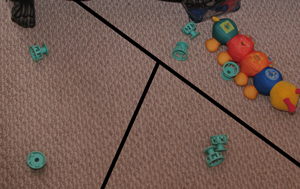
For instance, I glanced at the hot rollers Daughter had scattered on my side of the bed. I perceived there were three on the nightstand. But I had to do a little conceptual subitizing to arrive at the number of curlers on the floor (see the pictures).
I had to mentally “chunk” these hair curlers into smaller perceivable bundles to conceptually subitize the number here.
Do you wonder if your children should be using a calculator “at their age”? Are you a fan of calculators, but have friends who aren’t? Are your friends “into” calculators while you oppose them?
I often hear people say that children 50 years ago understood math concepts more quickly. Although our parents weren’t taking classes called algebra in the 7th grade, they were doing algebra in the 7th grade.
Algebra is arithmetic.
There are two fundamental and rarely understood facts about algebra:
Algebra is arithmetic with one or more numbers in disguise.
Algebra has exactly the same rules as arithmetic.
Which means if you can do arithmetic you already know how to do algebra!
Our parents or grandparents, 50 or even 30 years ago, weren’t using calculators. They had to apply all the rules of arithmetic to get the job done. Which means that they had to apply all the rules of algebra.
Teaching them a class called “Algebra” was much easier because of this.
What are the rules?
The basic rules that non-calculator users must apply are the distributive property and the order of operations. The distributive property is the thing that calculator use eliminates.
Children could get practice mentally multiplying things like 3 x 86 and do 3(80+6) = 240+18=268. With this practice, they are ready for 4x(3y+2z) = 12xy+8xz.
If they never have to multiply 3 x 86 in their head, they never get the experience of the distributive property. Which means teaching them 4x(3y+2z) = 12xy+8xz will cause anxiety and frustration. They see it as “magic” or “something you made up just to confuse me.”
Give them the tools they need.
Refuse to let students have the calculator. Let them have the tool of the distributive property for algebra before you teach them “Algebra”. Give them the benefit our parents and grandparents had!
Does your child struggle when you put him down in front of his math book? Are you frustrated in your attempts to get him to do math classwork or homework?
Maybe he’s a top-down learner. If so, you might not know based on his current “regular” work. It will help in his education if you know he needs the big picture before the details – or the big theories before the steps.
I remember learning to do derivatives when watching the foster kids that lived with us. I was eight. I’m a top-down learner. Here’s how to find out if your child is one too:
How the “green beans” con works.
My mom used to leave green beans open in a can on the table. We would walk by and eat them. If she put them on our plate, we would refuse them. So she got us to eat vegetables without asking us to, by just making them available.
You can use the “green beans” con as a test.
For math, put out the harder stuff. Find some books at Half Price Books or someplace cheap in your area. Open up the book. Sit and do some of the math yourself while mumbling aloud. Then walk away.
If he sees his folks (or older sibs) working through those problems, he might be interested. Watch to see if he goes up to the book to check it out (steal a green bean). Be available to answer questions if he asks.
If he can grasp some of that “higher level” stuff, he’s probably be a top-down learner. He won’t want the building blocks until he sees the plans for the whole house. This could be the cause of some of the struggle and frustration – he’s been given the building blocks instead.
Let him have the big stuff – start “allowing” him to do more of the advanced books. He’ll back up on his own to learn the “lesser” stuff so he can understand the big stuff better. You won’t have to force the work on him anymore.
Share your experience with your top-down or bottom-up learning in the comments!
Remember the ol’ “if A equals B and B equals C, then A equals C” deal? At parties it’s a great line to drop. In math, it’s officially called … cue music…
The Transitive Property
Saying it is fun, teaching it is curious, learning it can be weird.
Grownups think it’s intuitive. But to a kid, it isn’t. It takes experience and experimentation to learn all the bits that we think are “common sense.”
The transitive property is really thinking things through. Starting from one place and moving along through another and then arriving at a third place.
There are many ways to help kids with this learning. Word problems simulate thinking stepping stones. But they can be rather stressful. If you do it through play, you reduce the stress that they face and give them skills they need to tackle advanced thinking, forever.
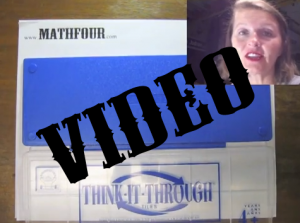
This video shows a nifty “toy” from Discovery Toys that can get kiddos using those brain stepping stones.
Notice the flow is
Choose the number tile with the question number.
Read and answer the question.
Correspond the answer to the letter in the answer box.
Put the number tile with the question number in the corresponding letter box.
Thinking through from question number to answer letter while avoiding the pitfalls is the challenge.
Have you played with these? How do you train your kids’ brains for the transitive property?
Have you seen the kid that isn’t getting the attention he needs at home? Wonder what’s going to become of him?
Well, the “it takes a village” concept isn’t far off. You might not be able to change his world, but sharing a little about math might help with one corner of it.
Share math in small bites.
Every time you see the child, pose a fun puzzle. It doesn’t have to be blatantly mathematical. Anything to get his logic working helps. I love the Childcraft Mathemagic book for puzzle ideas.
Ask her random math facts. Tell her you’ll give her something for each one she gets right – or each 10 she gets right in a row. Find out what’s important to her that you can’t get in trouble sharing. Like money, chocolate, baubles, etc.
Tell him that when you were growing up you wanted to be a mathematician. Ask him to find his favorite mathematician online. Find one yourself that you can discuss – I’m partial to Abel and Galois.
Be positive about math.
There might be many things wrong in a child’s life. Let math be the one that isn’t. Be positive. Help make math the thing a kid can hold on to.
Be the village because it takes a village. Share your stories in the comments!
This post is an answer to a question Michelle, a high school math teacher, sent. She writes:
I explain a new concept then give an example and finally do an example with the class directing me on how to solve. What I have noticed is that the bulk of the questions occur during or after the chapter assessment. Most of the students’ questions are great questions. It’s just that the questions they are asking are ones they should have asked much earlier.
Think of knowledge as a bag of shapes – all of which have different colors and textures. Once you get the bag, you have to sort through them. Some people want to count them, some people want to sort them by color, some by shape. Some people need to sort by texture. Some people need to sort by all three or just lay all of them out in rows to get a good look at them.
Everyone sorts the bag of shapes differently. Likewise, everyone sorts information differently.
Turns out, the bag of shapes isn’t the knowledge. It’s merely the information. And it takes each person “sorting” it in their own way to turn the information into knowledge.
In teaching and learning math, I’ve noticed a cycle. I’ll use the bag of shapes to illustrate it:
1. Exposure
Exposure is usually in the form of lecture and examples done by the instructor. It can be the first time the student has seen it or the first time in a long while.
This is where the student receives the closed bag of shapes.
2. Activity
Any activity following the exposure. This typically is in the form of homework or classwork practicing the concept and problems.
This is the “peeking into” the bag of shapes. The student gets to remove a few of them and start looking at them.
3. Settling
Allowing the subconscious to work. The brain does this all on its own.
Often mathematicians will go for long walks, go to the movies, hang out with their kids, talk to non-math people or do any number of non-math things to force the settling phase.
Children don’t know how to force the settling phase, nor do they need to. It just happens between when they do the homework and when they start to study for the exam.
In the bag-o-shapes analogy, this is where the students dumps all the shapes onto the floor and sorts them in various ways. It takes a while to get through all the shapes and see what kinds of sorting can be done.
4. Re-engagement
This is typically in the form of studying for the test and taking the test. It can be a heightened emotional situation where the learner is under stress.
This is a revisit of the concepts. It becomes easier because the settling has occurred and the information (the bag of shapes) is already organized.
The learner at this point will attempt to modify some of the conscious thinking to best fit with what the subconscious has done. The added stress will allow them to connect with what they’ve done better – as the “feeling” state induces a different type of learning.
5. Application
This is using the concepts for something else. This will often be the next class or next term of the math curriculum. If you learned graphing functions, you will likely use graphing functions in the future.
To wrap up the analogy, this might be a student realizing that the bag of shapes is needed for something – not just a random bag of shapes. Therefore he can re-organize them to be of use in the new situation.
Let the learning flow.
This flow of learning is natural. It will happen and has to happen. The only thing you can do to artificially speed it up is cycle it more often.
The students ask the good questions, as Michelle said, “during or after the chapter assessment.” This is in phase 4 – Re-engagement.
Instead of going through a single cycle, do it two or three times. Like this:
Monday: Lecture, chapter 1 (exposure)
Monday: Classwork and homework, chapter 1 (activity)
Friday: Test, chapter 1 (re-engagement)
Monday: Lecture, chapter 2 (initial exposure to chapter 2 and application of chapter 1)
Monday: Classwork and homework, chapter 2 (activity)
Monday: Lecture, chapter 3 (initial exposure to chapter 3 and application of chapters 1 and 2)
Monday: Classwork and homework, chapter 3 (activity)
Wednesday: Test, chapters 1 and 2 (re-engagement again)
Friday: Test, chapter 3 (re-engagement)
Monday: Lecture, chapter 4 (initial exposure to chapter 3 and application of chapters 1, 2 and 3)
Monday: Classwork and homework, chapter 2 (activity)
Wednesday: Test, chapters 1, 2 and 3 (re-engagement again)
Friday: Test, chapter 4 (re-engagement)
What do you think? Share your experiences with the cycle below in the comments.
Thanks to Michelle for requesting this tip. Michelle is one of only two math teachers in a rural private school. She teaches Algebra I, II, Geometry and Calculus.
Do you have a question? Ask it in the comments section.