In the order of operations, the “Exponents” rule represents a bunch more than just superscripts or tiny numbers flying up and to the right of things.
Roots are exponents, too!
Tree Roots by Linda Allardice
Not the ones from trees, but things like square roots and cube roots. Consider . You do the square root first because it qualified as an “exponent.”
But if you had , the 9 + 2 is under the radical sign (the square root sign) so it’s bound together in the “Parenthesis” rule.
This one isn’t that hard with arithmetic, but when you come to algebra and start “undoing” these things – it’s important to remember that roots fall into this category.
Fractional exponents are exponents.
This one seems pretty “duh” so it’s easy to see how they fall into the “E” of the order of operations. But what are fractional exponents really?
So fractional exponents are the same as roots.
Note that some fractional exponents are roots and “plain” exponents all mixed up. Like this one:
This is a big fat full concept that needs a little more explaining. I’ll write more on these in another article.
Logs fall under the E.
Axe In Stump by caroline steinhauer
As my algebra and computer math teacher in high school, Mrs. Kelley, used to tell us – logarithms are exponents. It took me a long time to figure out what the heck she meant. But when I did, I thought it was brilliant.
Notice who the exponent is in this: 32 = 9: 2 is the exponent. And 2 is the same as because the equals sign in means “is the same as.” So the logarithm is the exponent 2.
Still with me? Either way, it’s okay. It’s a weird concept that I can go into detail in a video soon.
The thing to remember here is that logarithms fall into the “Exponents” rule of the order of operations.
So if you have , you have to do the first and then add the 7 after.
Want more on exponents?
In the meantime, you can check out more than everything you always wanted to know about exponents on the Wikipedia Exponents page. Rebecca Zook created a great video on logarithms. And check out this explanation and problems to work on fractional exponents.
And let me know what you think. Did I miss something?
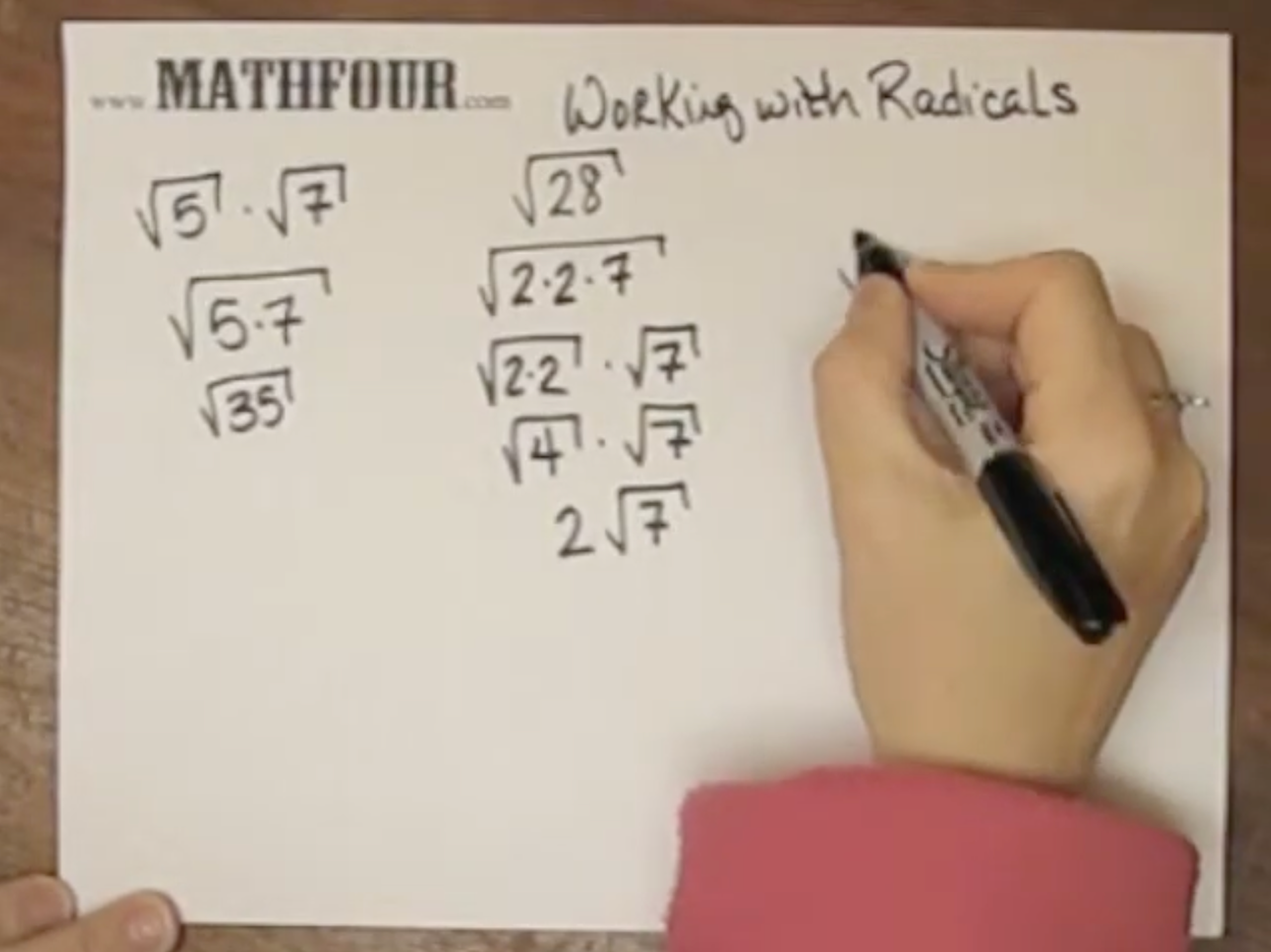
Square Roots (aka radicals) are part of the multiplication world. They have the same properties, but because they look weird – living in little “houses” – it is hard to grasp what they can do.
This is how the “houses” (the radicals) can “move”:
After that, you can work with multiple radicals:
It is important to note that this little trick works because it’s all multiplication, division and roots. If you have addition or subtraction in there, you’ve got yourself a challenge. Watch this to see how to deal with addition in the mix:
Thanks to jrobbo at MyMathForum.com for the inspiration for this post.

![[50 Word Friday] A Boy Wonders About Math and His World](http://mathfour.com/wp-content/uploads/2026/01/image-137.png)