Tag: hate math

  • Creativity Destroyed

    Creativity Destroyed

    I am attending the Offshore Technology Conference this week, meeting old friends and looking for great math to talk about. Yesterday, while relaxing at the Oil States booth, I explained my goal of finding math at a trade show.

    Amber, a subsea and pipeline engineer (i.e. super math girl) started throwing out ideas.

    She saw the ratio of bolts in a flange connection to the size. She mentioned gear ratios and the number of turns it takes to open and close valves.

    And then things took a strange turn.

    Amber jumped outside the box with both feet: “How many CEOs does it take to change a light bulb?” I wrote down the joke.

    Feeling comfortable with getting a little math-crazy, she unleashed her creativity.

    She suggested that thread size, shape and spacing on bolts was like the binding on spiral notebooks – both good places where math is used. She pondered the statistics of letter frequency in the names of different nationalities of people.

    And she noticed that the distance between the signs hanging from the rafters, and the tops of the booths must have been calculated or they would be smacking into each other.

    “I love thinking outside the box,” she gleefully exclaimed.

    And then she told a story of creativity destroyed.

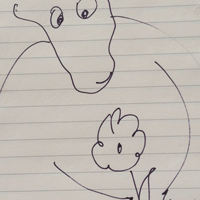
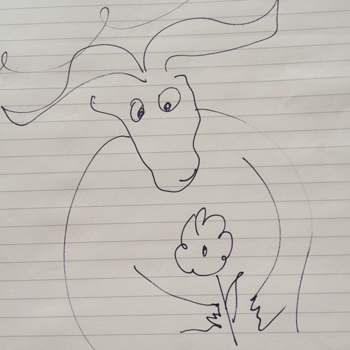
    As a child, she had drawn the famous Ferdinand the Bull under his favorite tree, smelling the flowers.

    And her teacher told her it sucked.

    “I never did art again,” she confessed to me.

    Heartbreaking – especially since I’ve heard a version of this story hundreds of times. I never thought that I would ever hear it told with drawing, though.

    A few words can destroy creativity.

    It’s normal and healthy to know our strengths and weaknesses. But we each have a right to discover our own weaknesses. Having someone declare our weaknesses is a violation.

    Amber does very well as an engineer. But how different would her life look like now if she had continued to draw?

    Maybe none. Maybe she would have drawn for years, enjoying it. Perhaps she would have eventually discovered that she was much better suited to engineering.

    But maybe she would have become a Picasso.

    Be careful what you say.

    If a child is giving it their best shot and you meet them with criticism, you might shut down their creativity for life. And it’s easy to do this with math – there are so many ways for a kid to do things “wrong.”

    But try to treat math learning like learning to create art. Regardless of how much the drawing sucks, be encouraging.

    If a child is adding denominators instead of finding a common one, discuss what the answer looks like. Give them the right, and the power, to see where they went wrong.

    Foster each child like they’re a budding Picasso and Pythagoras, regardless of how little talent you may see in them. Let them do things their way.

    You just might be surprised at what they end up doing.

    Do you have a story of creativity destroyed? Share it in the comments. And don’t forget to share Amber’s story on twitter.

    Related Articles:
  • Do Parents See the Math Monster? Or Just Think It's There?

    Do Parents See the Math Monster? Or Just Think It's There?


    There were several thoughtful and intense comments to the Sylvan commercial. As promised, here is a follow-up article based on the comments. A special thanks to those commenting on the video, as this is what keeps the math-revolution conversation going!


    There is definitely a disconnect from a service or product and those advertising or making the sales. I’m sure a lot of tutors/teachers at Sylvan wouldn’t endorse the commercial or would go about it a different way.

    Our intent wasn’t to beat up on Sylvan for trying to make a buck. We wanted to bring the commercial’s message to the attention of readers more as a way of asking:

    What does it say that a (probably) well paid ad dept. thinks that this would be effective (which it is)? And what does that say about us as a society (‘math stinks, it’s something to fear, I don’t even want to try’)?

    How about the fear?

    What you don’t know or understand is often scary.

    You may have memorized some math at some point, then brain dumped it on some test. If so, do you really understand this math you “learned”?

    If not, the idea of helping your children with math, without the guidance of someone telling you how, is frightening.

    What’s more frightening: wondering what the monster looks like, or seeing him?

    So they will never show you what your “math monster” looks like.

    But what if they did? Is the math monster that bad?

    What would it look like to help make math less scary for parents? Could parents model this “okay-ness” to their kids? Or better yet, would they have the confidence to help little Billy with homework?

    It’s not going to happen if parents really believe they are helpless and shouldn’t even try. The kids see this and do the same thing 25 years later to their kids. (Perpetual pattern?)

    It’s ok, maybe even cool to say “I’m bad at math”.

    This makes the commercial palatable, or even comical, to some who may relate.

    But if this commercial featured a mom running away from little Billy when he asked, “Mom, can you help me with my reading?” folks would be offended!

    Let’s make math okay for parents too.

    I’m not saying places like Sylvan shouldn’t exist. To the contrary, actually. They provide a wonderful service.

    But if parents are running – and encouraged to run – from helping their kids, they are sending a message. Kids see this and learn, “Mom doesn’t do or like math, so it’s really not that important.”

    Little Billy might end up passing, even making an A, but he’ll continue the pattern with his kids.

    So now’s the time to interrupt the pattern. If you’re a parent, find ways to see and say math around you. If you run from math, pretend you don’t.


    What do you think? Keep the conversation going in the comments! And share this article on twitter.


    Feature image by jez.atkinson | Flickr.com | CC BY

    Related articles
  • How to Teach Adults Math

    How to Teach Adults Math

    Today is my first day of teaching Developmental Math. I picked up two classes in the “late start session” at Lone Star College.(Yup – in Texas. How’d’y’guess?)

    And I’m so excited about teaching again!

    But how do I do it?

    A year ago the answer to that question would have been, “Duh!” Having taught for so many years I’ve gotten the art of explaining math on the chalkboard (and later whiteboard) down to a science. I’m good. Real good.

    But this past year, writing on MathFour.com, has changed things. I’ve connected with wonderful moms, dads, teachers of math and teachers of… well… just about everything. My philosophy on teaching math has been shattered.

    In the past, I’ve taught content. We’ll do the slope-intercept formula, talk about graphing and test over things like “Section 1.3 to 2.5.”

    But I’m not sure if that’s the right thing to teach. In fact, I’m not sure there’s anything to “teach” at all.

    I have to remember what they’re up against.

    This class is the most “remedial” of the classes offered in the math department. But the “gaps” they have in the math may not have anything to do with ability.

    I’m going to forego a syllabus – at least at first. Instead, their first assignment will be to read a research paper on math anxiety.

    From there, I’m going to let them guide what we do. We’ll likely get to content, but we’re not doing to push it.

    We’re going to get ready for whatever is next.

    They aren’t done after this class. In fact, this is the first of at least four math classes they’ll have to take. So whatever we do here lays the foundation for how they handle the other classes.

    The next math class they take might be inspirational and based on understanding, exploration and learning. Or it might be another content driven, talk-at-you-while-you-take-notes semester full of processes and methods to arrive at a RIGHT answer.

    Either way, I hope that by the end of this semester, they will feel empowered to take on their own learning. To demand learning facilitation instead of teaching. And join the teachers that have been leading the math revolution.

    Will I get fired?

    I hope not. But it’s possible. There’s no telling what’s fixing to happen.

    The only thing I know is that I’ll no longer sacrifice students for the sake of the system again.

    What are your thoughts? Please share them in the comments.

    Feature image by ralph and jenny | Flickr.com | CC BY

    Related articles
  • What Are Your Thoughts on This Fearful Parents Video?

    What Are Your Thoughts on This Fearful Parents Video?

    Wil showed up at the Math Shack this morning talking about a commercial he saw on TV last night. “Wow, this is what parents are up against!” he said shaking his head.

    Check it out for yourself:

    We’ve been talking about it all morning. Before we post our thoughts, we’d love to have yours.

    1. What’s the intended message?
    2. What’s the real or perceived message?
    3. How does it affect your view on math as a parent?

    Share your opinion in the comments and let others know via twitter.

    Related articles
  • ‘I Hate Math’ – It’s Okay to Say It!

    ‘I Hate Math’ – It’s Okay to Say It!

    Gary commented on an article I wrote called, How to Get People to Stop Saying “I Hate Math”.

    He spent tons of energy defending his position, explaining how “math people” really anger him and his fellow “math haters.”

    My initial reaction was to type out a response demonstrating where he does math, how he does it, and even the parts in his comments where he admitted he does math everyday.

    But I stopped. It seemed… wrong somehow. So I’ve been thinking about his comments for a couple of weeks now – wondering how I should respond.

    I learned something new about learning math.

    Gary has taught me something about learning and teaching math: when we push, others push back.

    For so long I’ve told people to stop saying, “I hate math.” I’ve tried to convince them they can’t hate math because they do math everyday. Clearly (I see now) this helps people say it more.

    When told they don’t really hate math – they find reasons that they do. They work very hard at digging up all the experiences that support it. They can’t remember the experiences that might have been good. Everything they’ve got is poured into defending their stance.

    When we invalidate feelings, they push more.

    Every time I tell someone they don’t hate math, I’m invalidating their feelings! How is this fair?

    It isn’t. It’s yukky and hurtful.

    If you hate math, good for you! That’s the way you feel.

    I hate magic – something that lots of people think is stupid. But that’s the way I feel. And I don’t want those turds invalidating those feelings.

    People have the right to feel the way they feel. And if they hate math, that’s okay.

    People do math everyday.

    The fact is that people do math. Everybody. Everyday. Even Gary.

    Gary writes in his comments: “this isn’t to say that I can’t perform basic math or even a few not-so-basic mathematical/arithmetic disciplines.” He does math everyday, but I’ve given him reason to dig out all the horrid things about it.

    My business coach, Sarah Shah, has a really cool way of handling things like this. She gets people to open up. But not by telling them what they should think or feel. Instead she yields and acknowledges the other person. She validates their feelings.

    Up until now I’ve been doing just the opposite. And I feel terrible about it.

    I apologize to you.

    So Gary, and everyone else in Gary’s shoes, please accept my apology. You hate math. And I’m not going to push you on that anymore.

    And from here out, when someone says “I hate math,” I’m going to open up. I’m going to say, “You hate math,” and I’ll wait for them to offer more.

    I’m not going to give the “mom look” ever again.

    Back to you…

    What happens when someone says, “I hate math” in front of you? What happens when you say it to others? Will you do anything differently now? Share your thoughts in the comments.

    And a huge thanks to Gary for his honesty!

    Feature image by Alesist | Flickr.com | CC BY SA

    Related articles

  • 3 Words to Improve Your Child’s Success in Math

    3 Words to Improve Your Child’s Success in Math

    Yup – only three. Said by you, the parent and grownup. Say them loud, say them often. And contact me when you wonder where math is in your world – or leave a comment here!

    Related articles
  • Everybody’s Good at Math

    Everybody’s Good at Math

    This past Monday we had a great #mathchat via Twitter. The topic was: “If you could clear one misconception about mathematics and/or teaching it, what would it be?”

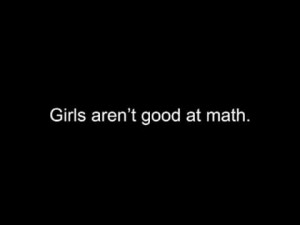
    I was getting a bit frustrated that a couple of people kept bringing up the misconception that girls aren’t good at math. Even to the point of creating their own hashtag #girlsaregoodatmath2.

    In my life, I’ve never heard anyone say this – in any other form than somebody complaining that people say it.

    So here’s my response to everyone who keeps saying to me, “I wish people would stop saying, ‘Girls aren’t good at math.’”

    What do you think? What will you say from here on out?

    Related articles
  • Why Engineers Make Bad Math Tutors

    Why Engineers Make Bad Math Tutors

    I was at my dad’s house the other day and decided to pull out my new Math’d Potatoes game to see how my super-gaming family liked it.

    The kids in the house were too young to play, so my sister and I asked Aunt Linda and our stepmom to play with us.

    They quickly claimed they were “math Neanderthals” but agreed to play anyway. My dad, an engineer, was asleep.

    The game has simple rules.

    You play Math’d Potatoes by drawing a card, rolling five dice and making an expression that “satisfies” the card.

    The card requests various types of “answers”:

    • Even or odd
    • Equal to a certain number
    • Between two numbers
    • Less than/greater than a certain number

    Everybody got into it.

    Aunt Linda and Louise (my pet name for my stepmom) both agreed that it was a fun math game. This is in spite of the fact that neither one of them like math, and Aunt Linda doesn’t even like to play games at all!

    My dad saw the game the next morning.

    I had intentionally not waken up my father to play with us the night before. My decision was validated the next morning.

    My dad is an engineer, and as such tends to use the phrase “all you have to do is,” and the word “just.” He’s a very smart man, and I’ve learned lots from him through the years. And one of those lessons is: “Keep an engineer away from sensitive math learners.”

    Sure enough, when he saw the game, he eagerly said, “What’s this? Are we going to play it?”

    When I explained we played the night before he responded with, “Why didn’t you wake me? I totally would’ve won.”

    Math learning is slowly build, and quickly destroyed.

    When we were playing, Aunt Linda and Louise were both starting to warm to the idea of math. They were enjoying the game. My sister and I were holding back just a little to give them an opportunity to discovery their own skills. (We both experienced the engineer–math–dad super push growing up.)

    So by the end of the game that night, they were excited, confident, and enjoying themselves.

    Had I woken up my father to play the game, he certainly would have won. He might’ve turned it into a competition, or he might have tried to help a little too much.

    Either way they would’ve lost interest. Their confidence would have been destroyed. And two beautiful, smart and happy women would have their, “I’m a math Neanderthal” thoughts validated.

    You can use this with your children.

    If you or your spouse are in a math related field, or was “always good at math,” be aware of your potential intimidation factor. Hold back. Don’t help. Allow discovery and confidence to come at its own slow and natural pace. Your children will learn math, in their own time.

    Don’t force it, or you might destroy it.

    Note: They sent me this game for free. This is not a review, per se, but still – you should know how I got it.

    Related articles
  • [50 Word Friday] A Vicious Cycle

    [50 Word Friday] A Vicious Cycle

    Jacques_Callot_The_Seven_Deadly_Sins_-_Anger_175

    “I hate math,” the girl said to her friends. They repeated it. Then they grew up.

    “I hate math,” they all said to their kids. “I hate math,” the kids repeated to their teachers.

    “NO YOU DON’T,” the teachers scolded. “It’s fun and you’ll do it!”

    “No! We hate math.”

    Learn more about 50 Word Friday here.

    Related articles
  • How to Quit Saying “I Hate Math”

    How to Quit Saying “I Hate Math”

    Is changing how you feel about math like changing who you are?

    My Little Brother is a licensed professional counselor. He often tells me that you can change your attitude by changing your behavior.

    Apparently the behavior-attitude door swings both ways. If you don’t want to do something because you feel frustrated, do it anyway and that will clear up the frustration.

    So that’s how you can get your attitude and your child’s attitude aligned with positive feelings of math.

    Stop saying angry math things.

    I’ve pointed out that the real place kids learn math is at home. And I’ve discussed why grown-ups should quit talking about hating math. But until now, I’ve never said how to do this.

    Because it’s easier said than done right? When you’re frustrated, or your children are frustrated, you’ve gotta say something. So you can’t “just stop.”

    HOW do you quit saying “I hate math” (when you really do hate math)?

    First, make a list of all the math things you do (download the handy helper here). Here’s a starter list for both you and your children:

    • I know how long it takes to get dressed and so I can calculate when I have to wake up in the morning.
    • I can figure out if our car is getting good gas mileage.
    • I can figure out if I have enough money saved to by a nice toy.
    • I know what I have in savings and if that’s enough to buy the fancy shoes I want.
    • I know how many minutes it takes me to walk to my friend’s house.
    • I know that riding my bike to my friend’s house is faster than walking.
    • I know that in the past I couldn’t reach the middle of the dinner table, and now I can – because my arms are longer.
    • I can figure out how much I’ve grown in the past year by looking at my growth chart.

    Copy your list and put it on the refrigerator, in the bathrooms, on the front door and next to your bed. When you find your child or yourself wanting to say, “I hate math,” instead say, “I can do math because __” and fill in the blank with something from the list. If you need to, continue like this:

    This particular math problem I’m working on is more challenging than what I already know, but it isn’t hard. I just have to figure it out. And since I’m smart enough to do all that other math, I can figure this out!

    The behavior of changing what you say will have a positive affect on how you and your children feel about math!

    Try it. Let me know how it goes!

    This article was previously part of a We Are That Family “Works for Me Wednesday” post.

    Related articles