Tag: cognition

  • Time Zone Math: Using the Fret & Grind Method

    Time Zone Math: Using the Fret & Grind Method

    It took me a long time to learn how to figure out what time it was in Los Angeles when it was at 7 AM in Houston.

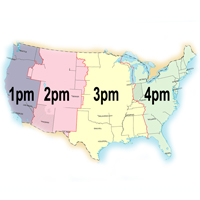
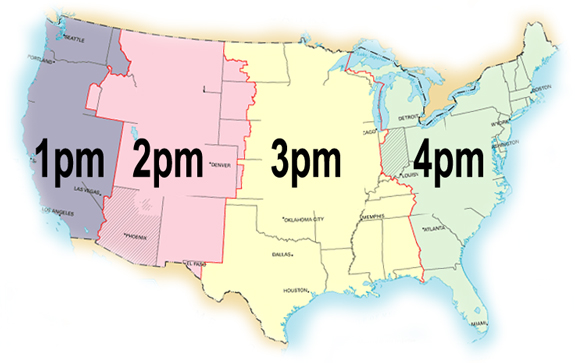
    Notice on this time zone map that the numbers count in a very intuitive way across the US:

    This works just fine if you’re managing locally.

    Global time zones are more of a challenge.

    I used to send out a weekly newsletter. Generally it was set to arrive in people’s inboxes between 3 PM and 6 PM Thursdays — in their local time zone.

    Which means any changes that I had to do would have to happen before they got the e-mail at 3pm on Thursday.

    But not everybody lives in Texas. So my deadline was not 3 PM on Thursday, really. It was the first time anyone in the world encountered 3 PM Thursday.

    In order for me to make the deadline for a global audience, it was essential to figure out what time in Houston that is.

    Greenwich Mean Time -6

    According to the website Greenwich Mean Time:

    Greenwich Mean Time (GMT) was established in 1884 at the International Meridian Conference, when it was decided to place the Prime Meridian at Greenwich, England.

    All time zones range from GMT -12 hours GMT +12 hours. Houston is Greenwich Mean Time -6 hours. Which means it should be a rather easy exercise.

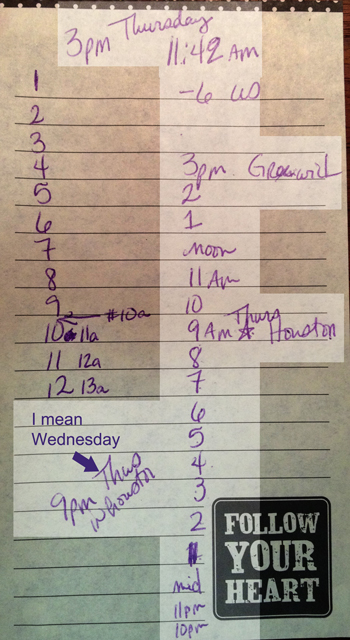
    All I have to do is add my six hours on the left side of the Meridian to the 12 hours on the right side to see that I’m 18 hours difference.

    I subtract 18 hours from 3 PM Thursday to arrive at 9 PM Wednesday as my true deadline.

    But we all know what happens when you say, “all you have to do is.”

    I used maps, charts and a lot of time.

    As I mentioned in the discussion of the book What Your Math Problem?, I often use very crude methods to solve problems.

    I opened up a world time zone map, started counting and making charts:

    I didn’t solve the problem traditionally.

    Often when grownups present math problems to kids, they’ve prepared. They demonstrate working a problem like I worked it above:

    Add my six hours on the negative side of Greenwich Mean Time to the 12 hours on the positive side. I’m 18 hours difference. Subtract 18 hours from 3 PM Thursday to arrive at 9 PM Wednesday as my true deadline.

    But that’s not the real way we do math. We often use the Fret & Grind method. Fret about what’s going on, grind out some rough sketches. Then fret some more…

    So why do we show kids the nice way?

    If they see the “all you have to do is” way, then they won’t gain the confidence to use the Fret & Grind method.

    And the Fret & Grind method is the best way — sometime the only way.

    How do you teach time zone math? Do you encourage Fret & Grind?

    Share your thoughts in the comments or on twitter/x.

    You might also like:
  • What's Your Math Problem? Book Study

    What's Your Math Problem? Book Study

    Donna Boucher over at Math Coach’s Corner has started an online book study with the book What’s Your Math Problem? Getting to the Heart of Teaching Problem-Solving by Linda Gojak. I’ve jumped in late, but I’m in with a bang!

    The book is a how-to guide on teaching children math problem solving tactics. This helps them develop their own problem solving styles.

    It’s written for the classroom teacher but I’ll be giving tips on how to use the tips in your homeschooling or afterschooling journey.

    Here’s the outline of the book:

    • Chapter 1, The 5 Ws and an H of Problem Solving
    • Chapter 2, Planning for Problem Solving in the Classroom
    • Chapter 3, Getting Started Strategies
    • Chapter 4, Getting Organized Strategies
    • Chapter 5, Visualizing Strategies
    • Chapter 6, Advanced Thinking Strategies
    • Chapter 7, Assessing Problem Solving
    • Chapter 8, Questions from the Field

    Here’s what it looks like in the order that I’ll be publishing it:

    • Intro & Chapter 3 (this one — remember I’m starting late)
    • Chapter 1 (catching up)
    • Chapter 4 (I don’t want to fall behind again)
    • Chapter 2 (almost there…)
    • Chapter 5 (sweet — now I’m on schedule)
    • Chapter 6
    • Chapter 7
    • Chapter 8

    Grab your copy of What’s Your Math Problem? and jump in. Here goes Chapter 3…

    Getting started on a problem can be challenging.

    I love how Linda Gojak calls juicy, meaty problems “rich problems.” A good, fun thinkable is indeed a math word problem rich with problem solving challenges.

    But getting started on a rich problem can leave you feeling rather poor. So Chapter 3 gives, and is called, “Getting Started Strategies.”

    What’s that problem about anyway?

    The first question you (or your child) should ask when given a problem is, “What’s it all about, anyway?” This is the strategy of “Restate the Problem in Your Own Words.”

    Ask

    1. What’s happening — what does it look like?
    2. What bits of this problem are useless to me?
    3. If a normal person were to ask the question, how would it be written?
    4. Now what the heck does it really say?

    Restating the question in your own words means understanding what’s being asked and what’s happening.

    Is this a trick question?

    Sometimes textbooks (and even life) give you problems without giving you all the required information. This is grownup-talk for what kids call a trick question.

    If there’s missing information, call that bluff! What info do you need to calculate the final answer?

    • Is that information contained in the problem?
    • Can you find that information online or in a library?
    • Can you figure out that information using other stuff in the problem?
    • Is it just a flat-out trick question — there can’t be an answer because there’s no way to get the information needed?

    Calculate the information, if you can.

    Now it’s time to do a little pre-work. Gojak calls it “identifying a subgoal.”

    If you’re missing some numbers in the problem but you can get these from others, then start calculating.

    I walked 30 feet and then walked another 24 inches. How many feet did I walk?

    The subgoal here — figure out how many feet I walked the second time.

    Figure out how to show your work — or not?

    One of the strategies in chapter 3 is “Select Appropriate Notation” — which means determine how you’ll show your work.

    But first ask the question, “Do you want to show your work?”

    Here’s the big place where classroom schoolers and homeschoolers will diverge. It isn’t really necessary to show your work. Ever. And in homeschool, children don’t have to.

    If you want to show your work that’s great. If you want to share your work, you have to show your work. If you want to be a famous mathematician or even a run-of-the-mill engineer, you have to show your work.

    It doesn’t hurt to learn to show your work. But it’s not required to be a great problem solver.

    In fact, if your child struggles with notation, and you push this too hard, their developing problem-solving strategies could be stunted.

    But should you show your work for other reasons?

    Gojak writes:

    “…you use notation to help you reach a solution.”

    This is not necessarily true. Some people do. I don’t. The problem-solving strategy that works for me is doodling pictures and trial and error, strategies covered later in the book.

    I rarely solve a problem using x and y — or even crude representations of x and y like question marks or blanks.

    If you feel the need to verify that your child is thinking properly, ask them to explain it out loud. Or give them another rich problem. Don’t force them to show their work because you want to see it.

    Read more about it…

    Don’t forget to check out Math Coach’s Corner for some other thoughts on Chapter 3 of What’s Your Math Problem? Make sure to scroll to the bottom, because others are linking up their thoughts and opinions!

    Share your thoughts in the comments or on twitter/x.

    You might also like:
  • Understanding Math — Let Kids Fake It

    Understanding Math — Let Kids Fake It

    There’s a lot of talk about making sure kids understand what they are learning — instead of just practicing some arbitrary set of steps. I’m a proponent of this myself.

    I copied and laminated this back in 1998!

    But how well a child grasps a concept is based on how well he or she connects with it.

    The learning style and interests a child has has an impact on if (or how well) he or she will understand a concept. And, as far as I know, there’s no rule on figuring that out.

    You keep explaining it in different ways until you see the “aha moment.”

    Except there are some times when understanding is too far out of reach. Or the child’s way of learning requires a deeper understanding than what’s available or possible at that point.

    So what do you do in those cases?

    Do you delay teaching that piece for understanding? Do you go on to something else and skip it altogether? Can you go on to something else?

    Before making that decision, consider three points.

    1. Nobody understands everything.

    The way all the pieces of math work together is amazing. Nobody knows how they all fit — even the most famous of mathematicians. Everyone has something missing. Some of us have much missing.

    So if your child is lacking in understanding for a few things — or even many things — that’s okay.

    2. There’s more than one way to “understand” something.

    Take any math concept and you’ll find that the applications of it are vast. It’s likely that you can use it in business, in fashion, in your yard and kitchen and in the toy box. So you can explain the concept — and inspire understanding — with any of the applications.

    You can also explain a concept with metaphors to other math concepts and even metaphors to non-math concepts.

    3. But they’ll get it, eventually.

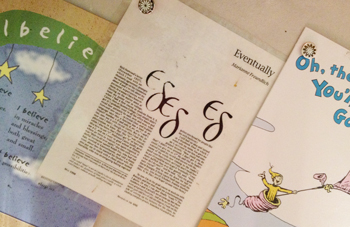
    Back in 1998 I photocopied an article from an AMS Notices journal called “Eventually” by Marianne Freundlich. I laminated it and hung it on my office wall.

    It’s moved offices a dozen times at least, but has remained an important reminder: “When learning something new, you may not get it now, but eventually you will. Just stick with it.”

    The “fake it ’til you make it” principle works in math too. It’s okay for them to practice something that they don’t understand.

    But kids need you to know they’re faking it.

    Often kids fake their learning. But they’re also trying to fake out the instructor. It turns into a big dirty secret that they keep inside. Like this:

    “Mr. Smith, I don’t understand this. I think I can do the problems, though.”

    “Well, Joan, let me explain it this way…”

    Mr. Smith explains another way. Joan feels uncomfortable because he’s spent so much time on her and she still doesn’t get it.

    “Okay, I think I understand now.”

    “I’m glad. It’s important for you to understand before we move on.”

    Joan thinks she’ll just keep practicing and hope that something clicks before the test. She doesn’t want to ask for more explanation.

    Fake it like Fermat!

    (That’s supposed to be a play on “Bend It Like Beckham” — I’m not sure it works.)

    A well known phrase in math graduate school is, “Okay, I don’t understand that, but I’ll go with it for now.”

    Mathematicians fake it all the time. They come back later to see if they can work out the details (and don’t publish or approve of something until they do). But they announce out loud that they’re faking it.

    And kids should be allowed this too.

    “Mr. Smith, I don’t understand this. I think I can do the problems, though.”

    “Okay, Joan, that’s fine. Perhaps after you do it a while, you’ll get it. “

    “It’s possible.”

    “No problem, if you don’t get it now, you’ll get it eventually. As we move forward, when you come to something like this, just keep doing the steps. That might help you understand, too.”

    “That works for me. Thanks, Mr. Smith.”

    “Feel free to ask me any questions about it and we’ll continue the conversation until you do get it.”

    Not understanding is totally okay — but the child must know it. And, more importantly, they must know that you know it!

    So let them fake it!

    When understanding is too far out of reach, encourage some rote practicing of the steps. And let them admit, out loud, that understanding isn’t there — even be happy for it.

    Anticipate the understanding and be excited that someday it will come.

    And if your child wants to move on, do it. They’ll get that other stuff eventually.

    Share your thoughts in the comments or on twitter/x.

    You might also like:
  • Midpoint Formula and Counting – Logarithmic Style

    Midpoint Formula and Counting – Logarithmic Style

    Download a printable version of this post here.

    I’ve never been a believer in the real number line. It just always felt wrong that between any two numbers, there’s another number. Sure, you can go between two things – but is there a number there?

    And then I think, “Well, add up the numbers you’re standing between and divide it by 2 – that’s the number between them.”

    But it still doesn’t feel right.

    I could be onto something, though.

    I listened to Episode #110 of Stuff To Blow Your Mind called “Is math a human invention or a human discovery?” They pointed out that tiny babies can perceive quantities.

    “Curious,” I thought.

    Then I peeked at their math series, in particular the article on What are Numbers? Which led me to Stanislas Dehaene and his appearance on RadioLab’s episode on Innate Numbers.

    Here’s the discussion.

    I was particularly interested when they noted (around minute 11) that we don’t naturally switch from logarithmic thinking to this 1-2-3-4-counting we do now!

    Around minute 12 in the audio, they consider the idea of midpoint. Dehaene notes that in logarithmic thinking, the midpoint between 1 and 9 isn’t 5, but 3.

    The midpoint between 1 and 9 is… 3?

    Here’s how we think of the middle: “What do I add to 1 twice to get 9?”

    We can add 4 to 1, twice, to get 9. So then we add it only once to get halfway there – and halfway there is 5.

    Graphically it can look like this:

    We could also use the fancy midpoint formula:

    \((x+y) \cdot \frac{1}{2} = (1+9) \cdot \frac{1}{2} = 10 \cdot \frac{1}{2} = 5\)

    Instead of adding, how about…

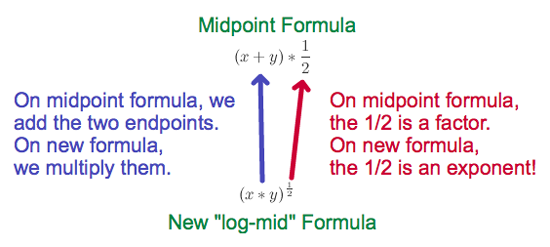
    Dehaene notes that logarithmic thinkers multiply to find the midpoint! Like this:

    These people think, “What do I multiply by 1 twice to get to 9?”

    So the new fancy formula can be seen as this:

    \((x \cdot y)^ {\frac{1}{2}} = (1 \cdot 9)^{\frac{1}{2}} = 9^{\frac{1}{2}} = 3 \)

    Whoa!

    Midpoint Formula Gone Wild!

    Look how the formula got adjusted:

    (Of course this leads to a whole ‘nother discussion about how the square root is really just “half” with respect to multiplication. But that’s going a bit to far for this article)

    How about another “midpoint” example?

    What’s between 4 and 762?

    For “normal” folks, it’s:

    \((4+762) \cdot \frac{1}{2} = 766 \cdot \frac{1}{2} = 383 \)

    And for the more “natural,” logarithmic thinkers, it’s:

    \((4 \cdot 762)^ {\frac{1}{2}} = (3048)^{\frac{1}{2}} = 55 \)

    Like this:

    And the bigger the numbers, the more “ish” things become. And apparently, that’s okay!

    So maybe we do have it wrong.

    I’ve told thousands of students over the years that mathematicians just make this crap up. There’s no truth to that “mathematics is the universal language” hoo-ha that they feed you in the movies.

    Leopold Kronecker noted:

    God made the integers; all else is the work of man.

    And just maybe man has messed it up.

    So is there really a number between any two numbers? Or is there just something “sort of” between any two numbers?

    What does this mean to math learners?

    Okay – now the bottom line. What does this mean to grownups teaching math – and the kids learning math?

    These little super heros have amazing powers – right when they’re born!

    Well – one thing is that we grownups can lay off. Let the kids learn their own ways. Let them inquire, discover and develop their own methods for doing things.

    If they’re logarithmic thinkers (which they are from the start), let them ride that wave a while.

    Also, remember that we, the grownups, have been conditioned out of logarithmic thinking. Which means that their way (the natural way) seems wrong.

    But we are the ones who are wrong.

    So if your kids don’t believe what you’re feeding them. Let them doubt. They’ll learn enough eventually to pay their rent, balance their checkbook and meet their friends halfway.

    With or without our interruption.

    Buy Dehaene’s The Number Sense on Amazon.

    Share your thoughts in the comments or on twitter/x.

    You might also like:
  • GeoGebra – Who's It Really For?

    GeoGebra – Who's It Really For?

    Yesterday I shared my first experience on GeoGebra – and hinted that I had some concerns.

    GeoGebra bills itself as “Free mathematics software for learning and teaching.” Indeed the intent is learning – but the market for the software is teachers.

    Which means grownups are using it and then making kids use it. And we are using it as if we know what a student needs to learn math.

    Yes, we occasionally do. But we have much less discovery learning these days and much more spoonfeeding.

    And I worry that a powerful tool like this can easily turn into another way we can tell students:

    Here, do this. It will help you learn math because it’s hands on. Make sure you follow the instructions so you can discover what you’re supposed to.

    But we don’t have to let it!

    The objectives are the current focus.

    In the classic backwards way we teach, the “lesson plan” might go something like this:

    We need to learn that the center of the circumcircle around a right triangle is the midpoint of the hypotenuse. So I’ll give them the steps to draw a circumcircle. Then I’ll teach them how to move the vertices.

    I’ll construct specific questions to lead them to discover that the center of the circle will be the midpoint of the hypotenuse. They’ll certainly get it then.

    And what if they don’t “discover” it on their own? It becomes another performance based failure. And then the teacher discovers it for them.

    We can refocus on discovery!

    I discovered math when I used GeoGebra. Math I never knew.

    I loved watching the circles and triangles dance. From that I saw that when my point “Marsha” is on each of the sides, it appears she’s on the midpoint.

    But I wasn’t answering any questions about it. I followed the instructions to draw the triangle and the circle. And then I played.

    There were no leading questions. Nothing I had to “get right.” I just had fun.

    Try it in class.

    Suppose you gave your kids exactly what I had – instructions to draw the circumcircle and how to use the Move Tool.

    And left it at that.

    Would some students discover the hypotenuse/center thing?

    Sure!

    Would other students not?

    Yepper!

    And that’s okay.

    I’d never heard of a circumcircle. I know “circumscribed” – but not circumcircle or circumcenter. And I’m doing pretty well mathematically.

    If a child discovers something, that’s a win. If they don’t – well that’s NOT a loss! Let it go.

    It’s not your job to discover it for them. No matter what the Common Core Standards or TEKS say.

    See what happens…

    Restructure your lesson plans. See if you can give lots of different “how-to” sheets on drawing stuff on GeoGebra. And see where their curiosity takes all of you. You just might be surprised!

    Share your thoughts in the comments or on Twitter/X.

    You might also like:
  • The Gruel We Feed Our Children

    The Gruel We Feed Our Children

    We used to discover math.

    Now it’s processed and canned in textbook factories.

    We spoon feed it to our kids.

    And sprinkle it with carcinogenic sweeteners.

    We make the spoons bigger and force feed this gruel to them.

    So much in our world is going organic.

    Maybe math should too.

    This article is a part of the 50 Word Friday series. Learn more about this strange, limited writing style here…

    Related articles
  • Time and Technology – Are we missing some math practice?

    Time and Technology – Are we missing some math practice?

    I’ve written before that teaching time isn’t only about telling time. And this morning I started thinking about it again.

    I found my super fun circle watch from Fossil and put it on. I haven’t worn a watch in quite a while. So it’s fun wear it again.

    We don’t need to wear watches anymore.

    Well, except for fashion. Our mobile phones (even the “dumb” ones) keep time rather well.

    If you need the time, you dig out your phone. And if it’s too deep in your purse, you ask someone.

    And they tell you with words like, “It’s 8:23.”

    You never have to wonder.

    Do you recall this type of conversation:

    Kate: What time do you have?

    Wil: I show 10:15, but I’m usually about 5 minutes fast. So it’s really about ten after.

    Kate: Thanks!

    That phrase, do you have, is now obsolete. Everyone has the same time. It’s from Verizon, AT&T or TMobile. And they get it from the same place – the place that has the exact time.

    This means a lot for math.

    Nobody runs fast or slow. Also, we don’t have to add or subtract to get the real time.

    The time just is.

    20 years ago when your watch was six minutes fast, you had to do this to get the real time:

    1. Look at your watch.
    2. Figure out the time (the big hand’s on the …”).
    3. Subtract 6.

    You got to practice addition and subtraction – often!

    Which means our kids don’t get this benefit.

    Is it hurting them?

    What do you think? Share in the comments and don’t forget to tweet it out!

    Related articles
  • Happy Meal Coupon Reveals Lack of Thinking at McDonald's

    Happy Meal Coupon Reveals Lack of Thinking at McDonald's

    It was Monday. My “day off” from my diet. So Daughter and I decided to use the McDonald’s coupon we got in the mail yesterday.

    $1.99 for a Happy Meal for her if I buy a grownup value meal.

    Easy enough, right?

    I informed the speaker: “I have a coupon for a $1.99 Happy Meal with value meal. I’d like a #2 and a Cheeseburger Happy Meal.”

    The voice said great and gave me my total: $9.97.

    Something didn’t add up.

    As I drove around, I couldn’t help thinking my $5.50 value meal, plus her $2 happy meal, plus tax shouldn’t get me all the way to $10.

    So I asked about it when I got to the first window.

    “Well,” she started, “We don’t have a button for that.”

    “I’m sorry…?”

    “Those coupons got sent out and they never put a button on our register for it. So I can’t give you the $1.99 Happy Meal. Sorry.”

    I was stunned.

    “So you’re telling me you sent me this coupon and I can’t use it because there’s no button for it?”

    She smiled and shrugged cheerily, “Right. When they sent out the coupons, they didn’t put a button on here for it. If you want to use the coupon later, they might give us a button for it in the next couple of days.”

    “Can I talk to a manager?”

    The manager was equally unhelpful.

    The conversation was similar. With a lot of “there’s no button for it.”

    She told me they would be happy to take down my name. Later I could come back for “a small fry or something.” And she tried to keep my coupon.

    I was totally confused.

    The obvious solution was, well… not obvious.

    “There’s no button for it.”

    But they have a $.99 menu. And two $.99 menu items is pretty close to $1.99. So why didn’t they merely charge me for two of those?

    I have been frustrated many times at the inability of clerks to do simple arithmetic (and to be fair, I’ve also been pleased).

    But this was more than arithmetic.

    This was thinking.

    They were both paralyzed by the fact that there was no button for it. They couldn’t see past that.

    Their lack of thinking created a terrible lack of customer service.

    I took my coupon back and said that I would be happy to patronize the McDonald’s down the road from now on.

    “Oh,” she said, “So you don’t want anything?”

    Really, lady?

    Can anything be done?

    Can we fix the lack of thinking ability in normal people?

    I don’t know the answer to that. And I don’t know the cause.

    Sometimes I think that early calculator use caused this. But there are lots of parents who allow calculator use early on and raise brilliant, thinking kids.

    Sometimes I think it’s the education system.

    And sometimes I think it’s society.

    What I do know is that my Grams had a 6th grade education and more thinking power than many high school graduates.

    Don’t raise blind button pushers.

    However you can. Whatever method you find.

    We need our kids to learn: If there’s no button for it, you can make it work another way.

    Raise them to be thinkers.

    Comments?

    Related articles
  • Teaching Time Isn’t Only About Telling Time

    Teaching Time Isn’t Only About Telling Time

    There are tons of great products out there to help with teaching time. White board clocks, clocks with movable hands, games, etc.

    But teaching time isn’t only about telling time.

    When we teach children how to tell time, we are merely giving them another “reading” skill. We’re teaching them how to interpret the hands on a clock.

    We also teach them how to understand what time things happen during the day. With this we’re getting closer to giving them an appreciation of what time is. But we’re still not there.

    We “spend” time like we spend money.

    My friend, Paul Cunningham once told me he was, “time poor.” We all have the same amount of time in each day. So why would one person be “poor” with respect to time, while others are not?

    Time is relative to the “must do” work.

    Parkinson’s law is: “Work expands so as to fill the time available for its completion.”

    Which also means that if you have something that must be accomplished, and extremely limited amount of time, then you figure out a way to get it done. Which sometimes means to do it at a less than perfect quality.

    Grownups experience this all the time – with work and personal tasks.

    Must do it.
    Must do it fast.

    So do it as best as you can and be done.

    Kids are required to sleep. That’s about it. Daughter sleeps 10 hours each night and about 2 hours during nap. She’s got a whopping 12 hours every day to do just about anything else!

    Of course she’s corralled in various places against her (very strong) will. But nevertheless, her only “work” is to learn.

    Parkinson’s law allows her all the time she can to “perfectly” learn everything she can.

    Time is relative to our age.

    I remember as a child understanding that Christmas was two weeks away. As an adult I can calculate that two weeks to a five-year-old is equivalent to four months as a 40-year-old!

    See… I’m 14,600 days old. My nephew is 730 days old. For me, Christmas is about \(\frac{14}{14,600}\) of my life away. For my nephew, Christmas is \(\frac{14}{730}\) of his life away!

    There are two things going on when we anticipate something in the future. As shown above, there is the amount of time we have to wait as a fraction of the amount of time we’ve been alive.

    And there is also the “habit” of waiting that gets established over time. I can wait two weeks (or even four months) because I’ve done it many many times before. A five year old rarely waits two weeks for anything!

    Can we teach the full appreciation of time?

    These subtleties and intricacies make time a very slippery subject. Teaching all these strange bits might not be doable. But it’s important as grownups that we know that they exist for us – and they don’t exist for them.

    Some of us, like Paul Cunningham, have “less time” than others.

    So when you teach time – either telling time or knowing what time things happen – don’t forget that there’s so much more. And when your child is able to grasp it – share it!

    Oh, and share your thoughts on this in the comments. 🙂

    Related articles
  • Motivation or Inspiration – How do you teach?

    Motivation or Inspiration – How do you teach?

    In order to see what the difference is between motivation and inspiration when teaching math, I’m going to start with a quick story…

    You have a dog named Herman. Herman is cute, fuzzy, has a pink nose and loves you unconditionally. You think he’s great. So you want to share him.

    You put a bow around his neck, and hand him to your children, Abby and Dirk.

    “Here is Herman. He’s cute, lovable, and a perfect pet. Isn’t he fabulous?” you tell them.

    Abby looks at Herman and is so excited. She thinks he’s fabulous, wonderful and sees in him everything that you do. Inspiration hits her – she loves him like you do!

    Dirk, on the other hand, wants a cat. He’s not sure how to voice this. But since you’re so excited about Herman the dog, he rolls with it.

    He wants to please you, so he feigns interest in Herman.

    Herman’s not a dog.

    Herman is your curiosity. Herman is what you find interesting and inspirational.

    And just because Herman is wonderful for you, doesn’t mean Herman is perfect for everyone else.

    Abby loves Herman. And Dirk loves Herman, but only because loving Herman pleases you.

    We offer Herman, and they take him. Because they want to please us.

    Lots of educators these days are talking about helping children connect with math through real life experiences. They want to give children curiosity about math in the real world.

    But the real world means different things to different people. And it means different things to different kids.

    • Some children like to build things. Give them a stack of Legos and they’ll work for hours.
    • There are kids who are outdoor people, always running around and wanting to see what next thing they can find in nature.
    • Some kids want to be in the kitchen, helping their parents cook dinner.
    • Some kids are quite happy connecting math just to math.
    • Some children are gamers, enjoying puzzles, riddles and games just for the fun of it.
    • And the list goes on…

    Grownups take their connection to the real world, their own curiosity, and pass it on to children. We take everything that we find fascinating, our own personal Herman, and hand it to the child.

    And they take it. Some because they are excited about it, and some because they want to please us.

    Motivation is not inspiration.

    The growing thought among educators is that children need to be curious in order to learn math. So we’re creating ways to get children curious.

    But are we doing it right?

    The child will happily take Herman, your form of curiosity. This could mean they are truly inspired by what you give. And it could mean that they are merely motivated.

    Motivation isn’t a bad thing, for sure! But if we mistake motivation for inspiration we are doing the children a disservice.

    If they’re motivated, they’ll only do what’s next to get praise. It’s about you, the grown-up, and how much they can please you.

    If they’re inspired, they’ll want to take their learning to the next level – even when you’re not around. They’ll want to see and do things to enhance their understanding without needing your praise and attention. It’s about them.

    And when things are about them, they own it. They succeed because they can, not just because we want them to.

    What’s your Herman?

    And have you passed him along? Was he inspirational or motivational? Share your thoughts in the comments!

    Related articles