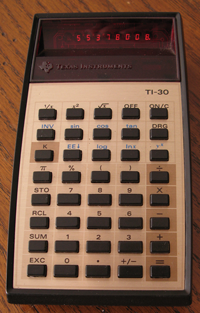
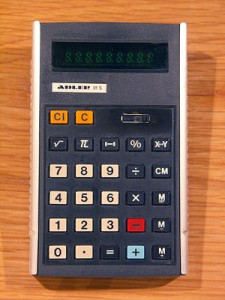
It’s no secret that I’m an opponent of calculators. In fact, I recently suggested to readers of 12Most.com that they burn their calculators!
But there is one calculator that isn’t burn-worthy.
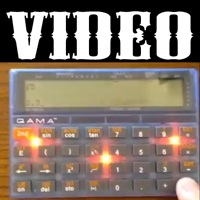
The QAMA Calculator requires the user to input a reasonable approximation before it churns out an exact answer.
So if you asked your QAMA Calculator to find the square root of 5, it would ask you first what \(\sqrt{5}\) is really close to. Like this:
That’s annoying!
Okay, maybe. If you need the calculator to do some quick work (the real reason to use a calculator), then you don’t need the darn thing quizzing you about an approximation.
But the QAMA Calculator people thought of everything. You can turn off that feature!
But then the kids will cheat!
Ah! You would think so. But check out what it does when you turn the feature off:
So what do you think? Will you get a QAMA Calculator? (It’s only about $25 after shipping & handling.) Will you let your kids use it?
P.S. I paid full price for it — it’s not expensive and it’s a crazy brilliant idea, so I went for it.
It was Monday. My “day off” from my diet. So Daughter and I decided to use the McDonald’s coupon we got in the mail yesterday.
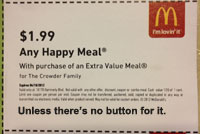
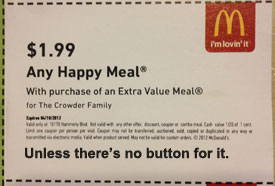
$1.99 for a Happy Meal for her if I buy a grownup value meal.
Easy enough, right?
I informed the speaker: “I have a coupon for a $1.99 Happy Meal with value meal. I’d like a #2 and a Cheeseburger Happy Meal.”
The voice said great and gave me my total: $9.97.
Something didn’t add up.
As I drove around, I couldn’t help thinking my $5.50 value meal, plus her $2 happy meal, plus tax shouldn’t get me all the way to $10.
So I asked about it when I got to the first window.
“Well,” she started, “We don’t have a button for that.”
“I’m sorry…?”
“Those coupons got sent out and they never put a button on our register for it. So I can’t give you the $1.99 Happy Meal. Sorry.”
I was stunned.
“So you’re telling me you sent me this coupon and I can’t use it because there’s no button for it?”
She smiled and shrugged cheerily, “Right. When they sent out the coupons, they didn’t put a button on here for it. If you want to use the coupon later, they might give us a button for it in the next couple of days.”
“Can I talk to a manager?”
The manager was equally unhelpful.
The conversation was similar. With a lot of “there’s no button for it.”
She told me they would be happy to take down my name. Later I could come back for “a small fry or something.” And she tried to keep my coupon.
I was totally confused.
The obvious solution was, well… not obvious.
“There’s no button for it.”
But they have a $.99 menu. And two $.99 menu items is pretty close to $1.99. So why didn’t they merely charge me for two of those?
I have been frustrated many times at the inability of clerks to do simple arithmetic (and to be fair, I’ve also been pleased).
But this was more than arithmetic.
This was thinking.
They were both paralyzed by the fact that there was no button for it. They couldn’t see past that.
Their lack of thinking created a terrible lack of customer service.
I took my coupon back and said that I would be happy to patronize the McDonald’s down the road from now on.
“Oh,” she said, “So you don’t want anything?”
Really, lady?
Can anything be done?
Can we fix the lack of thinking ability in normal people?
I don’t know the answer to that. And I don’t know the cause.
Sometimes I think that early calculator use caused this. But there are lots of parents who allow calculator use early on and raise brilliant, thinking kids.
Sometimes I think it’s the education system.
And sometimes I think it’s society.
What I do know is that my Grams had a 6th grade education and more thinking power than many high school graduates.
Don’t raise blind button pushers.
However you can. Whatever method you find.
We need our kids to learn: If there’s no button for it, you can make it work another way.
This article is based on the talk “Improving Creativity with Technology” given at the University of Houston teachHouston T3 Regional Conference.
Traditionally we give a concept or algorithm to the students and ask them to memorize, understand and use it. And by “give” I mean we serve it to them well done, fully baked, nothing left to do but eat it.
Piaget’s research (and subsequently others) suggest that allowing students to discover or create the methods is more effective than handing them the method and asking them to take it, eat it, no questions asked.
But how do you let them discover it?
Since the math we teach in middle school and high school is based on real numbers, every concept can be demonstrated with “plain” numbers. Which means it can be discovered by playing with numbers.
Calculators make this playing or experimentation fast – giving a student the ability to quickly see patterns and construct concepts.
Introduce the topic with numbers.
When you introduce a topic, give 10-20 “examples” of it with real numbers. Ask the students to play with them and notice any patterns they find.
Notice you’re creating an inquiry-based learning environment, an Inquiry Zone for Math Learning. Remember to maintain positive body language, ignore negativity, and super-validate what any student says.
Give the students the power!
Until the student decides differently, everyone is wrong. Even the teacher and textbook. They get to validate it for themselves – and they can do this with real numbers.
Ultimately, if they grow to be mathematicians, they’ll learn that verifying with lots of real numbers doesn’t mean “proving” it – but for the time being, this works fine.
Giving them this power lets them experiment as much as they need, and only as much as they need, to verify a concept for themselves.
Use the Play & Say method.
You’ve heard of the “Plug & Chug” method? You take a formula, plug in the numbers and chug through the arithmetic. Plug & Chug is a non-discovery based practice tool. The practice is good, mind you, but the formula is given, not discovered.
Remember, something discovered is more likely to be remembered than something given.
So use the “Play & Say” method. Each student plays with the numbers until he or she can say what the formula or concept is.
Caveats
If you’re trying to teach a concept with this and one student discovers a different formula or concept. Run with it – as long as it’s mathematically sound. Don’t discourage the discovery of anything, even something not on the current curriculum.
If a student gets frustrated, don’t force them to discover it themselves. Give them the concept or formula and encourage them to experiment later with it.
Suggestions
If you find there is a big difference in how much time each student takes, send the experiments home with them. Give them five minutes at the beginning of class to play – the students who realize they need more time will have done more the night before.
How will you do it? Share your thoughts and experiences in the comments.
I went to my H-E-B pharmacy the other day to pick up my prescriptions. My total came to \$59.82, before my coupon for $15 off one of the medications.
The gen-Y pharmacy clerk, Brandy, looked at my coupon, looked at the total and thought for a minute. She said, “So your total is now $44.82.”
I was so impressed. It’s rare that I find a clerk, especially a younger clerk, who will confidently do basic mental arithmetic. Almost all of the clerks I’ve encountered would’ve reached for a calculator to do that $15 subtraction!
What’s Brandy story?
I didn’t have a chance to talk to her long, but it turns out that she’s a chemistry student who’s also looking to get a teaching certificate. Yay, Brandy!
I’m quite curious how she remained confident in her abilities to do mental math. Did she learn math at a public or private school or was she homeschooled? At what age was she allowed a calculator?
What’s your story?
Are you a calculator addict like I was or are you confident in your mental arithmetic? How did you get the way you are? What can you do to help your children be great arithmeticians?
Please share your story and/or thoughts in the comments. And keep your fingers crossed that we can get Brandy in here to share more of her story!
Note: Banner and feature image for this article are by euthman on Flickr.com CC-BY-SA.
Most parents aren’t professional mathematicians. But there are a few. This is the sixth in a series of interviews with mathematician parents with the goal of helping parents integrate math teaching into parenting.
Jennifer here shown receiving recognition for being a Mississippi finalist for the Presidential Awards for Excellence in Mathematics and Science Teaching!
This week we visit with a high school math teacher in Mississippi. Jennifer Wilson, NBCT, teaches at Northwest Rankin High School, and is a Teachers Teaching with Technology (T3) instructor with Texas Instruments.
MathFour: Thanks so much, Jennifer for giving us your time. First, can you share a little about your degree and career?
Jennifer: I have a B.S. and an M.S. in mathematics. I have been teaching high school mathematics for 18 years.
MathFour: Tell me about your family – how many kids do you have and how old are they? Are any of them more or less interested in math than the others in the family?
Jennifer: I have two daughters who are 6 and 9. They are okay with math – but the 9 year old will tell everyone very quickly that her first love is reading.
MathFour: Do you have any worries about your girls academically? In particular, do you think they will do better in math than in other subjects because of your influence?
Jennifer: I feel very lucky to not be worried about my children academically. They love to learn. My husband and I both encourage their curiosity and try not to stifle their desire to ask why or come up with a different idea of how to do something, especially when the only good reason we can think of is “because I told you so”.
I think they will do well in math – but not necessarily better than other subjects. My husband and I both love to learn, and so the girls definitely recognize that desire and enjoy learning as well.
MathFour: That’s great! How do you play with your daughters? Do you view your playtime as different in any way than other “non-mathematician” parents?
Jennifer: We play games. I probably view play differently than a lot of parents – but probably similar to many teachers, no matter their subject of expertise. I am all about learning, and it is hard to turn that off, even at home.
MathFour: Do you think you speak with your daughters or behave differently than other parents because you have a math background?
Jennifer: Yes. Anytime some kind of math problem arises, I always ask the girls about their thinking, because I am very interested in how they arrive at answers.
At dinner, one daughter noticed that her tortilla chip was in the shape of a trapezoid, so we had a great conversation that night about trapezoids. We have a “pi” pie plate, so both girls already know a little bit about pi. They definitely call an “oval” an ellipse and a “diamond” a rhombus. They have called their blocks by the appropriate solid names, such as cylinders, prisms, and pyramids, since a very early age.
When the 9 year old missed a question on her state practice test about perspective drawing, instead of just telling her the correct answer, I got out the stash of Unifix cubes at our house to make her build the drawing with the cubes. She completely understood after doing so – and asked me to make up some more questions for her because she enjoyed working through the problems with the manipulatives. Both daughters play with my TI-Nspire™ CX handheld. They love making shapes, measuring their parts, and making them different colors.
MathFour: I had to google that one – fancy device!
Have you ever had either of your girls express negative thoughts about math? If not, how do you think you will handle it if that happens?
Jennifer: Not yet…I’m not sure I will handle it well. But I am hopeful that since my goal is not just calculating math but understanding math, they can at least appreciate my passion for it, and I will honor their passion for another subject, if the need arises.
MathFour: How do you think you’ll handle it if you find your self in disagreement with one of your children’s math teachers?
Jennifer: I’m not sure I will handle it well if it does happen, but so far, so good. I am lucky to teach in a great school district with great support for teachers at all levels, so I will keep my fingers crossed!
MathFour: Now to change direction a little to a more worldview of math. What do you see as the biggest challenge in math education today?
Jennifer: Having teachers who are experts in mathematics at all grade levels.
MathFour: What do you see great happening in the world of math education?
Jennifer: I see teachers who are willing to use technology to engage students in the learning and understanding of mathematics, teachers who are learning alongside students (often because of and through technology), and teachers who are willing to give up some of their control over the classroom to create a classroom that is truly interactive.
MathFour: What advice can you give to non-mathematician parents that might help them raise their kids to like and appreciate math.
Jennifer: I have been amazed at some of the mathematics that my students are learning in the computer games that they play. So while I realize that some students go overboard with the time that they spend in front of their electronic devices, find a way to encourage them to explore mathematics through tools that do interest them.
MathFour: Wonderful, Jennifer, thank you so much!
How ’bout You? It’s back to school time – do you have any questions for a super technology oriented math mom? Ask them in the comments!
Do you wonder if your children should be using a calculator “at their age”? Are you a fan of calculators, but have friends who aren’t? Are your friends “into” calculators while you oppose them?
I often hear people say that children 50 years ago understood math concepts more quickly. Although our parents weren’t taking classes called algebra in the 7th grade, they were doing algebra in the 7th grade.
Algebra is arithmetic.
There are two fundamental and rarely understood facts about algebra:
Algebra is arithmetic with one or more numbers in disguise.
Algebra has exactly the same rules as arithmetic.
Which means if you can do arithmetic you already know how to do algebra!
Our parents or grandparents, 50 or even 30 years ago, weren’t using calculators. They had to apply all the rules of arithmetic to get the job done. Which means that they had to apply all the rules of algebra.
Teaching them a class called “Algebra” was much easier because of this.
What are the rules?
The basic rules that non-calculator users must apply are the distributive property and the order of operations. The distributive property is the thing that calculator use eliminates.
Children could get practice mentally multiplying things like 3 x 86 and do 3(80+6) = 240+18=268. With this practice, they are ready for 4x(3y+2z) = 12xy+8xz.
If they never have to multiply 3 x 86 in their head, they never get the experience of the distributive property. Which means teaching them 4x(3y+2z) = 12xy+8xz will cause anxiety and frustration. They see it as “magic” or “something you made up just to confuse me.”
Give them the tools they need.
Refuse to let students have the calculator. Let them have the tool of the distributive property for algebra before you teach them “Algebra”. Give them the benefit our parents and grandparents had!
Siggi over at Turkeydoodles wrote a post about her preference of calculators over flashcards. It’s her preference, but her arguments seem to be founded on the misuse of of flashcards. Furthermore, it seems she’s not seen the detrimental effects of early calculator use, yet.
When you should give a kid a calculator is a topic for another article. In the meantime, here are some tips on good flash card usage.
Flashcards are educational toys.
Flashcards shouldn’t be used as testing devices. They’re educational toys. They’re exploratory devices. Let them “peek” as much as they want.
As a first introduction, use them to build houses of cards. They should be fun and comfortable.
They are limited in scope.
The 6 x 8 = 48 card will never be able to give the cosine of 60 degrees. This makes the flashcards so beautiful. Once you understand what happens when you create a calculator addict, and see how that works as the kid enters college, you’ll know how important this limitation is.
Encourage variation to limit boredom.
I distinctly remember using flashcards in my dining room, sitting next to the sliding glass door. I was reading them. But because they would get boring, I would chant them. It became sing-songy and fun. I could go through them quickly this way.
And I looked forward to the ones that rhymed.
Let the flashcards be rejected.
If a kid really hates them, let it go. There are other ways to get that information across. Schoolhouse Rock’s Multiplication Rock is a fabulous tool for this.
And you can sing or chant multiplication facts yourself. My mother learned the most common prepositions by saying them as she jumped rope. You can vary some skip counting with jumping rope to learn multiplication facts:
3 x 1 = 3
3 x 2 = 6
3 x 3 = 9
and so on…
Allow the flashcards to be the context in and of itself.
It is not necessary that math be learned in context. So many people keep pushing this. Sometimes it’s just fun to know random stuff – including some quick and nifty facts.
Don’t push math for math’s sake, but offer it. There are kids, lots of them, who just like to do puzzles. Plain math – arithmetic and facts – is a great puzzler.
What do you think? Is this a better use of flashcards than the ones you’ve seen? Share your thoughts in the comments.
When we teach kids how to drive, we give them a few months in the classroom so they can learn the basics of driving and the rules of the road. Nobody in their right mind puts a teenager behind the wheel and says, while flying down the road, “Now, the brake pedal is the one on the left.”
Not only is it safer, but it makes more sense to teach them outside of the car first. After they pass a competency test then they’re allowed to use the technology (car).
We drop a calculator into the hands of teenagers and ask them to learn math at the same time. There isn’t a safety factor here, but the principle is the same.
There’s a different challenge in learning which buttons to press than learning the reasons behind why you press those buttons. We bring technology into the classroom thinking we’re in service of the children, and instead do them a disservice. We double the concepts and think that one is helping the other. It isn’t.
Begin by teaching user’s manuals.
The use of a calculator, a program or web-based application can be easily taught by teaching children how to read a user’s manual or follow instructions. It’s a device, a tool.
Before they start up their new John Deere riding lawnmower, they should read the user’s manual. Likewise, before they turn on their Hewlett-Packard 32sII, they should bend the spine of its little book.
Math classes and home schools can incorporate user’s manual reading in their curriculum. It will prepare students to learn and understand technology, including calculators and applications.
Introduce the calculator after they have mastered the concept.
Teaching children to do math through calculator use can destroy their sense of confidence in doing it themselves and also make them uncomfortable with the tool. Allow them to fully understand an entire concept in mathematics before giving them technology.
If you want them to learn to graph on a calculator, make sure they can do it with pencil and paper first. Allow a few years between the initial introduction of a concept and learning to make it work on a calculator. This should provide ample time for them to practice it and build their confidence that they can do it without the crutch.
When they are ready, give them the user’s manual to the calculator. Have them do problems by hand on one side of their paper. Have them write the page numbers from the user’s manual and keystrokes for the calculator in a column next to it.
When they have completed this, let them confirm their keystrokes are correct by doing it in the tool. This reinforces the connection between what they have learned, and can do on paper, with what’s being done in the machine.
Do you give your kids a calculator to learn on? Will you continue to do so? Share your thoughts and ideas in the comments.
I remember being allowed in Jr. High to use the calculator to “check my work.” Soon after I learned that the books in High School had the answers in the back! It was like condoned cheating!
How could I go wrong with the magic box and the answers given to me straight from the publisher?
And then I became addicted.
Sometime after Geometry I lost my multiplication facts. I wasn’t just checking my work on the calculator.
Subconsciously I figured there was no reason to trust my potentially faulty memory of math facts if I had the absolute sure thing right there next to me.
For years I stopped doing arithmetic.
And my dad chastised me. Every time some quick calculation came up in the kitchen, garage or grocery store, I would stare at him blankly. Then I would reach for my calculator.
The way he looked at me, you’d think I had reached for a bong, ripped off my bra, sang Kumbaya and spat on the pope.
I ignored him.
For years.
Until one day I realized that I had absolutely no memory of . Yep – was what did it. I started watching myself. I always did simple arithmetic (even addition of single digits) on the calculator!
Then I watched other people. I saw the clerks in the grocery store reach for the magic box to figure out 10% off something. I saw an older man at McDonald’s send the girl into a tizzy because he modified his cash payment after the girl had already typed it in.
“There’s a problem here,” I thought. Maybe Paps was right.
I put it on my syllabi that calculators were strictly prohibited (unless expressly invited by me – in the case of probability and statistics). I growled at anyone who reached for one.
And I taught them arithmetic.
And we were all better off.
Are you a calculator addict? Share your story in the comments.