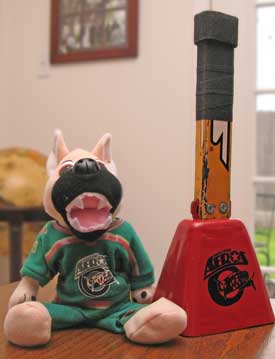
That was a pretty expensive trip to a hockey game. Especially since the tickets were free!
In the spirit of Dan Meyer‘s Any Questions? style of learning, my question arose:
Was it worth it for the Aeros to give me tickets to the hockey game?
Here are some things I need to know before I can arrive at the answer:
What’s the value of the tickets?
How much did I spend?
Answer 1. The tickets we got were $26 each. So my ticket, along with Daughter’s ticket, was $52.
Answer 2. Here’s the total of what she and I “consumed” on non-ticket items:
Two beers ($13.50) (that was me, not us together)
One stuffed animal (the mascot Chilly) $12.50
A cowbell (I’m from the country, I couldn’t resist) $25
One hotdog $6.50
Parking $10
So we spent $67.50 at the hockey game. That’s $15.50 more than the cost of the tickets. Seems like it was worth it for them to give me the tickets.
But did they make money off me?
Just because they got their money back, plus some, doesn’t mean they made money.
Would these tickets have been sold to someone else at full price? And would those people have also spent $67.50?
What was the cost of us being there? And what was the cost of the stuffed animal, the cowbell, the hotdog and the beer?
Answer 1. There were lots of empty seats, so I’m thinking they were leftover seats. Nobody was going to buy them.
Answer 2. Supposing we took up $.05 of air conditioning and maybe $.05 in water (we also washed our hands), it cost them ten cents to have us around. For the things we bought:
Stuffed animal – $1
Cowbell – $1
Hotdog – $.25
Beer – $4 (there’s serious tax in this, I think)
So they spent about $6.35 having us there and paying for the products we bought. So yes, they definitely made money.
It was Monday. My “day off” from my diet. So Daughter and I decided to use the McDonald’s coupon we got in the mail yesterday.
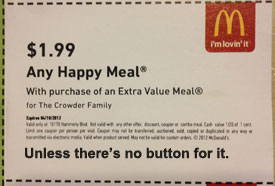
$1.99 for a Happy Meal for her if I buy a grownup value meal.
Easy enough, right?
I informed the speaker: “I have a coupon for a $1.99 Happy Meal with value meal. I’d like a #2 and a Cheeseburger Happy Meal.”
The voice said great and gave me my total: $9.97.
Something didn’t add up.
As I drove around, I couldn’t help thinking my $5.50 value meal, plus her $2 happy meal, plus tax shouldn’t get me all the way to $10.
So I asked about it when I got to the first window.
“Well,” she started, “We don’t have a button for that.”
“I’m sorry…?”
“Those coupons got sent out and they never put a button on our register for it. So I can’t give you the $1.99 Happy Meal. Sorry.”
I was stunned.
“So you’re telling me you sent me this coupon and I can’t use it because there’s no button for it?”
She smiled and shrugged cheerily, “Right. When they sent out the coupons, they didn’t put a button on here for it. If you want to use the coupon later, they might give us a button for it in the next couple of days.”
“Can I talk to a manager?”
The manager was equally unhelpful.
The conversation was similar. With a lot of “there’s no button for it.”
She told me they would be happy to take down my name. Later I could come back for “a small fry or something.” And she tried to keep my coupon.
I was totally confused.
The obvious solution was, well… not obvious.
“There’s no button for it.”
But they have a $.99 menu. And two $.99 menu items is pretty close to $1.99. So why didn’t they merely charge me for two of those?
I have been frustrated many times at the inability of clerks to do simple arithmetic (and to be fair, I’ve also been pleased).
But this was more than arithmetic.
This was thinking.
They were both paralyzed by the fact that there was no button for it. They couldn’t see past that.
Their lack of thinking created a terrible lack of customer service.
I took my coupon back and said that I would be happy to patronize the McDonald’s down the road from now on.
“Oh,” she said, “So you don’t want anything?”
Really, lady?
Can anything be done?
Can we fix the lack of thinking ability in normal people?
I don’t know the answer to that. And I don’t know the cause.
Sometimes I think that early calculator use caused this. But there are lots of parents who allow calculator use early on and raise brilliant, thinking kids.
Sometimes I think it’s the education system.
And sometimes I think it’s society.
What I do know is that my Grams had a 6th grade education and more thinking power than many high school graduates.
Don’t raise blind button pushers.
However you can. Whatever method you find.
We need our kids to learn: If there’s no button for it, you can make it work another way.
In my Mustang I get 20 miles to the gallon. Currently gas is hovering at three dollars per gallon. Which means for every 20 miles I drive, it costs me $3.
It’s 5 miles to school from my house. If I take her to school and back in the morning, and then retrieve her in the evening, it takes me 20 miles – or $3. (These are true numbers – even though they are working out rather nicely.)
Which means in addition to tuition, it’s another $15 a week. So in a 40 week school year, I spend another $600 in gas!
Maybe I should consider toddler carpooling…
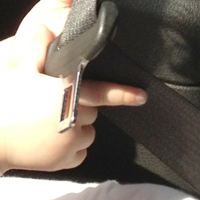
But is it worth it to buy another car seat?
Some forward facing car seat models can go up to 80 pounds. Even in the 97th percentile of weight, our daughters won’t grow out of one of these car seats until they’re about eight years old. That’s another five years!
The first car seat I find on Amazon.com that goes to 80 pounds is the Cosco Juvenile High Back Booster Car Seat. It’s $46.54 and eligible for free shipping. Add tax, and you’re right at $50.
Sharing the duties with my neighbor means cutting my gas bill in half. So I would save $7.50 each week by carpooling. After seven weeks of carpooling, I would save
\(7 \times \$7.50 = \$52.50\)
That car seat would pay for itself after less than two months!
Will it be worth it long term?
After this year, I have three more years of carpooling available before we start homeschooling.
Three years at 40 weeks/year in school and $7.50 savings per week gets me at
I’ll save $900 over the next three years. And so will my neighbor!
I’m off to buy the carseat!
What will you do?
Do you take your kids to a co-op or day-school? Is there a family you can carpool with that you haven’t yet considered because of the logistics? Will you now work the numbers to see if it makes sense?
The order of operations includes two types of rules: those that are based on the way the operations work, and those that are arbitrary. My friend @harrisonalg from the Twitter chat #mathchat and I have been discussing this.
You can explain the truly arbitrary elements of PEMDAS (the left to right of AS and MD) through an experiment. Allow students, independently, to do these two problems any way they want, ignoring any stupid arbitrary rule they might have previously memorized:
3 – 2 + 8 – 3 + 4
2 x 7 ÷ 2 x 6 ÷ 3
The idea is that they will come up with many different answers:
3 – 2 + 8 – 3 + 4 could be any of -14, 0, 10 or others
2 x 7 ÷ 2 x 6 ÷ 3 might be 7/18, 7/2, 14, etc.
If they were on a team building a bridge with these calculations, things wouldn’t work so well.
Enter the Stupid Arbitrary Rule (SAR).
Because we need to all come up with the same answer, we need a rule to follow. Really, it can be any stupid arbitrary rule (SAR). But we agreed, at some point in history, to all follow the “left to right” thing once we were down to addition & subtraction or multiplication & division.
It’s important to note that kids didn’t get to be part of that agreement we made. Just like they don’t get to vote in elections.
Is it fair? Probably not. They would probably do a better job of choosing leaders as well as determining the order of operations. But that’s the way things likes SARs work.
PEMDAS doesn’t cover it all!
To throw a few more kinks into it, check out how wikipedia explains some special cases of the order of operations. . Factorials aren’t covered in PEMDAS, neither are the order of exponents.
Here’s another fun one: even calculators do things differently (and arbitrarily). Check out the way the the TI-92 and the TI-30XII handles exponents. Clearly you get to make up your own order of exponents!
Let them play king: they create the rules!
Let your students determine the order of operations for addition & subtraction and multiplication & division – just for the class. Make sure to write the rule down and tack it to the wall so everyone remembers what they decided. In your class, and your class only, they are to follow that rule.
Remember the back of the book, as well as your answer keys or teacher edition textbook, will now be totally wrong. But it’s worth it.
Doing it this way they might start to understand which pieces of PEMDAS are dependent upon the way the operations are constructed () and which pieces of PEMDAS are arbitrary (left to right).
Once the class determines their special arbitrary rule, practice creating expressions whose result is some important number. Some options could be:
The age of one of the kids
Someone’s favorite number
Your age (be careful)
The age of some other grown-up they know
The last four digits of their phone number
The number part of their street address
Create the expression using the Class Rule as well as the stupid arbitrary rule. Then translate and have a good laugh. I just did my age with my “Bon Rule.”
Bon Rule: addition and subtraction go from left to right, and multiplication comes before division.
My age is 120 ÷ 2 x 3.
If I did this according to the SAR, I’d be dead. Or really famous.
Your turn!
Can you teach the order of operations like this with your kids? If you classroom school, how much trouble are you going to get in when you become the math teaching rebel?
I’ve been dying to check out the book You Can Count on Monsters for a while. My sweet niece, without knowing how much I wanted it, gave it to me for Christmas!
It’s a book about numbers.
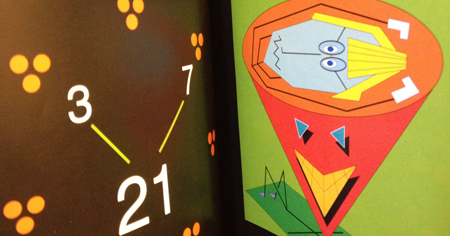
You Can Count on Monsters is a book that illustrates the numbers 1-100 in a very special way. Each of the prime numbers has an original “monster” that has a link to it. For instance, 2 has two eyes, 7 has a body with seven sides, and the edges of 19’s eyes – they total nineteen.
Each of the composite numbers is a blend of mosters from the prime numbers of its factorization.
So 14 is the 2-monster hanging around in the mouth of the 7-monster. The other composite numbers range from cute to crazy-hard-to-recognize (like the 72-monster).
For each number, you can examine the monster and see how it was created – what aspects of the monster correspond to the number.
Starting at the beginning seems to be the best bet. Jumping into the middle got me lost. When I began at 1 and then allowed the composite numbers to “grow” on each other, things made much more sense. And as the prime numbers get larger, it’s harder to tell what piece of the image to count.
Walking through it with a child will be very interesting too. Daughter is two, so she’s pretty much not interested in numbers higher than five. Although I can start using the terminology “composite numbers” and “prime numbers.”
You can use it as a template.
Making your own monsters is a fun, crafty way to explain prime numbers and composite numbers. Children would notice quickly that there aren’t many ways to represent 2 – drawing two sided figures is a bit of a challenge.
The obvious 2 monster has two circles, while the 3 monster has either three circles or is a triangle. But the bigger the prime numbers get, the more creative (and different from the book) you can get.
And how you put them together – well, that’s where the real fun is. There are so many different ways to create the composite numbers!
There is a drawback.
I was showing You Can Count on Monsters to my Ma. When I showed her the 6-monster she said, “That’s not counting.”
Indeed the images represent factorizations, not summations. Which means the image that involves 2 and 3 “officially” represents 6 but there are only 5 things “going on” in the picture.
She’s got a point.
What can you do?
Have you seen the book? Are your kids open to drawing number critters? And do you, or your kids, see it like Ma does?
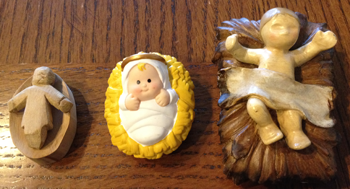
I’ve been stumbling over baby Jesuses for a few weeks now. I realized that with three working nativity sets in the house it was time to do a little math with Jesus.
All of them.
You can count the bits and pieces.
Animals, people, buildings – count them for each nativity set and count them up total.
How many total Jesuses do you have?
How many angels?
How many “visitors” does Jesus have?
How many sheep? Cows? Donkeys? Camels?
How many total animals?
You can compare the numbers.
My three nativity sets have varying numbers of characters and structures. It’s curious how some sets include more animals that visitors – and some sets don’t have any animals.
Which of your nativity sets have more animals? Which has more people?
Which has more buildings (or non-people/non-animal things)?
Are there more visitors than animals or more animals than visitors?
Arrange the sets in order of least to greatest – people, animals, etc. Are they always in the same order?
Is one set bigger or heavier than the others?
Do some arithmetic.
Take the opportunity to show how counting and arithmetic are kinda the same thing.
If you add up the number of sheep you have with the number of donkeys, how many is that? Is it the same if you group them together and just count them?
What if all the shepherds left? Talk about how you can count them, or you subtract the number of shepherds from the total number of visitors.
How many nativity sets do you have? Talk about how 3 times that number is the number of wise men you have.
Do fractions – but only if you must.
I know many people avoid fractions. I wish I could have avoided it with Math with Jesus. Daughter gave us the opportunity to talk about fractions by breaking the angel (or the “butterfly” as she calls it). Good thing we have Gorilla Tape.
I went to my H-E-B pharmacy the other day to pick up my prescriptions. My total came to \$59.82, before my coupon for $15 off one of the medications.
The gen-Y pharmacy clerk, Brandy, looked at my coupon, looked at the total and thought for a minute. She said, “So your total is now $44.82.”
I was so impressed. It’s rare that I find a clerk, especially a younger clerk, who will confidently do basic mental arithmetic. Almost all of the clerks I’ve encountered would’ve reached for a calculator to do that $15 subtraction!
What’s Brandy story?
I didn’t have a chance to talk to her long, but it turns out that she’s a chemistry student who’s also looking to get a teaching certificate. Yay, Brandy!
I’m quite curious how she remained confident in her abilities to do mental math. Did she learn math at a public or private school or was she homeschooled? At what age was she allowed a calculator?
What’s your story?
Are you a calculator addict like I was or are you confident in your mental arithmetic? How did you get the way you are? What can you do to help your children be great arithmeticians?
Please share your story and/or thoughts in the comments. And keep your fingers crossed that we can get Brandy in here to share more of her story!
Note: Banner and feature image for this article are by euthman on Flickr.com CC-BY-SA.
Here’s a FREE Activity Packet to read and share with your children to get them thinking about how numbers got started.
Somewhere in the past we recognized that we have these “digits” on the ends of our hands. Using these, we created numbers, adding, subtraction, multiplication, division and even fractions!