Tag: addition

  • Math Picture Book: The Grapes of Math

    Math Picture Book: The Grapes of Math

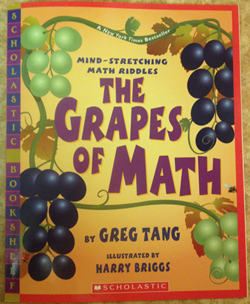
    When I stumbled upon the math picture book, The Grapes of Math by Greg Tang and Harry Briggs, I was more than a little impressed.

    This book has three great elements:

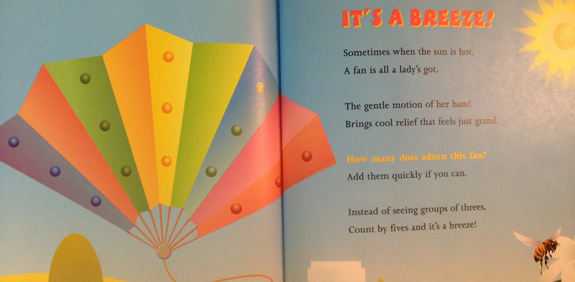
    The images are colorful and fun!

    The first thing you see in this math picture book are the bright but simple images. Looking at them you feel like you’ve stepped into the surreal world of those old View-Master reels.

    The rhymes are catchy and cute!

    I’m all about iambic pentameter. Well, I really don’t know exactly what that is, but it sounds like it means bouncy poetry.

    And that’s what this math picture book has!

    While scallops on the beach look great,
    I’d rather see them on my plate.

    Unfortunately it’s their loss,
    They swim their best in butter sauce.

    Oh, but the counting’s even better!

    Each page has objects (fruit, bugs, dice, etc.) spread out so that children can experiment with different ways to “see” how many there are. You can subitize, group, multiply, subtract – or do them all!

    The answer key in the back helps you understand the intent of the authors.

    But I recommend you try various ways yourself before turning to the back. Some of their methods were very different than what I came up with.

    And you can try it at home!

    There are 16 different pictures and riddles to practice on. But it doesn’t have to stop there.

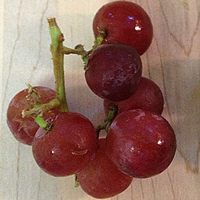
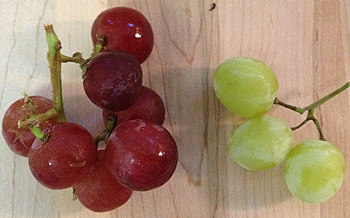
    You can do your own playing at home. Check out the grapes I did here:

    How will you use the math picture book, The Grapes of Math? Share in the comments or on twitter/x.
    You might also like:
  • Math Picture Book: 1+1=5 And Other Unlikely Additions

    Math Picture Book: 1+1=5 And Other Unlikely Additions

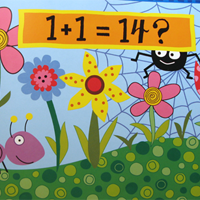
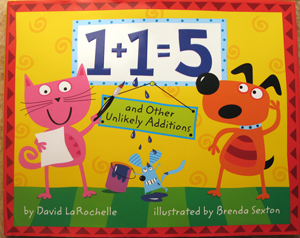
    This wonderful book caught my eye the other day in the bookstore: 1 + 1 = 5 And Other Unlikely Additions, by David LaRochelle.

    How could I not buy it?

    It’s colorful, fun and – the best part – unexpected!

    Each page introduces a new way to look at 1 + 1.

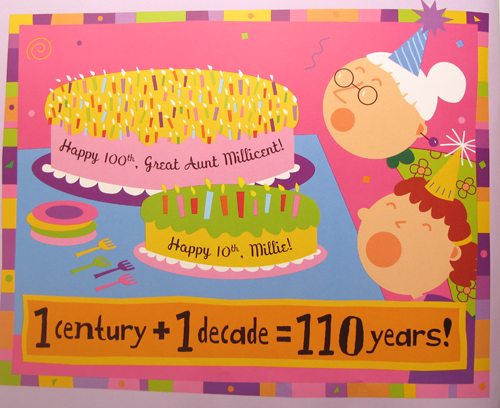
    This book enforces the concept of units and place value. Like this page where 1+1=110.

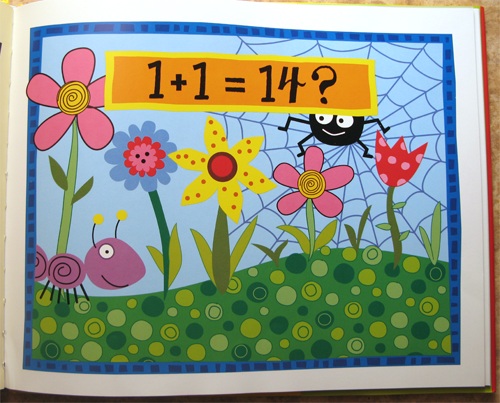
    It also gives parents and teachers the opportunity to talk about things like creepy crawlies – and their differences. Here’s a page where we see some differences in ants and spiders:

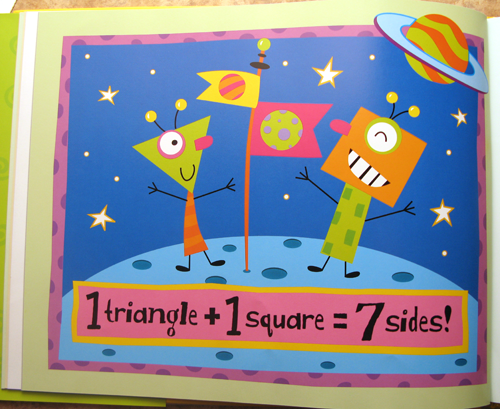
    And who could resist a discussion about shapes when you get to this one:

    When I read it to K8, Husband was enthralled. Clearly there’s fun stuff for all ages in this one!

    Click here to share this on Twitter/X. And when you find you love it as much as we do, tell everyone in the comments!

    Related articles
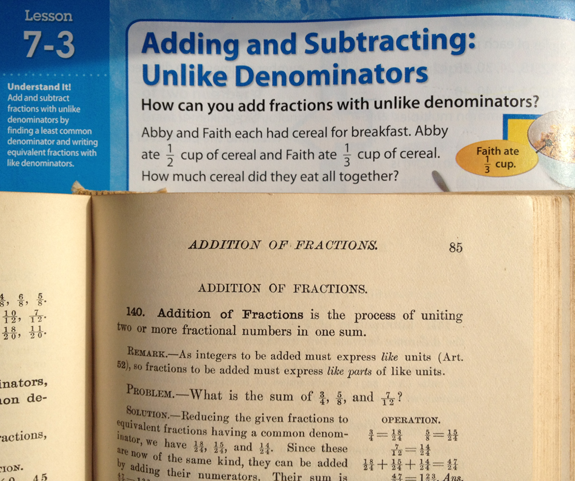
  • Adding Fractions – Then & Now

    Adding Fractions – Then & Now

    Part of Wordless Wednesday

    Ray’s Higher Arithmetic, original copyright 1880. Photo is of the 1908 printing, page 85.

    enVisionMATH Grade 6, copyright 2009. Photo is of page 166.

    Do you want to comment on this? How about tweet it out?

    Related articles
  • Addition with Tattoos

    Addition with Tattoos

    Seems that I’m learning something called “addition” these days. My parents say things like “two bottles of vitamins plus one bottle of vitamins equals four bottles of vitamins. That’s addition!”

    I’ve figured out that “addition” means you use the words “plus” and “equals” in the same sentence.

    You can do addition with counting too!

    I’m into tattoos. I have kitten tattoos and Spider Man ones. To put them on, we have to use a wet rag and count – first to 20 and then to 10. My mom says that “twenty plus ten equals thirty.”

    That sentence has both of the important words: “plus” and “equals.”

    So doing tattoos is not just counting, but addition too!

    So tattoos are math!

    My dad doesn’t like me to have so many tattoos. He prefers I use the fun band-aids. Band-aids are okay, but you don’t have to count or add to put them on.

    The more tattoos I put on, the more counting and addition practice I can get. So he should be happy I’m getting lots of tattoos!

    Tattoos and counting teach other stuff also.

    I’m learning “patience.” That means waiting without whining or screaming.

    I don’t mind “patience” when I’m counting. Because I’m doing something fun.

    Do you have a 2 year old like me, that can count? Are you teaching him or her addition too? And what kinds of tattoos do y’all have?

    Let me know in the comments – and don’t forget to tweet out this article.

    Related articles
  • PEMDAS and a Stupid Arbitrary Rule

    PEMDAS and a Stupid Arbitrary Rule

    The order of operations includes two types of rules: those that are based on the way the operations work, and those that are arbitrary. My friend @harrisonalg from the Twitter chat #mathchat and I have been discussing this.

    You can explain the truly arbitrary elements of PEMDAS (the left to right of AS and MD) through an experiment. Allow students, independently, to do these two problems any way they want, ignoring any stupid arbitrary rule they might have previously memorized:

    1. 3 – 2 + 8 – 3 + 4
    2. 2 x 7 ÷ 2 x 6 ÷ 3

    The idea is that they will come up with many different answers:

    1. 3 – 2 + 8 – 3 + 4 could be any of -14, 0, 10 or others
    2. 2 x 7 ÷ 2 x 6 ÷ 3 might be 7/18, 7/2, 14, etc.

    If they were on a team building a bridge with these calculations, things wouldn’t work so well.

    Enter the Stupid Arbitrary Rule (SAR).

    Because we need to all come up with the same answer, we need a rule to follow. Really, it can be any stupid arbitrary rule (SAR). But we agreed, at some point in history, to all follow the “left to right” thing once we were down to addition & subtraction or multiplication & division.

    It’s important to note that kids didn’t get to be part of that agreement we made. Just like they don’t get to vote in elections.

    Is it fair? Probably not. They would probably do a better job of choosing leaders as well as determining the order of operations. But that’s the way things likes SARs work.

    PEMDAS doesn’t cover it all!

    To throw a few more kinks into it, check out how wikipedia explains some special cases of the order of operations. . Factorials aren’t covered in PEMDAS, neither are the order of exponents.

    Here’s another fun one: even calculators do things differently (and arbitrarily). Check out the way the the TI-92 and the TI-30XII handles exponents. Clearly you get to make up your own order of exponents!

    Let them play king: they create the rules!

    Let your students determine the order of operations for addition & subtraction and multiplication & division – just for the class. Make sure to write the rule down and tack it to the wall so everyone remembers what they decided. In your class, and your class only, they are to follow that rule.

    Remember the back of the book, as well as your answer keys or teacher edition textbook, will now be totally wrong. But it’s worth it.

    Doing it this way they might start to understand which pieces of PEMDAS are dependent upon the way the operations are constructed () and which pieces of PEMDAS are arbitrary (left to right).

    Once the class determines their special arbitrary rule, practice creating expressions whose result is some important number. Some options could be:

    • The age of one of the kids
    • Someone’s favorite number
    • Your age (be careful)
    • The age of some other grown-up they know
    • The last four digits of their phone number
    • The number part of their street address

    Create the expression using the Class Rule as well as the stupid arbitrary rule. Then translate and have a good laugh. I just did my age with my “Bon Rule.”

    Bon Rule: addition and subtraction go from left to right, and multiplication comes before division.

    My age is 120 ÷ 2 x 3.

    If I did this according to the SAR, I’d be dead. Or really famous.

    Your turn!

    Can you teach the order of operations like this with your kids? If you classroom school, how much trouble are you going to get in when you become the math teaching rebel?

    Share your experiences in the comments!

    Feature image by tim846 | Flickr.com | CC BY SA

    Related articles
  • 3 1/2 Ways to Do Math with Jesus

    3 1/2 Ways to Do Math with Jesus

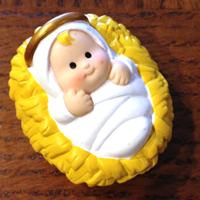
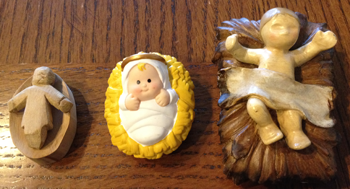
    I’ve been stumbling over baby Jesuses for a few weeks now. I realized that with three working nativity sets in the house it was time to do a little math with Jesus.

    All of them.

    You can count the bits and pieces.

    Animals, people, buildings – count them for each nativity set and count them up total.

    • How many total Jesuses do you have?
    • How many angels?
    • How many “visitors” does Jesus have?
    • How many sheep? Cows? Donkeys? Camels?
    • How many total animals?

    You can compare the numbers.

    My three nativity sets have varying numbers of characters and structures. It’s curious how some sets include more animals that visitors – and some sets don’t have any animals.

    • Which of your nativity sets have more animals? Which has more people?
    • Which has more buildings (or non-people/non-animal things)?
    • Are there more visitors than animals or more animals than visitors?
    • Arrange the sets in order of least to greatest – people, animals, etc. Are they always in the same order?
    • Is one set bigger or heavier than the others?

    Do some arithmetic.

    Take the opportunity to show how counting and arithmetic are kinda the same thing.

    • If you add up the number of sheep you have with the number of donkeys, how many is that? Is it the same if you group them together and just count them?
    • What if all the shepherds left? Talk about how you can count them, or you subtract the number of shepherds from the total number of visitors.
    • How many nativity sets do you have? Talk about how 3 times that number is the number of wise men you have.

    Do fractions – but only if you must.

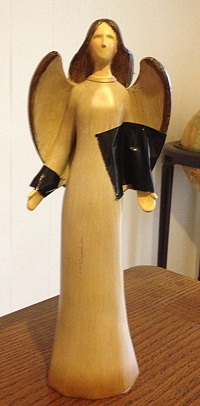
    I know many people avoid fractions. I wish I could have avoided it with Math with Jesus. Daughter gave us the opportunity to talk about fractions by breaking the angel (or the “butterfly” as she calls it). Good thing we have Gorilla Tape.

    Where can you find math in your Christmas things?

    Related articles
  • Free Activity Packet – How Your Kids Can Ponder Numbers

    Free Activity Packet – How Your Kids Can Ponder Numbers

    Here’s a FREE Activity Packet to read and share with your children to get them thinking about how numbers got started.

    Somewhere in the past we recognized that we have these “digits” on the ends of our hands. Using these, we created numbers, adding, subtraction, multiplication, division and even fractions!

    Get it free here!

    When you get it, unzip it and you’ll have all this great stuff:

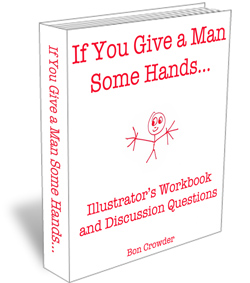
    • If You Give a Man Some Hands ebook (IfYouGiveAManSomeHandsByBonCrowderMathFourDotCom.pdf)
    • If You Give a Man Some Hands Illustrators Workbook (IfYouGiveAManSomeHands_IllustratorsWorkbook.pdf)
    • If You Give a Man Some Hands Supplemental Questions (IfYouGiveAManSomeHands_Questions.pdf)
    • A list of math resources for homeschooling and afterschooling parents (HomeschoolMathResources.pdf)
    • A reprint of the article 9 ½ Ways to Homeschool Math (WaysToHomeschoolMath.pdf)

    Have questions? Ask here or shoot me a note with the contact form.

    Related articles
  • Why Engineers Make Bad Math Tutors

    Why Engineers Make Bad Math Tutors

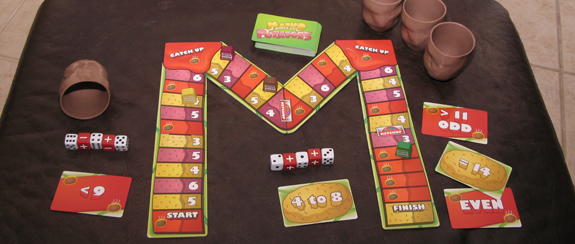
    I was at my dad’s house the other day and decided to pull out my new Math’d Potatoes game to see how my super-gaming family liked it.

    The kids in the house were too young to play, so my sister and I asked Aunt Linda and our stepmom to play with us.

    They quickly claimed they were “math Neanderthals” but agreed to play anyway. My dad, an engineer, was asleep.

    The game has simple rules.

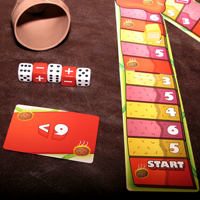
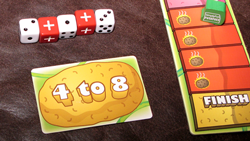
    You play Math’d Potatoes by drawing a card, rolling five dice and making an expression that “satisfies” the card.

    The card requests various types of “answers”:

    • Even or odd
    • Equal to a certain number
    • Between two numbers
    • Less than/greater than a certain number

    Everybody got into it.

    Aunt Linda and Louise (my pet name for my stepmom) both agreed that it was a fun math game. This is in spite of the fact that neither one of them like math, and Aunt Linda doesn’t even like to play games at all!

    My dad saw the game the next morning.

    I had intentionally not waken up my father to play with us the night before. My decision was validated the next morning.

    My dad is an engineer, and as such tends to use the phrase “all you have to do is,” and the word “just.” He’s a very smart man, and I’ve learned lots from him through the years. And one of those lessons is: “Keep an engineer away from sensitive math learners.”

    Sure enough, when he saw the game, he eagerly said, “What’s this? Are we going to play it?”

    When I explained we played the night before he responded with, “Why didn’t you wake me? I totally would’ve won.”

    Math learning is slowly build, and quickly destroyed.

    When we were playing, Aunt Linda and Louise were both starting to warm to the idea of math. They were enjoying the game. My sister and I were holding back just a little to give them an opportunity to discovery their own skills. (We both experienced the engineer–math–dad super push growing up.)

    So by the end of the game that night, they were excited, confident, and enjoying themselves.

    Had I woken up my father to play the game, he certainly would have won. He might’ve turned it into a competition, or he might have tried to help a little too much.

    Either way they would’ve lost interest. Their confidence would have been destroyed. And two beautiful, smart and happy women would have their, “I’m a math Neanderthal” thoughts validated.

    You can use this with your children.

    If you or your spouse are in a math related field, or was “always good at math,” be aware of your potential intimidation factor. Hold back. Don’t help. Allow discovery and confidence to come at its own slow and natural pace. Your children will learn math, in their own time.

    Don’t force it, or you might destroy it.

    Note: They sent me this game for free. This is not a review, per se, but still – you should know how I got it.

    Related articles
  • Playing with Algebra Concepts

    Playing with Algebra Concepts

    I’ve been itching to get into some basic abstract algebra goodies. With the help of the Cuisenaire Rods, Simply Fun Sumology number tiles and the Discovery Toys Busy Bugs, I’m able to do that.

    Start with wrap around addition.

    This type of math is officially called “modular arithmetic.”  We are only going to use the numbers 0, 1 and 2.

    It begins as regular addition. And since we are only using those three numbers, all our answers have to be either 0, 1 or 2. So when we add 1+2, we wrap around.

    If we were to count in our system, we’d say: “0, 1, 2, 0, 1, 2, 0, 1, 2, 0, 1, …”

    The addition table looks like this:

    (Notice you could do this with numbers from 1- 12 and it would be clock addition!)

    Now things get buggy.

    Switch out all the number tiles with some pretty color Cuisenaire Rods. They don’t have to be the “right” rods. We’re only looking at the colors. Here’s the progression I did:

    The end result is a very abstract chart!

    You can “bug” two things together.

    Like this:

    (I know – a spider isn’t a bug. But run with me on this, okay?)

    Notice that each of these are directly from the “spider table” above.

    You can read this as, “Purple spider green equals green,” just like you would say, “Zero plus one equals one.”

    And then turn your child loose!

    First make a chart, or download this one.

    You can, but don’t have to, start out with numbers. The rules are this:

    • You can only use three colors.
    • All three colors must go across the top.
    • All three colors must go down the left.
    • Fill in the 9 spaces however you want, as long as it’s only those three colors.

    I did this one with the blue beetle as the “addition” piece:

    So what can you do with a goofy “blue beetle table”?

    Let your child play, for one. And experiment.

    You can also talk about commutativity and associativity, identities, inverses… but I’ll leave that for another article!

    What do you think? Does your child want to play like this? What else can you do? Share your thoughts in the comments.

    Related articles
  • Count 10 Read 10: Random Number Game

    Count 10 Read 10: Random Number Game

    Learning math isn’t just about being taught math. It’s about fun, discovery and experimentation. In the Count 10, Read 10! program, parents get to spend 10 minutes a night playing math with their children.

    Like many games you’ll find here, this is a version of Calvinball (from Bill Watterson’s Calving & Hobbes cartoon). You and your children make up the rules as you go along or as you see fit.

    This is merely a guideline or starting point.

    Random Adding

    Objective:

    Have fun with numbers, counting and quantities.

    Breakable rules:

    1. The leader starts by saying a number.
    2. The next player says “plus” and another number. Then adds them and says the result.
    3. The next player says “plus” and another number. She adds that to the previous result and says the new result.
    4. Play continues until a winner is determined.

    Example

    Leader: Five!

    Player 2: Plus three is eight!

    Leader: Plus one is nine!

    Player 2: Plus two is eleven!

    Leader: WINNER!

    End game, and how to choose a winner.

    The round ends when the youngest child reaches their limit of counting or adding. The winner is determined by a rule or random choosing. The older the children, the more “real rules” you’ll need to follow.

    Possible winning rules:

    • The first person to add up to 10 – or a number designated by the leader at the beginning of the game.
    • The person who noticies that another player is wrong in their calculations (this is perfect for the parent to “test” the kid).
    • At the whim of child or parent.

    Variations

    The point is to have fun with counting and math. As your children grow, you’ll have to adjust the rules to give them more challenge and to fit the “real game” model. Here are some options for variations:

    • Each player can only add a multiple of their age (grownups use one of the digits from their age).
    • Each player can only add a multiple of a roll of a die (get foam dice for bedtime).
    • Subtraction – instead of adding up, start with a higher number and add down.
    • Multiplication – instead of adding, multiply each new number. This one could get “fun” really quick!

    Will it work?

    All games created at MathFour.com are tested or will be tested on Daughter. The rub is that Daughter is almost 2 – we’ll have to wait a while to do this one. So your input is important.

    Will it work? Did it work? Try it and let me know how it goes in the comments, please. Also share your own variations.

    Related articles