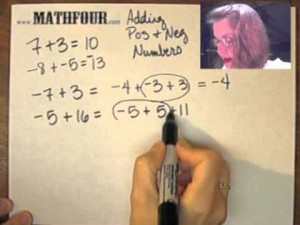
I’ve discovered many ways of teaching math through the years and the most interesting one was the addition of numbers with opposite signs. I learned this from a teacher who said that he never understood the rules – so he made up his own method.
He “breaks” the bigger number into two pieces so it can be cancelled. Here it is:
What do you think? Can you teach it this way? Share your thoughts in the comments.
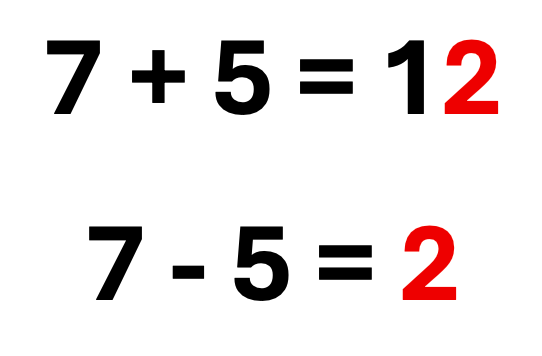
For some reason I have trouble adding 5 to the larger digits (like 7, 8 and 9). I noticed at some point that the last digit of that addition is the same as if you subtracted 5 from that number. Like this:
7 + 5 = 12
7 – 5 = 2
and
8 + 5 = 13
8 – 5 = 3
and
9 + 5 = 14
9 – 5 = 4
So now when I add them, I merely subtract them and slap on a 1 at the beginning!
(Oh, yeah, and there is a good reason this happens – it has to do with 5 being half of 10. And 10 is the base of our number system. Maybe one of the other math blogs can do a proof of this using base n…?)
Do you keep struggling to teach common denominators? Do your kids just not “get it”?
Well, it’s time to quit.
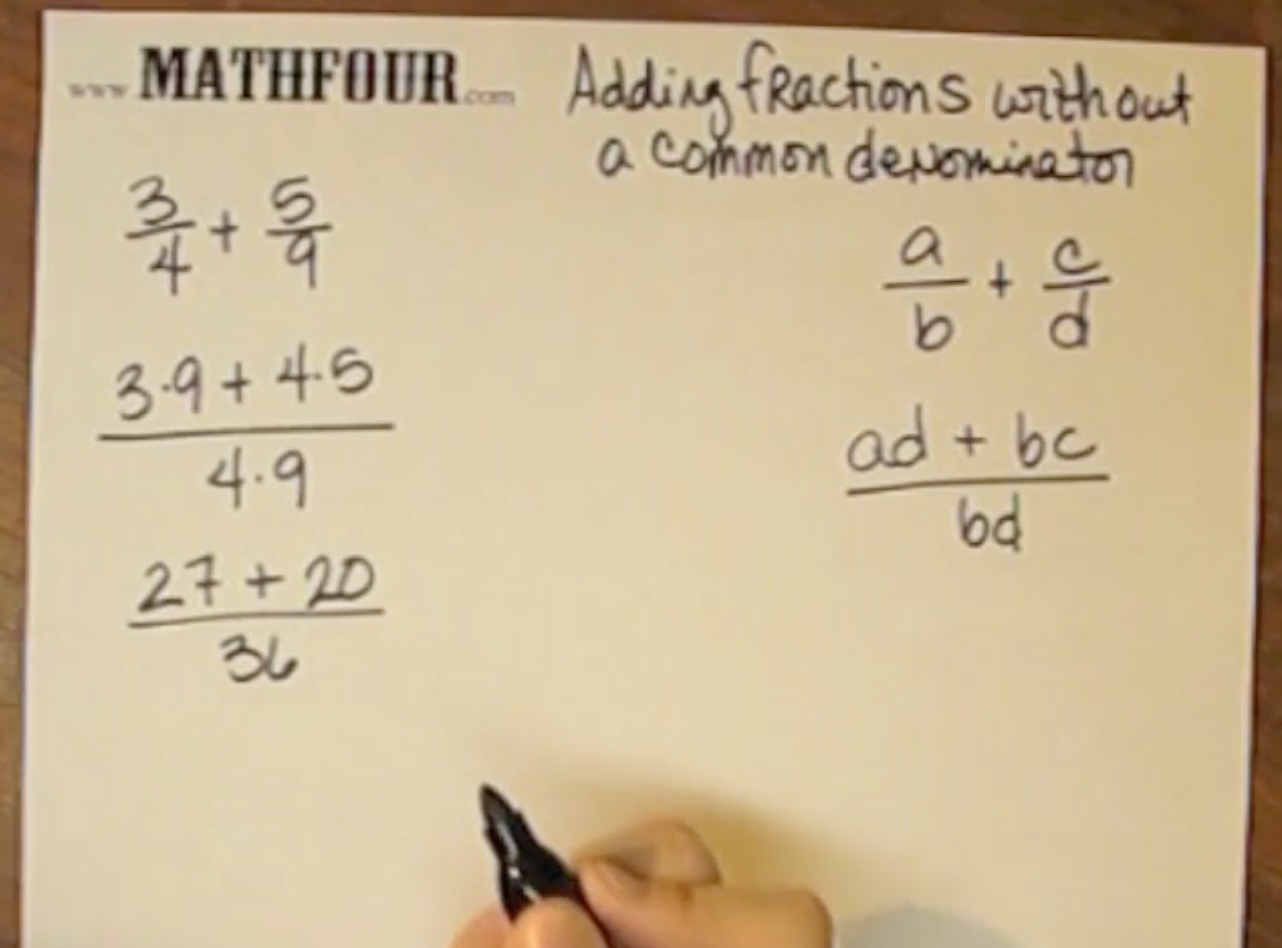
Yep! You can teach (and do) fractions without ever finding a common denominator.
The key is in the definition of addition for rational numbers. If you have two numbers and the sum of them is .
Granted there is the technical issue of reducing, but using a little prime factorization will get you there without an issue. (And you don’t really HAVE to reduce, which I will discuss in a later post.)
Here is an example:
Here’s one with an obviously easy common denominator that works just fine with this method. In it I explain a little about why you would want to do it this way:
You might argue that finding a common denominator is an important learning experience. And you’re right. In the same way that learning about death through the loss of a pet is an important learning experience. But if you can avoid all that pain, why wouldn’t you?
If you teach this method first, kids will get annoyed with having to do so much reducing and discover the common denominator method for themselves. And that’s really what learning math is all about.
What do you think? Can you teach fractions this way? Share your thoughts and experiences in the comments.
Thanks to @padgets for our conversation about teaching fraction on #mathchat a few weeks ago. You inspired this post!