
Category: Cognition

  • Practicing Math Skills Early in Life Is a Brain Changing Event

    Practicing Math Skills Early in Life Is a Brain Changing Event

    Thanks to Will Summer who inspired this post with a retweet to me.

    Seems researchers have previously studied the differences in math skills among children vs. adolescents and grownups. Dr. Vinod Menon with has done new research on early math training that focused on kiddos who where merely one year apart.

    Turns out that in one year of math, the brain changes quite significantly!

    You can integrate early math learning into just about anything.

    Daughter is heavy into Brown Bear, Brown Bear by Bill Martin, Jr. and Eric Carle. This is not a math book. Nor does it pretend to be. But I’ve found a way to use it to develop math skills.

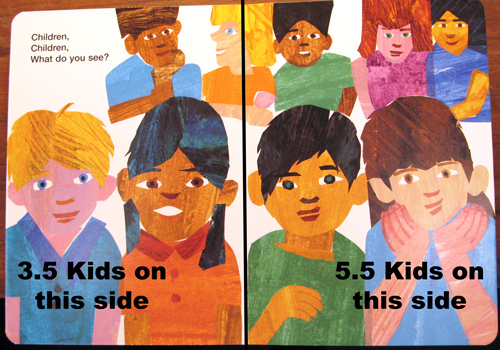
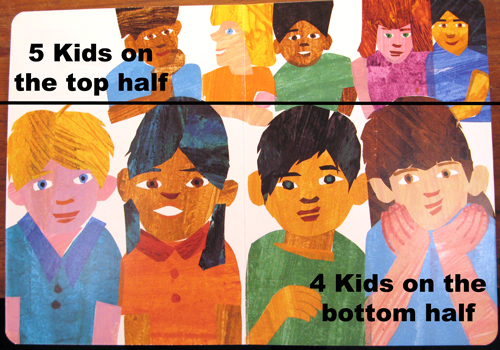
    When we arrive at the page with the children, we practice counting the kids. First in one direction, then in the other – as direction matters to kids. It isn’t inherent that if you count one way you’ll get the same number as if you count the other way.

    Sometimes we’ll count the top row of children and add it to the number of the bottom row. We can practice the commutative property by adding 5 + 4 = 9 and the adding 4 + 5 = 9.

    As an alternative twist, we’ll count and add the kids on the left page to the kids on the right page. This one gets fun, because that little blond girl is half and half!

    So we can now add fractions and practice the commutative property at the same time!

    What else?

    With Dr. Menon’s research, we now know how important it is to get started early with math learning. What other things can you do to start teaching math skills early?

    Related articles
  • What’s the Difference Between Gifted and Disabled?

    What’s the Difference Between Gifted and Disabled?

    There are many definitions of giftedness. And there are many reason to test for giftedness. But the bottom line is how that giftedness is treated.

    I was so moved by this letter I received from a homeschooling mom in Australia. She has generously allowed me to reproduce it.

    Of course ALL children ARE gifted! ALL people ARE gifted!

    What people seem to refer to by the use of the word ‘gifted’, is actually referencing ‘intellect’ or ‘intelligence’ or just plain good ‘ole ‘smarts’! or is it speed? ie, the child can do the work faster than other children and have more time to spare. Or is it their ability to concentrate better in such a busy environment as a classroom? aren’t easily side-tracked? extremely focused?

    My children are extremely gifted, and I have never thought of them in any other way except that. Yet they have been diagnosed with several ‘disabilities’ (I refer to them as ‘diffabilities’ – different abilities) and if the doctor’s had their way, they’d be diagnosed with more!

    So, why are they considered ‘disabled’? because they meet a set of criteria which isn’t the norm. Why is someone considered ‘gifted’? because they meet a set of criteria which isn’t the norm. Why is one considered to be on one end of the ‘intelligent/ability’ spectrum and the other on the opposite end? semantics? perception? social conditioning?

    What is normal anyway?

    If I compared my children’s IQ test with most children, my children would win – only saying that from the numbers on a piece of paper, not pride.

    Yet, because of many other challenges they have, they can’t even survive in a classroom environment, and would be considered for remediation classes, not the advanced classes. They would be considered intellectually disabled and shunted to a special needs learning unit (separate ‘schooling’ on same campus as ‘normal’ school and the aim is to integrate them into the ‘normal’ school classroom).

    Yet, my gifted, brilliant munchkins are struggling with learning higher math concepts, because, although we have spent more than 7 years trying to learn and retain the basic math facts, it just seems out of their ability to grasp. Yet we do university level science and computer studies, etc.

    Gifted? Disabled?

    All I know is that it’s a daily challenge for our munchkins and many others like them, who may or may not benefit from labelling in our society. I sincerely have no idea whether labelling is a wise course to take or not. Unfortunately we don’t have parallel lives so that we can compare the two with the same people and situations – wouldn’t that be fabulous?

    One thing I didn’t understand for many years was this particular comment from parents, therapists and professionals alike “it’s so obvious you love your children” – what the??? doesn’t everybody love their children??? But sadly, I started seeing that although parents LOVED their ‘gifted/disabled’ children deeply and painfully, they just couldn’t tolerate their behaviour, so their interaction with their child looked like intolerance, disgust, despair…

    …and a lot of shame and guilt in the mix.

    It’s so sad that we don’t feel we have the freedom to show how much we love our children in our society, especially when our children just don’t ‘fit’ anywhere. They are too different.

    But isn’t that what we should be celebrating? their difference?

    We do.

    But I won’t say it’s always easy to do so 😉

    Thanks for letting me share this!

  • Should You Test Children to See if They’re “Gifted”?

    Should You Test Children to See if They’re “Gifted”?

    In a previous article, I wrote What it Means to Be Gifted in Math. Now the question is, should you test for this?

    I heard this story once about testing and learning:

    A group of people were given a test and then separated into two rooms. One room of people was told that the test showed they had an aptitude for learning welding. And so they were being taught welding. The other set was told that their tests reflected a lack of natural ability to weld. But they were being taught welding, anyway. The group that was told they were gifted at welding, excelled. The group that was told they had no aptitude, did poorly.

    Curiously, the tests were never graded and the people were separated arbitrarily!

    Perception changes things.

    As soon as the people in the “bad at welding” class perceived they couldn’t do the job, they didn’t try as hard. It became part of their internal belief system that they wouldn’t be good at it.

    And once the gifted people realized that welding was their “thing,” they believed they would be great, so they tried harder.

    If it is part of your and your children’s internal belief system that they’re mathematicians at heart, then they will be. They will excel regardless of the method of teaching you choose. They might still decide to be political scientists or English professors, but they will do well in math.

    Do you test your child for Gifted & Talented?

    There’s a saying among corporate trainers: “Don’t ask for feedback about something unless you can, and intend to, change it.”

    Only test your child if you will act on the results of the test.

    Children who are part of a classroom school system will be tested before being allowed into an honors or GT class. If you are a homeschool system, you can teach “GT style” without ever testing.

    But you may be interested in “testing just out of curiosity.” Keep the story of the welding students in mind as you make that decision. As soon as you “know” something about your child, you will treat them differently. We’re human; we can’t prevent this.

    If you’re curious, and the result of a GT test is, “Nope, your child’s just plain normal,” there’ll be disappointment.

    Indeed there are anomalies – prodigies, math intuitives, etc. But unless you’re sure that your child falls into one of these categories, and you intend to act on that knowledge, don’t have them tested.

    Treat your child as gifted.

    In lieu of testing, just treat them as gifted from the get-go. It’s not about if your child is gifted, it’s about if you believe they are gifted.

    Thanks to the great parents at the LivingMathForum for the discussion that inspired this post.

    Related articles
  • How to Tell if Your Child Is a Top-Down Learner

    How to Tell if Your Child Is a Top-Down Learner

    Does your child struggle when you put him down in front of his math book? Are you frustrated in your attempts to get him to do math classwork or homework?

    Maybe he’s a top-down learner. If so, you might not know based on his current “regular” work. It will help in his education if you know he needs the big picture before the details – or the big theories before the steps.

    I remember learning to do derivatives when watching the foster kids that lived with us. I was eight. I’m a top-down learner. Here’s how to find out if your child is one too:

    How the “green beans” con works.

    My mom used to leave green beans open in a can on the table. We would walk by and eat them. If she put them on our plate, we would refuse them. So she got us to eat vegetables without asking us to, by just making them available.

    You can use the “green beans” con as a test.

    For math, put out the harder stuff. Find some books at Half Price Books or someplace cheap in your area. Open up the book. Sit and do some of the math yourself while mumbling aloud. Then walk away.

    If he sees his folks (or older sibs) working through those problems, he might be interested. Watch to see if he goes up to the book to check it out (steal a green bean). Be available to answer questions if he asks.

    If he can grasp some of  that “higher level” stuff, he’s probably be a top-down learner. He won’t want the building blocks until he sees the plans for the whole house. This could be the cause of some of the struggle and frustration – he’s been given the building blocks instead.

    Let him have the big stuff – start “allowing” him to do more of the advanced books. He’ll back up on his own to learn the “lesser” stuff so he can understand the big stuff better. You won’t have to force the work on him anymore.

    Share your experience with your top-down or bottom-up learning in the comments!

    Related articles
  • What It Means to Be Gifted in Math

    What It Means to Be Gifted in Math

    Galois died at age 19 but produced some of the worlds most amazing mathematics! Image via Wikipedia

    Do you ever wonder if your child is gifted in math?

    We’ve been having a discussion on gifted children at the Living Math Forum. We’ve discussed a few definitions of gifted.

    Here’s my definition (from the thread):

    All parents should treat their children like tiny bundles of brilliance. And indeed all children ARE gifted. Right out of the womb. It isn’t until the grownups get to them and try to teach them “reality” that they lose that ability. Want a gifted child? Treat them as gifted from the get-go.

    But that wasn’t the end of the story. Lots of people have responded.

    The “official” definition of gifted.

    If you’re a classroom teacher or parent, you know about that. You have to differentiate between who is gifted and who isn’t. This ensures the appropriate children get placed in the right learning environment.

    A child is “gifted” if the local testing center says he is.

    Some kids have “different brain-wiring.”

    Another definition that was discussed was of a neurological nature. Many kids just “get” math while some kids struggle.

    But that doesn’t mean the strugglers can’t do math. It merely means that they will likely be brilliant writers, politicians and historians, not mathematicians.

    This definition makes my thought of “every child is gifted in math” fly out the window. Indeed every child is “special” and everyone thinks in their own ways. But some people are wired in a way that lets them “see” things more easily than the rest of us.

    Math intuitives are one of these groups. I’ve recently encountered a couple of math intuitives – people who will “see” an answer to a math problem without having to do any of the work. One of these even can do Sudoku this way (to the frustration of her father).

    Others in this group are true child prodigies. I’m not sure if this is merely an intuitive who is nurtured or actually different. But there are children that amaze scientists and mathematicians.

    Every child is still gifted!

    Regardless of how you look at it, we all do math. Like Daughter’s pediatrician told us: “We’re all potty-trained.” Indeed – we are all potty-trained and we all do math. On some level. It’s natural. It’s intuitive.

    And I still hold that if the grownups stay out of the way, the kids will do all the math their brains are built to do!

    What’s your definition of gifted? Are your children/students gifted?

  • How to Train the Brain to Understand the Transitive Property

    How to Train the Brain to Understand the Transitive Property

    Remember the ol’ “if A equals B and B equals C, then A equals C” deal? At parties it’s a great line to drop. In math, it’s officially called … cue music…

    The Transitive Property

    Saying it is fun, teaching it is curious, learning it can be weird.

    Grownups think it’s intuitive. But to a kid, it isn’t. It takes experience and experimentation to learn all the bits that we think are “common sense.”

    The transitive property is really thinking things through. Starting from one place and moving along through another and then arriving at a third place.

    There are many ways to help kids with this learning. Word problems simulate thinking stepping stones. But they can be rather stressful. If you do it through play, you reduce the stress that they face and give them skills they need to tackle advanced thinking, forever.

    This video shows a nifty “toy” from Discovery Toys that can get kiddos using those brain stepping stones.

    Notice the flow is

    1. Choose the number tile with the question number.
    2. Read and answer the question.
    3. Correspond the answer to the letter in the answer box.
    4. Put the number tile with the question number in the corresponding letter box.

    Thinking through from question number to answer letter while avoiding the pitfalls is the challenge.

    Have you played with these? How do you train your kids’ brains for the transitive property?

  • 5 Phases of Learning Math

    5 Phases of Learning Math

    This post is an answer to a question Michelle, a high school math teacher, sent. She writes:

    I explain a new concept then give an example and finally do an example with the class directing me on how to solve. What I have noticed is that the bulk of the questions occur during or after the chapter assessment. Most of the students’ questions are great questions. It’s just that the questions they are asking are ones they should have asked much earlier.

    Think of knowledge as a bag of shapes – all of which have different colors and textures. Once you get the bag, you have to sort through them. Some people want to count them, some people want to sort them by color, some by shape. Some people need to sort by texture. Some people need to sort by all three or just lay all of them out in rows to get a good look at them.

    Everyone sorts the bag of shapes differently. Likewise, everyone sorts information differently.

    Turns out, the bag of shapes isn’t the knowledge. It’s merely the information. And it takes each person “sorting” it in their own way to turn the information into knowledge.

    In teaching and learning math, I’ve noticed a cycle. I’ll use the bag of shapes to illustrate it:

    1. Exposure

    Exposure is usually in the form of lecture and examples done by the instructor. It can be the first time the student has seen it or the first time in a long while.

    This is where the student receives the closed bag of shapes.

    2. Activity

    Any activity following the exposure. This typically is in the form of homework or classwork practicing the concept and problems.

    This is the “peeking into” the bag of shapes. The student gets to remove a few of them and start looking at them.

    3. Settling

    Allowing the subconscious to work. The brain does this all on its own.

    Often mathematicians will go for long walks, go to the movies, hang out with their kids, talk to non-math people or do any number of non-math things to force the settling phase.

    Children don’t know how to force the settling phase, nor do they need to. It just happens between when they do the homework and when they start to study for the exam.

    In the bag-o-shapes analogy, this is where the students dumps all the shapes onto the floor and sorts them in various ways. It takes a while to get through all the shapes and see what kinds of sorting can be done.

    4. Re-engagement

    This is typically in the form of studying for the test and taking the test. It can be a heightened emotional situation where the learner is under stress.

    This is a revisit of the concepts. It becomes easier because the settling has occurred and the information (the bag of shapes) is already organized.

    The learner at this point will attempt to modify some of the conscious thinking to best fit with what the subconscious has done. The added stress will allow them to connect with what they’ve done better – as the “feeling” state induces a different type of learning.

    5. Application

    This is using the concepts for something else. This will often be the next class or next term of the math curriculum. If you learned graphing functions, you will likely use graphing functions in the future.

    To wrap up the analogy, this might be a student realizing that the bag of shapes is needed for something – not just a random bag of shapes. Therefore he can re-organize them to be of use in the new situation.

    Let the learning flow.

    This flow of learning is natural. It will happen and has to happen. The only thing you can do to artificially speed it up is cycle it more often.

    The students ask the good questions, as Michelle said, “during or after the chapter assessment.” This is in phase 4 – Re-engagement.

    Instead of going through a single cycle, do it two or three times. Like this:

    1. Monday: Lecture, chapter 1 (exposure)
    2. Monday: Classwork and homework, chapter 1 (activity)
    3. Friday: Test, chapter 1 (re-engagement)
    4. Monday: Lecture, chapter 2 (initial exposure to chapter 2 and application of chapter 1)
    5. Monday: Classwork and homework, chapter 2 (activity)
    6. Wednesday: Test, chapter 1 (yes – chapter ONE; re-engagement again)
    7. Friday: Test, chapter 2 (re-engagement)
    8. Monday: Lecture, chapter 3 (initial exposure to chapter 3 and application of chapters 1 and 2)
    9. Monday: Classwork and homework, chapter 3 (activity)
    10. Wednesday: Test, chapters 1 and 2 (re-engagement again)
    11. Friday: Test, chapter 3 (re-engagement)
    12. Monday: Lecture, chapter 4 (initial exposure to chapter 3 and application of chapters 1, 2 and 3)
    13. Monday: Classwork and homework, chapter 2 (activity)
    14. Wednesday: Test, chapters 1, 2 and 3 (re-engagement again)
    15. Friday: Test, chapter 4 (re-engagement)

    What do you think? Share your experiences with the cycle below in the comments.

    Thanks to Michelle for requesting this tip. Michelle is one of only two math teachers in a rural private school. She teaches Algebra I, II, Geometry and Calculus.

    Do you have a question? Ask it in the comments section.

  • 6 Techniques to Brain Training from a Pro Brain Trainer

    6 Techniques to Brain Training from a Pro Brain Trainer

    This is a guest post by Dr. Vicki Parker of The Brain Trainer.

    If your child has always done well in math but has recently had difficulty in one area of math, such as geometry, then tutoring on specific information may be helpful.

    However, if your child has struggled with math year after year, it may be time to look at underlying cognitive skills, the building blocks of thinking. The specific skills that drive math include

    • Attention
    • Memory
    • Visual processing
    • Logic and reasoning
    • Processing speed
    • Number fluency

    If there are weaknesses in any of these areas, there will be learning struggles.

    Attention is the ability to stay focused over time.

    Attention is important for math because you have to be able to focus and attend over time to information, especially as problems get more complex. You can tell if your child has trouble paying attention if he understands the concept of the problem but adds instead of multiplies, or subtracts instead of adds.

    A simple deck of playing cards can be magic for reinforcing cognitive skills. To build attentional skills, have your child raise his/her hand or hit a bell whenever s/he sees the targeted number or suite of card as you flip through a deck of playing or Uno ™ cards.

    To further challenge your child, s/he must say the targeted card or quickly add, subtract or multiply a number to the card. To build sustained attention, add another deck of cards.

    Memory is the ability to store and retrieve information.

    Memory is important to recall number facts and sequence. What’s your child’s ability to hold on to the first steps of a problem or the initial calculation?

    If she cannot hold this information long enough to move on to the next step of the problem, progression will be difficult. She may need to retrieve previously learned information from long-term memory to execute the problems at hand.

    Try showing your child a numbered card, then turning it over, hiding the number, then have your child say the card number. Present another card in the same way.

    Next, have your child remember the two numbers and then add the numbers. Repeat this process with two new cards at a time.

    As s/he gets better, have him/her work on serially adding in this sequence:

    1. See 1st number & hide
    2. See 2nd number & hide
    3. Add the two numbers

    The child will recall last number shown (not the sum), you will show & hide another card and the child will add this new number to the previous number recalled.

    Continue, but remember: don’t add the sum number, only the numbers presented visually.

    Visual processing is the ability to see and manipulate visual stimuli.

    Visual processing is helpful to see shape, size, and relationships. We use it to see groups, understand angles, and other activities in math.

    Quick matching of similar shapes or numbers is helpful here. You can make small tweaks to this activity by sorting by size with various sizes presented and the same for the orientation of the shape – a triangle upside down or at an angle matching a triangle presented in the vertical position.

    Logic and reasoning allows us to see patterns and trends.

    It allows us to order events. You need logic and reasoning to understand bigger concepts. When we decide what’s needed and how to set up a story problem we’re using logic and reasoning.

    Practice copying patterns with young children using such items as beads or blocks. You can even have fun and have them create a pattern for a crown, flower pot border or placemat for dinner.

    For older children, start a pattern and see if they can finish the pattern. This can be easily done with building blocks and Leggo’s ™.

    Processing speed is how efficiently and quickly we can process information.

    Processing speed is very important to be able to do the basics quickly and move to second or third steps.

    To work on processing speed, try timing your child working his/her way through various paper and pencil mazes. Your child will love the competition when you make it a race between multiple participants!

    Number fluency is recognition of written numbers.

    Number fluency is a coding process normally developed by age three or four. If we are delayed with recognition of numbers, it slows us down with calculation.

    You need two decks of cards for this fun task. Deal out one deck of cards, an equal amount of cards for each player. Use the second deck to flip the target cards over.

    The players must match the number on the card, being pulled from the second deck. The first person to get rid of all their cards by matching the numbers is the winner.

    To push number fluency that is more than visual recognition, have the participants say the number before they place their card on the target card and then the game moves on.

    Conclusion

    Knowing your child’s unique cognitive profile will help you understand their performance and take you one step closer to solving their math challenges.

    The good news is weak cognitive skills can improve if targeted and trained. Brain training is a type of mental exercise, carefully designed to stimulate the brain and make lasting changes in cognitive abilities.

    The idea is to improve one’s ability to learn, rather than focusing on one concept of math. It is analogous to learning how to play an instrument (which is a process) and not just a specific song (which is knowledge or data – one concept).

    Vicki Parker, Ph.D. is the founder and director of The Brain Trainer and writes for their blog.