Author: Bon Crowder

  • Why Learning to Subitize Is Important

    Why Learning to Subitize Is Important

    Previously, I gave a definition and some resources for subitizing – assessing quantity without counting. The questions I posed in the previous article were

    • If you do it, how did you learn to do it?
    • How do we teach children to do it?

    Having thought a great deal about it, I wondered if it was even relevant to teach it. And Husband asked the question, “Don’t they need to count and know their numbers before learning to subitize?”

    You don’t have to learn to count to know “how many.”
    Although evidence indicates that subitizing and counting happen in the same part of the brain, you don’t have to know how to count to subitize.

    Subitizing up to 4 or 5 using recognition bypasses the “counting” of numbers.

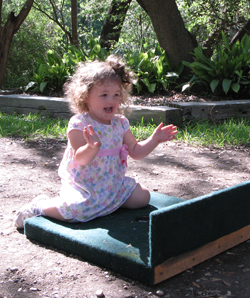
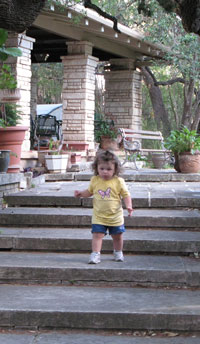
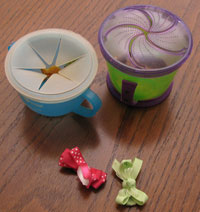
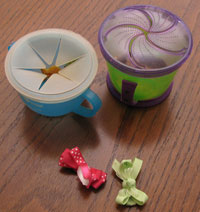
    Daughter is currently subitizing 2 – without counting. I haven’t taught her how to count objects at home and they don’t do it at school yet. So she has no concept of one. But “two bows” (one for my hair and one for hers) is very important to her. Likewise “two bowls” (one with goldfish and one with Rice Chex) is an amazing thing.

    This article by Ernst von Glasersfeld explains how number words can be associated with the quantity without ever counting. Children give the appearance of counting because they’ve memorized the number words and they use the cadence to tap their finger on objects. But they’re usually doing this to be rewarded with praises and cheers. They don’t really understand the concept of counting. This is what I saw the little girl doing at the playground.

    It IS important for kids to subitize.

    What’s the point, anyhow? If I can quickly see 8 things  – does it matter? And is it important to tell the difference between 8 things and 9 things? If there are 8 hungry tigers heading for me and I subitize that there are 9, will it make a difference in how fast I run from them?

    I researched more and found out that  subitizing does matter to the understanding of numerical concepts.

    Subitizing 2 items and putting it with a subitzed 3 items can yeild the perceived 5 without ever knowing what addition is. And having the group of 4 items and seeing within it a group of 3 or 2, leads quickly to subtraction and division.

    Thus subitizing “teaches” various mathematical concepts without ever getting into the language or construct that grownups have put on it.

    So how did we learn it?

    My initial guess was that we’ve learned to do it the same way we’ve learned to read without sounding out the words. Over the years we’ve seen and counted many hundreds of bundles of 3 things that when we see another bundle of 3 things, we know there’s 3 of them.

    Upon further research I’m now of the opinion that I learned it from Ma saying to me “there’s three of them” while I looked at a collection of three objects. I bypassed the counting and went straight to learning the cardinality – with the help of grownups.

    The cliffhanger…

    So I’ve yet to answer the question, “How do we teach subitizing?” Alas, it’s coming. (UPDATE: it’s here, complete with downloadables!)

    In the meantime, where do you observe subitizing and does it seem important?

    Related articles

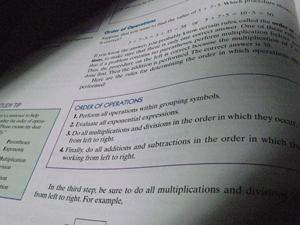
  • The Order of Operations Explained: Parenthesis

    The Order of Operations Explained: Parenthesis

    This is the 2nd in the series The Order of Operations Explained. For the other articles in this series, click here to visit the introduction.

    I mentioned in the introductory article for this series that “the order of operations isn’t best practice for expressions involving variables.”

    When you involve a variable, you can’t just “do” the arithmetic. Like in the case of 2(3x + 4)=11. You can’t add 3x and 4 to get a result before moving on. You have to use the distributive property.

    And even the distributive property won’t work sometimes – as in the case of absolute values shown below.

    Parenthesis mean isolation.

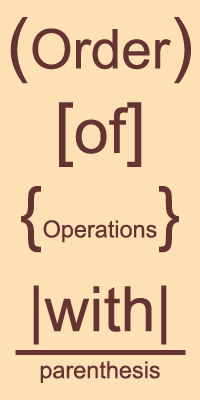
    When we say “parenthesis” in the Order of Operations (OoO for short), we mean anything that’s grouped together and isolated. This could mean with actual parenthesis. This could mean [square brackets] or {curly brackets}.

    Although grownups seem to know that square and curly brackets are the equivalent of parenthesis, children don’t. This has to be said out loud.

    “Parenthesis” in the OoO can also mean |absolute value bars|. This one’s not so clear.

    When you try to solve the equation 4|2x+3|=20, you have to start with dividing by 4 to isolate the absolute value chunk. There’s not a “rule” for distributing the 4.

    (Although, it would be worth it, and fun, to see if your children can come up with some rules for distributing within absolute value bars. This would be some real mathematics at work for them – experimenting and discovering.)

    Tops and bottoms of fractions are implied parenthesis.

    It’s also the case that the numerator (top) and denominator (bottom) of a fraction are isolated places. These fall under the OoO as parenthesis.

    Check out this older video I did. It shows how this works with fractions:

    Parenthesis are for deviation from the other rules.

    David Chandler of Math without Borders commented this in the previous article of this series:

    The rule is to do higher level operations first. Use parentheses whenever your intention is to deviate from this rule.

    If you can focus on this instead of a mnemonic device, you can get students to internalize what’s going on with the OoO. It’s important, however, to make sure they remember about other bracket shapes as well as isolation.

    Let us know your tips and thoughts on the P in PEMDAS!

    Related articles

  • Can You Teach All K-12 Math in 8 Weeks?

    Can You Teach All K-12 Math in 8 Weeks?

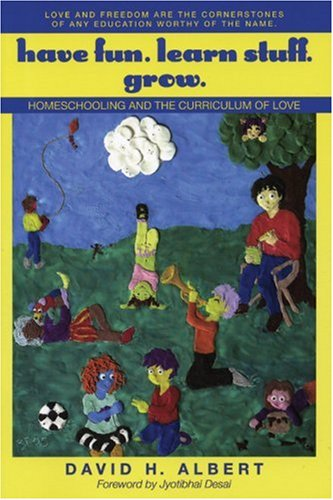
    Elizabeth, @Ser3nd1pity, tweeted an excerpt from a book by David H. Albert called Have Fun. Learn Stuff. Grow.

    Reading through it, the thought that came to mind over and over was, “Finally.”

    Here was my favorite part:

    …the subject matter itself isn’t all that hard. What’s hard, virtually impossible, is beating it into the heads of youngsters who hate every step.

    Indeed there is a gracious sufficiency of beating – and resistance – when teaching math.

    But everyone already knows math!

    In the book, Albert wrote:

    If you never teach a stitch of math, in a mathematical culture your kids will learn heaps of it anyway. …learning math along the journey is a difficult thing to avoid.

    You can’t not do math and exist. It’s like not breathing. Impossible.

    We survived for a very long time without the written word. But we’ve never existed without math.

    Early humans knew that to divide a chunk of meat between two people would yield too little:

    meat2<what I need\frac{\text{meat}}{2} < \text{what I need}

    He might not have have had the fancy way to write it – but he could learn how to write it in 8 weeks.

    Daughter playing with washers: counting them and learning math in her world.

    Can you teach all of K-12 math in 8 weeks?

    The short answer – it depends on to whom. In Albert’s article, he’s teaching children. You can totally do this with kids. And cavemen, I suspect.

    Grownups are a different story. Innumerate adults already have anxiety, anger or fear associated with math. There’s a whole lifetime of un-doing that would have to take place.

    But once you undo this, then the 8 weeks would work.

    The way I teach college classes is this: we’re going to spend 48 contact hours together – I’m going to wow you in ways you’ve never expected. When we’re done, you’ll be much calmer. You’ll be able to learn math much better, both on your own or in a classroom.

    I don’t force learning. I don’t even require learning. I let it happen. It’s the closest I can get, in the classroom, to what Albert is saying.

    Can you get closer to the 8-week method?

    Related articles
  • What is Subitizing?

    What is Subitizing?

    Suzanne at Guided Math Study Group emailed me about subitizing the other day.

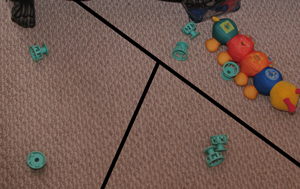
    I used perceptual subitizing to “know” that there were three green hair curlers here.

    Alas, I had never heard this term. So I did some research and thought I’d share what I’d learned.

    Subitizing is a way of instantly counting. In fancy math terms it would be getting to the cardinal number of a set (how many) without without going through the ordinals (counting each one’s position).

    There are two types, perceptual and conceptual. Perceptual is perceiving the number of objects immediately. Conceptual is putting a little effort into it.

    For instance, I glanced at the hot rollers Daughter had scattered on my side of the bed. I perceived there were three on the nightstand. But I had to do a little conceptual subitizing to arrive at the number of curlers on the floor (see the pictures).

    I had to mentally “chunk” these hair curlers into smaller perceivable bundles to conceptually subitize the number here.

    Here is a list of resources I found about it:

    In the next article, I’ll attempt to answer the two questions I see associated with subitizing:

    • If you do it, how did you learn to do it?
    • How do we teach children to do it?

    What do you think of these questions? Do you do it? Do you teach it?

    (By the way, it is pronounced with ooo – like “Ooo! Subitizing is neat!”)

    Related articles
  • Counting Isn’t an Inherent Concept

    Counting Isn’t an Inherent Concept

    We spent our vacation a couple of weeks ago in central Texas. We had lots of fun – including lots of counting.

    One to one association of fingers to Discovery Toys’s Giant Pegboard pegs

    I noticed that some of the basic counting principles grownups know, aren’t inherently known to kids.

    I was observing Daughter as I was counting. She continued to look in deep concentration as I counted from one direction and then recounted from the other. Then I would rearrange the items and count them again. She was still enthralled.

    We teach our young children to count to 10, but never realize they don’t know what that means.

    Counting is a way to associate how much with a group of objects.

    If there are three things in a bundle, we associate the word “three” and the symbol 3 with that bundle. This number is called the cardinality of the set/bundle and means the number of things in it.

    My lone Calculus classmate in high school decided to create her own number system when we were freshmen. Everyone else laughed at her, but I got it. She was noticing that there was no rhyme or reason that we called a set of two objects “two.”

    We’ve decided to say out loud “two” and label it two and 2 and that means this many things: X X

    Counting is a way to order things.

    A bunch of things can be lined up and counted – even if they aren’t technically in a line. Each subsequent number is associated with another object. These numbers are the ordinal numbers. The final number that you count ends up being the cardinality of the set (from above). In this way you use ordinals to determine the cardinality.

    Counting is a way to compare one group of objects with another.

    Take two groups of objects. Pair one object from one group to an object from the other group – set them up in a one-to-one fashion. This shows that the two groups have the same number of objects. It doesn’t determine how many there are, but very young children don’t have to know the numbers to grasp the concept of “the same.”

    This eventually leads to the concepts of equality as well as less than and greater than.

    Counting isn’t dependent on which object you start with.

    This was the craziest concept for me. I noticed this when reading Brown Bear, Brown Bear one night.

    To mix it up (to keep my sanity) I would count the children in the book in differnet directions. After 3,000 nights of reading the same book over and over, something occurred to me. There is no reason for a 2 year old to know that counting in one direction will yeild the same number as counting in another direction.

    This is taught – not directly, but through experience. After counting a bazillion times, we eventually figure out that no matter which way you count things, you’ll get the same number.

    Well, unless Little Brother starts eating those things.

    Counting can be stopped and picked up where you left off.

    This is another concept that grownups “just know.” If you can mark your place (and Little Brother isn’t involved), stopping and coming back won’t change the result. This is the forerunner to addition, too.

    Counting is the foundation of all mathematics.

    This is the kicker. Counting is the beginning of it all.

    If you can get your kiddo to count, the rest is cake. And not just saying, “1, 2, 3, 4, 5, 6, 7, 8, 9, 10,” but really getting him or her to understand the totality of the concepts.

    • How much is there?
    • Is there an order?
    • Does one group have more, less or the same as another group?
    • Did the number of objects change when you counted differently?

    Grownups get it, but we aren’t born with it. Imagine that you don’t know these things inherently. How does that change the way you observe the world?

    This article was originally shared on Homeschool Creations.

    Related articles
  • The Order of Operations Explained: Intro and Mnemonics

    The Order of Operations Explained: Intro and Mnemonics

    The Order of Operations (OoO for short) is used everywhere in mathematics because it encompasses many of the foundational rules that we’ve agreed to follow.

    Alas, students have been given the cheap and dirty version of it for years. “Here, memorize this thing about your Dear Aunt Sally!” What the heck?!

    There are subtleties in the Order of Operations that every person over the age of seven should know.

    The series begins today.

    The order of operations is a set of rules – like the drivers’ handbook for math. If everyone follows the rules, we’ll all be safe. But if someone makes a bad turn, we could be looking at a crash.

    But the Order of Operations is only a set of rules for arithmetic! It isn’t even the best practice when it comes to expressions involving a variable like x. I’ll cover what I mean in this weekly series.

    Here are the proposed articles:

    1. Intro and mnemonics
    2. Parenthesis
    3. Exponents
    4. Exponents, Multiplication and Addition
    5. Multiplication and Division
    6. Addition, Subtraction and Conclusions
    7. Exponents of Negative Numbers
    8. Another Reason to Ban PEMDAS (aka parenthesis aren’t an operation)

    Mnemonics for PEMDAS

    Well, there’s one: PEMDAS (pronounced just like it looks). That’s what the cool kids in high school always said. It was the same kids who said “soh-cah-toa” – which I thought sounded really goofy.

    And then there’s “Please Excuse My Dear Aunt Sally.” And of course “Piranhas Eat Mostly Decayed Antelope Skin.”

    What’s your way to remember it?

  • Teaching Math with Counting

    Teaching Math with Counting

    Counting is a big deal in our household these days. Daughter’s 21 months old so teaching advanced multivariable calculus takes way too long for her attention span.

    Walking Steps and Counting Them

    But we count everything. Things in books, steps, bobby pins, people… you name it.

    We count in negatives, too.

    If you’re following my tweets, you might know that I count to Daughter in the bathtub – from negative 30 to positive 30.

    My neighbor suggested that early introduction to negatives might have helped her friend’s 14 year old son. He now has all sorts of difficulties with math. Not the least of which is arithmetic among positives and negatives.

    This makes me even more excited about counting in negatives to Daughter.

    Counting in negatives shows order.

    You may not need 61 seconds of anything. But you can count from negative 5 to positive 5. The point in the counting of negatives is to introduce the order of the numbers – since negatives seem to go “backwards” when you list them in order.

    And you can introduce distances with counting. You can show how distance is different than the number of points. Counting from -5 to +5 is actually 11 numbers. In this video you can see how I “rediscovered” this and then explained it:

    Parents often focus on the alphabet and reading in the very early years. There’s some neglect of math things outside of counting to 10 (starting at 1). You can do so much with counting – counting negatives, counting distances, skip counting (2, 4, 6, 8, etc.), finger counting, counting backwards.

    Counting is the foundation of all of math. And there’s tons of fun ways to use it in the early years.

    Share your ideas about counting in the comments below!

    Related articles
  • Practicing Math Skills Early in Life Is a Brain Changing Event

    Practicing Math Skills Early in Life Is a Brain Changing Event

    Thanks to Will Summer who inspired this post with a retweet to me.

    Seems researchers have previously studied the differences in math skills among children vs. adolescents and grownups. Dr. Vinod Menon with has done new research on early math training that focused on kiddos who where merely one year apart.

    Turns out that in one year of math, the brain changes quite significantly!

    You can integrate early math learning into just about anything.

    Daughter is heavy into Brown Bear, Brown Bear by Bill Martin, Jr. and Eric Carle. This is not a math book. Nor does it pretend to be. But I’ve found a way to use it to develop math skills.

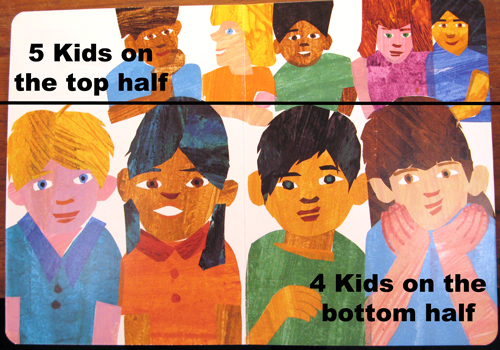
    When we arrive at the page with the children, we practice counting the kids. First in one direction, then in the other – as direction matters to kids. It isn’t inherent that if you count one way you’ll get the same number as if you count the other way.

    Sometimes we’ll count the top row of children and add it to the number of the bottom row. We can practice the commutative property by adding 5 + 4 = 9 and the adding 4 + 5 = 9.

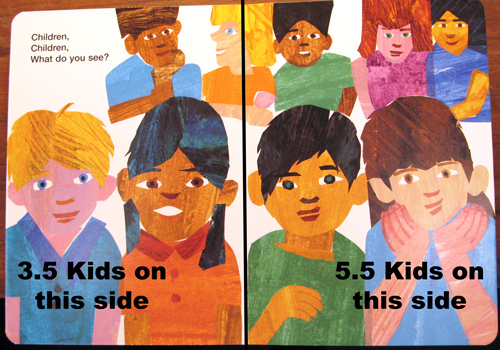
    As an alternative twist, we’ll count and add the kids on the left page to the kids on the right page. This one gets fun, because that little blond girl is half and half!

    So we can now add fractions and practice the commutative property at the same time!

    What else?

    With Dr. Menon’s research, we now know how important it is to get started early with math learning. What other things can you do to start teaching math skills early?

    Related articles
  • How Adding Evens and Odds is like Multiplying Positives and Negatives

    How Adding Evens and Odds is like Multiplying Positives and Negatives

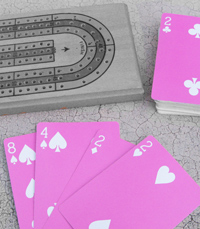
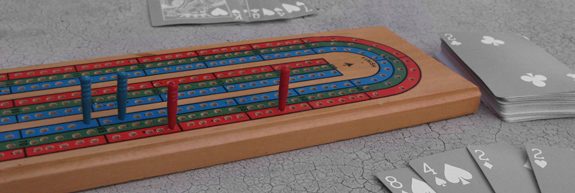
    I was playing cribbage with Husband when I found my hand to be 8, 4, 2, 2 and the cut card was also a 2. I focused hard to see if I could come up with 15. (If any group of cards add to 15, you get two points.)

    My resolve was strong. Then I remembered that for any group of numbers to add up to an odd number, one of them must be odd.

    While shuffling for the next hand, I started thinking about adding evens and odds:

    • Even + Even = Even
    • Odd + Odd = Even
    • Odd + Even = Odd

    This looked familiar. Then I remembered the rules of multiplying positives and negatives:

    • Pos x Pos = Pos
    • Neg x Neg = Pos
    • Neg x Pos = Neg

    I was so excited to notice this. Alas, I’m pretty sure I’ve noticed it before. I love rediscovering patterns as much as discovering them!

    Look for patterns everywhere.

    Always keep your eyes peeled for similarities. When you see them, if your children are old enough, use leading questions to get them to observe the same thing. If they aren’t old enough, keep a journal to share things with them later. Encourage your kids to look for patterns in everything. Use toys and manipulatives to improve this, but also use nature and everyday activities. What patterns or nifty things in math have you noticed recently?

    Related articles
  • 6 Confusing Terms in Mathematics

    6 Confusing Terms in Mathematics

    Thanks to David Ginsburg for inspiring this post.

    Do you struggle explaining to your students what “simplify” means? Do you wonder why they won’t reduce fractions to their lowest terms?

    Here’s how to explain and teach some of the top confusing terms in mathematics – without throwing you or your students into a tizzy!

    Where

    Really! “Where.”

    As in “Where do the lines intersect?” or “Where is the highest point of the graph?”

    “Where” in math almost always means “at what x-value?” Every now and then “where” can mean “at what point?” In the first case, “Where do the lines intersect?” can be just as easily satisfied by a point (x, y) as the x-value only.

    When you get into calculus, the word “where” is used everywhere (pardon the pun). “Where is the slope of the tangent line equal to zero?” and “Where are there discontinuities?” among others.

    Keep your eyes peeled in the textbooks for this tricky term.

    Reduce

    Typically this means to reduce to lowest terms. Which isn’t really helpful, since you still need the definition of “terms.”

    Numerators and denominators (tops and bottoms of fractions) that have one or more common factors are not officially “reduced.” Once they have no common factors at all (except 1), they are said to be reduced or reduced to lowest terms.

    A reduced fraction helps in many ways. You can “feel” the value more easily: 2/5 is a lot easier to picture than 14/35. Also, when you add fractions, starting out with all the numbers in their reduced form will often help to find common denominators.

    Zeros, Real Zeros and Roots

    Zeros, real zeros and roots all mean the same thing. It is where a graph passes through the x-axis. We can write “where are the zeros” meaning at what x-value (“where” from above) does the graph pass through the x-axis? We also will write “what are the zeros” and mean the same thing.

    To find the zeros or roots, we set a function (or any equation solved for y that involves x) equal to zero. Then we solve for x. This will give the result that we want – the x-values where the graph will go through the x-axis.

    We call them zeros because they are where y = 0. We call them real zeros because there can be complex or imaginary zeros that don’t exist on the graph.

    Finding the zeros or roots of a function help when graphing it. If you know all the places it goes through the x-axis, you can then determine where it’s above or below the x-axis. Then you can roughly sketch the graph.

    Simplify

    Of all the terms in mathematics, this one is the most slippery. This meaning of this term is always in context to the book or situation. What it means is “manipulate the expression.” The end result may or may not be “simpler” than the starting expression.

    Better textbooks use phrases that are clearer, like “multiply the polynomials” and “combine like terms.”

    If “simplify” is the instruction to a problem set in a textbook, consult the examples to see what type of manipulation to do.

    In later courses, students have to recognize when a situation requires a different form of the expression. Practicing various forms of manipulation (or “simplifying”) gives them tools to manipulate the expression to satisfy their needs.

    Do you run into other terms in mathematics that are hard to explain to students? Hard to understand yourself? Share them in the comments!

    Related articles