I have since shot another video showing this with number tiles instead of playing cards.
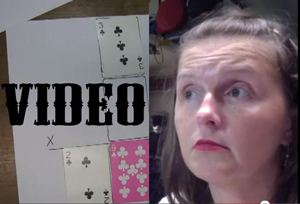
In response to a post on the Living Math Forum, here’s a way to teach long division with playing cards.
Whatcha think? Will it work? Let me know if it does!


I have since shot another video showing this with number tiles instead of playing cards.
In response to a post on the Living Math Forum, here’s a way to teach long division with playing cards.
Whatcha think? Will it work? Let me know if it does!

Originally published as a guest post on MathForGrownups.com, a math blog by Laura Laing.
A couple of weeks ago, a fellow freelance writer wrote me about her foray into graduate school. She needed to brush up on some math skills, and she wasn’t sure how. I have a feeling that her questions weren’t unique. Whether you need to learn a little extra to help your kid with his homework or you need to take a math class to further your education, learning math again (or for the first time) can be daunting.
Luckily, my friend and fellow math blogger, Bon Crowder offered to write a guest post on this very topic. I swear, Bon and I were separated at graduation or something, because we approach math education in very similar ways. Plus she’s fun. (See? Math folks aren’t always boring and difficult to understand!)
I wanted to title this “Being a Great Adult Learner.”
But that’s dumb. All adults are great learners. If we weren’t, we’d be stumbling around, bumping into doors, starving and naked. We know how to learn, and the proof is that we’re still alive.
And dressed.
The question is “What makes you learn?”
Confidence involves two things: feeling worthy and knowing you have the ability.
When people feel they’re entitled to something, they’re more likely to feel confident in getting it. Hang around any Best Buy service desk and you’ll see this in action. People say all kinds of strange things when trying to return a broken product, and these things are said with a sense of entitlement. BY GOLLY they’re going to get their way!
So how do you gain worthiness and ability? You’re worthy of it because you already have it. And you’re able to do it because you already do.
You have it all. It’s just hidden behind a wall of words you or someone else (or both) has told you for years. Now’s the time to ignore everybody, even yourself.
Because here’s the gosh-honest truth: There is not a single thing within a mathematician that is not within you.
You’ve done math since you were a kid. Even before you were in school. You knew at a deep level that if there was one toy and there was another kid around, you’d better run like the dickens to get it. There’s no dividing that toy evenly between kids.
You balance your checkbook (or you would be in jail right now), you probably have some rough idea of your gas mileage, and you know that if you have 12 people coming over, you’re going to have to double or triple that recipe for shepherds pie. You know math. Now’s the time to admit it.
So say this every night before your prayers. If you don’t pray at night, say it twice:
I do math. Today I woke up on time because I calculated how long it would take to get dressed. I knew how much money to spend because balanced my checkbook. I figured out how much weight I needed to lose – and I used math to do it.
Modify this statement to fit your lifestyle and run with it. Every night.
Once you’ve tapped in to the realization that you’re inherently good at math, you need the right learning environment.
This includes location, timing and the other people involved. If you have to drive too far away after working all day and all you get is a lousy quarter-pounder-with-cheese, you’re going to be tired, grumpy and irritable. If your class is full of teenagers fresh out of high school and the professor is 400 years old and believes in death by PowerPoint, things are not going to go well.
How do you know the right environment?
Look at all the learning experiences you’ve had through the years. List out the good ones and the bad ones. And then dig deep – what made the good ones good? Why were the bad ones so detrimental?
Include timing, location, student body, temperature in the room and details of the instructor. List out the attitude of the instructor, his/her teaching style, voice intonations – even how he wrote on the board.
Pick out the deal-breakers and the nice-to-haves and write them on a special piece of paper. This is your official “Environment Requirement” page. Laminate it, put it in Evernote, tatoo it to your bottom – whatever you do to keep it close so you can refer to it often.
How do you make sure your Environment Requirements are honored?
Here’s where that sense of entitlement comes back into play. If your class has a deal-breaker environment element, do something about it. Think, “If this were a faulty remote control that I bought at Best Buy, how would I handle it?”
Ask the instructor to manage the loud students better. Ask building maintenance to change the temp of the room (or bring a sweater). Don’t sign up for a class during a time when you’ll be tired, hungry and irritable.
And if you can’t change the environment – leave. Drop the class. Get your money back.
If it were a crappy remote control, that’s what you’d do, right?
You’re dressed…
And fed. You learn all the time. And you do math.
Now go find a class that fits and have fun!
Bon Crowder publishes www.MathFour.com, a math education site for parents. But that’s not all! Bon has launched a really, really, really cool initiative called Count 10, Read 10. While parents are encouraged to read to their infants, toddlers and preschoolers, we’re rarely encouraged to inject a little bit of math into the day. Bon will show you how. Take a look at her blog for more information on developing math literacy (or numeracy). I’ll be writing about this more in the coming months.
Questions or comments? Leave them in the comments section below!

I’m heading to the Texas Home School Coalition’s Convention this weekend in The Woodlands, close to Houston, Texas. The excitement I have for it makes me think of the excitement due to math…
(and I have on Husband’s Roger Creager shirt that is faded brown – I’m NOT naked.)

On Friday and Saturday I’ll be attending my first ever homeschool conference.
I’m so fresh and new at this – but really, I’ve been doing it forever. My ma sent us to public school (a really good one, Tarkington ISD) but as a single parent, she didn’t have much choice. At least back then.
But she started her own business cleaning houses so she could be an afterschooling mom. She really REALLY wanted us to have the learning and interaction she could provide from 4pm to bedtime.
Almost everything I know about math, I learned from her. She (and you) might be surprised at that because her degree is in English! But she taught me puns, patterns and a way to look at the world in a totally different light. Which is exactly what math is.
Husband and I haven’t decided on how we’ll educate Daughter. Right now she’s going to a day school, which is really good for her and us.
And we afterschool like crazy. It takes me forever to get anywhere with her because I let her observe everything. For as long as she wants.
Everything I publish on this site is either used on her or I can’t wait to use it on her.
My mission is to help the first and most important teachers – parents – to be comfortable enough with math to teach it to their children through experiences. Which means I need to know what parents need from me. How can I help?
I’ve got experience with infants and toddlers at this point. I know grownups, too (taught college for 15 years). But school-aged kids? I’m depending on y’all.
So what should I ask when I go to the conference? What should I learn and discover that will help me help you?
Please, please, let me know in the comments!
(Oh, and if you want to meet up, let me know that too – I’d love to connect!)
Written as part of the Count 10, Read 10 series.
I noticed Daughter attempting to bejewel Husband with a strand of my faux pearls the other day. I watched, enthralled with the math learning taking place.
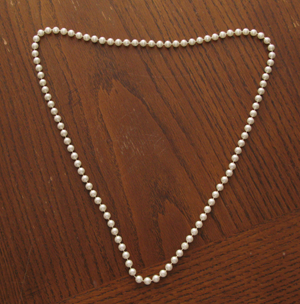
She held the necklace in her hands – one on each side. Just about equal. So the space available for Husband’s head was almost non-existent. Like this:

If she were to hold the necklace at two points that were closer together, she would create a “dip” in the necklace where his head could fit. Like this:
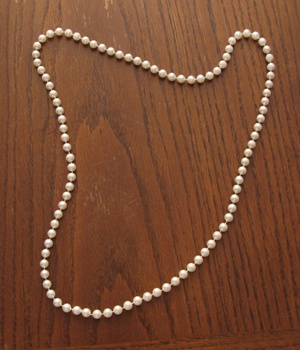
This made me think of all the nifty things you can show about the relationship of perimeter to area and how you can have the same perimeter but change the area to all sorts of sizes.
If you aren’t wearing a necklace, find some mardi-gras beads. Daughter has many strands, so I’m guessing your house might be littered with them as well. If not, join the club. Go buy some.
Play with them in the bathtub or right before bed. (Make sure they give them up before going to sleep, though – it’s a strangulation hazard!)
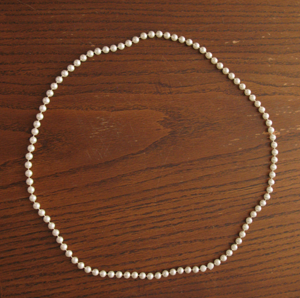
Move the necklace around on a flat surface (or on the bed) and let your child experiment with the ways the area changes. Ask questions like:
Don’t forget, activities like this should be fun. For your child as well as you. So don’t get too in depth talking the math talk if it feels weird. Go with the flow.
And let me know how that flow goes, would you? Share your thoughts in the comments.

Most parents aren’t professional mathematicians. But there are a few. This is the third in a series of interviews with mathematician parents with the goal of helping parents integrate math teaching into parenting.
I had the privilege of interviewing John Golden, a university math professor and publisher of Math Hombre, a website with clever and fun math content that’s new every week!
Just a sample: “As a bad beginning teacher, emulating David Letterman of all people, I realized that I loved teaching math.”
MathFour: Thanks for taking the time to answer some questions, John. First, what’s your degree and career? And how long have you been in math?
John: I have a PhD math in 1996, and am working as math ed faculty at GVSU a 25000 student public university in Michigan.
MathFour: Tell us about your children and how they feel about math.
John: Xavier – 11, a bit more positive about math than his sister, Ysabela – 12. Neither loves it.
MathFour: Do you have any worries about your children academically? In particular, do you think they will do better in math than in other subjects because of your influence?
John: They’re both decent problem solvers, but that doesn’t necessarily equip them to do school mathematics. Ysabela, for example, found out this year she wasn’t allowed to use her method to divide and had to use the standard algorithm.
We encourage them to follow their passions. Both are quite artistic, and Ysabela is an amazing reader. I do worry that I’ve emphasized understanding over grades to the point where they have no interest in academic success.
MathFour: How do you play with your kids? Do you play math things?
John: Lots of games: card, board, table. No video games other than some flash games on the computer. I love games for their math like nature, or math for its game-like nature, so I see it as connected.
MathFour: Do you think you speak with your children or behave differently than other parents because you have a math background?
John: Definitely. Distinguish between what they’re asked to do and what math is, talk about cool and interesting math connections, do think alouds when doing homework, etc.
MathFour: Have you ever had any of your children express negative thoughts about math and how did you handle it?
John: More than occasionally. I take it with a grain of salt because I hated math at this age, too – for being boring and repetitive. I talk about the importance or confirm the irrelevance of what they’re doing, and try to emphasize making sense, and help them make sense.
MathFour: Have you ever disagreed with one of your children’s math teachers?
John: I always volunteer in their classrooms and bring games and such into it. This year, my daughter’s middle school classroom didn’t have me until the end of the year to do algebra tiles, but that was a positive experience. I strongly respect teachers, whether I agree or disagree, and never feel like they’re doing anything other than what they think is best.
MathFour: Now to change direction a little to a more worldview of math. What do you see as the biggest challenge in math education today?
John: Irrelevance of school mathematics, anti-math culture, misunderstanding of what math is, professional/governmental insistence on teaching junk, high stakes tests that preserve bad pedagogy…
MathFour: Wow, that’s a lot. So what do you see great happening in the world of math education?
John: Internet networking, slow but growing awareness among new math teachers about better ways, leveraging of new technologies and opportunities for change because of bad test results.
MathFour: What advice can you give to non-mathematician parents that might help them raise their kids to like and appreciate math.
John: Give it a go themselves. If it didn’t the first time, try to make sense of it along with your kids if they learn it. Value thinking and communication over the right answer. Play games!
MathFour: Thanks so much, John! Great tips and insight.
How about you? What are some questions you have for a mathematician parent? Share them in the comments – I’ll try to get John in here to answer them.
If you want to connect with John directly, get with him on twitter, find his contact information here and make sure to check out his site, Math Hombre!
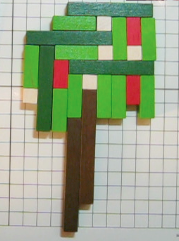
Cuisenaire Rods are brightly colored wooden sticks. Technically, they’re “proportionally sized rectangular parallelepipeds.” (But only say that if you want to hear your 3 year old repeat something really cute!)
The “proportional” thing is important. The white ones are 1cm square, the red ones are twice as long and each color is 1cm more than the next color.
I’m anticipating many articles and videos on how to teach with these (since the possibilities with these things are virtually unlimited), so I thought I would start a running series. Here are the ideas and the links to the articles/videos that are ready:
Share your own ideas on how to use Cuisenaire Rods in the comments!
P.S. I spent my hard earned money on these at Teacher Heaven. This small set was $15 in the store, but I see you can get it for less than $13 online.
This is also shared on Works for Me Wednesday.
![[50 Word Friday] A Boy Wonders About Math and His World](https://mathfour.com/wp-content/uploads/2026/01/image-137.png)
A little boy wondered about pi. Why is this number so strange? Shouldn’t natural associations like the circumference to the diameter be whole numbers?
Then he thought, the hypotenuse of a isosceles right triangle is root two of one of the sides. They’re all wonky!
What’s wrong with our universe?
Learn more about 50 Word Friday here.

Learning math isn’t just about being taught math. It’s about fun, discovery and experimentation. In the Count 10, Read 10! program, parents get to spend 10 minutes a night playing math with their children.
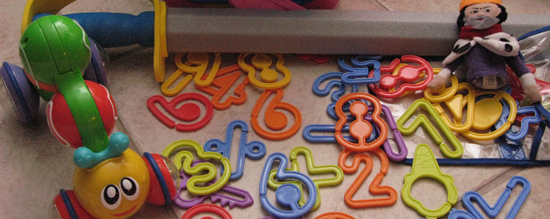
Like many games you’ll find here, this is a version of Calvinball (from Bill Watterson’s Calving & Hobbes cartoon). You and your children make up the rules as you go along or as you see fit.
This is merely a guideline or starting point.
Objective:
Have fun with numbers, counting and quantities.
Breakable rules:
Leader: Five!
Player 2: Plus three is eight!
Leader: Plus one is nine!
Player 2: Plus two is eleven!
Leader: WINNER!
The round ends when the youngest child reaches their limit of counting or adding. The winner is determined by a rule or random choosing. The older the children, the more “real rules” you’ll need to follow.
Possible winning rules:
The point is to have fun with counting and math. As your children grow, you’ll have to adjust the rules to give them more challenge and to fit the “real game” model. Here are some options for variations:
All games created at MathFour.com are tested or will be tested on Daughter. The rub is that Daughter is almost 2 – we’ll have to wait a while to do this one. So your input is important.
Will it work? Did it work? Try it and let me know how it goes in the comments, please. Also share your own variations.
See update below.
Homeschooler @Ser3nd1pity requested my thoughts on the math program from IXL via twitter a few days ago.
So I checked it out.
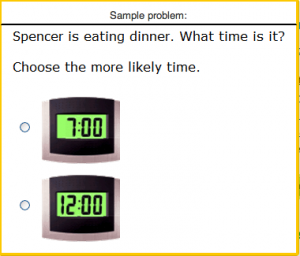
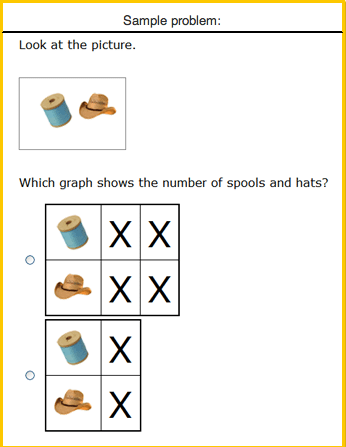
When looking at the IXL sample page, I started having some concerns. Here are some screenshots that I’m running into, as well as my thoughts:
Some people say “dinner” for “lunch.” They reserve the word “supper” for the evening meal. Instead of using terms that might be cultural, perhaps they could have used breakfast.
I was so confused by this one. I’ve never seen a graph made of two objects. Nor have I seen graphs made with giant Xs. I think a graph with lines or bars instead of Xs would be clearer. As well as having a few of the objects, not just one of each.
These suitcases appear to be the same but zoomed in. A reference object would certainly help this.

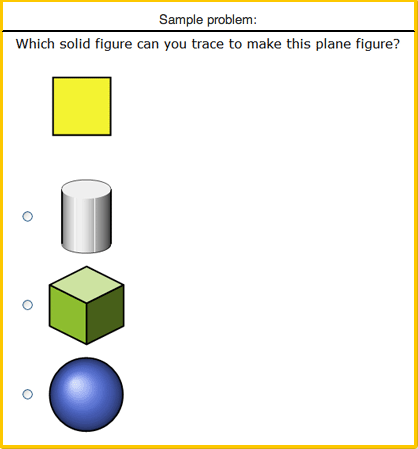
I didn’t know what plane geometry was until college. I’m pretty sure that five-year-olds and their parents will figure out what the answer is, but the question stem is written at a really high level.
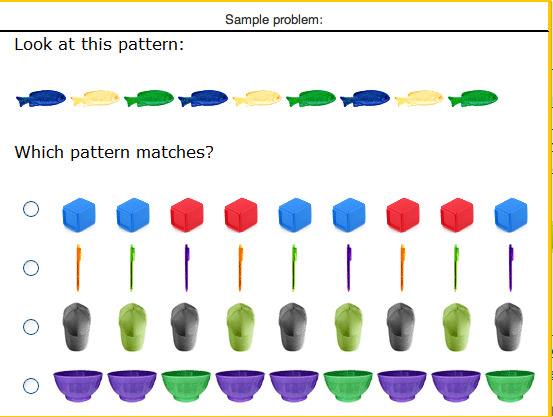
The right answer (the pens) are very very hard to see here. And the various colors and objects are confusing. Better would be the same objects, or bigger or with more space between the lines.
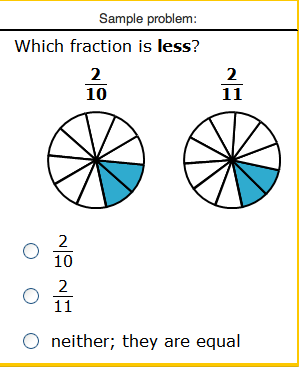
These pies really look the same to me. If I look and count really, or look at the fractions, I can see they’re different. This might be more effective without the pictures. For a seven year old (and for me), if you had 2/10 of that pie and he (or I) had 2/11 of that pie and it looked like these pictures, they could easily be perceived as the same.
Of course I haven’t really gotten into the curriculum. These are merely samples. I don’t know how they teach this in the IXL Math Practice program. I worry, though, that these examples might be representative of the way it is taught.
I welcome a view into the curriculum, if they’re interested in more thoughts on their offering.
Update March 29, 2012: IXL has communicated to me that they’ve been making changes – including some based on this article. They’ve also hired me to take a deeper look at their product and give them feedback. I look forward to seeing what they’ve got.
I’ll post updates, so stay tuned!