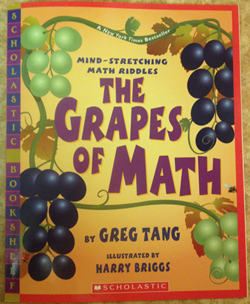
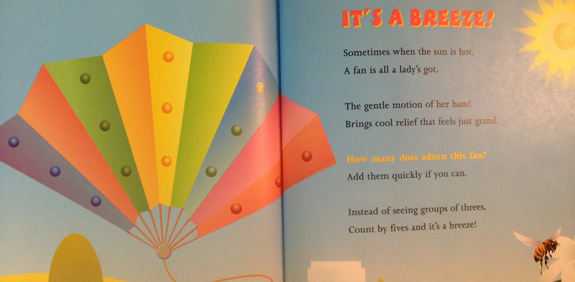
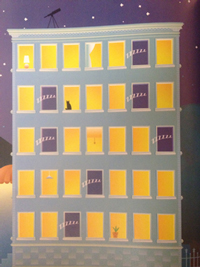
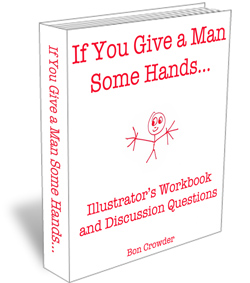
The first thing you see in this math picture book are the bright but simple images. Looking at them you feel like you’ve stepped into the surreal world of those old View-Master reels.
The rhymes are catchy and cute!
I’m all about iambic pentameter. Well, I really don’t know exactly what that is, but it sounds like it means bouncy poetry.
And that’s what this math picture book has!
While scallops on the beach look great, I’d rather see them on my plate.
Unfortunately it’s their loss, They swim their best in butter sauce.
Oh, but the counting’s even better!
Each page has objects (fruit, bugs, dice, etc.) spread out so that children can experiment with different ways to “see” how many there are. You can subitize, group, multiply, subtract – or do them all!
The answer key in the back helps you understand the intent of the authors.
But I recommend you try various ways yourself before turning to the back. Some of their methods were very different than what I came up with.
And you can try it at home!
There are 16 different pictures and riddles to practice on. But it doesn’t have to stop there.
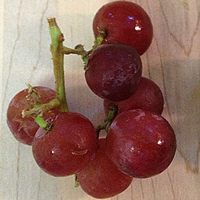
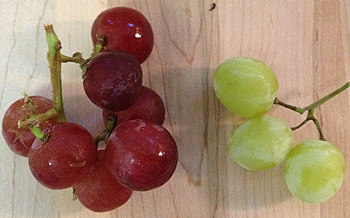
You can do your own playing at home. Check out the grapes I did here:
The order of operations includes two types of rules: those that are based on the way the operations work, and those that are arbitrary. My friend @harrisonalg from the Twitter chat #mathchat and I have been discussing this.
You can explain the truly arbitrary elements of PEMDAS (the left to right of AS and MD) through an experiment. Allow students, independently, to do these two problems any way they want, ignoring any stupid arbitrary rule they might have previously memorized:
3 – 2 + 8 – 3 + 4
2 x 7 ÷ 2 x 6 ÷ 3
The idea is that they will come up with many different answers:
3 – 2 + 8 – 3 + 4 could be any of -14, 0, 10 or others
2 x 7 ÷ 2 x 6 ÷ 3 might be 7/18, 7/2, 14, etc.
If they were on a team building a bridge with these calculations, things wouldn’t work so well.
Enter the Stupid Arbitrary Rule (SAR).
Because we need to all come up with the same answer, we need a rule to follow. Really, it can be any stupid arbitrary rule (SAR). But we agreed, at some point in history, to all follow the “left to right” thing once we were down to addition & subtraction or multiplication & division.
It’s important to note that kids didn’t get to be part of that agreement we made. Just like they don’t get to vote in elections.
Is it fair? Probably not. They would probably do a better job of choosing leaders as well as determining the order of operations. But that’s the way things likes SARs work.
PEMDAS doesn’t cover it all!
To throw a few more kinks into it, check out how wikipedia explains some special cases of the order of operations. . Factorials aren’t covered in PEMDAS, neither are the order of exponents.
Here’s another fun one: even calculators do things differently (and arbitrarily). Check out the way the the TI-92 and the TI-30XII handles exponents. Clearly you get to make up your own order of exponents!
Let them play king: they create the rules!
Let your students determine the order of operations for addition & subtraction and multiplication & division – just for the class. Make sure to write the rule down and tack it to the wall so everyone remembers what they decided. In your class, and your class only, they are to follow that rule.
Remember the back of the book, as well as your answer keys or teacher edition textbook, will now be totally wrong. But it’s worth it.
Doing it this way they might start to understand which pieces of PEMDAS are dependent upon the way the operations are constructed () and which pieces of PEMDAS are arbitrary (left to right).
Once the class determines their special arbitrary rule, practice creating expressions whose result is some important number. Some options could be:
The age of one of the kids
Someone’s favorite number
Your age (be careful)
The age of some other grown-up they know
The last four digits of their phone number
The number part of their street address
Create the expression using the Class Rule as well as the stupid arbitrary rule. Then translate and have a good laugh. I just did my age with my “Bon Rule.”
Bon Rule: addition and subtraction go from left to right, and multiplication comes before division.
My age is 120 ÷ 2 x 3.
If I did this according to the SAR, I’d be dead. Or really famous.
Your turn!
Can you teach the order of operations like this with your kids? If you classroom school, how much trouble are you going to get in when you become the math teaching rebel?
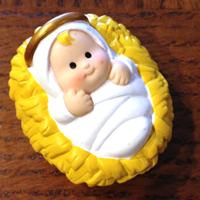
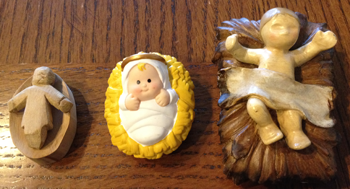
I’ve been stumbling over baby Jesuses for a few weeks now. I realized that with three working nativity sets in the house it was time to do a little math with Jesus.
All of them.
You can count the bits and pieces.
Animals, people, buildings – count them for each nativity set and count them up total.
How many total Jesuses do you have?
How many angels?
How many “visitors” does Jesus have?
How many sheep? Cows? Donkeys? Camels?
How many total animals?
You can compare the numbers.
My three nativity sets have varying numbers of characters and structures. It’s curious how some sets include more animals that visitors – and some sets don’t have any animals.
Which of your nativity sets have more animals? Which has more people?
Which has more buildings (or non-people/non-animal things)?
Are there more visitors than animals or more animals than visitors?
Arrange the sets in order of least to greatest – people, animals, etc. Are they always in the same order?
Is one set bigger or heavier than the others?
Do some arithmetic.
Take the opportunity to show how counting and arithmetic are kinda the same thing.
If you add up the number of sheep you have with the number of donkeys, how many is that? Is it the same if you group them together and just count them?
What if all the shepherds left? Talk about how you can count them, or you subtract the number of shepherds from the total number of visitors.
How many nativity sets do you have? Talk about how 3 times that number is the number of wise men you have.
Do fractions – but only if you must.
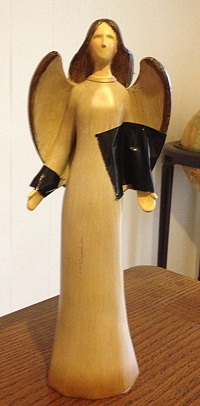
I know many people avoid fractions. I wish I could have avoided it with Math with Jesus. Daughter gave us the opportunity to talk about fractions by breaking the angel (or the “butterfly” as she calls it). Good thing we have Gorilla Tape.
Here’s a FREE Activity Packet to read and share with your children to get them thinking about how numbers got started.
Somewhere in the past we recognized that we have these “digits” on the ends of our hands. Using these, we created numbers, adding, subtraction, multiplication, division and even fractions!
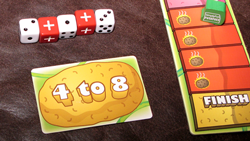
I was at my dad’s house the other day and decided to pull out my new Math’d Potatoes game to see how my super-gaming family liked it.
The kids in the house were too young to play, so my sister and I asked Aunt Linda and our stepmom to play with us.
They quickly claimed they were “math Neanderthals” but agreed to play anyway. My dad, an engineer, was asleep.
The game has simple rules.
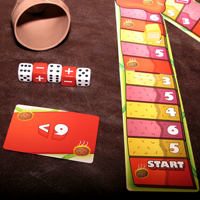
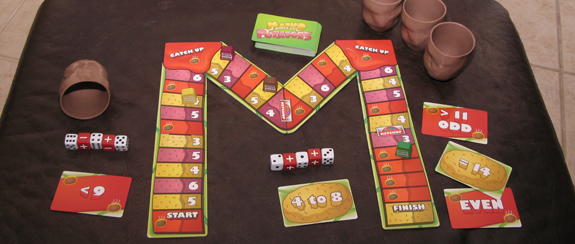
You play Math’d Potatoes by drawing a card, rolling five dice and making an expression that “satisfies” the card.
The card requests various types of “answers”:
Even or odd
Equal to a certain number
Between two numbers
Less than/greater than a certain number
Everybody got into it.
Aunt Linda and Louise (my pet name for my stepmom) both agreed that it was a fun math game. This is in spite of the fact that neither one of them like math, and Aunt Linda doesn’t even like to play games at all!
My dad saw the game the next morning.
I had intentionally not waken up my father to play with us the night before. My decision was validated the next morning.
My dad is an engineer, and as such tends to use the phrase “all you have to do is,” and the word “just.” He’s a very smart man, and I’ve learned lots from him through the years. And one of those lessons is: “Keep an engineer away from sensitive math learners.”
Sure enough, when he saw the game, he eagerly said, “What’s this? Are we going to play it?”
When I explained we played the night before he responded with, “Why didn’t you wake me? I totally would’ve won.”
Math learning is slowly build, and quickly destroyed.
When we were playing, Aunt Linda and Louise were both starting to warm to the idea of math. They were enjoying the game. My sister and I were holding back just a little to give them an opportunity to discovery their own skills. (We both experienced the engineer–math–dad super push growing up.)
So by the end of the game that night, they were excited, confident, and enjoying themselves.
Had I woken up my father to play the game, he certainly would have won. He might’ve turned it into a competition, or he might have tried to help a little too much.
Either way they would’ve lost interest. Their confidence would have been destroyed. And two beautiful, smart and happy women would have their, “I’m a math Neanderthal” thoughts validated.
You can use this with your children.
If you or your spouse are in a math related field, or was “always good at math,” be aware of your potential intimidation factor. Hold back. Don’t help. Allow discovery and confidence to come at its own slow and natural pace. Your children will learn math, in their own time.
Don’t force it, or you might destroy it.
Note: They sent me this game for free. This is not a review, per se, but still – you should know how I got it.
I started this series over a month ago. In that time, I’ve gotten pretty deep in thinking, learning and reading about the order of operations. I’ve seen a variety of ways people view, use and teach it.
Before I go too far into some conclusions, though, let’s look at addition and subtraction.
Consider the problem . Moving from left to right, and doing both subtraction and addition as we come to them, we get 4. If we found a book, or person, that meant the full-on PEMDAS and wanted addition done strictly before subtraction, then we would end up with 0. The latter is because we would do the addition of 3 and 2 before we did the subtraction.
Which is right?
It depends on what you really mean. If you don’t know if you should go left to right or strictly addition before subtraction, either look in the textbook you’re using or demand parenthesis.
The text will clearly outline the order of operations it’s following. Be careful, too because there isn’t always agreement among textbooks. I have seen some texts that instruct the learner to do multiplication first and then go back and do all the division signs. While others (and this is more common, today) have us do multiplication and division from left to right, simultaneously.
If you compare contemporary texts to each other, you’re likely to find them all the same. But grab a math text from the 80s at Half Priced Books. I’ll bet you’ll find at least 50% of the time they put division strictly after multiplication. (I’ll verify this the next time I’m there.)
The order of operations needs context.
I have $5 in my bank account. Then I bought a coffee for $3 and a bagel for $2. I might accidentally write down . I still mean, “I need to add up the stuff I spent and subtract it from my balance.” I wrote it in error, though. What’s “mathematically” correct is .
But you knew what I meant.
This was a typo that was helped along by using the context.
Until there’s a reason to do arithmetic, the order in which we do things is arbitrary. If we all agreed to do addition first, then multiplication, we would calculate and come up with 35 (instead of 23).
As long as we all come up with the same thing, we’re fine.
“We” have agreed to do multiplication things before we do addition things. So “we” would come up with 23 in the example.
Coach G noted it correctly: the order of operations is a convention. In other words, we’ve decided on it. We invented it.
How can you use this to teach your children?
The coolest thing is that you can let them play. Get dirty. Break it.
Remember opposite day? Have that. Let your little one make new rules. Let them see what happens if you all decide one day to do multiplication before addition. If your child is older and doing some algebra, this will mean reversing the order in which you UNDO the operations too!
This is a real brain stretcher. But it’s just math. You’re not building a bridge or balancing your checkbook. Let them break it. Let them see what happens if you make your own rules.
And then they’ll really learn!
Let me know how it goes – share your stories in the comments.
The Order of Operations can be boiled down into three “real” operations.
Parenthesis are merely a way to group things – they aren’t a real operation. So they doesn’t count as a real operation.
Since division is really just multiplication turned upside down, we don’t need to include it separately, either. Likewise, subtraction is addition on its ear. So we throw him out, too.
Now we have only three: exponents, multiplication and addition.
You see that 3 x 3 x 3 x 3 is 34. The exponent is the shortcut for multiplication.
Multiplication is the shortcut for addition.
Likewise, when we get overwhelmed with adding up the same numbers over and over, like in the video, 4 + 4 + 4 + 4 + 4, we can use multiplication to shortcut it: 5 x 4.
Follow the shortcut evolution.
The shortcut evolution is like this
Addition came first.
Then we created multiplication to make addition easier.
Then we created exponents to make multiplication easier.
So when you do arithmetic, we should do the “recent” shortcuts first (exponents) and then the “older” shortcuts (multiplication) and then the “regular” arithmetic (addition). Remember that subtraction is addition and division is multiplication.
And keep in mind that we need to watch the grouping or anything isolated with parenthesis, absolute value bars or in a fraction. The grouping/isolation tools always trump the other operation rules.
What if your answer isn’t the same as the back of the book?
Some textbooks actually have multiplication done before division. This means that the problem 9 ÷ 3 x 2 will show a different answer (3/2) in that textbook’s solution pages than what you would get following the OoO I’m describing here (6). These texts are rare, but I’ve seen them. So keep your eyes peeled.
The Order of Operations is a set of rules that we’ve agreed on. Which means that as long as a textbook clearly defines their order that they will follow, they can do things like this.
If you get confused as to which to do first, demand parenthesis. (Yes, you can do that.) Or put parenthesis into your child’s textbook to help them out.
The problem sets should be there to enforce, not confuse.
What do you think? Does this help or hinder the way you’ve always viewed the Order of Operations? Share your thoughts in the comments.
In the order of operations, the “Exponents” rule represents a bunch more than just superscripts or tiny numbers flying up and to the right of things.
Roots are exponents, too!
Tree Roots by Linda Allardice
Not the ones from trees, but things like square roots and cube roots. Consider . You do the square root first because it qualified as an “exponent.”
But if you had , the 9 + 2 is under the radical sign (the square root sign) so it’s bound together in the “Parenthesis” rule.
This one isn’t that hard with arithmetic, but when you come to algebra and start “undoing” these things – it’s important to remember that roots fall into this category.
Fractional exponents are exponents.
This one seems pretty “duh” so it’s easy to see how they fall into the “E” of the order of operations. But what are fractional exponents really?
So fractional exponents are the same as roots.
Note that some fractional exponents are roots and “plain” exponents all mixed up. Like this one:
This is a big fat full concept that needs a little more explaining. I’ll write more on these in another article.
Logs fall under the E.
Axe In Stump by caroline steinhauer
As my algebra and computer math teacher in high school, Mrs. Kelley, used to tell us – logarithms are exponents. It took me a long time to figure out what the heck she meant. But when I did, I thought it was brilliant.
Notice who the exponent is in this: 32 = 9: 2 is the exponent. And 2 is the same as because the equals sign in means “is the same as.” So the logarithm is the exponent 2.
Still with me? Either way, it’s okay. It’s a weird concept that I can go into detail in a video soon.
The thing to remember here is that logarithms fall into the “Exponents” rule of the order of operations.
So if you have , you have to do the first and then add the 7 after.
Want more on exponents?
In the meantime, you can check out more than everything you always wanted to know about exponents on the Wikipedia Exponents page. Rebecca Zook created a great video on logarithms. And check out this explanation and problems to work on fractional exponents.
And let me know what you think. Did I miss something?
Previously, I gave a definition and some resources for subitizing – assessing quantity without counting. The questions I posed in the previous article were
Having thought a great deal about it, I wondered if it was even relevant to teach it. And Husband asked the question, “Don’t they need to count and know their numbers before learning to subitize?”
You don’t have to learn to count to know “how many.”
Although evidence indicates that subitizing and counting happen in the same part of the brain, you don’t have to know how to count to subitize.
Subitizing up to 4 or 5 using recognition bypasses the “counting” of numbers.
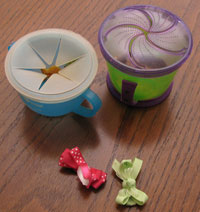
Daughter is currently subitizing 2 – without counting. I haven’t taught her how to count objects at home and they don’t do it at school yet. So she has no concept of one. But “two bows” (one for my hair and one for hers) is very important to her. Likewise “two bowls” (one with goldfish and one with Rice Chex) is an amazing thing.
This article by Ernst von Glasersfeld explains how number words can be associated with the quantity without ever counting. Children give the appearance of counting because they’ve memorized the number words and they use the cadence to tap their finger on objects. But they’re usually doing this to be rewarded with praises and cheers. They don’t really understand the concept of counting. This is what I saw the little girl doing at the playground.
It IS important for kids to subitize.
What’s the point, anyhow? If I can quickly see 8 things – does it matter? And is it important to tell the difference between 8 things and 9 things? If there are 8 hungry tigers heading for me and I subitize that there are 9, will it make a difference in how fast I run from them?
I researched more and found out that subitizing does matter to the understanding of numerical concepts.
Subitizing 2 items and putting it with a subitzed 3 items can yeild the perceived 5 without ever knowing what addition is. And having the group of 4 items and seeing within it a group of 3 or 2, leads quickly to subtraction and division.
Thus subitizing “teaches” various mathematical concepts without ever getting into the language or construct that grownups have put on it.
So how did we learn it?
My initial guess was that we’ve learned to do it the same way we’ve learned to read without sounding out the words. Over the years we’ve seen and counted many hundreds of bundles of 3 things that when we see another bundle of 3 things, we know there’s 3 of them.
Upon further research I’m now of the opinion that I learned it from Ma saying to me “there’s three of them” while I looked at a collection of three objects. I bypassed the counting and went straight to learning the cardinality – with the help of grownups.
The cliffhanger…
So I’ve yet to answer the question, “How do we teach subitizing?” Alas, it’s coming. (UPDATE: it’s here, complete with downloadables!)
In the meantime, where do you observe subitizing and does it seem important?
I mentioned in the introductory article for this series that “the order of operations isn’t best practice for expressions involving variables.”
When you involve a variable, you can’t just “do” the arithmetic. Like in the case of 2(3x + 4)=11. You can’t add 3x and 4 to get a result before moving on. You have to use the distributive property.
And even the distributive property won’t work sometimes – as in the case of absolute values shown below.
Parenthesis mean isolation.
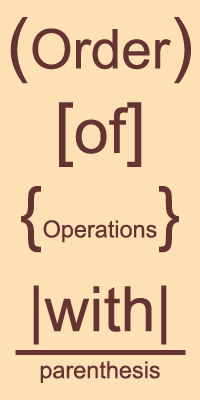
When we say “parenthesis” in the Order of Operations (OoO for short), we mean anything that’s grouped together and isolated. This could mean with actual parenthesis. This could mean [square brackets] or {curly brackets}.
Although grownups seem to know that square and curly brackets are the equivalent of parenthesis, children don’t. This has to be said out loud.
“Parenthesis” in the OoO can also mean |absolute value bars|. This one’s not so clear.
When you try to solve the equation 4|2x+3|=20, you have to start with dividing by 4 to isolate the absolute value chunk. There’s not a “rule” for distributing the 4.
(Although, it would be worth it, and fun, to see if your children can come up with some rules for distributing within absolute value bars. This would be some real mathematics at work for them – experimenting and discovering.)
Tops and bottoms of fractions are implied parenthesis.
It’s also the case that the numerator (top) and denominator (bottom) of a fraction are isolated places. These fall under the OoO as parenthesis.
Check out this older video I did. It shows how this works with fractions:
Parenthesis are for deviation from the other rules.
David Chandler of Math without Borders commented this in the previous article of this series:
The rule is to do higher level operations first. Use parentheses whenever your intention is to deviate from this rule.
If you can focus on this instead of a mnemonic device, you can get students to internalize what’s going on with the OoO. It’s important, however, to make sure they remember about other bracket shapes as well as isolation.
Let us know your tips and thoughts on the P in PEMDAS!