I have long wondered about the similarity between some math words and some English grammar words. In particular ellipse vs. ellipsis and hyperbola vs. hyperbole.
I finally decided to look up their etymologies, and amazingly there is good rhyme to the reason!
Ellipse and Ellipsis
Both of these words come from a Latin root meaning, “a falling short or deficit.”
The grammar term, ellipsis, means the three dots used to designate missing words, or a deficit of words. Like … well…, you get the picture!
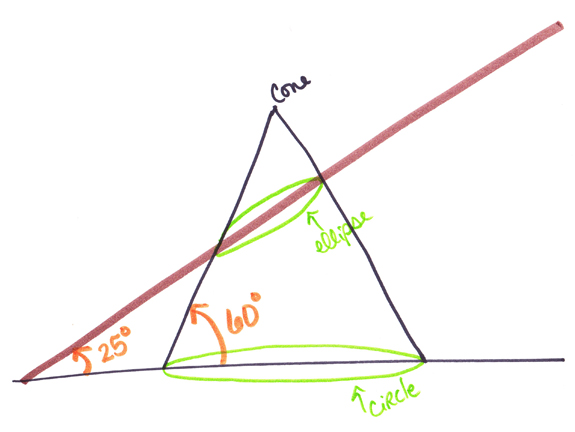
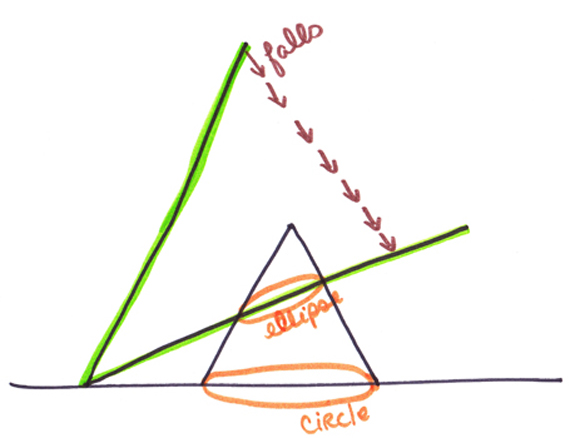
For the mathematical shape, or graph, an ellipse is created when a cone is cut by a line whose angle is less than (or falls short of) the angle of the side of the cone to the bottom of it. (#ARG, I know. Check out the pix.)
The brown line that creates the ellipse has a 25° angle which is much smaller than the 60° angle between the bottom and side of the cone:
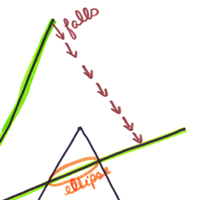
You can see it “in action” here with the line falling:
Hyperbola and Hyperbole
A hyperbole is the fancy English grammar term for exaggeration. Everyone use hyperbole all the time! (See what I did there…?)
And a hyperbola in math is the graph/shape that looks like the light beams from a two-sided flashlight.
Both of these words come from a Latin word that means extravagance or “throwing beyond.” You can see how an exaggeration (a hyperbole) is throwing beyond. But what’s up with the math word, hyperbola?
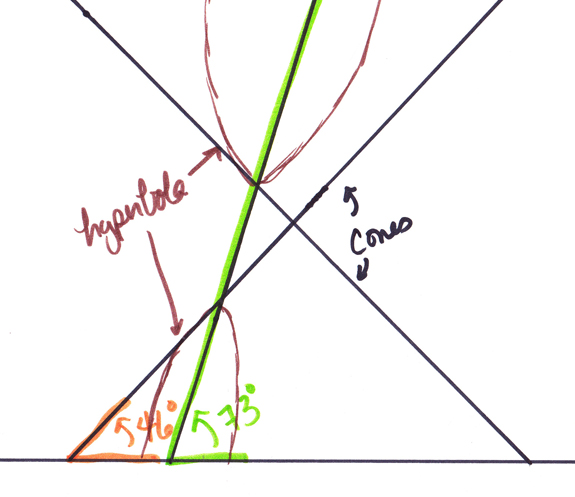
We look to the angle of the cutting line again. A hyperbola is cut from a cone (actually stacked cones — see the picture) with a line who’s angle is “beyond” or more than the angle of the side of the cone to the bottom. It’s just the opposite of the ellipse!
Check it out: (This one is somewhat drawn to scale so you can really see what’s going on.)
Are there more?
These are the only two that have bugged me through the years. But now I’m wondering if there are other math words that have cousins over in the English department.
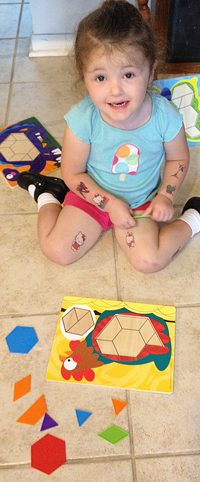
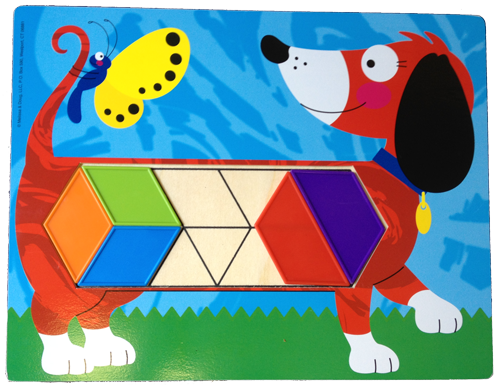
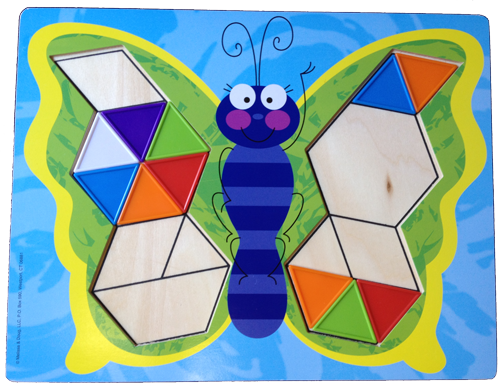
It has ten different animals (on five two-sided boards) and over 50 plastic shapes in tons of colors to complete the pictures.
Use it to teach more than just shapes.
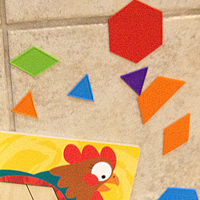
Of course you can talk to your toddler about hexagons, triangles, parallelograms (which are also rhombuses in this math toy) and trapezoids. But you can do even more!
All the shapes can make the bigger ones. So it’s not just a bunch of shapes that may or may not work – this toy is designed with some serious thought.
Here are some questions you can ask while playing:
How many of each shape can squeeze into a hexagon?
Pick a shape and cram them into the hexagons!
How many triangles fit in each shape?
This is huge in math. Since all shapes can be made of triangles, answering this questions preps your little one for some big geometry stuff.
And after you play with those a while, you might notice how the number of sides of a shape compare to the number of smaller shapes that can fit in it.
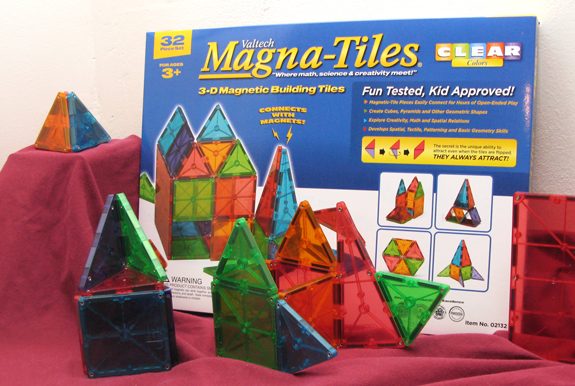
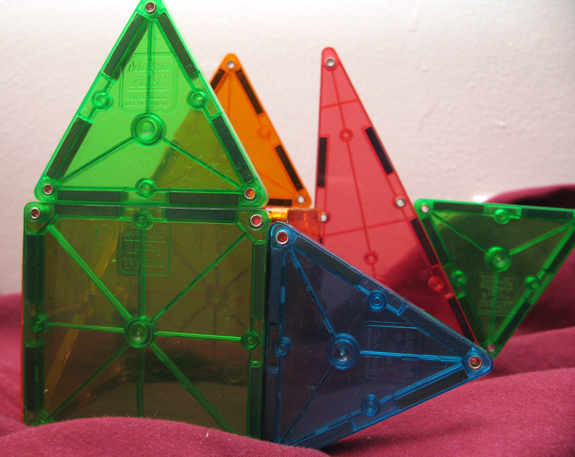
Daughter got a set of Magna-Tiles geometric shapes from her aunt for Christmas. I distracted her long enough to get some great photos so I could write about this amazing toy.
When teaching math, you pull out any shapes you can from anywhere in the house. And sometimes stuff you can buy trumps all the other stuff. Not often – the home holds tons of great geometric manipulatives – but sometimes.
Magna-Tiles are better than anything in the house!
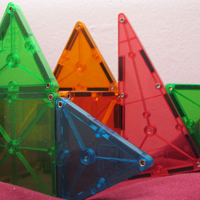
The magna-tiles are clear, so they’re pretty and you can shine light through them.
Also they’re magnetic – so they stick together and stick on the fridge. Great storage for fast usage!
And then – here’s the best part – they’re geometric shapes! Two sizes of squares, three sizes and shapes of triangles.
You’d think that being geometrical was the first requirement. But really – clear, pretty and magnetic go a long way!
Get these fabulous shapes at Valtech! Co. on Amazon.com, or at your local teacher/homeschool supply store.
Do you have some? Do you want some? Share your thoughts in the comments.






![[50 Word Friday] Math in Christmas Lights](http://mathfour.com/wp-content/uploads/2026/05/MathFourChristmasLightsFI-1.jpg)