Tag: sets

  • How to Teach Subitizing: 1 – 4

    How to Teach Subitizing: 1 – 4

    The comparison of numeracy to literacy is curious.
    Learning math is the opposite of learning to read. When you read, usually simultaneous to learning a language, you sound out words and then put meaning to them. When you learn to count and do math, you know the meaning inherently and then put a language to it.

    At some point we learn to recognize words without sounding them out. And at some point we learn to recognize quantities without counting them out. This is called subitizing.

    The Your Baby Can Read program uses the concept of subitizing to teach reading – you show your baby the word alongside the object. So the shape of the word car is as recognizable as a car itself.

    The children using Your Baby Can Read don’t learn to sound out words. They don’t understand the concept of letters any more than babies not using the program. But they instantly recognize the shapes of the words – giving them an (assumed) advantage.

    Aside: We didn’t use the “Your Baby Can Read” program, not because it was gimmicky (I love anything that looks gimmicky), but because there is a huge DVD element to it. We decided not to put Daughter in front of the TV for her first 2 years. A decision we stuck with, but sometimes was a struggle!

    This article contains a “your baby can count” type program. (And it’s a free download!)

    How did we learn subitizing?

    I don’t recall having been taught it directly. Although I could be wrong. The research on it has been happening since the early 1900s, so it might have been taught without being labeled “subitzing.”

    In a previous article about why learning to subitize is importantChristine Guest commented that she learned it out of frustration for counting with chanting.

    I wonder how many of us do that. Are grownups so adept at subitizing that they forget that’s how we assess quantity? Maybe we’re taught to chant-count because that’s the way we think counting is.

    But it isn’t!

    How do you teach subitizing?

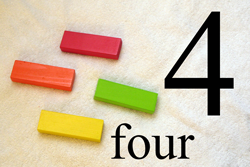
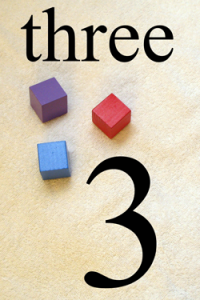
    Images are accompanied by the written numeral as well as the number spoken aloud. The images would be printed on cards, done via video or “live” with 3D objects.

    I’m still working on the numbers 5-10 and up, but for the numbers 1-4, the following 8 styles of image sets would be done twice. Once using the same objects for each image set, and once using different objects for each image set.

    1. Organized in a row vertically.
    2. Organized in a row horizontally.
    3. Organized in a row diagonally.
    4. Organized in a row other way diagonally.
    5. Organized in a regular shape (triangle, square).
    6. Organized in a differently oriented regular shape.
    7. Organized in an irregular shape.
    8. Organized in a different irregular shape. (There will be more of these for 4 than 3, etc.)
    The objects could be blocks, cars, little dolls, just about anything. I created the set below from blocks I found left in Daughter’s block set.

    Each zip file contains a few .jpg files with 4″ x 6″ pictures. You can print them at home or ship them to Walmart, Target, CVS, etc. for printing. I left off the MathFour.com logo so the kiddos wouldn’t get distracted. Please share them along with links back here.

    What do you think? Can you use these? Did you?

    Related articles
  • Union, Intersection and the Empty Set

    Union, Intersection and the Empty Set

    The union is on the left and the intersection is on the right.

    I discussed empty sets in a previous article. I hadn’t yet listened to the recent podcast of The Math Dude, Jason Marshall, in which he introduced sets and subsets. Such a curious coincidence; I thought I would continue down our united path.

    This week, the sweet Math Dude talked about union and intersection of sets. So I’m heading there too – and incorporating the empty set.

    Union and intersection have symbols.

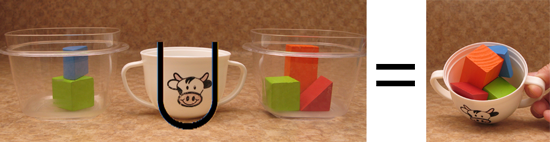
    These symbols represent “operations” (like addition or multiplication) that you do to a pair of sets. They are called the cup and cap and look like, well, a cup and a cap. Or a U and an upside down U. The Union is the U and the intersection is the other one – that’s how I remember it and teach it.

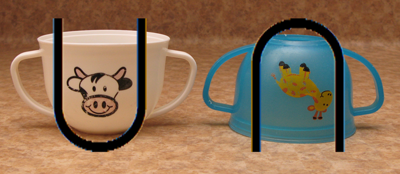
    For the sake of illustration, I’ll use Daughter’s handy SnackTraps like in the picture above.

    The union is everything.

    The sets I’m using are

    L ={green cube, blue half circle thingie}

    R = {green cube, red triangular prism, orange rectangular prism}

    I’m using the letters L and R for left and right in the picture.

    The union of the two sets results in all the pieces from each set, all crammed together. (And if there is a repeated item, you only take it once.)

    The union of the two sets is everything combined (without duplicates).

    Let’s take the set of all states that border Texas and the set of all states that border Oklahoma, like this:

    T = {Louisiana, Arkansas, Oklahoma, New Mexico}

    O = {Arkansas, Colorado, Kansas, Missouri, New Mexico, Texas}

    Then the union of the two would be “The set of all states that border both Texas or Oklahoma or both” and would be T U O = {Louisiana, Arkansas, Oklahoma, New Mexico, Colorado, Kansas, Missouri, Texas}

    Notice we don’t keep duplicates.

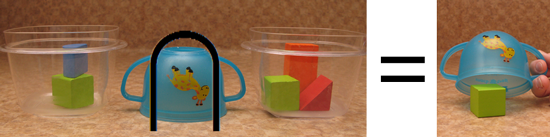
    The intersection is only the common stuff.

    Using the same L and R sets from above, I can take the intersection.

    The intersection is only the stuff they have in common (we get rid of the duplicates here, too).

    Let’s go back to our set of all states that border Texas and Oklahoma:

    T = {Louisiana, Arkansas, Oklahoma, New Mexico}

    O = {Arkansas, Colorado, Kansas, Missouri, New Mexico, Texas}

    Then the intersection of the two would be “The set of all states that border both Texas and Oklahoma, at the same time” and would be T ∩ O = {Arkansas, New Mexico}.

    What happens with the empty set?

    When you start throwing the empty set into the mix, you follow the same rules.

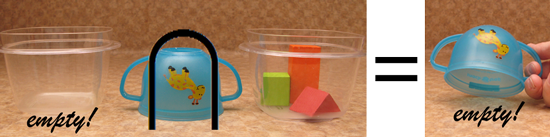
    For the union, you throw everything in both sets into one bag. Well, since there’s nothing in the empty set, “everything” is the original other set!

    The union of the empty set with anything… is that same set back!

    For the intersection, you take only the stuff that’s in common between the two. Since the empty set has nothing – there’s nothing in common.

    The intersection of the empty set with any other set it just the empty set – there’s nothing in common at all!

    Think about it…

    Does this remind you of anything? What similarities do you see between this and addition or multiplication (or subtraction or division)? Ask your children these questions too.

    Get out some snack traps and blocks (or a map) and go for it! Let me know how it goes in the comments.

    Related articles
  • Empty Sets – When to Use Curly Brackets

    Empty Sets – When to Use Curly Brackets

    Are you teaching sets? Some of the stuff that you talk about in set theory  is pretty clear – you have a basket { } and you put stuff in it {♥, ✂, ☎, ✿}. No problem.

    But what’s the deal with the basket with no stuff in it?

    That’s the empty set. It’s written like Ø or simply as the “basket” like this: { }.

    But kids might be tempted to write {Ø} – and then they get it wrong. BUT WHY?

    The empty set is an object!

    Suppose you have four empty sets. Do you have nothing? Nope – you have four containers. Just check your cabinets – I’m guessing you have a handful of empty sets in there with the Rubbermaid® or Tupperware® logo on them.

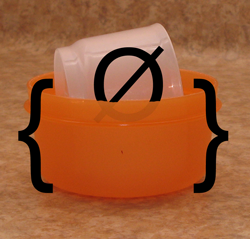
    And {Ø} is an object inside a set.

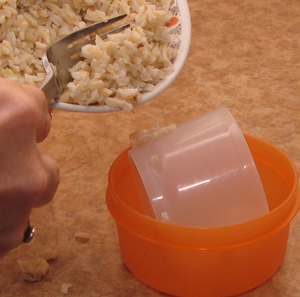
    Supposed you put one inside the other, like this:

    This is the same as {Ø}. Would you be willing to put leftovers inside the bigger one while the smaller one is there? It would be something like this:

    Instead, wouldn’t you be more likely to remove one empty set from the other and have just Ø and Ø (no curly brackets) like this:

    What do you think? Does this help you understand the empty set? Will it help you teach it?

    Related articles
  • Why Learning to Subitize Is Important

    Why Learning to Subitize Is Important

    Previously, I gave a definition and some resources for subitizing – assessing quantity without counting. The questions I posed in the previous article were

    • If you do it, how did you learn to do it?
    • How do we teach children to do it?

    Having thought a great deal about it, I wondered if it was even relevant to teach it. And Husband asked the question, “Don’t they need to count and know their numbers before learning to subitize?”

    You don’t have to learn to count to know “how many.”

    Although evidence indicates that subitizing and counting happen in the same part of the brain, you don’t have to know how to count to subitize.

    Subitizing up to 4 or 5 using recognition bypasses the “counting” of numbers.

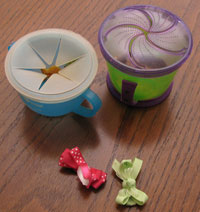
    Daughter is currently subitizing 2 – without counting. I haven’t taught her how to count objects at home and they don’t do it at school yet. So she has no concept of one. But “two bows” (one for my hair and one for hers) is very important to her. Likewise “two bowls” (one with goldfish and one with Rice Chex) is an amazing thing.

    This article by Ernst von Glasersfeld explains how number words can be associated with the quantity without ever counting. Children give the appearance of counting because they’ve memorized the number words and they use the cadence to tap their finger on objects. But they’re usually doing this to be rewarded with praises and cheers. They don’t really understand the concept of counting. This is what I saw the little girl doing at the playground.

    It IS important for kids to subitize.

    What’s the point, anyhow? If I can quickly see 8 things  – does it matter? And is it important to tell the difference between 8 things and 9 things? If there are 8 hungry tigers heading for me and I subitize that there are 9, will it make a difference in how fast I run from them?

    I researched more and found out that  subitizing does matter to the understanding of numerical concepts.

    Subitizing 2 items and putting it with a subitzed 3 items can yeild the perceived 5 without ever knowing what addition is. And having the group of 4 items and seeing within it a group of 3 or 2, leads quickly to subtraction and division.

    Thus subitizing “teaches” various mathematical concepts without ever getting into the language or construct that grownups have put on it.

    So how did we learn it?

    My initial guess was that we’ve learned to do it the same way we’ve learned to read without sounding out the words. Over the years we’ve seen and counted many hundreds of bundles of 3 things that when we see another bundle of 3 things, we know there’s 3 of them.

    Upon further research I’m now of the opinion that I learned it from Ma saying to me “there’s three of them” while I looked at a collection of three objects. I bypassed the counting and went straight to learning the cardinality – with the help of grownups.

    The cliffhanger…

    So I’ve yet to answer the question, “How do we teach subitizing?” Alas, it’s coming. (UPDATE: it’s here, complete with downloadables!)

    In the meantime, where do you observe subitizing and does it seem important?

    Related articles

  • Counting with Ordinal Numbers

    Counting with Ordinal Numbers

    In the last post I discussed cardinal and ordinal numbers. I gave definitions but not much in the way of examples.

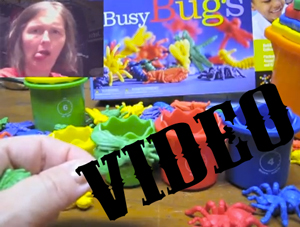
    Here’s an example of using ordinal numbers to count up to arrive at the final cardinal number. Oh – and I’m using the fun little critters from Discovery Toys!

    Whatcha think? Does it make you want to count some bugs?

    What other ways can you use to teach counting?