
Tag: range

  • What’s the Range of a Function?

    What’s the Range of a Function?

    You’ve taught what a function is. And the kids are starting to understand what the domain is all about.

    But then they ask, “What’s the point in the range?”

    As I wrote in a previous post, a function is a question with only one answer to a valid question. The domain is the set of all valid questions. The range of a function is the set of all answers you can get.

    Simple? Sounds like it – but kids the world over still struggle with the question, what’s the point of the range?

    To be or not to be a function.

    Why is it important to know all the answers of an equation? It has to do with the equation being or not being a function.

    If you have an equation like

    y=xy=\sqrt{x}

    you have more than one answer per question.

    Here are some valid questions associated with this equation:

    1. What is the square root of a number, specifically the number 1?
    2. What is the square root of a number, specifically the number 1.69?
    3. What is the square root of a number, specifically the number 4?
    4. What is the square root of a number, specifically the number 9?

    The answers to these questions are:

    1. 1 or -1
    2. 1.3 or -1.3
    3. 2 or -2
    4. 3 or -3

    Notice that there is not “only one” answer to each question. So this equation isn’t a function!

    But that’s no fun at all!

    You can force an equation to be a function by limiting the answers.

    By limiting the answers (AKA limiting the range of a function) you can force an equation to be a function. So if we write

    y=+xy= + \sqrt{x}

    We have just limited the range of answers to be only the positive square roots of numbers.

    The practical application for kids is the graphing.

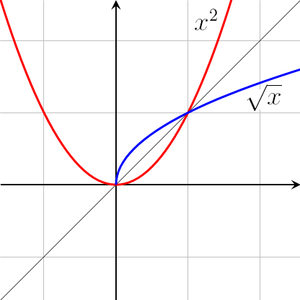
    In this image above it’s the blue curve:
    You can see that we get only  the “upper half” of the curve. If you look at “squishing” a function (like the garbage compactor in the movie Star Wars) you can see the range of a function (all y-values) becomes the vertical line:

    The line starts at zero and goes up forever. (In the video it stops, but that’s only because I have a hard time displaying forever on a computer screen.)

    The handy thing about knowing the range of a function before you graph is that you know how much space on the paper you need – or how small to make your units!

    Does this help? Share your range of experiences with this in the comments! (And pardon the very bad pun.)

  • What’s the Domain, Why You Need It and How You Get It

    What’s the Domain, Why You Need It and How You Get It

    As you teach domain and range, do you get the question, “Why are we doing this?”

    No doubt the question, “When am I ever going to use this?” comes up too, right?

    I’ve asked myself that question my whole teaching and tutoring life. And now’s the time for an answer.

    A function is really a question.

    As I wrote in a previous post, a function is a question with only one answer to a valid question.

    When I write:

    y = 3x + 2 where x = 4

    I mean: “What is three times a number (that number is four), plus two?”

    The domain is all the possible questions:

    • What is three times a number (that number is five,) plus two?
    • What is three times a number (that number is six,) plus two?
    • What is three times a number (that number is seven,) plus two?
    • What is three times a number (that number is eight,) plus two?
    • <how long will I have to do this – Egad!>

    Not only do the questions go on forever, but they also have all the fractions and decimals in between. And all the negative versions of those numbers (and zero).

    So, what’s the point, you might ask. Looks like the questions go on forever and you can just pick any number.

    The domain might not include all the numbers.

    The two sticky points for the definition of “function” are bolded:

    A function is a question with only one answer to a valid question.

    The “valid question” part is where the domain comes in.

    The numbers that make  “valid” – meaning we actually can get some answer – are the numbers that aren’t negative.

    Many functions have “all real numbers” as a domain. There are no limits on the things you can put in, other than numbers that aren’t imaginary or alligators.

    For the most part, there are only two places where you have to be careful of limited domains. Those are

    • Numbers that cause a zero to turn up in the denominator
    • Numbers that cause negatives to turn up in square roots.

    Here are two videos tackling each:

    What do you think? Is this easier to teach when you consider “analyzing” the function rather than “solving” it? Share your thoughts and tips in the comments!