
Tag: psychology

  • Understanding Math — Let Kids Fake It

    Understanding Math — Let Kids Fake It

    There’s a lot of talk about making sure kids understand what they are learning — instead of just practicing some arbitrary set of steps. I’m a proponent of this myself.
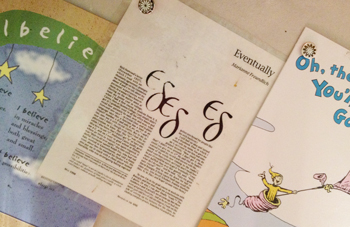
    I copied and laminated this back in 1998!

    But how well a child grasps a concept is based on how well he or she connects with it.

    The learning style and interests a child has has an impact on if (or how well) he or she will understand a concept. And, as far as I know, there’s no rule on figuring that out.

    You keep explaining it in different ways until you see the “aha moment.”

    Except there are some times when understanding is too far out of reach. Or the child’s way of learning requires a deeper understanding than what’s available or possible at that point.

    So what do you do in those cases?

    Do you delay teaching that piece for understanding? Do you go on to something else and skip it altogether? Can you go on to something else?

    Before making that decision, consider three points.

    1. Nobody understands everything.

    The way all the pieces of math work together is amazing. Nobody knows how they all fit — even the most famous of mathematicians. Everyone has something missing. Some of us have much missing.

    So if your child is lacking in understanding for a few things — or even many things — that’s okay.

    2. There’s more than one way to “understand” something.

    Take any math concept and you’ll find that the applications of it are vast. It’s likely that you can use it in business, in fashion, in your yard and kitchen and in the toy box. So you can explain the concept — and inspire understanding — with any of the applications.

    You can also explain a concept with metaphors to other math concepts and even metaphors to non-math concepts.

    3. But they’ll get it, eventually.

    Back in 1998 I photocopied an article from an AMS Notices journal called “Eventually” by Marianne Freundlich. I laminated it and hung it on my office wall.

    It’s moved offices a dozen times at least, but has remained an important reminder: “When learning something new, you may not get it now, but eventually you will. Just stick with it.”

    The “fake it ’til you make it” principle works in math too. It’s okay for them to practice something that they don’t understand.

    But kids need you to know they’re faking it.

    Often kids fake their learning. But they’re also trying to fake out the instructor. It turns into a big dirty secret that they keep inside. Like this:

    “Mr. Smith, I don’t understand this. I think I can do the problems, though.”

    “Well, Joan, let me explain it this way…”

    Mr. Smith explains another way. Joan feels uncomfortable because he’s spent so much time on her and she still doesn’t get it.

    “Okay, I think I understand now.”

    “I’m glad. It’s important for you to understand before we move on.”

    Joan thinks she’ll just keep practicing and hope that something clicks before the test. She doesn’t want to ask for more explanation.

    Fake it like Fermat!

    (That’s supposed to be a play on “Bend It Like Beckham” — I’m not sure it works.)
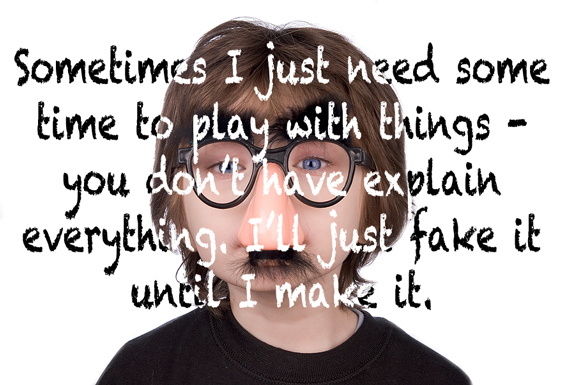
    A well known phrase in math graduate school is, “Okay, I don’t understand that, but I’ll go with it for now.”

    Mathematicians fake it all the time. They come back later to see if they can work out the details (and don’t publish or approve of something until they do). But they announce out loud that they’re faking it.

    And kids should be allowed this too.

    “Mr. Smith, I don’t understand this. I think I can do the problems, though.”

    “Okay, Joan, that’s fine. Perhaps after you do it a while, you’ll get it. “

    “It’s possible.”

    “No problem, if you don’t get it now, you’ll get it eventually. As we move forward, when you come to something like this, just keep doing the steps. That might help you understand, too.”

    “That works for me. Thanks, Mr. Smith.”

    “Feel free to ask me any questions about it and we’ll continue the conversation until you do get it.”

    Not understanding is totally okay — but the child must know it. And, more importantly, they must know that you know it!

    So let them fake it!

    When understanding is too far out of reach, encourage some rote practicing of the steps. And let them admit, out loud, that understanding isn’t there — even be happy for it.

    Anticipate the understanding and be excited that someday it will come.

    And if your child wants to move on, do it. They’ll get that other stuff eventually.

    Share your thoughts in the comments or on twitter/x.

    You might also like:
  • Lipstick Math

    Lipstick Math

    My best friend used to buy $1 lipstick when we were in high school. I think she still does.

    Her logic: “If I only pay a dollar for it, I can have lots of different ones. And I don’t have to fret about losing it or having it melt in the car.”

    Like a good friend, I went along with this logic.

    For years.

    Is expensive lipstick really expensive?

    I’m not here to convince you of the quality of expensive lipstick. There are blogs out there dedicated to lipstick. I’m merely a serious lipstick user.

    I will, however, attempt to convince you of the math (economics?) in lipstick.

    There’s some psychology in this.

    Suppose you buy your own lipstick (which you probably do). If you pay $1 for it, the perceived value is quite low – regardless of the actual quality. And you treat it like that — leaving it in the car to melt, forgetting it in a public restroom, etc.

    Just like my friend does.

    Now let’s assume that you pay $10 for a tube of lipstick. That’s ten times what you’ve been paying.

    All of a sudden the perceived value is huge!

    The loss factor is indirectly proportional to the price of the lipstick!

    If you pay ten times as much for a tube of lipstick, you’re 1/10 as likely to lose it. Okay, I have no empirical evidence to confirm this, merely empirical experience.

    But it’s true!

    As soon as I started buying expensive lipsticks, I quit losing them. And I quit leaving them in the car to be melted by the Houston heat!

    Note for my mathematician friends — the constant of proportionality is affected by the lipstick wearer and that crazy butterfly down in South America. There’s not strict math here. Yet. 😀

    The finish-factor is directly proportional to the price of the lipstick.

    Not only do I keep an expensive tube much longer, but I tend to finish it. In fact, the more expensive it is, the more likely I’ll use a lip brush to dig out the stuff crammed deep in the tube!

    My current favorite, Chanel Allure Rouge, is a shocking $30 per tube. I keep the old broken tube in the Math Shack so I can dig lip color out of the bottom of it when it’s time to video or do a daily mug shot.

    Lipstick Math applies to everything!

    If your child uses his own allowance to buy a new toy, he really knows the value. Furthermore, if he spends more, he’s more likely to care for it.

    When you notice this, point it out. Make sure to note how it’s math – and that your kiddo is doing it effortlessly!

    Share your thoughts in the comments or on twitter/x.

    You might also like:
  • Why You Should Give Your Phone Number to Students

    Why You Should Give Your Phone Number to Students

    This is the 3rd in the draft purge series where I’m throwing stuff out. I’m down to 56 drafts – down from 70! (not factorial)

    I’ve taught in the classroom for over 17 years. I never hesitated to give my phone number out. In all those years, with all those kiddos, I got one drunk call. And that was an accident – he meant to call Ben and not Bon.

    It was a good idea. And I’ve had good results.

    So why should you do it?

    To show you’re human.

    If you teach math, you just might be viewed as supernatural. Or inhuman, depending on the student. Famous, important or supernatural people don’t just give out their phone numbers willy-nilly.

    If you give yours, you’re showing your human side. You have to keep the authority, but you can give a little. Let them in.

    To offer a ray of hope.

    They will probably be nervous about calling, but they’ll text. And they’ll understand if it takes you a while to get back to them. If they have this lifeline, they won’t lose the confidence

    they have gained in your presence.

    I’ve heard hundreds of students say, “I was doing okay in class, but when I got home, I just couldn’t understand what I’d been doing.”

    There’s a magic of the teacher standing there. It’s a safety net. And it gives many students the confidence they need to keep going.

    It’s a fake net, but it works.

    If they know they can text you, they maintain this safety net at home.

    To show trust.

    For some reason, classrooms have gotten into the “us vs. them” mentality. Teachers are the bad guys to the students. Teachers may label kids unfairly, too.

    Show your students you’re not a label maker. Let them know that you have trust and faith in them. Give them your number!

    Will you do it?

    How do you show you’re human? How do you give hope and show trust? Will you try the phone number sharing?

    Let me know in the comments and don’t forget to share this on twitter!

    You might also like:
  • 3 Words to Improve Your Child’s Success in Math

    3 Words to Improve Your Child’s Success in Math

    Yup – only three. Said by you, the parent and grownup. Say them loud, say them often. And contact me when you wonder where math is in your world – or leave a comment here!

    Related articles