This post originally appeared on The HSBA Post on February 28, 2012.
When I opened Katy & The Big Snow by Virginia Lee Burton to find some math, I was shocked. I didn’t have to look far at all – it was everywhere!
Math is disguised in all sorts of fun places in this beautiful book!
Katy includes graphing!
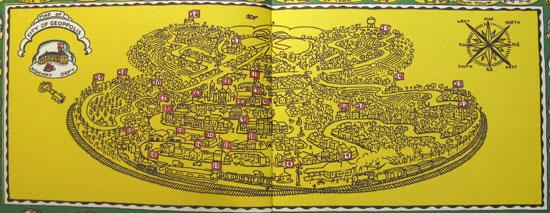
The book starts off with the map of the city. Maps are graphing.
And when the city is shown on other pages, if the orientation is different, a compass is shown to indicate direction. The compass represents the x-axis (N/S) and y-axis (E/W). It also shows the 360º in a circle.
When Katy (the tractor) is introduced, you can see lots of symmetry – especially in her big snow plow. Symmetry is another important concept in graphing.
Factors and multiplication are in the book.
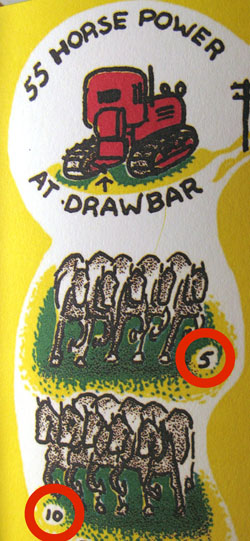
Katy’s features are outlined in the margins and include her horsepower. Instead of merely writing “55 horsepower,” Burton illustrates it with 55 horses, and they are counted in 5s.
Skip counting like this shows factoring as well as multiples (which are used in finding the GCF and LCM – remember those?).
And Burton doesn’t just stop at 5 and 10, she illustrates and counts all 55 horses.
(Note: I put the red circles on the images.)
So when you read Katy & The Big Snow with your children – you can support their math learning by seeing and saying the math in the pictures!
Share your thoughts and experiences in the comments!
This post originally appeared on The HSBA Post on December 29, 2011.
The Story of Ferdinand, by Munro Leaf, is a tale of mistaken identity: Ferdinand is a sweet bull who loves to smell flowers and has no interest in anything remotely violent. He is selected to be part of the Madrid Bullfights due to an unfortunate event with a bee.
I’ve enjoyed this book since I was very young. The nifty thing is the breadth of teaching opportunities Ferdinand gives us. There’s even math in it!
To integrate math in this wonderful tale, try using some of these questions when you read the story:
Distance
Where is Spain? Where do we live? How far away is Spain from us?
Height
Look at the page where it shows how tall Ferdinand is. How many marks are there on the tree stump? How long was the time between each of the measurements? Is that equal? Would there be a better amount of time between each mark?
Suppose the marks for Ferdinand’s height were at 6 months, 1 year, 1.5 years and 2 years. Approximately where on the stump would those be?
Amount
Five men came to to pick the “biggest, fastest, roughest bull.” Why do you think there were five?
How many Banderilleros are there? How many Picadores?
Page Numbers
Most books have page numbers. Ferdinand doesn’t. Why do you think that is? How many pages is Ferdinand? Could the book be written in fewer pages? How would that be done?
What’s next?
You can use the book Ferdinand and these math stimulators in your Five in a Row math day or integrate it into any other math curriculum. Or do it just for fun! Also try doing math with other picture books you have.
Oh – and don’t forget to share how it went in the comments!
This post originally appeared on The HSBA Post on November 22, 2011.
How to Make an Apple Pie and See the World by Marjorie Priceman is an “instructional” picture book that takes children on a journey through the world to pick up ingredients to make an apple pie.
Lots of great shapes!
An apple pie recipe is included in the back which has obvious math. But you can use the rest of the book for some math lessons as well!
Here’s a set of math stimulators to share with your kids. Don’t forget that math is a discovery process; if your children are compelled to answer a question or not answer a question, that’s okay.
Here are the questions and some hints and coaching tips for you, the parent.
Find the shapes in the pictures.
See if you can find circles, trapezoids, ovals and rectangles. Also identify the irregular shapes. Have your children trace them and see if they’re made up of regular shapes.
How far is it from your house to Europe?
Also ask: How fast will the ship have to go in order to get to Europe from your house in six days?
How many Italian words do you think you would need to learn each day in order to speak Italian?
How many words are there in an average Italian’s vocabulary? How many words do you need to be considered fluent in Italian?
What time does your train leave Italy?
Notice the time on the clock.
This one encourages children to look at the pictures as well as the text. Also ask, “How far is it to France from Italy?” And to take it farther, “What time would you arrive in France?”
How far is Sri Lanka from France?
Pull out an atlas or globe to get some geography lessons. Also ask, “Which route do you think is the fastest to get there? Which would be the most fun?”
If you were to make two apple pies, how many apples should you pick from the apple tree?
This is what many students would call a trick question. In the book, she picks 8 apples so that she and her friends can enjoy 3 and use 5 to make the pie.
It takes some thought for a child to realize you only need 5 apples for the pie, so you’re not doubling the amount you pick. You have to double the amount for the pie (2 x 5) then add the 3 apples for the friends to enjoy.
Looking at the recipe, how much of each ingredient would you need if you made two pies?
This question allows them to double everything on the recipe. You can also triple or quadruple or get into fractions by asking, “What if you made one regular sized pie and one mini pie – how much of each ingredient would you need then?”
This post originally appeared on The HSBA Post on October 20, 2011.
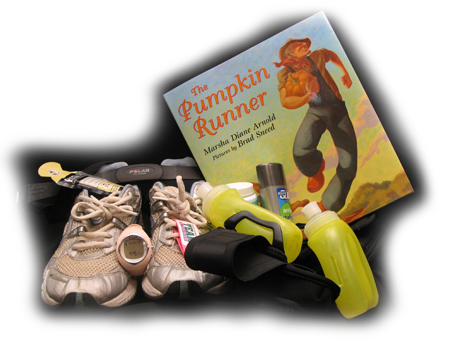
The Pumpkin Runner by Marsha Diane Arnold (illustrated by Brad Sneed) is a sweet story about a man and his dog on a 900 km race across Australia. What’s nifty is that you can use this story in your math lessons! Below is a list of some questions to try.
Filter all these questions before asking them of your children. Some children might find them more advanced and need some help and discussion. Others may dig right in.
Use this downloadable list of math stimulators, if you want to give them to your kids without the tips.
And keep in mind, math is a discovery process; you can get to the right answer in many ways.
How old is Joshua?
You can point out that he’d been running for 50 years and he started when he was 10 years old.
How many generations of dogs did Joshua run with?
When 10-year-old Joshua ran for the first time, he ran with an ancestor of Yellow Dog. The book says he started running with the “great-great-great-grandfather of Yellow Dog.”
How old did each dog get? Is it possible that Joshua ever ran with more than one dog at the same time?
How many pumpkins will Joshua need to run the race?
Children might think about it this way: If one pumpkin gave Joshua enough energy to run 40 km (his very first run) how many pumpkins might he need to run 900 km in the race?
Children can also count the number of pumpkins loaded in the Jeep. Allow your child to ponder, guess, speculate, or calculate the answer.
What’s up with Damien Dodgerelle?
He trained for the race for three months.
How many kilometers do you think he ran each day?
How many kilometers did he run total in this training time?
How long should it take him to run 900 km based on how he trained?
How long did it take Joshua and Yellow Dog to finish the race?
Joshua got to the finish line two days earlier than any previous winner. How many days do you think it took him? Why was he faster than everyone else?
How much did each person “win”?
When Joshua split the winnings, how much did each person get? If he only kept enough for new overalls and gum boots, how much do you think he might have given to Aunt Millie and Rancher Waudley?
What’s next?
You can use the book The Pumpkin Runner and the math stimulators in your Five in a Row math day or integrate it into any other math curriculum. Also try using the same line of questioning with other picture books you have.
Oh – and don’t forget to share how it went in the comments!
This is a guest article by Caroline Mukisa who publishes Maths Insider.
Does your middle- or high-schooler know their times tables? If the answer is a resounding “Yes” then, great, have a great day, and read the other great tips here at MathFour.
I also have some great tips and advice on how to guide your child to maths success on my Maths Insider site.
If not, then it’s time to help your teen develop their own times tables boot camp.
Why are times tables important at all?
Well it’s used loads in algebra, and those geometry questions usually need a fair bit of multiplication or division. It’s also great for those grown-up things that they’re going to be doing in the years to come, working out payment plans, home remodelling, calculating sale prices and just plain making sure that they’re not ripped off in life.
Of course we’ve got computers and calculators, but who wants to be fiddling about to open a smartphone app, just to work out the price of a pair of jeans. And if they press the wrong buttons, how will they know the answer is wrong?
Yep, they’re important!
Why are times tables a problem for older learners?
It’s like spending years trying to pass a driving test. Or still not being able to conjugate Spanish verbs after studying them for ages. Or trying to lose those last few pounds of weight. It sucks, and it gets to the point where it’s easier to develop a work-around: catch the train everywhere, just get by with a few Spanish phrases, or buy bigger clothes.
Of course, your teen can “get by” and may even do rather well at maths without knowing their times tables. But before you give up, try some of the following strategies to help your teen make their own times tables bootcamp to fix those essential times tables facts in their heads. It’s never too late!
Times tables boot camp strategies
1) Figure out what they know, and what they don’t know. Are they fine with their 2’s, 3’s and 4’s and 5’s but shaky after that? Then focus on quickly reviewing the easy tables before some concentrated repetition of the harder tables.
2) Use incremental steps. Make sure the 5’s are solid before moving on to the 6’s and the 6’s are fast before moving onto the 7’s.
3) Give your teen a fixed target. It’s completely possible to learn the times tables from 2-9 in a month with just 5-10 minutes of daily study.
4) Let them choose their own activities. Worksheets won’t be a popular option – iphone apps, You Tube videos, online games are all things that teens are more likely to tolerate.
5) Be encouraging – don’t say, “That’s easy, you should know it” instead say, “I can see you’re working hard on this, keep it up.”
Use these strategies to help your child plan their own successful times tables boot camp, so they won’t have to just “get by” in maths any longer.
Caroline Mukisa is a homeschooling mom of 4, who publishes at Maths Insider.
Children need a strong foundation in beginning math skills, like counting and basic addition and subtraction, in order to succeed with higher level math operations.
You probably already know this, but it’s easy to feel pressure to move your child on to the next level in math even when these basic foundational skills are stabilized. It’s easy to assume she’ll just “get it” with enough exposure.
Except that isn’t true.
Children that don’t pick up basic math skills with a decent amount of exposure and practice likely need a different kind of math stimulation.
Take basic addition and subtraction. Learning facts like 3+4=7 requires both a strong understanding of the concept of addition as well as a strong picture for the fact itself. In many ways, math facts are like sight words. Even when we understand the meaning of 3+4=7, we still need automatic fluency with recognizing and remembering it.
If you treat basic facts like sight words, it’s possible to help your child develop a strong mental picture for the fact – just like you can close your eyes and picture the letters in the word ‘teach.” (There are five symbols – letters or numbers/signs – in each!)
You can develop imagery for basic facts using sensory processing by using a “see, say, feel” multi-sensory approach.
After looking at a fact flash card, have your child write the fact horizontally in the air with her dominant pointer finger. Encourage her to really watch her finger and focus on picturing the equation as she writes it
As she writes the numbers and signs, have her say what she is writing out loud. “Three plus four equals seven.” This should happen simultaneously as she writes.
After she writes the equation, ask imagery questions like: “What number do you see in the middle?” or “What sign do you picture after the three?”
This simple process stimulates your child’s sensory processing in three fundamental ways all at the same time.
It stimulates her visual processing as she focuses on creating a mental image for the fact.
It stimulates her auditory processing as she says and hears the equation out loud.
It stimulates her kinesthetic processing as she literally feels her finger drawing the equation and develops muscle memory for writing it.
Using a multi-sensory approach to teaching basic math facts benefits all math students.
For children who really need to strengthen their visual, auditory, or kinesthetic processing for learning, this technique fills a need that additional worksheets, timed tests, and more flash cards games just can’t. For kids who don’t necessarily need the multi-sensory stimulation, it serves to accelerate learning. They are more engaged in each problem.
Now if only they made scratch-and-sniff flash cards – that would probably really get their attention!
How did it work for you? Please share your experiences in the comments.
Beth McKeon, of Bright Brain Studio, is a brain-based educator on a mission to demonstrate that every child has the capacity to learn. She has spent the past ten years customizing instruction for individual students and teaching teachers and parents how to engage the whole brain in the learning process. Her workshops and coaching provide practical techniques parents can use to reduce the frustration and resistance around homework assignments.
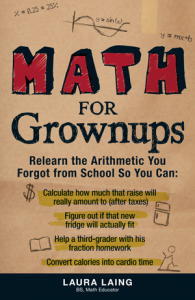
Today’s article is from Laura Laing, author of the book Math For Grownups and publisher of the website of the same name.
So you think you don’t use math on a daily basis? Think again.
You may not be solving for x, and the distance formula may not roll off the tip of your frontal lobe—mainly because you haven’t used it in years and years. But if you can put “parent” among your titles, you do math. I promise.
Just look at a typical day:
6:35 a.m.
Your darling daughter went to bed late last night. Seems that she couldn’t pull herself away from the most recent novel she’s devouring, and she had to finish, “just one chapter.” Problem is, she’s a bear to wake up when sleep deprived, and she’s got an 8:00 checkup at the pediatrician. She can usually get ready in about 45 minutes, and it takes 15 minutes to get to the doc’s office. How much longer can you let her sleep in?
9:03 a.m.
Check-up is done, and you’re waiting to pay the bill. You’ve got $33.65 in your wallet and a $25 co-pay. But after a morning of running errands, you’ve promised dear daughter lunch at the local fast food place. Should you use your cash for the co-pay or pay with plastic?
11:21 a.m.
At the grocery store, you’re deciding between three brands of ketchup. One is on sale for $2.27. For another, you have a 50¢ off coupon. And the third is a smaller container for only $1.49. Which one should you buy?
12:08 p.m.
At Burgers ‘R’ Us, your daughter has requested the chicken nuggets and a drink – no fries! You’d like to eat the fries that come with her kids’ meal, but you’re not sure you can afford the calories. Luckily, the restaurant has a handy sign displaying the caloric values for each menu item. What can you order to go with her fries that won’t force you to eat only carrot sticks for dinner?
1:31 p.m.
You need to fill up, and you have your choice of gas stations. One offers regular unleaded for $3.27 per gallon, plus a free car wash (a $10 value). Another offers $3.15 per gallon—no car wash. Which station offers the best deal?
2:47 p.m.
It’s time for your daughter to practice piano—a task that she hates. You thought the practicing contest that her teacher started would give her the motivation to practice every day. Nope. So today, she’s going to try to catch up on the days that she slacked off. She’s expected to practice a total of 15 minutes a day, but she’s only practiced a total of 25 minutes for the week. Her lesson is tomorrow. How many more minutes does she need to practice to please her teacher?
5:32 p.m.
Time for dinner, and you’re exhausted. Instead of making a meal from scratch, you decide to order from the local pizza joint. Your daughter wants plain cheese, your husband wants pepperoni and sausage and you want a veggie pizza. What’s the most cost-effective way to order dinner?
8:35 p.m.
Thankfully, your daughter has crashed early, meaning she can catch up on the sleep she lost last night. If you wake her up at 7:00 a.m., how much sleep will she have gotten?
Typical day? Perhaps. Typical math? Definitely.
So the next time you think, “I can’t do math,” keep in mind the number-based tasks that come across your path on a normal day. You might be surprised at what you accomplish without even thinking about it.
Where is the math in your day? Tell us in the comments!
Laura Laing is the author of Math for Grownups, a funny and accessible look at how the over-18 set uses math in everyday situations. While this post is not based exactly on a day out of her life, it could be. She is a freelance writer and the parent of a pre-teen in Baltimore.
Originally published as a guest post on MathForGrownups.com, a math blog by Laura Laing.
Guest Post: Grownups can learn new tricks!
Bon Crowder, another math evangelist
A couple of weeks ago, a fellow freelance writer wrote me about her foray into graduate school. She needed to brush up on some math skills, and she wasn’t sure how. I have a feeling that her questions weren’t unique. Whether you need to learn a little extra to help your kid with his homework or you need to take a math class to further your education, learning math again (or for the first time) can be daunting.
Luckily, my friend and fellow math blogger, Bon Crowder offered to write a guest post on this very topic. I swear, Bon and I were separated at graduation or something, because we approach math education in very similar ways. Plus she’s fun. (See? Math folks aren’t always boring and difficult to understand!)
I wanted to title this “Being a Great Adult Learner.”
But that’s dumb. All adults are great learners. If we weren’t, we’d be stumbling around, bumping into doors, starving and naked. We know how to learn, and the proof is that we’re still alive.
And dressed.
The question is “What makes you learn?”
1) You need confidence.
Confidence involves two things: feeling worthy and knowing you have the ability.
When people feel they’re entitled to something, they’re more likely to feel confident in getting it. Hang around any Best Buy service desk and you’ll see this in action. People say all kinds of strange things when trying to return a broken product, and these things are said with a sense of entitlement. BY GOLLY they’re going to get their way!
So how do you gain worthiness and ability? You’re worthy of it because you already have it. And you’re able to do it because you already do.
You have it all. It’s just hidden behind a wall of words you or someone else (or both) has told you for years. Now’s the time to ignore everybody, even yourself.
Because here’s the gosh-honest truth: There is not a single thing within a mathematician that is not within you.
You’ve done math since you were a kid. Even before you were in school. You knew at a deep level that if there was one toy and there was another kid around, you’d better run like the dickens to get it. There’s no dividing that toy evenly between kids.
You balance your checkbook (or you would be in jail right now), you probably have some rough idea of your gas mileage, and you know that if you have 12 people coming over, you’re going to have to double or triple that recipe for shepherds pie. You know math. Now’s the time to admit it.
So say this every night before your prayers. If you don’t pray at night, say it twice:
I do math. Today I woke up on time because I calculated how long it would take to get dressed. I knew how much money to spend because balanced my checkbook. I figured out how much weight I needed to lose – and I used math to do it.
Modify this statement to fit your lifestyle and run with it. Every night.
2) You need the right environment.
Once you’ve tapped in to the realization that you’re inherently good at math, you need the right learning environment.
This includes location, timing and the other people involved. If you have to drive too far away after working all day and all you get is a lousy quarter-pounder-with-cheese, you’re going to be tired, grumpy and irritable. If your class is full of teenagers fresh out of high school and the professor is 400 years old and believes in death by PowerPoint, things are not going to go well.
How do you know the right environment?
Look at all the learning experiences you’ve had through the years. List out the good ones and the bad ones. And then dig deep – what made the good ones good? Why were the bad ones so detrimental?
Include timing, location, student body, temperature in the room and details of the instructor. List out the attitude of the instructor, his/her teaching style, voice intonations – even how he wrote on the board.
Pick out the deal-breakers and the nice-to-haves and write them on a special piece of paper. This is your official “Environment Requirement” page. Laminate it, put it in Evernote, tatoo it to your bottom – whatever you do to keep it close so you can refer to it often.
How do you make sure your Environment Requirements are honored?
Here’s where that sense of entitlement comes back into play. If your class has a deal-breaker environment element, do something about it. Think, “If this were a faulty remote control that I bought at Best Buy, how would I handle it?”
Ask the instructor to manage the loud students better. Ask building maintenance to change the temp of the room (or bring a sweater). Don’t sign up for a class during a time when you’ll be tired, hungry and irritable.
And if you can’t change the environment – leave. Drop the class. Get your money back.
If it were a crappy remote control, that’s what you’d do, right?
You’re dressed…
And fed. You learn all the time. And you do math.
Now go find a class that fits and have fun!
Bon Crowder publishes www.MathFour.com, a math education site for parents. But that’s not all! Bon has launched a really, really, really cool initiative called Count 10, Read 10. While parents are encouraged to read to their infants, toddlers and preschoolers, we’re rarely encouraged to inject a little bit of math into the day. Bon will show you how. Take a look at her blog for more information on developing math literacy (or numeracy). I’ll be writing about this more in the coming months.
Questions or comments? Leave them in the comments section below!