Part of Wordless Wednesday…

Thoughts? Share them in the comments. Also, tell your friends on twitter.


Part of Wordless Wednesday…

Thoughts? Share them in the comments. Also, tell your friends on twitter.


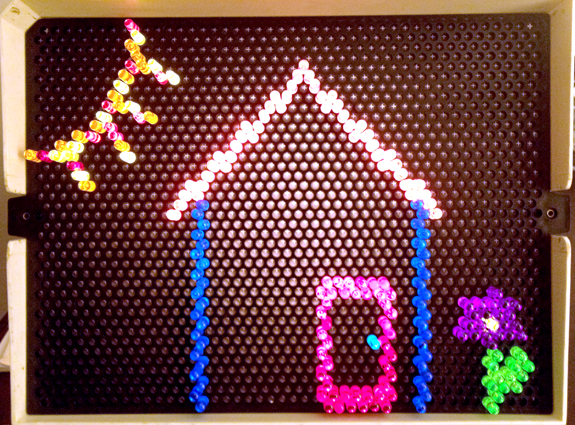
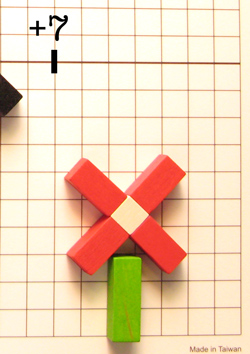
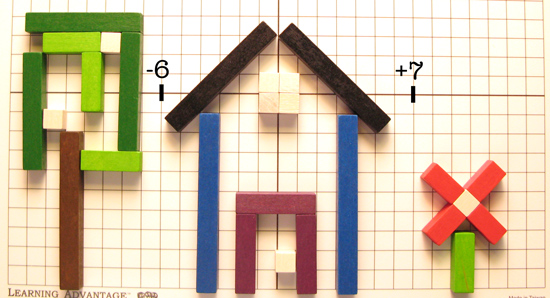
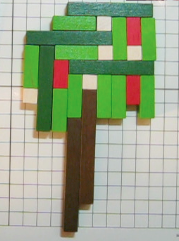
I’ve been playing with the lovely Cuisenaire Rods for a few weeks now. I made the (fortunate) mistake of creating this flower in a past article about coordinate pairs.
The mistake was that I would eventually have to come up with the coordinates for this thing. Fortunate because it gives the MathFourTicians out there something else to teach with the rods!
Since all the “petals” are attached to the center, that’s probably the best place to begin.

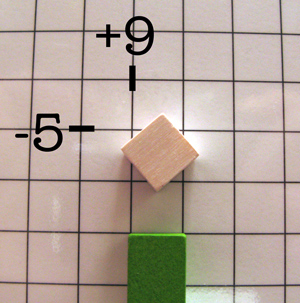
Since everything is tiny (1 cm), I went to a bigger setup. And some of the coordinates were easy to pick out. So I put those in the big grid, too:

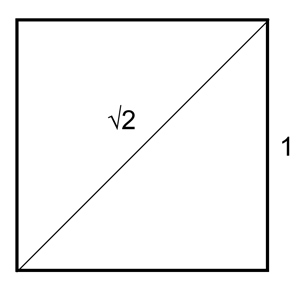
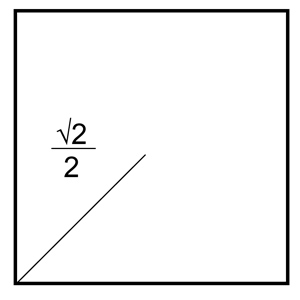
Next I considered what I was really dealing with: a square. And each side was 1 cm.
According to those crazy Pythagoreans, the diagonal measures :

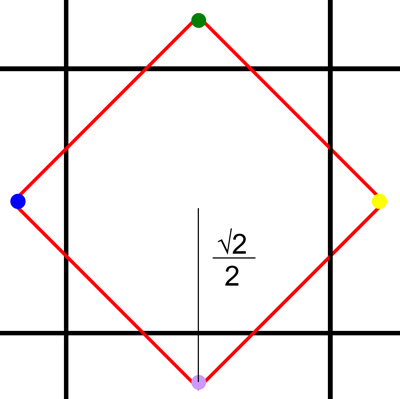
So half the diagonal is :

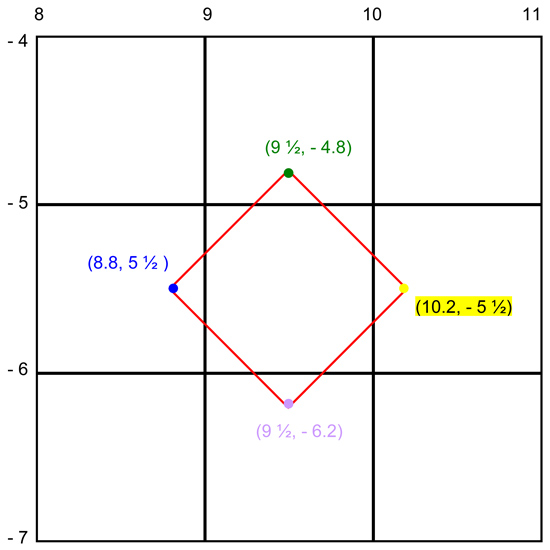
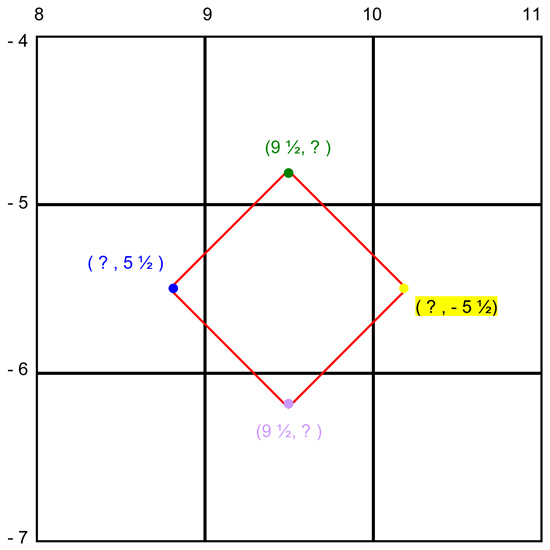
When I put this information on the big grid, it looks like this:

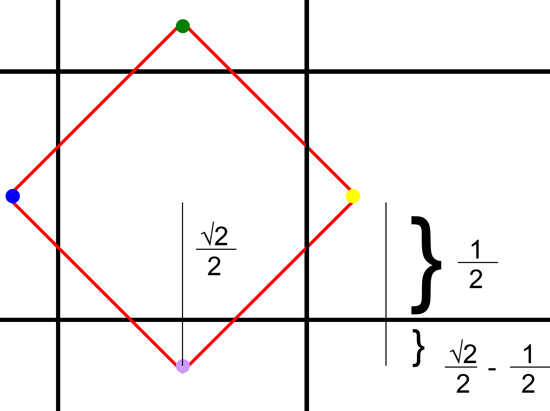
Doing some arithmetic and geometry, I get:

Using my very cool TI-30 calculator, I get that .
Knowing that each corner pokes out roughly 0.2, I can calculate the coordinates:

From this I can create the ordered quadruples as described here for the petals of the flower. But at this point I’m pretty much needing a break. So I’ll leave that for next time.
Whatcha think? Fun? Share your thoughts in the comments and on Twitter:


As with all good mathematics, I just spent hours pondering how to set up my super cool Cuisenaire Rod quadtuple.
It was a great experience. Made me wonder why I was being so selfish in keeping it to myself.
This is a perfect thing for kids to do!
Seems simple enough. Make a picture on 1cm square graph paper with Cuisenaire Rods. Then write down the coordinates of the rods. Voila! You have the coordinate representation of your picture. Furthermore, you’ve practiced coordinates!
Cool, right?
The rub is that you have to correctly identify the orientation of the rods – are they up-and-down or side-to-side? Or worse – at an angle!
So now we have four things to identify: size/color, angle of rotation, x coordinate, and y coordinate.
Since the rods have width, we can’t just say “put it at (3,2).” What part of the rod goes at (3,2)? One of the four corners? The midpoint of one of the sides?
My official Cuisenaire Rod Ordered Quadtuple (CROQ) looks like this:
(size of rod, angle of rod, x-value of anchor, y-value of anchor)
The size of the rod is easy.
The angle of the rod is clear, but we have to define what is zero (up-and-down or side-to-side) and how we rotate (always clockwise, counter-clockwise, either way, etc.).
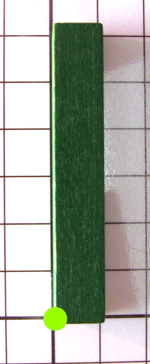
I picked up-and-down to be zero degrees. It is the way I naturally look at the rods. Like this:

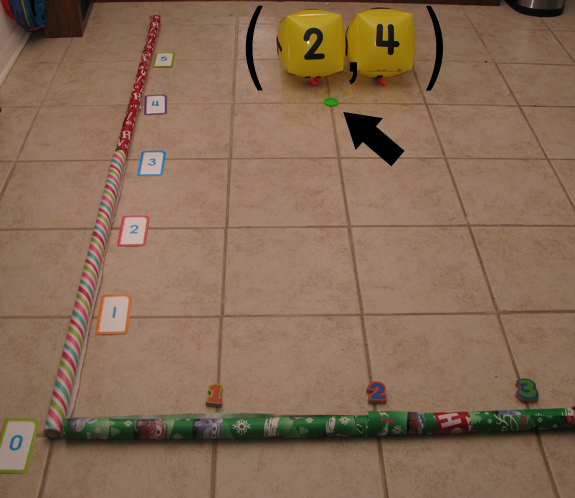
See the bright green dot? That’s the anchor point. It stays there (in your mind) and is the bit that you’ll put on the (x, y) point.
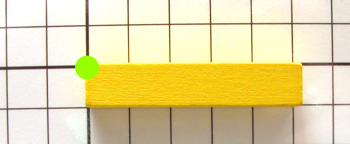
Which means that as you change the orientation (or rotate your rod), it sticks around. Like this:

This rod is (5, 90, 0, 0) because it is 5cm long, rotated 90 degrees (clockwise) and the anchor is at (0, 0).
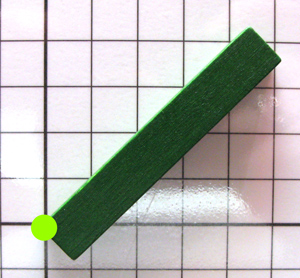
Check out the 45 degree one:

This one has the 4-tuple (6, 45, 0, 0). Notice that the rotation is always clockwise.
When we graph (typically), zero degrees is horizontal. And sticking out to the right of the origin.
Perhaps the best way to represent the rods on the plane is to use this type of set up. But it wasn’t the natural choice for me.
It doesn’t really matter. Unless you’re running a contest (which I think ETA Cuisenaire is putting together).
Try this at home. It simulates what researching mathematicians do everyday:
This is exactly what mathematics is all about. Not which is right, but which feels best. And which one will we agree on.
When ETA Cuisenaire puts together their contest, they’ll have the rules clearly defined. “Right” will only be according to how they set it up. When you enter, they’ll recreate your art based on their rules.
I like my rules. So much so, I’m going to use them next week to give the coordinates for the image at the top of this article. Wanna compare? Do it and post your CROQs in the comments.
(Notice there’s a whole-lotta math goin’ on in that image – not just coordinates!)


Cuisenaire Rods are brightly colored wooden sticks. Technically, they’re “proportionally sized rectangular parallelepipeds.” (But only say that if you want to hear your 3 year old repeat something really cute!)

The “proportional” thing is important. The white ones are 1cm square, the red ones are twice as long and each color is 1cm more than the next color.
I’m anticipating many articles and videos on how to teach with these (since the possibilities with these things are virtually unlimited), so I thought I would start a running series. Here are the ideas and the links to the articles/videos that are ready:
Share your own ideas on how to use Cuisenaire Rods in the comments!
P.S. I spent my hard earned money on these at Teacher Heaven. This small set was $15 in the store, but I see you can get it for less than $13 online.
This is also shared on Works for Me Wednesday.