Tag: anxiety

  • How a Mathematician Became Math Phobic

    How a Mathematician Became Math Phobic

    It’s rare that you get a chance to really see life from the other side. Today I did.

    I presented at the Western Social Science Association conference at 8am. I stayed to watch the other talks – and got a serious taste of what many people feel when in a math class.

    I was comfortable with the concepts.

    Strangely, I was totally comfortable with the hypotheses of this group of social scientists.

    I saw talks where people speculated on what was up with juvenile detention workers that liked their jobs. And I was cool with it.

    I was fascinated, engaged and understood the hypothesis that people who identified with their gender, and lived that way, were more healthy than those who claimed one thing and behaved the opposite.

    It made perfect sense to me that someone would want to do research to see if indeed boys who are close to their moms pray more as grownups.

    I got uncomfortable when they started talking… stats!

    Yup!

    It was the math that got me.

    At first I watched in relative peace as these folks paraded the slides loaded with positive and negative decimal numbers. I ignored my ignorance of something they deemed important called “R2.”

    I told myself that if I knew what these things were, I would totally get this.

    I’m an algebraist. We don’t even use numbers, much less negative decimals.

    But I assured myself that I was perfectly capable, I just hadn’t learned this branch of math.

    But the talks and slides kept coming.

    And my defenses didn’t hold up.

    Wil was kind enough to give me a cheater hint. I tried to memorize it. The rule ended up looking like this:

    Positive number means “as one thing goes up, the other does too.”

    Negative number means “as one thing goes up, the other goes down.”

    “Big” number means it really is true.

    “Small” number means it probably is just B.S.

    I developed math-anxiety.

    When a stat slide came up, I looked away. The speaker’s voice became Charlie Brown’s teacher. I checked my iPhone to see what was happening on Twitter.

    As Wil would say, I was participating in avoidance behavior.

    But occasionally I’d try…

    Calgon – take me away!

    If one of those slides came up and I didn’t turn away fast enough, I’d give it a shot.

    After all, I’m a mathematician by trade! This shouldn’t intimidate me.

    I would fish around desperately in my brain for that memorized rule.

    And to think that just two days ago I told my students, “You can’t just follow the rules – you should understand what they mean.”

    Easy for me to say.

    I’m going to crawl into the tub with a glass of wine.

    Will you comment or tweet?

    *sigh*

    Related articles
  • Math Anxiety – How to Empathize with Students

    Math Anxiety – How to Empathize with Students

    Have you ever experienced performance anxiety?

    If you don’t have math anxiety, remembering (or freshly experiencing) performance anxiety is a great way to understand what it’s about.

    This happened to me at the beginning of this semester.

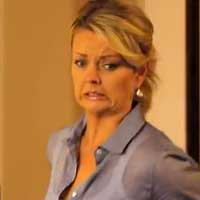
    Anxious Wrinkled Forehead

    I try to memorize the names of all my students. I go through the roll and for each person, I say the name and then look at the student. I study where they are, who they are and their name. I say it a few times and try to get it solid in my memory.

    Doing this helps students with math anxiety relax a little. And students who are trying to stay in the shadows (so they can miss class, etc.) learn quickly that I’m going to connect with them, personally.

    Of course the act of memorizing names isn’t perfect. The second day of class I usually remember about 30% of the names. So I go through and try to match the names on the roll with different people – giving it my best shot.

    I often get it wrong.

    A few weeks ago, I mistakenly called one woman, “Sandra.” I was wrong. She said, “Awe, come on, now!”

    It was all in jest, I had no doubt. But the strong reaction to my mistake hit me. So when I was looking through the roll to find her correct name, I was nervous.

    I was experiencing performance anxiety.

    If I gave it a shot and chose the right name, I would look good. But if I picked incorrectly, I would likely get another round of jeers.

    Of course, I’m the instructor, so there isn’t that much risk. But there certainly was performance anxiety.

    Surprisingly, there was a lot of anxiety.

    I pointed this out to the students.

    Because the class is less of a content based course and more of a confidence building/math anxiety busting experience, I thought pointing this out might be enlightening.

    We talked about how they might have said things like, “That’s a good try, Bon. Unfortunately, Sandra’s not my name. Would you like to give it another try?”

    We talked about how that kind of encouragement compares with the “Awe, come on, now!” reaction that they gave before.

    And we talked about the parallels of those statements to the statements by math instructors to students – about math. And the parallel of my performance anxiety to the math anxiety many experience.

    Consider it yourself.

    The next time you try something and get it wrong, notice how you feel. Think about how your child might feel in a similar situation.

    And ponder how this feeling would manifest itself as math anxiety if this performance anxiety happens in a math class.

    Share your thoughts and experiences in the comments. And tell others about it…

    Related articles
  • Anxiety Safe Learning Environments

    Anxiety Safe Learning Environments

    Would you like to create a safe math learning environment free from anxiety? What would that look like? Let’s first peek at what it doesn’t look like:

    Okay class, what’s the answer to number 12?

    I think it’s 75, Mr. Jones.

    No, Emma. That’s wrong. Have you been paying attention?

    Unintentionally or not, this is often taken as ridicule by Emma and her classmates.

    They quickly learn to avoid this verbal punishment and the anxiety it causes.

    And the easiest way to avoid it is by not trying.

    There is a power-dynamic, a vulnerability, that goes along with any instructor-student relationship. In these situations, students must feel safe to engage. Encouragement and support are ideal. But more importantly, the learning environment must be free of criticism, shame, or overwhelming frustration.

    If a student feels that there is threat of criticism, shame and frustration in a math class, it’s curtains. Even if forced to “stay in that chair and listen,” they won’t mentally stick around to learn much of anything.

    So how do you get your learning environment safe from anxiety?

    Praise the “wrong.”

    Being wrong means the student’s trying. Trying means they are engaged. Engagement gives an opportunity to learn.

    Without the opportunity, learning can’t happen.

    When you praise the incorrect answers, you praise the trying. When you praise the trying, the students are more engaged in math class. They have an opportunity to learn.

    So when they’re “wrong” – praise them.

    Exercise patience

    You may say, “But they didn’t give the right answer!”

    Got it.

    But before performance, or getting the right answer, a student must take in and process information at a pace where they can retain it. Getting the right answer is only an indicator of understanding and effective learning of math. A confirmation. It’s not the learning itself.

    Letting them be wrong and process how they got the wrong answer is part of the process of learning. And sometimes this can be slow.

    But giving a student time to think about and mull over questions and answers is more effective for learning in the long run, than requiring the right answer.

    Yup – you’ve got things to do, kids to teach. So it might leave you feeling frustrated when you allow wrong answers and give them time to ponder it.

    So when your patience is running thin, step away. Adults need breaks, too. Take one to avoid a damaging experience.

    Learn from the “wrong”

    When an incorrect math answer is given, ask them how they got there. Get them thinking about it. There are more learning opportunities in the wrong than the right.

    Right answer given. Say: Good job! Let’s move on to the next one.

    Incorrect answer given. Say: Excellent. Let’s talk about how you got there…

    We can praise the attempt and find something in the incorrect answer to build on and learn from.

    Think about the teaching implications of this. How many more folks would be willing to try something if being wrong is okay? How many more kids will you engage if there’s no criticism or humiliation to avoid?

    Be ready, don’t force it

    Your students might have been trained to avoid verbal punishment by not trying. Remember Mr. Jones from above? Mr. Jones is everywhere. So take it easy when creating this “anxiety safe” environment.

    When the more vocal students get wrong answers, praise like crazy, be patient and help them learn from the wrong answers. The rest of the students will follow.

    And whatever you do, don’t be Mr. Jones.

    Your turn…

    How do you create a learning environment safe from anxiety? Have I missed anything? Share your thoughts in the comments.


    William Devine

    William Devine is a licensed professional counselor in private practice. He has joined the MathFour.com team as the Director of Research. Connect with him in the comments, on the contact page or via twitter @MathPsych.


    Feature image adapted from an image by Marshall Astor – Food Fetishist | Flickr.com | CC BY SA

    Related articles
  • How to Teach Adults Math

    How to Teach Adults Math

    Today is my first day of teaching Developmental Math. I picked up two classes in the “late start session” at Lone Star College.(Yup – in Texas. How’d’y’guess?)

    And I’m so excited about teaching again!

    But how do I do it?

    A year ago the answer to that question would have been, “Duh!” Having taught for so many years I’ve gotten the art of explaining math on the chalkboard (and later whiteboard) down to a science. I’m good. Real good.

    But this past year, writing on MathFour.com, has changed things. I’ve connected with wonderful moms, dads, teachers of math and teachers of… well… just about everything. My philosophy on teaching math has been shattered.

    In the past, I’ve taught content. We’ll do the slope-intercept formula, talk about graphing and test over things like “Section 1.3 to 2.5.”

    But I’m not sure if that’s the right thing to teach. In fact, I’m not sure there’s anything to “teach” at all.

    I have to remember what they’re up against.

    This class is the most “remedial” of the classes offered in the math department. But the “gaps” they have in the math may not have anything to do with ability.

    I’m going to forego a syllabus – at least at first. Instead, their first assignment will be to read a research paper on math anxiety.

    From there, I’m going to let them guide what we do. We’ll likely get to content, but we’re not doing to push it.

    We’re going to get ready for whatever is next.

    They aren’t done after this class. In fact, this is the first of at least four math classes they’ll have to take. So whatever we do here lays the foundation for how they handle the other classes.

    The next math class they take might be inspirational and based on understanding, exploration and learning. Or it might be another content driven, talk-at-you-while-you-take-notes semester full of processes and methods to arrive at a RIGHT answer.

    Either way, I hope that by the end of this semester, they will feel empowered to take on their own learning. To demand learning facilitation instead of teaching. And join the teachers that have been leading the math revolution.

    Will I get fired?

    I hope not. But it’s possible. There’s no telling what’s fixing to happen.

    The only thing I know is that I’ll no longer sacrifice students for the sake of the system again.

    What are your thoughts? Please share them in the comments.

    Feature image by ralph and jenny | Flickr.com | CC BY

    Related articles
  • What Are Your Thoughts on This Fearful Parents Video?

    What Are Your Thoughts on This Fearful Parents Video?

    Wil showed up at the Math Shack this morning talking about a commercial he saw on TV last night. “Wow, this is what parents are up against!” he said shaking his head.

    Check it out for yourself:

    We’ve been talking about it all morning. Before we post our thoughts, we’d love to have yours.

    1. What’s the intended message?
    2. What’s the real or perceived message?
    3. How does it affect your view on math as a parent?

    Share your opinion in the comments and let others know via twitter.

    Related articles
  • How to Free Your Students from Math Anger

    How to Free Your Students from Math Anger

    Do your students say they just wanna chuck it all with regard to math?

    Are they sick of being a prisoner to the anxiety?

    Help them declare their independence!

    A great friend of mine is a technical trainer for an oilfield services company. He teaches a class called “Oilfield Math.”

    I helped him develop this class and I had the privilege of attending the first class. At the end of the class, he offered to buy everyone a beer – so he passed out a $2 bill.

    On the back of the $2 USD bill is an image of the signing of the Declaration of Independence of the US. He told everyone that they can either take the $2 and buy themselves a beer on him, or they can keep it as a token of their new found independence.

    His class teaches math for the oilfield, and for life, using a discovery process. The independence he offers is the freedom from senseless algorithms (step by step procedures that look like magic) and people who say, “All you have to do is…”

    I asked all the students in that first class sign mine. I still carry it. Although I’ve never been a prisoner like many people I’ve seen, this token reminds me that many are prisoners of the negativity.

    Hand out personal independence to your kids.

    Give each student their own $2 bill. They can write on it some freeing statements. They can write on it negative words that they never want to hear or say again. Or they can carry it blank. It’s their talisman.

    And integrate it into a history lesson too!