Author: Bon Crowder

  • MathFour is Back!

    MathFour is Back!

    For a while, a long while, I let this math blog just sit. I didn’t want to delete it. I spent too much time on it and I knew it was full of great stuff that was still being used. But I wasn’t in love with writing on it.

    In my lethargy, the hackers and jerks managed to infiltrate and completely take it down. That was on October 23, 2025.

    Today is December 30, 2025. I rescued all the posts and will gradually get all the good ones reposted. But I have to start over, creating the whole website from scratch.

    Luckily the wayback machine (internet archive) has a nice snapshot of the images and layout. It’ll take me a while, but I’ll get it all back up. Maybe even with some improvements!

    If you are looking for a specific post – something you remember from long ago or something you want to know about – leave it in the comments. I’ll hunt it down and get it posted.

    I’m looking forward to having all those great math stories, thoughts and tips live again – I hope you are too.

  • Fahrenheit to Celsius – Graphically!

    Fahrenheit to Celsius – Graphically!

    Part of Wordless Wednesday

    The beautiful and talented Heather at Freebies4Mom.com sent me a post on An Easy Way to Convert Celsius to Fahrenheit.

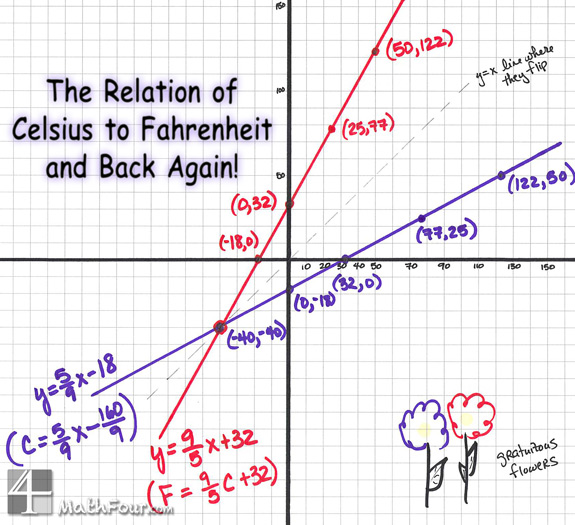
    It inspired me to draw the graphs of Celsius in terms of Fahrenheit and Fahrenheit in terms of Celsius.

    The conversion from Celsius to Fahrenheit and back again can be strange. One way to understand it is on a graph. And you can use this to teach some linear algebra too!

    Notice these two intersect at (-40, -40). Which means that -40°F is -40°C!

    Use it to convert temperatures.

    The x values on the red line are Celsius – so find the °C you have and then look at the y-value to convert to °F.

    It’s just the opposite on the purple line.

    Okay, fine. This isn’t the greatest way to convert – but it’s exciting to see it graphically. And it might be easier to convert this way for someone who’s more visual.

    Use it to teach math!

    These two lines are inverses of each other. So the coordinates of one are switched to make the other.

    Also, they mirror image across that 45° line. I marked the line with dashes and wrote $latex y=x$ on it.

    And if you’re into this, their functional composition (both ways) is… x! (not factorial)

    Compare and Contrast…

    Take a look at the way J.D.Roth did it and then look at the graphs I have. Let your students find the way they like the best. And encourage them to create new ways!

    Oh, yeah – and share what happens in the comments!

  • HELP – Logic Puzzle Announcing The Homeschool Blog Awards

    HELP – Logic Puzzle Announcing The Homeschool Blog Awards

    Okay, y’all, I’m in over my head. I’m trying to create a logic puzzle as a nifty way to announce The Homeschool Blog Awards. Having never created a logic puzzle before, I thought, “How hard can it be?”

    Well, pretty darn hard.

    So I thought I’d put my start out there, as well as the solution, and see if I can get some help from y’all.

    Read the puzzle, try to figure out the solution, then suggest in the comments one or more clues that I should add (or get rid of).

    The Puzzle

    The Homeschool Post is the sponsor of The Homeschool Blog Awards every year. Writers of The Homeschool Post aren’t allowed to win, nor be nominated. So some of the writers of thought it might be fun to do a “within the family” blog award for themselves.

    After all was said and done, they decided to pass all information over to me, the math mom in the team, and let me figure out the winner. Alas, the information wasn’t well organized. So I had to figure out which blog went with which person, who voted for whom and who was the winner.

    The Clues

    Six of the writers decided to participate. They were

    • Lana (like Banana)
    • The writer of OK Homeschool Mom
    • Heather
    • The writer of Knit 1 Kids 4
    • Gidget
    • Rachel
    1. Heather said, “I love everyone. I’m just voting for them all!”
    2. Someone suggested that nobody should vote for themselves. So they agreed on that.
    3. The writer of Finding Joy voted for three people, including Heather and Kristal.
    4. Everyone who voted for Rachel also voted for the blog I Love My 5 Kids.
    5. Everyone but Gidget voted for the author of the blog SprittiBee.
    6. The author of  Homeschooling Unscripted only got two votes.
    7. Donnetta and Gidget got the same number of votes. As did the authors of SprittiBee and Knit 1 Kids 4. Also, Rachel and the author of I Love My 5 Kids had the same number.
    8. The author of Finding Joy is very popular – everyone voted for her.

    The Solution

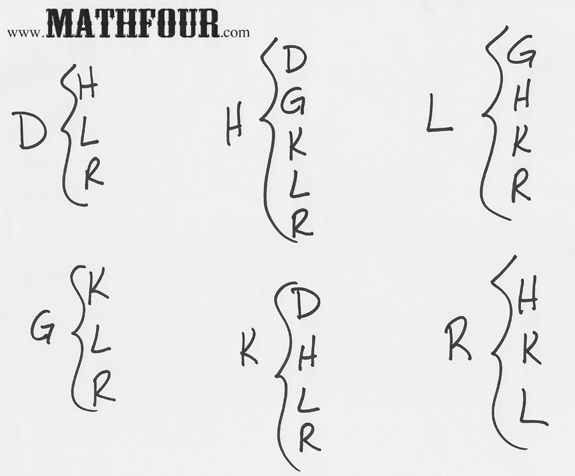
    Here is the solution of who voted for whom. The initial of the person is on the left and the initial of the people for whom they voted is in the curly brackets. Click on the picture to enlarge.

    Owners/writers of the blogs are here:

    • Donetta publishes OK Homeschool Mom
    • Gidget publishes Homeschooling Unscripted
    • Heather publishes SprittiBee
    • Kristal publishes Knit 1 Kids 4
    • Lana publishes I Love My 5 Kids
    • Rachel publishes Finding Joy

    Don’t forget…

    Suggest a clue in the comments!

    Related articles
  • Wordless Wednesday: Fibonacci Baskets

    Wordless Wednesday: Fibonacci Baskets

    I rarely do Wordless Wednesday, but some photos just lend themselves to it!

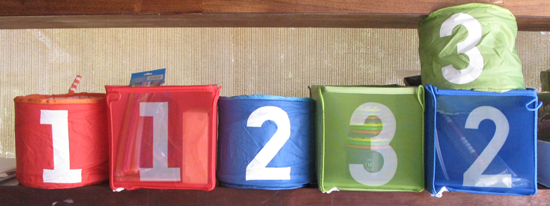
    These are from IKEA.

    In case you’ve not yet taught the Fibonacci Sequence, it starts with 1, 1 and then each next number is the sum of the previous two numbers:

    • Next is 1 + 1 = 2
    • Then 1 + 2 = 3
    • Then 2 +3 = 5, etc.

    How about some questions…

    • How many sets do I need for the next number? (A set from Ikea has 1, 2, and 3 in it.)
    • How many sets do I need for each number after that?
    • Is there a pattern? Like for the 12th number I need 12-2=10 sets and for the 17th number I need 17-2=15 sets?

    Do you have more questions? Or answers? Share in the comments.

    (150 words later my headline is pretty much wrong, huh?)

    Related articles
  • Present Value vs Future Value – How Can You Tell the Difference?

    Present Value vs Future Value – How Can You Tell the Difference?

    No formulas here, only how to figure out which formula you might need to use if you’re working with present value annuities or future value annuities. (These are part of finance and often found in a Finite Math class.)

    Related articles
  • Mathematician Parent: Libby Often

    Mathematician Parent: Libby Often

    Most parents aren’t professional mathematicians. But there are a few. This is the seventh in a series of interviews with mathematician parents with the goal of helping parents integrate math teaching into parenting.

    This week we visit with Libby Often, a math teacher at Greater Lowell Regional Technical High School. She’s also an EdD student studying Math and Science Education at the University of Massachusetts Lowell.

    MathFour: Hey there, Libby! Thanks for sharing your time. First, can you tell us a little about your degree and career?

    Libby: Hello Bon, it’s nice to hear from you.

    My undergraduate degree is in history and classical studies. I have the equivalent of an undergraduate major in math as well (but not the degree to show for it!). Additionally, I have an MEd in Secondary Math Education and am currently in the EdD program for Math and Science Education at UMass Lowell. I am a teacher in a technical high school in northeastern Massachusetts, where I have taught math for the past ten years. I am speaking “off the record” here – not as an official school employee 🙂

    In high school, I was on the math team and the calculus team, and I cannot recall not enjoying math. Well, actually, I didn’t really enjoy the first semester of linear algebra, and I have struggled with writing proofs, but there was always something interesting!

    MathFour: Tell me about your family – how many kids do you have and how old are they? Are any of them more or less interested in math than the others in the family?

    Libby: I have two sons, a 10 year old and a 12 year old. Both are in middle school (grades 5 and 7). They both enjoy math, and are successful in it at school. I should add that this is their interest, not mine. Although I did tell my 12 year old that he would need to go into Pre-Algebra in grade 7, and to make sure his grades supported it.

    MathFour: Do you have any worries about your sons, academically? In particular, do you think they will do better in math than in other subjects because of your influence?

    Libby: I don’t really have any worries about my children now – my younger son has poor handwriting, and both my children hate writing projects. My likes seem to not influence them tremendously, especially at this point.

    MathFour: How do you play with your sons? Do you view your playtime as different in any way than other “non-mathematician” parents?

    Libby: I don’t really play with my kids now, other than card and board games. When they were younger, I didn’t play with them in a way that was different from what I saw other parents doing.

    We do talk about strategy, about piece placement in board games, about probabilities in games like Yahtzee, but I don’t see that as very different from other parents – especially those who play board games. My sons really like video games, and I have utilized their interests in some of my lesson planning, so maybe that is different?

    MathFour: Do you think you speak with your sons or behave differently than other parents because you have a math background?

    Libby: I really don’t think I speak or behave differently with my children because of my background in math. The main difference might be in the way that I talk to their friends – I invite friends over to work on homework, summer math, projects, and other school work, and that is definitely influenced by being an educator.

    What I do like about being involved in math education is seeing the different ways that students are taught to approach problems, and having an opportunity to talk to them, and talk about why these approaches work, and when else they may use them.

    MathFour: Have you ever had either of your children express negative thoughts about math? If not, how do you think you will handle it if that happens?

    Libby: In general, my kids don’t express negative thoughts about math, unless they have gotten a low quiz or test score and I insist that they go over the answers and correct them. I think my response would be on par with what their goals are, and what type of negative response they were exhibiting.

    I would be much more upset if, for example, my son told me I was an idiot because no one would ever need to know how to use fractions, than if he decided he wanted to major in English because he didn’t like math, or that he didn’t want to take AP Calculus.

    I try hard to look at the end goal – a happy, well-functioning adult, who can support himself and others. And math is involved in that!

    MathFour: Indeed it is, Libby!

    Have you ever disagreed with one of your children’s math teachers? What happened and how did you handle it?

    Libby: I have disagreed with other teachers, not necessarily the ones teaching my children. Our district is fortunate to have math coaches, and my sons have overall had good teachers, who were interested in the accuracy of what they were teaching. My colleagues at school and I have disagreed on a number of occasions, and the thing is that we all want students to succeed. So we have to come to an agreement about what will lead to student success in understanding and in preparation for what will come next for them mathematically speaking. I would expect to be able to have a similar conversation with my children’s teachers.

    MathFour: Now to change direction a little to a more worldview of math. What do you see as the biggest challenge in math education today?

    Libby: I think the biggest challenge, and the biggest hope, right now in US Math Education is the new Common Core curriculum. I really like these standards and the clarity with which they are written. There is no longer the room for teachers to say, “I taught them that!” because the standards specify what the child should be able to do.

    But at the same time, students are expected to master all the content for, say, grade four, during grade four. In the US, our public education programs take almost everyone – we are not excluding people because of socio-economic status, language, gender, or other protected categories.

    But this can be at odds with the idea that a certain concept is mastered in grade four, and then we move on to utilize and deepen that concept in grade five, six, seven, etc. Some students may need more time, for whatever reason, and the curricula that we devise is going to have to address this need for review.

    In addition, the math standards for high school are really college preparation standards, and do a great job of developing the quantitative reasoning needed for success in college but at the expense of a lot of skills we used to teach in consumer mathematics. For students to be successful in those areas we need to be sure they are picking up the knowledge somewhere, perhaps in a “transitions to work” course, or in extracurricular programs.

    One other thing that I think is very challenging in terms of mathematics education and education in general is that our society tends to be very product focused in a way that works well for business, but not for education. The successful countries don’t see changes in a few months, but over a number of years. So people need to be willing to wait.

    MathFour: What can you say to non-mathematician parents that might help them raise their kids to like and appreciate math?

    Libby: What advice would I offer to parents who aren’t lovers of math? Admit that to your children, and talk to them about some other things that you don’t love.

    Personally, I dislike laundry and ironing, but I am still competent, and the family wears clean and pressed clothes. Also, I am not any good at plumbing work. But I do try to determine what may be causing a problem before I call the plumber, so I can be as helpful as possible. And I treat my plumber like a valuable professional.

    Even if kids and parents struggle with “school math,” they should treat it like any other problem – what do I understand, what do I not understand (and believe me, the answer is never “I don’t understand anything!”), what can I do with what I do know?

    Ian Stewart says something great in his book Letters to a Young Mathematician about mathematicians and what we can use mathematics for. The essence of it is that if someone trains to be a doctor, or a lawyer, or an electrician, you can SEE that, because there will be a sign “Joe Smith, electrician.”

    But mathematics can be more hidden. It is the person who designs the survey to determine who people will vote for, the circuit design in your cell phone, the accountant who does your taxes, the person who wrote your email software. All of these people may have studied math, but their job description doesn’t say it.

    The advice I take from that is look for the “hidden math,” and look too at the beauty of it.

    Bon: That’s awesome, Libby! Thank you so much for sharing not just yourself, but all this great information!

    Related articles

  • What is “Living Math”?

    What is “Living Math”?

    Look – there’s a 30 degree angle!

    Some folks over at the Living Math Forum were wondering if they were doing living math right.

    There’s probably a fancy definition of living math, but I don’t know it.

    The fact is that we all live math! The trick for parents and teachers is to point it out to our kids.

    Ever sat waiting in a doctor’s office with a child? You find yourself “edutaining” them with, “Look, the chair is BLUE!”

    Remember to also say things like, “Look, there are five chairs and six people…”.

    Encourage them to notice that one lady is sitting on the floor because there aren’t enough chairs. Voila! Subtraction!

    So counting people is living math. As is going grocery shopping, cooking, drinking 1/2 cup water, and breathing 87% O2.

    You’re doing it right because you just can’t do it wrong!

    Related articles
  • [50 Word Friday] Quit Counting Up to Punishment!

    [50 Word Friday] Quit Counting Up to Punishment!

    “You have until 5 to stop! 1, 2…” says the mom to her child.

    Isn’t it interesting how even punishment involves math? And it involves it negatively so!

    Why don’t we say, “Stop that. Now.”

    Or, “I’m going to give you until E to stop! … A, B, C, D, E.”

    Learn more about 50 Word Friday here.

    Related articles

  • Motivation or Inspiration – How do you teach?

    Motivation or Inspiration – How do you teach?

    In order to see what the difference is between motivation and inspiration when teaching math, I’m going to start with a quick story…

    You have a dog named Herman. Herman is cute, fuzzy, has a pink nose and loves you unconditionally. You think he’s great. So you want to share him.

    You put a bow around his neck, and hand him to your children, Abby and Dirk.

    “Here is Herman. He’s cute, lovable, and a perfect pet. Isn’t he fabulous?” you tell them.

    Abby looks at Herman and is so excited. She thinks he’s fabulous, wonderful and sees in him everything that you do. Inspiration hits her – she loves him like you do!

    Dirk, on the other hand, wants a cat. He’s not sure how to voice this. But since you’re so excited about Herman the dog, he rolls with it.

    He wants to please you, so he feigns interest in Herman.

    Herman’s not a dog.

    Herman is your curiosity. Herman is what you find interesting and inspirational.

    And just because Herman is wonderful for you, doesn’t mean Herman is perfect for everyone else.

    Abby loves Herman. And Dirk loves Herman, but only because loving Herman pleases you.

    We offer Herman, and they take him. Because they want to please us.

    Lots of educators these days are talking about helping children connect with math through real life experiences. They want to give children curiosity about math in the real world.

    But the real world means different things to different people. And it means different things to different kids.

    • Some children like to build things. Give them a stack of Legos and they’ll work for hours.
    • There are kids who are outdoor people, always running around and wanting to see what next thing they can find in nature.
    • Some kids want to be in the kitchen, helping their parents cook dinner.
    • Some kids are quite happy connecting math just to math.
    • Some children are gamers, enjoying puzzles, riddles and games just for the fun of it.
    • And the list goes on…

    Grownups take their connection to the real world, their own curiosity, and pass it on to children. We take everything that we find fascinating, our own personal Herman, and hand it to the child.

    And they take it. Some because they are excited about it, and some because they want to please us.

    Motivation is not inspiration.

    The growing thought among educators is that children need to be curious in order to learn math. So we’re creating ways to get children curious.

    But are we doing it right?

    The child will happily take Herman, your form of curiosity. This could mean they are truly inspired by what you give. And it could mean that they are merely motivated.

    Motivation isn’t a bad thing, for sure! But if we mistake motivation for inspiration we are doing the children a disservice.

    If they’re motivated, they’ll only do what’s next to get praise. It’s about you, the grown-up, and how much they can please you.

    If they’re inspired, they’ll want to take their learning to the next level – even when you’re not around. They’ll want to see and do things to enhance their understanding without needing your praise and attention. It’s about them.

    And when things are about them, they own it. They succeed because they can, not just because we want them to.

    What’s your Herman?

    And have you passed him along? Was he inspirational or motivational? Share your thoughts in the comments!

    Related articles
  • Times Tables Bootcamp

    Times Tables Bootcamp

    This is a guest article by Caroline Mukisa who publishes Maths Insider.

    Does your middle- or high-schooler know their times tables? If the answer is a resounding “Yes” then, great, have a great day, and read the other great tips here at MathFour.

    I also have some great tips and advice on how to guide your child to maths success on my Maths Insider site.

    If not, then it’s time to help your teen develop their own times tables boot camp.

    Why are times tables important at all?

    Well it’s used loads in algebra, and those geometry questions usually need a fair bit of multiplication or division. It’s also great for those grown-up things that they’re going to be doing in the years to come, working out payment plans, home remodelling, calculating sale prices and just plain making sure that they’re not ripped off in life.

    Of course we’ve got computers and calculators, but who wants to be fiddling about to open a smartphone app, just to work out the price of a pair of jeans. And if they press the wrong buttons, how will they know the answer is wrong?

    Yep, they’re important!

    Why are times tables a problem for older learners?

    It’s like spending years trying to pass a driving test. Or still not being able to conjugate Spanish verbs after studying them for ages. Or trying to lose those last few pounds of weight. It sucks, and it gets to the point where it’s easier to develop a work-around: catch the train everywhere, just get by with a few Spanish phrases, or buy bigger clothes.

    Of course, your teen can “get by” and may even do rather well at maths without knowing their times tables. But before you give up, try some of the following strategies to help your teen make their own times tables bootcamp to fix those essential times tables facts in their heads. It’s never too late!

    Times tables boot camp strategies

    1) Figure out what they know, and what they don’t know. Are they fine with their 2’s, 3’s and 4’s and 5’s but shaky after that? Then focus on quickly reviewing the easy tables before some concentrated repetition of the harder tables.

    2) Use incremental steps. Make sure the 5’s are solid before moving on to the 6’s and the 6’s are fast before moving onto the 7’s.

    3) Give your teen a fixed target. It’s completely possible to learn the times tables from 2-9 in a month with just 5-10 minutes of daily study.

    4) Let them choose their own activities. Worksheets won’t be a popular option – iphone apps, You Tube videos, online games are all things that teens are more likely to tolerate.

    5) Be encouraging – don’t say, “That’s easy, you should know it” instead say, “I can see you’re working hard on this, keep it up.”

    Use these strategies to help your child plan their own successful times tables boot camp, so they won’t have to just “get by” in maths any longer.

    Caroline Mukisa is a homeschooling mom of 4, who publishes at Maths Insider.

    Related articles