
Tag: curriculum

  • Math in the 4th Grade Language Arts List

    Math in the 4th Grade Language Arts List

    I’ve noted before how math shows up in course study lists like the Toddler Reading Readiness List. But in looking at other courses of study, I’m seeing math everywhere. So here’s another one!

    This list is from the WorldBook site and is their Typical Course of Study for Grade Level 4, Language Arts section.

    Silent and oral reading

    Reading and comprehending information is essential in math, too. And later in math classes you’ll find reading something out loud happens a lot more that you think.

    Listening skills

    Wowsers! If you don’t listen carefully to a theorem or explanation of a proof, you could be super lost!

    Telephone skills

    Can you say “study group calling tree”?

    Summarizing simple information

    This is the basis of all word problem solving.

    Listening to literature

    Which is another skill when listening to a word problem. Better yet – listening to a “real world” word problem that is being told to you by someone who needs help.

    Critical reading

    Using definitions of math things along with theorems and “math rules” is critical reading. Critical reading means following all the logic. And logic is math.

    Increasing dictionary skills

    This is called “lexicographic ordering” and is huge in math. Especially when you try to order the points on the plane (or complex numbers).

    Cursive handwriting

    You write faster with cursive. When you’re doing math and needing to write out details, getting them out on paper fast helps keep your brain caught up with what’s going on.

    Simple outlining

    This is one of the important skills in constructing a proof.

    Writing letters and informal notes

    It’s all about formulas here. If you can plug and chug with the salutation, date, closing, etc., you’re golden on math formulas and functions!

    And of course there’s math in stamps!

    Written and oral book reports

    Popular math books are great to read. And when you give a quick summary of them in a social setting, you look really cool. (Not to mention if you end up being a mom blogger you’re likely to review some math books at some time in your life.)

    Creative writing

    There’s nothing more creative than writing a word problem!

    Developing skills in locating information

    You don’t really need to know the right formula – if you can find it!

    Increasing indexing skills

    Finding something in a math book index is huge when you’re trying to figure stuff out.

    Developing encyclopedia skills

    Again – great to have when looking up a math word or formula.

    What you can do

    There’s math everywhere – even 4th grade Language Arts! When helping your children with their LA – in homeschool or classroom school – remind them how these skills will also help them in math.

    The more they hear that they’re doing math, the better they’ll be in their “official” math class.

    Share your thoughts in the comments or on twitter/x.

    You might also like:
  • Math in the Toddler Reading Readiness List

    Math in the Toddler Reading Readiness List

    I previously wrote about preschool math readiness after I found a list for preschool studies. There are many more preschool math concepts inside all the other subjects, too.

    Here’s the list for reading readiness and how math is really a part of these!

    Reading Readiness

    Remembers objects from a given picture.

    If a student can remember things that happened in previous problems in their math homework, they will make the connections faster. This remembering thing is huge in math!

    Knows what a letter is.

    This helps them to understand the difference between symbols with value (numbers) and sybols with no value (letters). Later they’ll be able to see that both letters and numbers can “signpost” things – like in an outline or the answer options on a test.

    Has been read to frequently.

    And count as many things in those books that you can!

    Looks at books and magazines.
    Make sure to include magazines like Time that have graphs and statistics in them.

    Recognizes some nursery rhymes.

    Great silly math one: “A dillar a dollar a 10 o’clock scholar – why do you come so soon? You used to come at 10 o’clock and now you come at noon!”

    Identifies parts of the body.

    The body is full of the symmetry and pairings. Not to mention patterns – like 5 fingers, 5 fingers, 5 toes, 5 toes.

    Identifies objects that have a functional use.

    Scissors cut things in half, glue allows you to add things.

    Knows common farm and zoo animals.

    Notice the pattern in the number of feet animals have. Also, if you multiply the number of animals by 4, you get the number of feet!

    Pronounces own first name.

    Identifying self helps to “name” things – in particular name a numeral with a word (like 2 is “two).

    Pronounces own last name.

    If a child has the same last name as one or both parents, you can point out that as a pattern.

    Expresses self verbally.

    Toddlers have to be ready for everything!

    This includes desires – so it’s a great opportunity to teach them to desire “three more,” and then count down. When they say, “one more,” they think it means “another” – unless they see they can go from three to two to one, etc.

    Identifies other children by name.

    Again – this is a forerunner to identifying the names of numerals.

    Tells the meaning of simple words.

    Number words are words too. Knowing the meaning of number words is important.

    Repeats a sentence of 6-8 words.

    When kids can repeat a sentence, they are ready to start repeating math facts. The sentence, “Four times eight is thirty-two” is pretty much a sentence of six words.

    Completes incomplete sentence with proper word.

    Can you say more math facts? Sweet!

    Has own books.

    And if some of these are counting books, how wonderful!

    Understands that print carries a message.

    This is the basis of equations too. An equation is a “printed” thing that means something, that has a message.

    Pretends to read.

    If your books also have basic math concepts, they can pretend to read those too.

    Uses left-to-right progression.

    Math is also read left to right.

    Answers questions about a short story.

    Include fun math stories and they can practice answering questions about those too.

    Tells the meaning of words heard in story.

    Use stories that have more than one of the same thing like two children – Hansel & Gretel – and Three Little Pigs. Discuss what it would change in the story if there were three children, or four little pigs.

    Looks at pictures and tells a story.

    If the pictures have multiples, they can use some counting and subitzing to explain what’s happening with those many objects.

    Identifies own first name in manuscript.

    Identifying manuscript letters is like identifying written numbers. It takes some time to see the differences between a 4 in print and a 4 in writing.

    Prints own first name.

    When they can do this, they also can print their phone number, zip code and street number.

    What you can do

    Notice that there’s math in so much – even toddler reading readiness. When you get your children ready for school – whether it’s homeschool or classroom school – you remind them that they are also doing math.

    The more they hear that they’re doing math, the better they’ll be when the get into an “official” math class.

    Got any tips? Share them in the comments. And you can also tweet this!

    Related articles
  • Preschool Math Success

    Preschool Math Success

    Through the Living Math Yahoo Group, I got a list for the typical courses of study for various grade levels. In each grade level link, there’s a list of math concepts.

    Since daughter is two, I immediately clicked on the preschool link. I was a little offended to find such a long reading list and no list titled, “Math.”

    And then I read the list. In almost every line I found math concepts!

    If you teach your little one these things on this list, check out the advanced math they will also be getting!

    (Note: my comments are italicized.)

    Size

    • Understands big and little.This preschool math concept sets them up for volume comparisons.
    • Understands long and short. This one gets them ready for length comparisons.
    • Matches shapes or objects based on size. Forerunner to inscribing shapes in other shapes, dissecting shapes to understand area formulas, etc. Also getting them ready for pattern recognition.

    Colors and Shapes

    • Recognizes and names primary colors. This preschool math concept is the beginning of pattern recognition.
    • Recognizes circles. Getting ready for the idea of a shape with no sides and a shape with infinite sides.(whoa!)
    • Recognizes rectangles. Setting up for all sorts of area formulas – since just about every regular shape can be made into a rectangle with scissors and glue.
    • Matches shapes or objects based on shape. The math concepts here get them ready for the geometric concept of similar and even more pattern recognition.
    • Copies shapes. Kinesthetically understanding concepts of geometry. This one also helps them get ready for pattern recognition – or making their own patterns!

    Numbers

    • Counts orally through 10. This is less of a preschool math concept and more of a “you just really gotta know this” concept – kinda like the alphabet.
    • Counts objects in one-to-one correspondence. One-to-one correspondence is a huge and important concept in algebra.
    • Understands empty and full. Volume comparisons as well as the grouping of objects to fill a volume.
    • Understands more and less. The foundation of ordering numbers and understanding relations.

    Position and Direction

    • Understands up and down. Forerunner of the number line.
    • Understands in and out. This preschool math concept gets them into early set theory.
    • Understands front and back. More number line stuff.
    • Understands over (on) and under. The math concepts here get them ready for setting up fractions.
    • Understands top, bottom, middle. Standard preschool readiness and also the basics of ordering.
    • Understands beside and next to. Gets them ready to multiply a number by a variable by just standing the number next to the variable: 3x means 3 times x.
    • Understands hot and cold. Getting ready to measure temperature.
    • Understands fast and slow. Getting ready to measure speed as well as rates.

    Time

    • Understands day and night. This preschool math concept gets them ready to expand into bigger and bigger time units – which will allow them to eventually understand the ideas of infinity and infinitely small. Curiously, this is also pattern recognition – every day you get day and every day you get night!
    • Knows age and birthday. This seems to be another “good to know” thing. However, it is another forerunner to big time units.

    More…

    There are many more preschool math concepts that can be spun off from the other lists, like Reading and Social-Emotional Development. I’ll be writing up how to integrate math in those in a few days!

    Am I missing anything? Let me know in the comments.

  • Frustrations with IXL Math – A Review

    Frustrations with IXL Math – A Review

    See update below.

    Homeschooler @Ser3nd1pity requested my thoughts on the math program from IXL via twitter a few days ago.

    So I checked it out.

    When looking at the IXL sample page, I started having some concerns. Here are some screenshots that I’m running into, as well as my thoughts:

    Kindergarten Skills

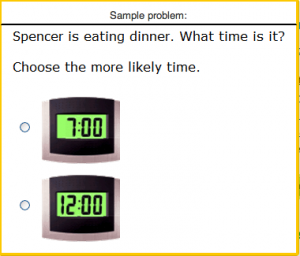
    Some people say “dinner” for “lunch.” They reserve the word “supper” for the evening meal. Instead of using terms that might be cultural, perhaps they could have used breakfast.

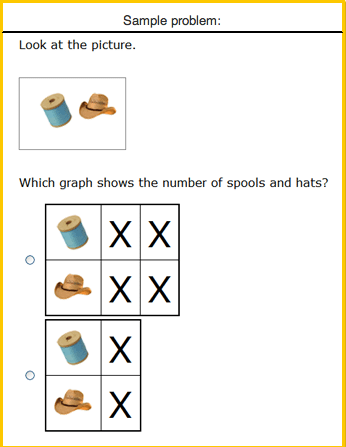
    I was so confused by this one. I’ve never seen a graph made of two objects. Nor have I seen graphs made with giant Xs. I think a graph with lines or bars instead of Xs would be clearer. As well as having a few of the objects, not just one of each.

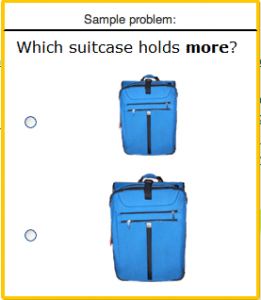
    These suitcases appear to be the same but zoomed in. A reference object would certainly help this.

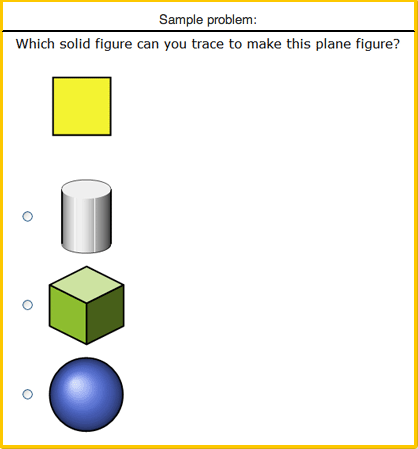
    I didn’t know what plane geometry was until college. I’m pretty sure that five-year-olds and their parents will figure out what the answer is, but the question stem is written at a really high level.

    Grade 2 Skills

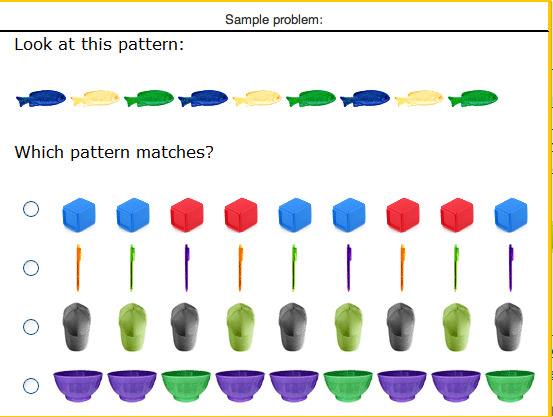
    The right answer (the pens) are very very hard to see here. And the various colors and objects are confusing. Better would be the same objects, or bigger or with more space between the lines.

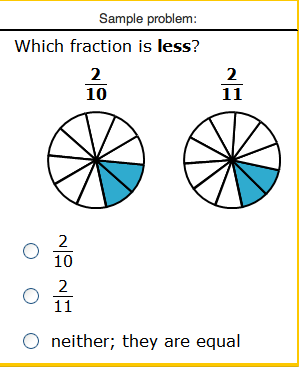
    These pies really look the same to me. If I look and count really, or look at the fractions, I can see they’re different. This might be more effective without the pictures.  For a seven year old (and for me), if you had 2/10 of that pie and he (or I) had 2/11 of that pie and it looked like these pictures, they could easily be perceived as the same.

    Stopping Now

    Of course I haven’t really gotten into the curriculum. These are merely samples. I don’t know how they teach this in the IXL Math Practice program. I worry, though, that these examples might be representative of the way it is taught.

    I welcome a view into the curriculum, if they’re interested in more thoughts on their offering.


    Update March 29, 2012: IXL has communicated to me that they’ve been making changes – including some based on this article. They’ve also hired me to take a deeper look at their product and give them feedback. I look forward to seeing what they’ve got.

    I’ll post updates, so stay tuned!