
Category: Math Around Us

  • The Math Behind Carpooling Toddlers

    The Math Behind Carpooling Toddlers

    But should it be?

    In my Mustang I get 20 miles to the gallon. Currently gas is hovering at three dollars per gallon. Which means for every 20 miles I drive, it costs me $3.

    It’s 5 miles to school from my house. If I take her to school and back in the morning, and then retrieve her in the evening, it takes me 20 miles – or $3. (These are true numbers – even though they are working out rather nicely.)

    Which means in addition to tuition, it’s another $15 a week. So in a 40 week school year, I spend another $600 in gas!

    Maybe I should consider toddler carpooling…

    But is it worth it to buy another car seat?

    Some forward facing car seat models can go up to 80 pounds. Even in the 97th percentile of weight, our daughters won’t grow out of one of these car seats until they’re about eight years old. That’s another five years!

    The first car seat I find on Amazon.com that goes to 80 pounds is the Cosco Juvenile High Back Booster Car Seat. It’s $46.54 and eligible for free shipping. Add tax, and you’re right at $50.
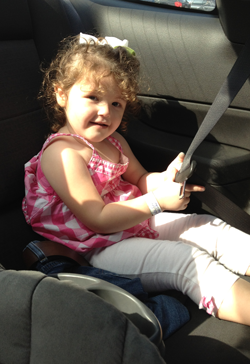
    Sharing the duties with my neighbor means cutting my gas bill in half. So I would save $7.50 each week by carpooling. After seven weeks of carpooling, I would save

    \(7 \times \$7.50 = \$52.50\)

    That car seat would pay for itself after less than two months!

    Will it be worth it long term?

    After this year, I have three more years of carpooling available before we start homeschooling.

    Three years at 40 weeks/year in school and $7.50 savings per week gets me at

    \(3 \text{ years} \times 40 \text{ weeks} \times \$7.50 = \$900\)

    I’ll save $900 over the next three years. And so will my neighbor!

    I’m off to buy the carseat!

    What will you do?

    Do you take your kids to a co-op or day-school? Is there a family you can carpool with that you haven’t yet considered because of the logistics? Will you now work the numbers to see if it makes sense?

    Share your thoughts in the comments!

    Related articles
  • 3 1/2 Ways to Do Math with Jesus

    3 1/2 Ways to Do Math with Jesus

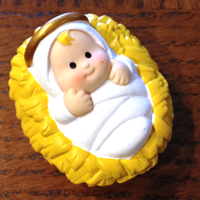
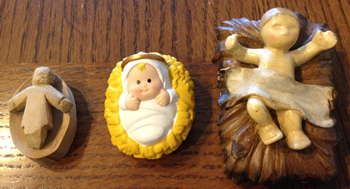
    I’ve been stumbling over baby Jesuses for a few weeks now. I realized that with three working nativity sets in the house it was time to do a little math with Jesus.

    All of them.

    You can count the bits and pieces.

    Animals, people, buildings – count them for each nativity set and count them up total.

    • How many total Jesuses do you have?
    • How many angels?
    • How many “visitors” does Jesus have?
    • How many sheep? Cows? Donkeys? Camels?
    • How many total animals?

    You can compare the numbers.

    My three nativity sets have varying numbers of characters and structures. It’s curious how some sets include more animals that visitors – and some sets don’t have any animals.

    • Which of your nativity sets have more animals? Which has more people?
    • Which has more buildings (or non-people/non-animal things)?
    • Are there more visitors than animals or more animals than visitors?
    • Arrange the sets in order of least to greatest – people, animals, etc. Are they always in the same order?
    • Is one set bigger or heavier than the others?

    Do some arithmetic.

    Take the opportunity to show how counting and arithmetic are kinda the same thing.

    • If you add up the number of sheep you have with the number of donkeys, how many is that? Is it the same if you group them together and just count them?
    • What if all the shepherds left? Talk about how you can count them, or you subtract the number of shepherds from the total number of visitors.
    • How many nativity sets do you have? Talk about how 3 times that number is the number of wise men you have.

    Do fractions – but only if you must.

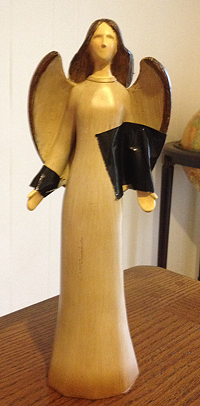
    I know many people avoid fractions. I wish I could have avoided it with Math with Jesus. Daughter gave us the opportunity to talk about fractions by breaking the angel (or the “butterfly” as she calls it). Good thing we have Gorilla Tape.

    Where can you find math in your Christmas things?

    Related articles
  • Wrapping Paper – Doing the Math this Season

    Wrapping Paper – Doing the Math this Season

    As you wrap presents this holiday season, take a minute to notice the patterns in the wrapping paper. You might just find some math!

    Christmas Paper

    How does the paper come together in the back? Does it neatly match up, seamlessly? Or is it way off?

    Are you able to scootch things a little so that you can get the paper to line up?

    What happens when you use a different box?

    Is this really math?

    Absolutely!

    Consider wallpaper: it has a pattern that repeats every so many inches. When you put wallpaper in your home it’s important to know how often it repeats so that you can match patterns in the corners and around windows, etc.

    Patterned wrapping paper also repeats. Most people ignore it because they don’t think about matching the patterns in the back when wrapping gifts.

    Unless they are particularly detail oriented, a perfectionist, or want to teach a little bit of math at home while wrapping presents…

    Choose your wrapping paper to match your boxes!

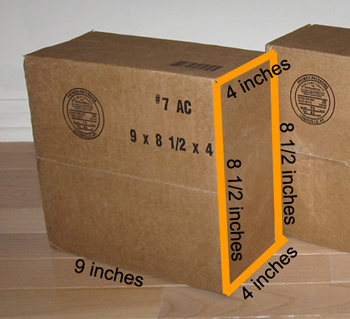
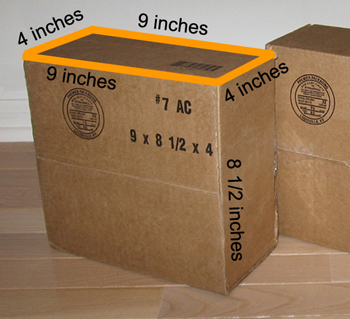
    On this box your wrapping paper would go around 8 1/2 + 4 + 8 1/2 + 4 inches.

    This means the wrapping paper would travel 25 inches before meeting back up with itself. So any wrapping paper that repeats after 5 inches or 25 inches will match back up in the back. Both 5 and 25 are factors of 25 – and that’s math!

    If you wrap the box the other way, instead, like this,

    …the wrapping paper would travel 26 inches. Therefore any patterned wrapping paper that repeated after 2 inches, 13 inches or 26 inches would match in the back perfectly.

    A box whose “wrap around” distance was 30 inches could use any wrapping paper that repeated after 2 inches, 3 inches, 5 inches, 6 inches, 10 inches, 15 inches or 30 inches. All those are factors of 30.

    Choose your boxes to match your wrapping paper!

    Or do it the other way – figure out how frequently your pattern repeats. Any box that has a girth of a multiple of this number can be wrapped perfectly. (Girth is the distance around the box – where you wrap the paper.)

    For instance, if your wrapping paper repeated after 2 1/2 inches, you would look for boxes that have a girth of 2 1/2 inches (a tiny ring box), 5 inches, 7 1/2 inches, 10 inches. All the way up to giant boxes that have a girth of 314 1/2 inches.

    Your turn!

    How often does your favorite wrapping paper repeat? Have you found the perfect box/wrapping paper combination? Share your wrapping paper math discoveries in the comments!

    Box photos by z287marc | Flickr.com | CC BY

    Related articles
  • Math Holiday Shopping Day

    Math Holiday Shopping Day

    There’s a lot of math involved in shopping. And around the holidays, since there’s a lot more shopping, there’s a lot more math.

    Today is special.

    Today is Sibling Christmas Shopping Day. An unofficial holiday created by my mother’s children a few years ago. My three siblings and I head out to the mall. Just us. No children, no spouses.

    We act like a bunch of wild 10 year olds stuck in grown-up bodies. And we’re not small grown-ups.

    If you’re in Memorial City Mall today, look out.

    There’s math in Sibling Christmas Shopping Day.

    There are three sisters and one brother. All of us wear clothing and accessories according to traditional gender roles. So how many Christmas earring ornaments do we need?

    And who will bring them?!

    There are four of us, and we’re shopping for each other. In how many different ways can we group together in pairs of two to optimize shopping for each other?

    And how on earth will we make sure to stay hidden!?

    My Christmas shopping budget for the day is $200. I have seven people to buy for and want to spend roughly the same on each one. I also want to buy coffee at Starbucks, lunch, and take some picture booth pictures. What’s a good estimate for me to spend on each of my seven people?

    And why can’t I have a bigger budget? *sigh*

    The probability for us getting thrown out of a store for horsing around is .04. There are about 200 stores in Memorial City Mall. If we visit 150 stores, how many times will we be kicked out for horsing around?

    And how can I make sure to blame it on them?

    We’re meeting at 9:30 and wanting to get done around 3:30. If we each have seven people on our lists, how many presents should we buy each hour to make sure we get everything done?

    And who’s going to be late to mess up all the math we’ve done figuring this out?

    If the line to see Santa is 45 minutes long and we all want to crowd on that poor man’s lap together, when should we arrive to do this so that we don’t take away any shopping time?

    And who’ll be the lonely sib stuck in line holding our place until the others finally show up?

    Math Fun, Mall Fun

    When you take your children shopping this season, start your day with a budgeting conversation. Even if the sky’s the limit you can visit about how much each child wants to spend. Revisit the topic at the end of the day and discuss their impressions of the value of things – were items more or less expensive than they’d anticipated? Did they go over budget?

    During the shopping trip, point out places where there are discounts. Discuss “just-for-you” deals that the kiosk clerks offer. Consider real value and how it compares with perceived value.

    Look around for ways to count, talk about time or money and look for patterns. When you do, point it out and say, “and that’s math!”

    And share what you see!

    Leave a comment below if you find anything interesting. And if you see a bunch of grownups acting worse than any kid you’ve seen… well, it’s not me. Really.

    Related articles
  • Math Songs

    Math Songs

    I’ve been wanting to write about all the cool math songs out there for quite some time. I’ve been somewhat collecting them in hopes that I’ll have the world’s biggest collection of math songs.

    Alas, I’m fairly confident that I’ve only managed to round up about 10%. They range in educational value, music quality and catchiness. Songs that I love, Daughter isn’t quite interested in. The one she loves I sometimes find slightly boring (especially after 3,000 times of replay).

    Not all math songs are good.

    Math and music are very similar in that everybody has their preference. I’m not a fan of calculus. And I’m not a fan of rap music. (Not that calculus is the mathematical equivalent of rap music, but for me it’s just as annoying.)

    If you’re searching for math songs, make sure you give them a listen before you buy. There’s a lot of garbage out there (sometimes that’s an opinion and sometimes that’s a technical fact).

    There’s also some NSFW stuff too – which can be fun for grownups, but you don’t want to inadvertently play something nasty for your parrot two year old (I’m speaking from experience here, #jussaying).

    Here’s my collection of songs and albums.

    • Do The Math by Ralph’s World is a song about friends… who happen to be shapes: Sanderson the Square, Tony the Triangle, Poly the polyhedron (non-Euclidean) mass. So fun!
    • Schoolhouse Rock: Multiplication Rock – the best ever. I’ve been singing this to Daughter since she was born! “Three is a Magic Number” still makes me tear up.
    • The Math Song by Scott Perry – I just downloaded this off iTunes and I’m excited about listening to it – over and over!
    • Another I grabbed this morning is I, Pythagoras (The Math Song) by Nikki Shultz. This is more of a grown up song, but she’s got an amazing voice.

    You can even make your own!

    Like I did (and had Husband sing it) with The 1-2-3 Song.

    Or have your students do it! This song was recorded about ten years ago for me by Sidney & Dale, two Art Institute students in my Fundamentals of Math class:

    So how about it – what math song is your favorite? And what math song would you like to hear, sing or write? Share it in the comments (and include a link to the audio or YouTube video).

    Sing the news loud and click here to share this on Twitter/X.

    Related articles
  • Mathematicians are People Too – And They Make Mistakes!

    Mathematicians are People Too – And They Make Mistakes!

    This story is in honor of my best friend’s 41st birthday. She’s called me “Michelle,” my middle name, since we met in 1977. Happy Birthday, Tammy!

    Two friends, Tammy, a poli-sci major, and Michelle a math major, were carpooling home from college one day.

    While on the freeway, Michelle recalled an interesting fact that she had recently learned.

    “Did you know the interstate freeways that run east and west are all odd numbers, and freeways that run north and south are all even numbers?”

    Tammy began to think.

    “Like I10 runs east and west and it’s an odd number,” explained Michelle.

    Tammy was silent.

    Minutes passed.

    Tammy finally said, hesitantly, “Michelle, I know you’re supposed to be the math person here, but I’m pretty sure that 10 is an even number.”

    Michelle replied, “Oh, yeah, I meant the other way.”

    The moral: Be confident. Even if you’re wrong.

    Related articles

  • Wordless Wednesday: Fibonacci Baskets

    Wordless Wednesday: Fibonacci Baskets

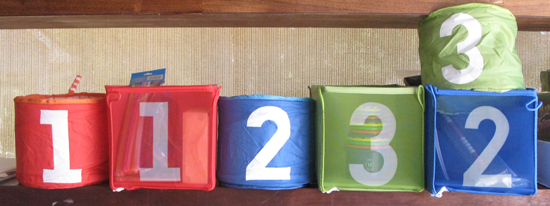
    I rarely do Wordless Wednesday, but some photos just lend themselves to it!

    These are from IKEA.

    In case you’ve not yet taught the Fibonacci Sequence, it starts with 1, 1 and then each next number is the sum of the previous two numbers:

    • Next is 1 + 1 = 2
    • Then 1 + 2 = 3
    • Then 2 +3 = 5, etc.

    How about some questions…

    • How many sets do I need for the next number? (A set from Ikea has 1, 2, and 3 in it.)
    • How many sets do I need for each number after that?
    • Is there a pattern? Like for the 12th number I need 12-2=10 sets and for the 17th number I need 17-2=15 sets?

    Do you have more questions? Or answers? Share in the comments.

    (150 words later my headline is pretty much wrong, huh?)

    Related articles
  • What is “Living Math”?

    What is “Living Math”?

    Look – there’s a 30 degree angle!

    Some folks over at the Living Math Forum were wondering if they were doing living math right.

    There’s probably a fancy definition of living math, but I don’t know it.

    The fact is that we all live math! The trick for parents and teachers is to point it out to our kids.

    Ever sat waiting in a doctor’s office with a child? You find yourself “edutaining” them with, “Look, the chair is BLUE!”

    Remember to also say things like, “Look, there are five chairs and six people…”.

    Encourage them to notice that one lady is sitting on the floor because there aren’t enough chairs. Voila! Subtraction!

    So counting people is living math. As is going grocery shopping, cooking, drinking 1/2 cup water, and breathing 87% O2.

    You’re doing it right because you just can’t do it wrong!

    Related articles
  • Memorizing Parent Phone Numbers Is Math and Safety!

    Memorizing Parent Phone Numbers Is Math and Safety!

    I’m a math mom. And I’m a paranoid mom. So when I saw the opportunity to put these two together on a daily basis, I was elated.

    Every night before bed we say our “words” right before our prayers. The routine sounds like this:

    My name is Doodle Crowder. My dad’s name is Big Crowder.* His number is 713-555-1254. My mom’s name is Bon Crowder. Her number is 713-555-1245. Thank you Jesus for letting me have a good day. Be with everybody who loves me, including…

    The safety benefit is obvious.

    If she’s ever lost or otherwise not where she’s supposed to be – at any age – she’ll have our phone numbers ingrained into her little noodle. With that memorized so clearly she’ll be able to tell any police officer around exactly to whom she belongs.

    This makes me much more comfortable about her growing up.

    The math part is really cool.

    We teach children this poem:

    One two three four five

    Six seven eight nine ten

    But this really means nothing. They’re just words. Until a child can associate each word with another (different) object, “counting” is merely a trick.

    Kind of like thinking that a kid can read just because they know how to sing the alphabet.

    And the association of each number word with an object is really very advanced. Especially since “seven” has two syllables. Might “se” and “ven” each be a number? And there’s no telling (for a child) if “won,” “wonto” or maybe “wontothree” is a single number!

    Kids differentiate number words by hearing other combinations!

    If they hear “towonthree” and “threetowon” and “wontothree” they can start to see where the sounds break. If “se” and “ven” are always stuck together, they start to understand that “seven” is a single word.

    Phone numbers are a great way to help them say and hear lots of number words in different orders. And it keeps it from getting too boring for you.

    Safety and math go together!

    So add the phone number routine to the front of your prayers. Pick the top two or three phone numbers in your little one’s lives and say them every night.

    And share your thoughts on this. What else do you do in your bedtime routine that supports math?

    *Names changed to protect our privacy – whatever little sliver of it there might be left. 😉