I just finished Dan Pink’s book A Whole New Mind in which he discusses the difference between a maze and a labyrinth. It made me think of this wonderful video of dissecting a maze into two walls to solve it:
From the discovery that David and his class of Math Explorers made, I learned that you can take two colors and create a maze. So off I went…
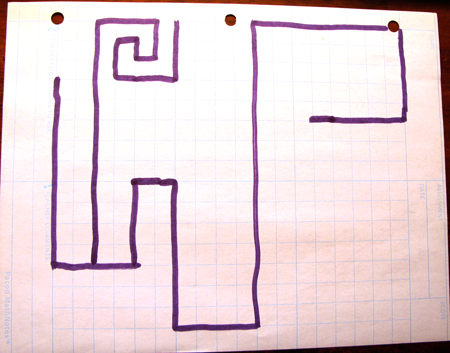
I’ve been dying to use this elementary school graph paper I got the other day so out it came. I grabbed a purple marker and started:
I immediately began creating the “rules” of what would be good maze design. And almost as quickly I began seeing that I was all wrong.
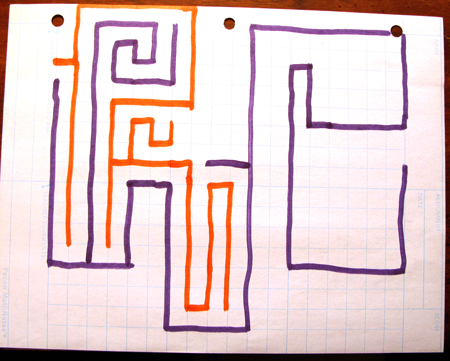
After a while I got out the orange marker:
More rules… more “…no, that’s not really a requirement” thoughts from me.
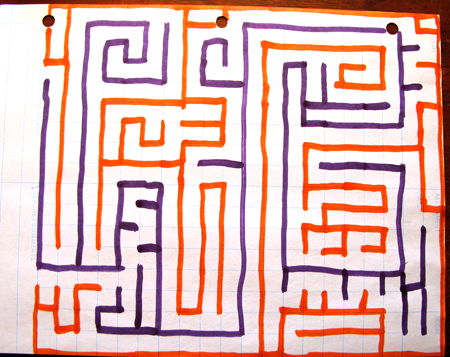
After a while I just gave up on making rules and decided to make sure that my purple and orange would come out at some point together.
Then with a little photoshop magic, I made it all black. You can download it here and play it!
Okay, your turn!
This might not be something to teach, but rather something to do at home together. It’ll be a learning experience for the whole family.
Grab anything with lines or a grid on it and two different color pens or markers and give it a shot. Let me know how it goes. You can even post a link to the pictures of them in the comments!
Are you teaching sets? Some of the stuff that you talk about in set theory is pretty clear – you have a basket { } and you put stuff in it {♥, ✂, ☎, ✿}. No problem.
But what’s the deal with the basket with no stuff in it?
That’s the empty set. It’s written like Ø or simply as the “basket” like this: { }.
But kids might be tempted to write {Ø} – and then they get it wrong. BUT WHY?
The empty set is an object!
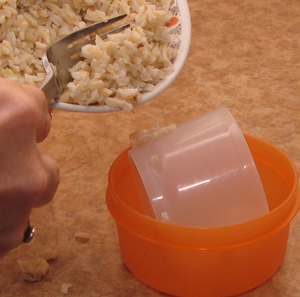
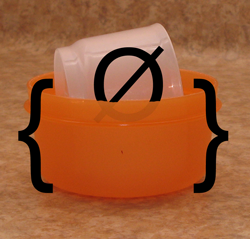
Suppose you have four empty sets. Do you have nothing? Nope – you have four containers. Just check your cabinets – I’m guessing you have a handful of empty sets in there with the Rubbermaid® or Tupperware® logo on them.
And {Ø} is an object inside a set.
Supposed you put one inside the other, like this:
This is the same as {Ø}. Would you be willing to put leftovers inside the bigger one while the smaller one is there? It would be something like this:
Instead, wouldn’t you be more likely to remove one empty set from the other and have just Ø and Ø (no curly brackets) like this:
What do you think? Does this help you understand the empty set? Will it help you teach it?
The Order of Operations can be boiled down into three “real” operations.
Parenthesis are merely a way to group things – they aren’t a real operation. So they doesn’t count as a real operation.
Since division is really just multiplication turned upside down, we don’t need to include it separately, either. Likewise, subtraction is addition on its ear. So we throw him out, too.
Now we have only three: exponents, multiplication and addition.
You see that 3 x 3 x 3 x 3 is 34. The exponent is the shortcut for multiplication.
Multiplication is the shortcut for addition.
Likewise, when we get overwhelmed with adding up the same numbers over and over, like in the video, 4 + 4 + 4 + 4 + 4, we can use multiplication to shortcut it: 5 x 4.
Follow the shortcut evolution.
The shortcut evolution is like this
Addition came first.
Then we created multiplication to make addition easier.
Then we created exponents to make multiplication easier.
So when you do arithmetic, we should do the “recent” shortcuts first (exponents) and then the “older” shortcuts (multiplication) and then the “regular” arithmetic (addition). Remember that subtraction is addition and division is multiplication.
And keep in mind that we need to watch the grouping or anything isolated with parenthesis, absolute value bars or in a fraction. The grouping/isolation tools always trump the other operation rules.
What if your answer isn’t the same as the back of the book?
Some textbooks actually have multiplication done before division. This means that the problem 9 ÷ 3 x 2 will show a different answer (3/2) in that textbook’s solution pages than what you would get following the OoO I’m describing here (6). These texts are rare, but I’ve seen them. So keep your eyes peeled.
The Order of Operations is a set of rules that we’ve agreed on. Which means that as long as a textbook clearly defines their order that they will follow, they can do things like this.
If you get confused as to which to do first, demand parenthesis. (Yes, you can do that.) Or put parenthesis into your child’s textbook to help them out.
The problem sets should be there to enforce, not confuse.
What do you think? Does this help or hinder the way you’ve always viewed the Order of Operations? Share your thoughts in the comments.
In the Story Portfolio, there’s a suggestion to create a mini-saga. It’s a story in exactly 50 words, not counting the title.
“What a great idea,” I thought, “Can it be done with math?”
Well, of course it can. But what that will look like, I’m not sure. So I’m launching 50 Word Friday – a Friday series for these mini-sagas.
The first is about me:
When Life Happens, Maybe It’s Happening Right
A girl spent years in college. Learning, then teaching, math. Mostly because she didn’t want to get a job. Then she joined corporate life as a choice. She soon realized that the previous unchosen path was more appropriate for her than a life in corporate American. And here she is.
Do you have a mini-saga? Tell your story in exactly 50 words and share it in the comments!
See these other 50 Word Articles from MathFour.com
Would you like to teach math everywhere you go? Well, here’s one from the table!
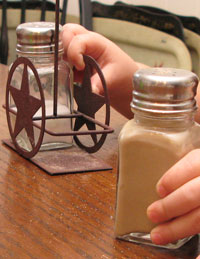
Daughter enjoys playing with our salt-and-pepper shaker holder at dinner. She takes out the salt, then takes out the pepper, then replaces the salt, then replaces the pepper.
The order in which she does these four operations vary. Including switching the salt and pepper.
She’s slowly putting together the pieces that will one day become the commutative property.
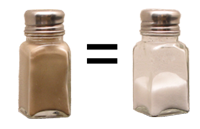
She’s also practicing substitution…
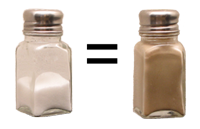
She’s learning that the salt and pepper can be switched (commutative). And she’s learning that one can be interchanged for the other (substitution).
…and the associative property!
She attempted to put her small milk cup into the holder. It fit, but only with pushing. She then removed the milk cup and attempted to put it in the other side. (At her age the things grown-ups understand are not obvious to her.)
Although non-equality isn’t part of the associative property (which is if a=b, b=c then a=c), the comparison of three things is.
Here are the things she’s learning from this dinner session:
This fact she discovers from interchanging them in the holder.By putting them in the holder in a different order, she learns that the equality is commutative.Since the milk cup won’t fit into the spot the salt was just in, she learns this.And trying to shove the milk cup in the other side yields this fact.
So pull out the stops – give the children everything. And let them explore. If they have the gift of language, you can hint at some of these properties, but be careful not to go into a full “lesson” at dinner. Teaching math at the dinner table should be fun.
Where have you seen math properties in your world? Share your stories in the comments – or link back to your story on your blog!
Thanks to Molly for this question she left in the comments, “Why is a negative times a positive, a negative?”
“Sign – One Way” by Andrew Schmidt
It’s common to hear a child say, “They created this rule just to make me mad.”
And on the heels of that usually comes a frustrated teacher’s comment of, “No, this has a purpose.”
When then faced with, “Okay… so what’s the purpose?” a teacher or parent might become more frustrated. It’s not always clear the purpose of things like the rules for multiplying differently signed numbers.
It may also be that the grown-up secretly believes that this was all created just to make us mad. After all, when the last time you had to multiply a negative number times a positive number in the real world?
I, personally, can’t ever remember a time when that case has come up outside of a math class or tutoring session.
Then why create the rules at all?
The truth is that many math rules are created because we need a rule to continue working – something to agree on among peers working on the same project. We need everyone on the same page.
This agreement somehow gets filtered down to the kiddos as “this is the absolute way it is – do it because we said.”
So it very much looks like we created rules to make them mad.
Good deduction, kids.
How do they pick the rules?
“Street Chess” by Petr Kratochvil
Some math rules are created arbitrarily just so we have something (anything) to agree to. Like the rules of a game. The order of operations is one such situation.
There is no natural reason why we’ve chosen to do multiplication and division before we do addition and subtraction. No more so than the people in the US have decided to drive on one side of the road whereas the people in England, Australia and the Bahamas drive on the other.
We’ve agreed to it.
It keeps us from crashing.
Sometimes, we agree to a rule because it is “less bad” than any of the other possible rules we can think of. The result of any number raised to the zero power is one of these. 30 feels like it should result in either zero or 3. But if you mess with all the other rules (in particular the one about subtracting exponents here ) you’ll see that 30 really needs to be 1. If it were anything else, it would mess up the rule of .
Why is a negative times a positive equal to a negative? Is it because it messes other things up or is it an arbitrary rule? Instead of explaining the reasoning to a child, allow them discover it.
Have a “King for a Day” day where the students get to rewrite a particular math rule. Allow them to sit as a class or family and decide on the rules for multiplying signs numbers.
Give them plenty of time to experiment and see if the new rule messes anything up. (If your administrators or math curriculum specialists fret about you allowing students this time, note to them that the students are behaving like real mathematicians. They are inventing a concept or rule and testing it out to see what happens.)
If the students discover that the new rule has dire consequences when applied to the rest of our number system, they then see the reason for the rule. And they’ve learned through experience and solidified the rule in their minds!
If the students discover that there are no consequences of the new rule, they can then determine that the rule was created arbitrarily and agreed upon for convenience. It is a rule for rules’ sake.
You can discuss with them how things would be different if they kept the new rule and everyone else in the world followed the old rule. Again experience and discussion will solidify the “real” rule.
So the next time you’re faced with “why?” regarding a math rule, give it a shot. Let the children be the rulers of their own math world!
Will it work? Did it work? Share your thoughts in the comments!
Sokikom (so-kee-kom) is an award-winning education technology company that develops math social learning games. Their recent offering, launching this week at the ISTE Conference, is an online social math game by the same name. It’s designed to motivate elementary school students in grades 1-6. I did a review of the game here.
Snehal Patel, founder of Sokikom
MathFour.com was privileged to interview the creator and founder of Sokikom, Snehal Patel.
MathFour: Thanks for agreeing to share with our readers, Snehal! Let’s start at the beginning. What is your background?
Snehal: I moved to the U.S. when I was very young. Through elementary school, my family moved to five different schools in various states across the country, which gave me first-hand experience of the challenges faced in elementary math. I was a math tutor in high school and college, and then went on to earn a degree in computer science from Arizona State University. From there, I became a senior software engineer at Motorola, where I also coached/tutored other engineers. I left that job to start a math tutoring learning center. I became a certified math tutor and also received certification to teach as a substitute. Through that experience, I provided one-on-one tutoring to over 500 students ranging in age from 5 to 72. I’m very passionate about improving learning – specifically in math.
MathFour: What prompted you to create an online social game using math?
Snehal: The idea for Sokikom came to me when I was a math tutor and become aware of how many students weren’t excited about and engaged in learning math. As a result, these kids were missing out on building the foundation in math skills that they were going to need to succeed in high school, college and beyond. I saw, however, that math games – especially those that were social – got these same kids excited about and engaged in learning math. This made me think: how many other students in the U.S. face this same problem, and how can we use online technology to address it? That was the genesis of Sokikom – a highly engaging online math game with community and team-play elements.
MathFour: Have you created other math based games?
Snehal: Yes, when I was a math tutor, I created various paper-based and card games that I used with my students.
MathFour: Have you created other online social games?
Snehal: No. Sokikom is my first online math social learning game.
MathFour: Do you have children? Did they play a part in the conceptualization or development of Sokikom?
Snehal: My wife and I don’t have children, but I have a younger sister I helped raise and tutored in math throughout her K-12 schooling. This experience absolutely helped me as I considered how to make Sokikom fun and educational. Another big part in the conceptualization of Sokikom came with my experience tutoring students in math.
MathFour: The American Academy of Pediatrics recommends limiting exposure to screen media. How much time do you recommend children play on Sokikom?
Snehal: Sokikom is designed to provide efficient learning within short periods of time. We recommend that children spend between 20 to 40 minutes playing Sokikom each day – a small block of time with a tremendous learning opportunity.
MathFour: In the multiplayer mode in Sokikom, you can’t actually “see” your opponent – only his scores. Do you plan on adding this feature at some point?
Snehal: Great question. Two of our multiplayer games don’t allow children to see their opponent teams – just their scores. However, Opirate multiplayer does allow children to see their teammates, but not opponents. In terms of future development, we are planning on adding “power ups,” which will allow interesting interactions between teammates and opponents.
MathFour: What’s next for Sokikom? What are your goals for the company and the game?
Snehal: We plan to continue improving Sokikom’s math social learning games! We are continuing with efficacy and usability research and love to hear feedback from parents, teachers and students on ways to improve Sokikom. We will be launching new games and cool virtual features such as “power ups” soon.
MathFour: Do you have any advice for parents and teachers?
Snehal: I believe that tools such as Sokikom can greatly increase the motivation for children to learn math, which leads to higher math achievement. In the case of Sokikom, I would advise parents and teachers to make use of the free reporting features available in the control panel. Parents and educators can keep track of children’s progress and usage, and receive alerts when students require extra help.
Thanks so much, Snehal! Find him and the Sokikom crew on Twitter @Sokikom and check out the game at Sokikom.com.
In the order of operations, the “Exponents” rule represents a bunch more than just superscripts or tiny numbers flying up and to the right of things.
Roots are exponents, too!
Tree Roots by Linda Allardice
Not the ones from trees, but things like square roots and cube roots. Consider . You do the square root first because it qualified as an “exponent.”
But if you had , the 9 + 2 is under the radical sign (the square root sign) so it’s bound together in the “Parenthesis” rule.
This one isn’t that hard with arithmetic, but when you come to algebra and start “undoing” these things – it’s important to remember that roots fall into this category.
Fractional exponents are exponents.
This one seems pretty “duh” so it’s easy to see how they fall into the “E” of the order of operations. But what are fractional exponents really?
So fractional exponents are the same as roots.
Note that some fractional exponents are roots and “plain” exponents all mixed up. Like this one:
This is a big fat full concept that needs a little more explaining. I’ll write more on these in another article.
Logs fall under the E.
Axe In Stump by caroline steinhauer
As my algebra and computer math teacher in high school, Mrs. Kelley, used to tell us – logarithms are exponents. It took me a long time to figure out what the heck she meant. But when I did, I thought it was brilliant.
Notice who the exponent is in this: 32 = 9: 2 is the exponent. And 2 is the same as because the equals sign in means “is the same as.” So the logarithm is the exponent 2.
Still with me? Either way, it’s okay. It’s a weird concept that I can go into detail in a video soon.
The thing to remember here is that logarithms fall into the “Exponents” rule of the order of operations.
So if you have , you have to do the first and then add the 7 after.
Want more on exponents?
In the meantime, you can check out more than everything you always wanted to know about exponents on the Wikipedia Exponents page. Rebecca Zook created a great video on logarithms. And check out this explanation and problems to work on fractional exponents.
And let me know what you think. Did I miss something?
Is changing how you feel about math like changing who you are?
My Little Brother is a licensed professional counselor. He often tells me that you can change your attitude by changing your behavior.
Apparently the behavior-attitude door swings both ways. If you don’t want to do something because you feel frustrated, do it anyway and that will clear up the frustration.
So that’s how you can get your attitude and your child’s attitude aligned with positive feelings of math.
Because it’s easier said than done right? When you’re frustrated, or your children are frustrated, you’ve gotta say something. So you can’t “just stop.”
HOW do you quit saying “I hate math” (when you really do hate math)?
First, make a list of all the math things you do (download the handy helper here). Here’s a starter list for both you and your children:
I know how long it takes to get dressed and so I can calculate when I have to wake up in the morning.
I can figure out if our car is getting good gas mileage.
I can figure out if I have enough money saved to by a nice toy.
I know what I have in savings and if that’s enough to buy the fancy shoes I want.
I know how many minutes it takes me to walk to my friend’s house.
I know that riding my bike to my friend’s house is faster than walking.
I know that in the past I couldn’t reach the middle of the dinner table, and now I can – because my arms are longer.
I can figure out how much I’ve grown in the past year by looking at my growth chart.
Copy your list and put it on the refrigerator, in the bathrooms, on the front door and next to your bed. When you find your child or yourself wanting to say, “I hate math,” instead say, “I can do math because __” and fill in the blank with something from the list. If you need to, continue like this:
This particular math problem I’m working on is more challenging than what I already know, but it isn’t hard. I just have to figure it out. And since I’m smart enough to do all that other math, I can figure this out!
The behavior of changing what you say will have a positive affect on how you and your children feel about math!
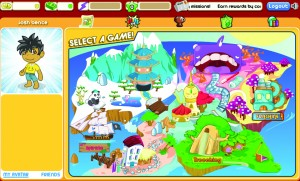
I’ve recently been playing a new math game called Sokikom (so-kee-kom). It’s an online social math game – yes “social” – for 1st through 6th graders.
So far I love it. The only bummer is that Daughter is only 21 months old, so a mouse to her either squeaks or is edible. But I did have some older kids in my family play – and they’ve all enjoyed it!
It currently has three games, Frachine, Treeching and Opirate, and various other perks and treats to help children with math. It’s officially launching next week and the folks at headquarters tell me there’s more to come – even after launch.
Here’s a little info to whet your whistle for it:
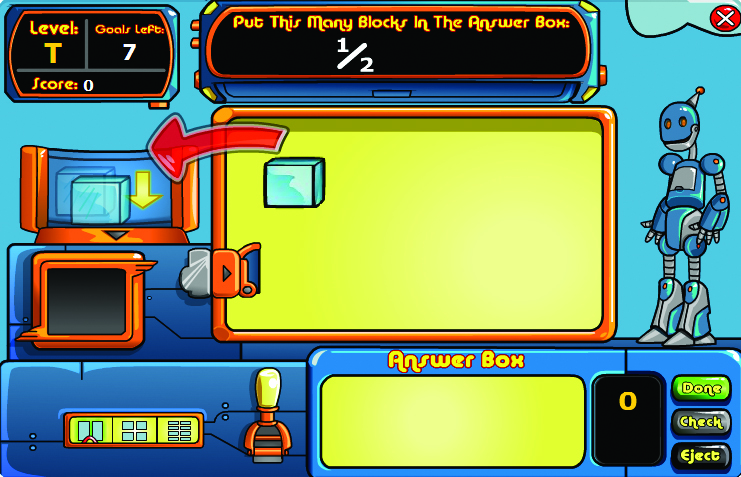
Frachine reinforces fractions.
The fun part of this fraction game is you get to cut the pieces up while you play. So it isn’t just showing parts of a whole, but the child actively makes the parts of the whole.
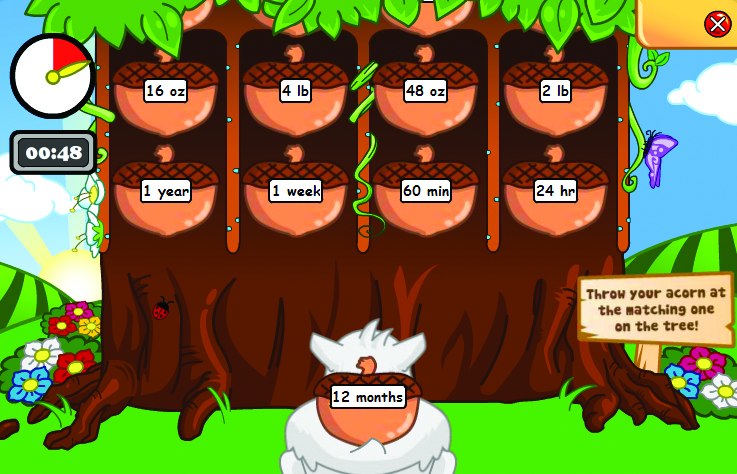
Treeching supports money, measurements, time, patterns and early algebra.
Sokikom is full of surprises. Sometimes the answer isn’t in the form you’re expecting. At first glance, this challenge puzzle seems all about mouse control. But notice there isn’t a matching “12 months” on the tree. Instead you have to convert. This is a great opportunity for teaching units!
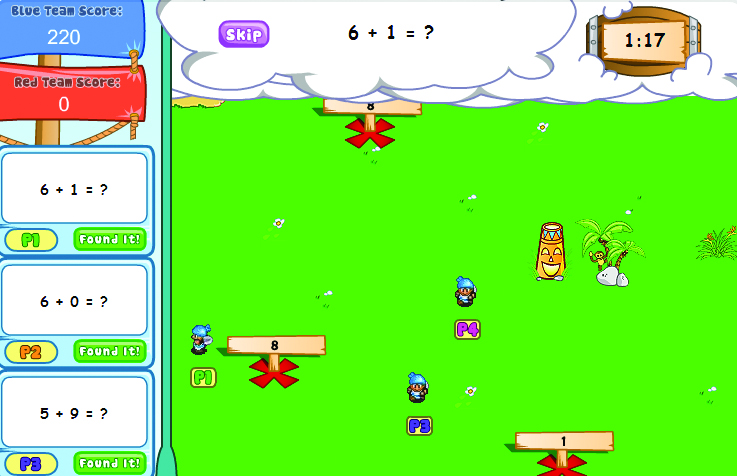
Opirate reinforces operations and early algebra.
This was my least favorite game of Sokikom – but only because my sister creamed me in it. (We used the online social part from our respective houses. Felt like being a kid again!)
Opirate is a bit of a thinking-through game. You have to do the problem (in the cloud at the top of the screen), then find the solution on the map, then get yourself to the solution. The “X marks the spot” numbers keep popping up – so every new problem has the old X’s that you had before (if you can remember where) as well as some new ones.
The Social Aspect
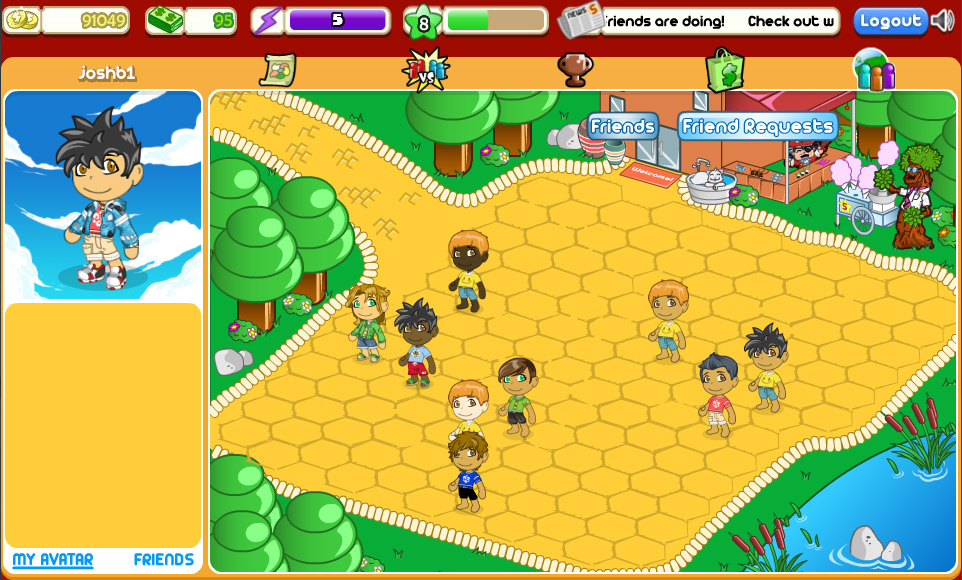
Your children can “friend” other kids with whom to play. I’m not a Farmville or World of Warcraft person, but I understand the appeal. Playing 20 minutes a night with an online friend keeps kids connected and at home, safe.
More Goodies for the Kids
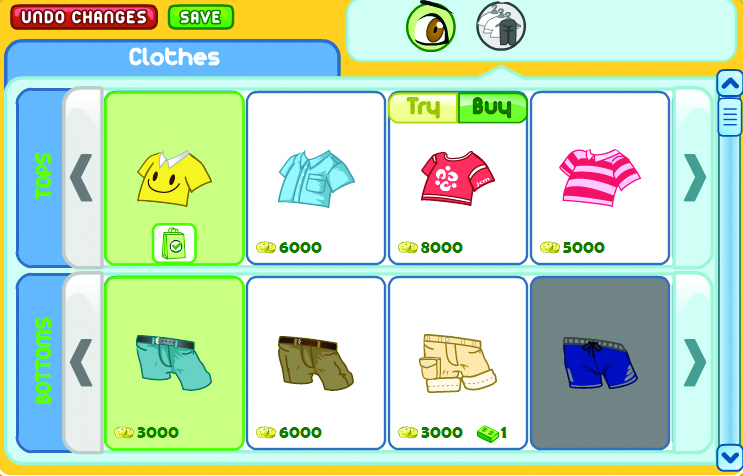
In Sokikom kids earn energy (which they need to play a game) and Soki-money. As they accomplish levels, they get awarded Soki-stars. The Soki-stars unlock clothing and accessories items they can “buy” with Soki-bucks to personalize their avatar – a popular element of any social game.
For parents and teachers
Parents typically read to children before bed. Sokikom is a way for parents to encourage a little bedtime math: do some Sokikom math for 10 minutes and read for 10 minutes.
And since many households have multiple computers, you can play online with your child – even sitting next to him or her. What a great bedtime routine!
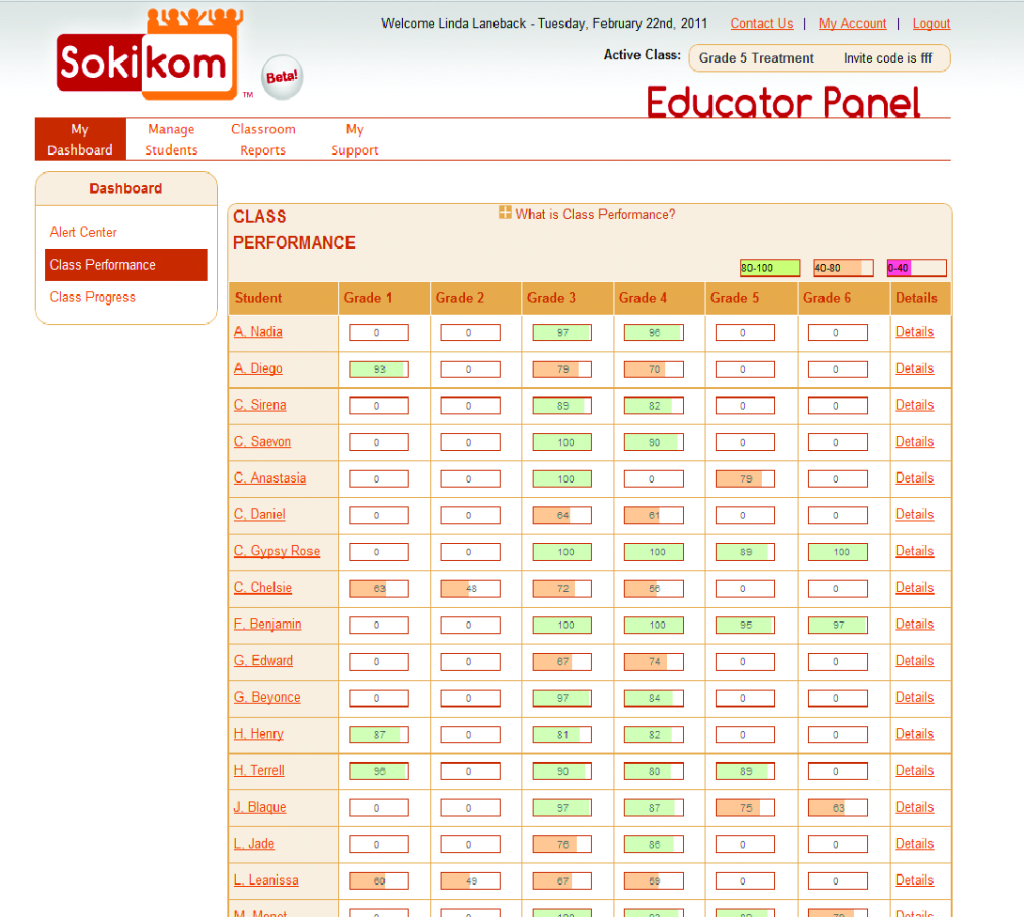
Sokikom also has a robust infrastructure to track and manage the progress of each child:
Are you ready for it?
Sokikom has won numerous awards and is funded by the US Department of Education. From their literature:
Sokikom is focused on five core tenets: provide social learning where kids help kids learn math; adapt to individual students’ needs and learning styles; encourage positive and safe competitive game-play, which leads to measurable improvements; and connect school and home to allow for continuous web-based learning.
I’ve seen these in action with this game. I’m a hands-on kind of mom and teacher, and I’m very much into attaching math to anything we can. If your kids lean toward video games, Sokikom‘s a great one to use!