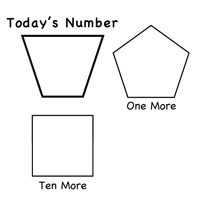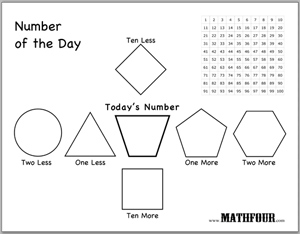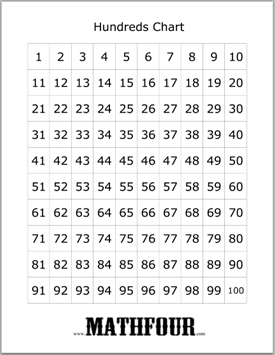
I started using a verbal version of this with K8 this week. She has a hundreds chart on her wall (she calls it her “present” because I gave it to her as a random gift one day) but I wanted one to write on too.
Why a Number of the Day?
Numeracy, or quantitative literacy, includes having a sense of how numbers work. Specifically in our base 10 system.
Every number can be related to a multiple of 5 or 10 by counting 1 or 2 up or down. Getting a good handle on how that works is essential in building your child’s numeracy.
The Number of the Day Worksheet helps children practice how the system works. And the hundreds chart helps them see it graphically — by tens.
Pick a Number of the Day everyday.
Create a hundreds chart for your wall, or download this printable one. Each day, let your child pick a number.
Talk about the number — what does it look like, what does it mean? And what other numbers around it “match”?
That last question was inspired by K8. She noticed that 84 on the hundreds chart matched the numbers to the right and left of it — the “8” was the same. Numeracy… here we come!
Fill out the Worksheet
Even if your child is too young to write, fill out the Number of the Day Worksheet and put it on the fridge. Practice filling in the spots, or talking about them. Let him or her color it or write on it.
Got stickers? Decorate the sheet!
I made the spaces in various shapes (notice the pattern?). I’m not sure if different shapes was a great idea, but it seemed fun. It might be a way to engage your older kids in the activity.
Now… Play!
Print out the worksheet and the hundreds chart and get your family going. At breakfast each day, choose a number — have each kid pick their own if you want.
Enjoy it and let me know how it goes in the comments or on twitter/x.

Can we apply the tactics of literacy improvement campaigns to numeracy improvement?
It sure would be nice!
Last week at the Western Social Science Association conference, I presented this question along with some possible answers.
This is the first in a series explaining how that may work. Here is the proposed series:
Introduction and Definitions (this one)
How Numeracy & Literacy are Similar
How Numeracy & Literacy are Different
Tactics of Literacy Improvement Models
Modification Ideas & Needs for Numeracy Improvement
The first step to formulating a plan to apply literacy improvement models to numeracy improvement is to define them.
The Definition of Literacy
James Paul Gee spent some considerable time, in a paper titled What is Literacy?, discussing and formulating a definition of literacy.
Many definitions include reading and writing. Some definitions include thinking critically.
Various definitions extend the definition to include cultural norms, technology and interpreting various multimedia forms of communication.
Under these extremely expanded definitions of literacy there is a much greater number of “illiterate” people that those normally labeled (either self-labeled or otherwise) as illiterate.
Because of this, I will keep my definition of literacy tightly defined as:
Literacy is the ability to decode written text and verbal statements, comprehend the literal meaning of them and speculate on the writer’s or speaker’s meaning.
Speculating on the writer’s or speaker’s meaning includes the comprehension of various forms of metaphorical devices. I have included this in my definition since metaphorical devices are ubiquitous.
Note that literacy, in this definition, much be of a certain language.
The Definition of Numeracy
Numeracy is a much less familiar word, but has no less variation in definition. Definitions can encompass: number sense, arithmetic, mathematical manipulation techniques, data analysis, measurement, geometry, probability, statistics, the ability to solve spacial and quantitative problems and the ability to interpret and understand graphs, diagrams, charts and tables.
Because of this seemingly exhaustive list, I will keep my definition to this:
Numeracy is the ability to collect, organize and interpret information and arrive at numerical or numerically supported conclusions.
This definition, because of the numerical requirement of conclusions, assumes the information being collected, organized and interpreted is of a numerical nature.
Thus the definition includes the requirement of a person to be able to “read math.”
A slight clarification of the definitions.
Both of my definitions include the assumption that the abilities don’t have to be demonstrated “out loud.” A person can have a “gut feeling” of the content of a written metaphor without the ability to articulate it.
Likewise, a person can, within moments, collect, organize and interpret the information of a pack of hungry lions rushing toward him and come to the conclusion of “RUN!” – a decision numerically supported by the number of attackers and the probability that he’s not going to win that fight.
Next…
Share your thoughts and your definitions in the comments. And shout it out on twitter.
Oh – and stay tuned for the next in the series, How Numeracy & Literacy are Similar.
Disclaimer – this was originally drafted as a Paper (capital P) so that’s why some parts might look a whole lot less like my normal writing. Please excuse this.
I’m doing research for a paper that I’ll be presenting in two days at the Western Social Science Association
conference. Here’s the outline:
What is literacy?
What is numeracy?
The Similarities between Numeracy and Literacy
The Differences between Numeracy and Literacy
Some Models for Literacy Improvement
How These Literacy Improvement Models Might be Modified for Numeracy Improvement
In attacking the first two questions, I’ve come across a paper titled What is Literacy? by James Paul Gee. Amazingly, the definitions he gives to primary discourse (or use of language), secondary discourse and meta-discourse are all applicable to math literacy/numeracy.
Primary use of language is “casual” discourse.
Primary use of language is the acquired communication tools we use among our “intimates.” This means it’s the way we talk, write or otherwise communicate with family members, close friends or others who are part of our personally identified social group.
Secondary use of language is more formal and used with anyone.
Secondary discourse is the acquired communication tools we use with anyone. This includes our close friends or family – sometimes.
But mostly this is the way we talk in (or write for) “polite company,” as my mother would say.
Meta-discourse is the study of the discourses.
Freaky, I know. But meta-anything is freaky once you think about it.
In particular, meta-discourse is the study of grammar and syntax as well as literary analysis and other English-class-goodies like that.
Where you put the commas and if you use “I” or “me,” are both bits that you’d find in meta-discourse.
How does this compare to numeracy?
Consider what primary, secondary and meta uses of mathematics might look like.
Primary use of math is the stuff you do everyday. The subtraction that you do without thought in order to know what time to set your alarm clock.
A secondary, or more formal used of math might be borrowing money from a bank. It could also look like the calculation of gas mileage.
Secondary use of math involves a more conscious effort to do “math things” – like annual percentage rate for a loan or division of miles driven by gallons used.
And meta-math is the formal stuff.
So then math that is taught (like in school) is the equivalent of meta-discourse. It is the study of the formalizations of arithmetic and logic that we use.
Often people term primary and secondary uses of math as “mathematics” while labeling meta-discourse in math as “Mathematics” – with the capital M.
You say tomato and I say, well… you know.
Literacy is acquired, not taught.
Yup – here’s the quote (and I love this):
Literacy is mastered through acquisition, not learning… it requires exposure to models in natural meaningful, and functional settings…
So we “teach” reading, but it’s really a matter of hurrying along the process of acquisition.
It’s likely that children are already well on their way to acquisition of language (or literacy) by the time they’re in school. Many parents read to their children very early – and continue to do so well into school aged years.
This is a display of discourse or use of the language. And it supports the child’s acquisition of the language.
Isn’t numeracy also acquired?
I certainly didn’t teach K8 perpendicular distance at 2 years old, and yet she knows enough about it to apply it at an Easter egg hunt!
Through experience, she’s acquired that primary use of math.
And just watch when a toddler does “division” using a box of three dolls when she sees four kids. You don’t want to be in that room!
This is also a “skill” acquired through experience and observation.
So why isn’t the acquisition of numeracy encouraged?
Math learning – at least in the primary and secondary uses – is happening automatically. But why don’t we notice and celebrate it?
Sure, we teach our kids to count and make sure they know their shapes. But then we stop.
We wait to start math-talk until children are sitting in their chairs, hair combed, hands washed, ready for class. We send the message that math isn’t done unless you’re in math class or at the kitchen table with pencil, paper and book.
We shove meta-math at them after making them think that they’ve never experienced the primary or secondary use of math.