Tag: arithmetic

  • Long Division with Sumology Number Tiles

    Long Division with Sumology Number Tiles

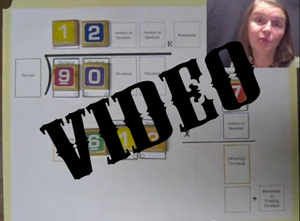
    A few articles back, I published a video called Long Division with Playing Cards.  I did it super-fast in response to a comment at  Living Math Forum.

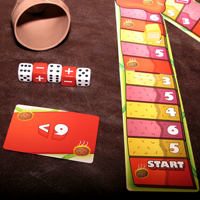
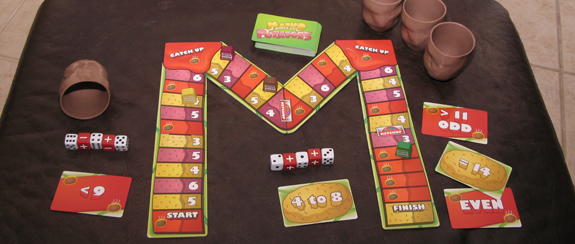
    I’ve pondered this a bunch since then and decided I like the idea, but the playing cards are too cumbersome. I ran across a game called Sumology (from Simply Fun) at the Texas Home School Coalition Convention. The heavens parted and angels sang.

    Or at least my heart started beating and my head started spinning.

    So here’s the same teaching method, but with a little more pizzazz and a couple of free downloads:

    What do you think? Will your child like it? Please share your thoughts in the comments.

    Related articles
  • Long Division with Playing Cards

    Long Division with Playing Cards

    I have since shot another video showing this with number tiles instead of playing cards.

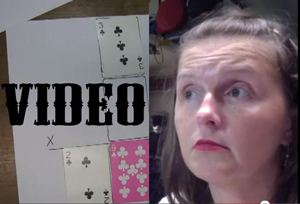
    In response to a post on the Living Math Forum, here’s a way to teach long division with playing cards.

    Whatcha think? Will it work? Let me know if it does!

    Related articles
  • The Order of Operations Explained: Exponents, Multiplication and Addition

    The Order of Operations Explained: Exponents, Multiplication and Addition

    This is the 4th in the series The Order of Operations Explained. For the other articles in this series, click here to visit the introduction.

    The Order of Operations can be boiled down into three “real” operations.

    Parenthesis are merely a way to group things – they aren’t a real operation. So they doesn’t count as a real operation.

    Since division is really just multiplication turned upside down, we don’t need to include it separately, either. Likewise, subtraction is addition on its ear. So we throw him out, too.

    Now we have only three: exponents, multiplication and addition.

    Exponents are the shortcut for multiplication.

    In a previous article about remembering exponent rules, I recorded this video about exponents:

    You see that 3 x 3 x 3 x 3 is 34. The exponent is the shortcut for multiplication.

    Multiplication is the shortcut for addition.

    Likewise, when we get overwhelmed with adding up the same numbers over and over, like in the video, 4 + 4 + 4 + 4 + 4, we can use multiplication to shortcut it: 5 x 4.

    Follow the shortcut evolution.

    The shortcut evolution is like this

    1. Addition came first.
    2. Then we created multiplication to make addition easier.
    3. Then we created exponents to make multiplication easier.

    So when you do arithmetic, we should do the “recent” shortcuts first (exponents) and then the “older” shortcuts (multiplication) and then the “regular” arithmetic (addition). Remember that subtraction is addition and division is multiplication.

    And keep in mind that we need to watch the grouping or anything isolated with parenthesis, absolute value bars or in a fraction. The grouping/isolation tools always trump the other operation rules.

    What if your answer isn’t the same as the back of the book?

    Some textbooks actually have multiplication done before division. This means that the problem 9 ÷ 3 x 2 will show a different answer (3/2) in that textbook’s solution pages than what you would get following the OoO I’m describing here (6). These texts are rare, but I’ve seen them. So keep your eyes peeled.

    The Order of Operations is a set of rules that we’ve agreed on. Which means that as long as a textbook clearly defines their order that they will follow, they can do things like this.

    If you get confused as to which to do first, demand parenthesis. (Yes, you can do that.) Or put parenthesis into your child’s textbook to help them out.

    The problem sets should be there to enforce, not confuse.

    What do you think? Does this help or hinder the way you’ve always viewed the Order of Operations? Share your thoughts in the comments.

    Related articles

  • The Order of Operations Explained: Exponents

    The Order of Operations Explained: Exponents

    This is the 3rd in the series The Order of Operations Explained. For the other articles in this series, click here to visit the introduction.

    Exponents are the second in the list for the Order of Operations (OoO).

    When we want to find the result of 32 x (2 + 7), we have no problem. We know to do parenthesis and then exponents, then multiplication.

    When you teach algebra, you’ll have to teach some distributing of exponents. But that’s still okay. And the rules of exponents are pretty straight up.

    So why a whole article on exponents?

    In the order of operations, the “Exponents” rule represents a bunch more than just superscripts or tiny numbers flying up and to the right of things.

    Roots are exponents, too!

    Tree Roots by Linda Allardice

    Not the ones from trees, but things like square roots and cube roots. Consider 9+2\sqrt9 + 2. You do the square root first because it qualified as an “exponent.”

    But if you had 9+2\sqrt{9+2}, the 9 + 2 is under the radical sign (the square root sign) so it’s bound together in the “Parenthesis” rule.

    This one isn’t that hard with arithmetic, but when you come to algebra and start “undoing” these things – it’s important to remember that roots fall into this category.

    Fractional exponents are exponents.

    This one seems pretty “duh” so it’s easy to see how they fall into the “E” of the order of operations. But what are fractional exponents really?

    912 means 99^\frac{1}{2} \text{ means }\sqrt9

    So fractional exponents are the same as roots.

    Note that some fractional exponents are roots and “plain” exponents all mixed up. Like this one:

    2723 means 2723 as well as (273)2.27^\frac{2}{3} \text{ means } \sqrt[3]{27^2} \text{ as well as } (\sqrt[3]{27})^2.

    This is a big fat full concept that needs a little more explaining. I’ll write more on these in another article.

    Logs fall under the E.

    Axe In Stump by caroline steinhauer

    As my algebra and computer math teacher in high school, Mrs. Kelley, used to tell us – logarithms are exponents. It took me a long time to figure out what the heck she meant. But when I did, I thought it was brilliant.

    This is a true statement: log39=2\log_3 9 = 2. Let’s analyze it.

    Based on the definition of logarithms, this means that 32 = 9. Which we know is true.

    Notice who the exponent is in this: 32 = 9: 2 is the exponent. And 2 is the same as log39\log_3 9 because the equals sign in log39=2\log_3 9 = 2 means “is the same as.” So the logarithm log39\log_3 9 is the exponent 2.

    Still with me? Either way, it’s okay. It’s a weird concept that I can go into detail in a video soon.

    The thing to remember here is that logarithms fall into the “Exponents” rule of the order of operations.

    So if you have log39+7\log_3 9 + 7, you have to do the log39\log_3 9 first and then add the 7 after.

    Want more on exponents?

    In the meantime, you can check out more than everything you always wanted to know about exponents on the Wikipedia Exponents page. Rebecca Zook created a great video on logarithms. And check out this explanation and problems to work on fractional exponents.

    And let me know what you think. Did I miss something?

    Related articles
  • The Order of Operations Explained: Parenthesis

    The Order of Operations Explained: Parenthesis

    This is the 2nd in the series The Order of Operations Explained. For the other articles in this series, click here to visit the introduction.

    I mentioned in the introductory article for this series that “the order of operations isn’t best practice for expressions involving variables.”

    When you involve a variable, you can’t just “do” the arithmetic. Like in the case of 2(3x + 4)=11. You can’t add 3x and 4 to get a result before moving on. You have to use the distributive property.

    And even the distributive property won’t work sometimes – as in the case of absolute values shown below.

    Parenthesis mean isolation.

    When we say “parenthesis” in the Order of Operations (OoO for short), we mean anything that’s grouped together and isolated. This could mean with actual parenthesis. This could mean [square brackets] or {curly brackets}.

    Although grownups seem to know that square and curly brackets are the equivalent of parenthesis, children don’t. This has to be said out loud.

    “Parenthesis” in the OoO can also mean |absolute value bars|. This one’s not so clear.

    When you try to solve the equation 4|2x+3|=20, you have to start with dividing by 4 to isolate the absolute value chunk. There’s not a “rule” for distributing the 4.

    (Although, it would be worth it, and fun, to see if your children can come up with some rules for distributing within absolute value bars. This would be some real mathematics at work for them – experimenting and discovering.)

    Tops and bottoms of fractions are implied parenthesis.

    It’s also the case that the numerator (top) and denominator (bottom) of a fraction are isolated places. These fall under the OoO as parenthesis.

    Check out this older video I did. It shows how this works with fractions:

    Parenthesis are for deviation from the other rules.

    David Chandler of Math without Borders commented this in the previous article of this series:

    The rule is to do higher level operations first. Use parentheses whenever your intention is to deviate from this rule.

    If you can focus on this instead of a mnemonic device, you can get students to internalize what’s going on with the OoO. It’s important, however, to make sure they remember about other bracket shapes as well as isolation.

    Let us know your tips and thoughts on the P in PEMDAS!

    Related articles

  • The Order of Operations Explained: Intro and Mnemonics

    The Order of Operations Explained: Intro and Mnemonics

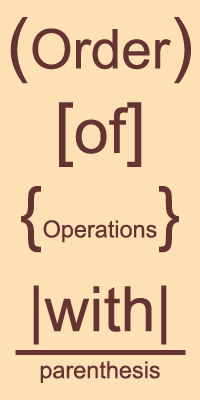
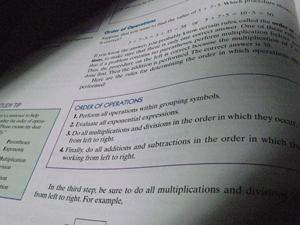
    The Order of Operations (OoO for short) is used everywhere in mathematics because it encompasses many of the foundational rules that we’ve agreed to follow.

    Alas, students have been given the cheap and dirty version of it for years. “Here, memorize this thing about your Dear Aunt Sally!” What the heck?!

    There are subtleties in the Order of Operations that every person over the age of seven should know.

    The series begins today.

    The order of operations is a set of rules – like the drivers’ handbook for math. If everyone follows the rules, we’ll all be safe. But if someone makes a bad turn, we could be looking at a crash.

    But the Order of Operations is only a set of rules for arithmetic! It isn’t even the best practice when it comes to expressions involving a variable like x. I’ll cover what I mean in this weekly series.

    Here are the proposed articles:

    1. Intro and mnemonics
    2. Parenthesis
    3. Exponents
    4. Exponents, Multiplication and Addition
    5. Multiplication and Division
    6. Addition, Subtraction and Conclusions
    7. Exponents of Negative Numbers
    8. Another Reason to Ban PEMDAS (aka parenthesis aren’t an operation)

    Mnemonics for PEMDAS

    Well, there’s one: PEMDAS (pronounced just like it looks). That’s what the cool kids in high school always said. It was the same kids who said “soh-cah-toa” – which I thought sounded really goofy.

    And then there’s “Please Excuse My Dear Aunt Sally.” And of course “Piranhas Eat Mostly Decayed Antelope Skin.”

    What’s your way to remember it?

  • Practicing Math Skills Early in Life Is a Brain Changing Event

    Practicing Math Skills Early in Life Is a Brain Changing Event

    Thanks to Will Summer who inspired this post with a retweet to me.

    Seems researchers have previously studied the differences in math skills among children vs. adolescents and grownups. Dr. Vinod Menon with has done new research on early math training that focused on kiddos who where merely one year apart.

    Turns out that in one year of math, the brain changes quite significantly!

    You can integrate early math learning into just about anything.

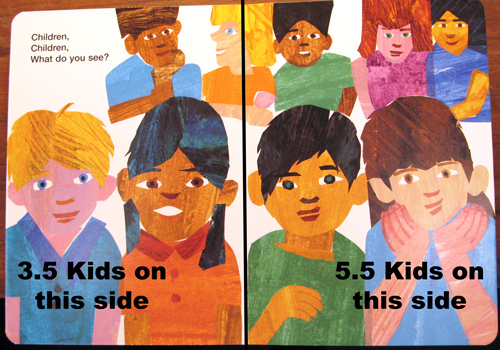
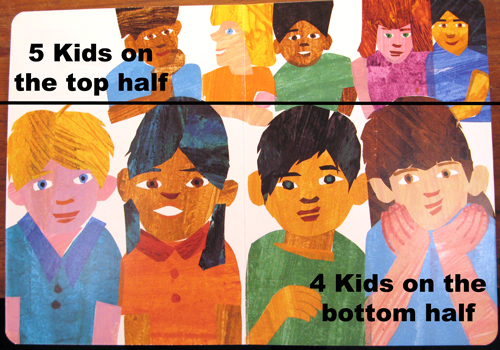
    Daughter is heavy into Brown Bear, Brown Bear by Bill Martin, Jr. and Eric Carle. This is not a math book. Nor does it pretend to be. But I’ve found a way to use it to develop math skills.

    When we arrive at the page with the children, we practice counting the kids. First in one direction, then in the other – as direction matters to kids. It isn’t inherent that if you count one way you’ll get the same number as if you count the other way.

    Sometimes we’ll count the top row of children and add it to the number of the bottom row. We can practice the commutative property by adding 5 + 4 = 9 and the adding 4 + 5 = 9.

    As an alternative twist, we’ll count and add the kids on the left page to the kids on the right page. This one gets fun, because that little blond girl is half and half!

    So we can now add fractions and practice the commutative property at the same time!

    What else?

    With Dr. Menon’s research, we now know how important it is to get started early with math learning. What other things can you do to start teaching math skills early?

    Related articles
  • How Calculators Inhibit Learning the Distributive Property in Algebra

    How Calculators Inhibit Learning the Distributive Property in Algebra

    Do you wonder if your children should be using a calculator “at their age”? Are you a fan of calculators, but have friends who aren’t? Are your friends “into” calculators while you oppose them?

    I often hear people say that children 50 years ago understood math concepts more quickly. Although our parents weren’t taking classes called algebra in the 7th grade, they were doing algebra in the 7th grade.

    Algebra is arithmetic.

    There are two fundamental and rarely understood facts about algebra:

    1. Algebra is arithmetic with one or more numbers in disguise.
    2. Algebra has exactly the same  rules as arithmetic.

    Which means if you can do arithmetic you already know how to do algebra!

    Our parents or grandparents, 50 or even 30 years ago, weren’t using calculators. They had to apply all the rules of arithmetic to get the job done. Which means that they had to apply all the rules of algebra.

    Teaching them a class called “Algebra” was much easier because of this.

    What are the rules?

    The basic rules that non-calculator users must apply are the distributive property and the order of operations. The distributive property is the thing that calculator use eliminates.

    Children could get practice mentally multiplying things like 3 x 86 and do 3(80+6) = 240+18=268. With this practice, they are ready for 4x(3y+2z) = 12xy+8xz.

    If they never have to multiply 3 x 86 in their head, they never get the experience of the distributive property. Which means teaching them 4x(3y+2z) = 12xy+8xz will cause anxiety and frustration. They see it as “magic” or “something you made up just to confuse me.”

    Give them the tools they need.

    Refuse to let students have the calculator. Let them have the tool of the distributive property for algebra before you teach them “Algebra”. Give them the benefit our parents and grandparents had!

    Related articles
  • How to Use Flashcards when Teaching Math

    How to Use Flashcards when Teaching Math

    Siggi over at Turkeydoodles wrote a post about her preference of calculators over flashcards. It’s her preference, but her arguments seem to be founded on the misuse of of flashcards. Furthermore, it seems she’s not seen the detrimental effects of early calculator use, yet.

    When you should give a kid a calculator is a topic for another article. In the meantime, here are some tips on good flash card usage.

    Flashcards are educational toys.

    Flashcards shouldn’t be used as testing devices. They’re educational toys. They’re exploratory devices. Let them “peek” as much as they want.

    As a first introduction, use them to build houses of cards. They should be fun and comfortable.

    They are limited in scope.

    The 6 x 8 = 48 card will never be able to give the cosine of 60 degrees. This makes the flashcards so beautiful. Once you understand what happens when you create a calculator addict, and see how that works as the kid enters college, you’ll know how important this limitation is.

    Encourage variation to limit boredom.

    I distinctly remember using flashcards in my dining room, sitting next to the sliding glass door. I was reading them. But because they would get boring, I would chant them. It became sing-songy and fun. I could go through them quickly this way.

    And I looked forward to the ones that rhymed.

    Let the flashcards be rejected.

    If a kid really hates them, let it go. There are other ways to get that information across. Schoolhouse Rock’s Multiplication Rock is a fabulous tool for this.

    And you can sing or chant multiplication facts yourself. My mother learned the most common prepositions by saying them as she jumped rope. You can vary some skip counting with jumping rope to learn multiplication facts:

    • 3 x 1 = 3
    • 3 x 2 = 6
    • 3 x 3 = 9
    • and so on…

    Allow the flashcards to be the context in and of itself.

    It is not necessary that math be learned in context. So many people keep pushing this. Sometimes it’s just fun to know random stuff – including some quick and nifty facts.

    Don’t push math for math’s sake, but offer it. There are kids, lots of them, who just like to do puzzles. Plain math – arithmetic and facts – is a great puzzler.

    What do you think? Is this a better use of flashcards than the ones you’ve seen? Share your thoughts in the comments.