Tag: area

  • Improve Math Learning With Rubik’s Cube Art!

    Improve Math Learning With Rubik’s Cube Art!

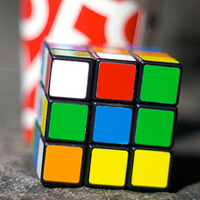
    I stumbled upon the Paul Smith Gallery in Las Vegas a couple of weeks ago and was completely drawn by the Rubikcubism art by Invader on the wall.

    It was a pixelated image that looked interesting from afar, but when you got close, there was a whole new surprise. It was made from 225 Rubik’s Cubes!

    I spent a good 30 minutes in the shop talking to David, the Paul Smith associate. So many questions came up, including:

    • How can you make an image with only six colors? (Rubik’s cube has six sides, thus only six colors.)
    • The price tag on the artwork was $22,000, how much money was spent in actual Rubik’s cubes?
    • Could I do something like this?
    • If I were to replicate it, could you tell the difference between the original and the fake?
    • What kind of math is involved in creating something like this?

    Can your kids do it?

    It might be fun. It could get expensive, though: at $10 a pop, and after sales tax, 225 Rubik’s Cubes come to about $2500.

    I don’t have this kind of money to drop on cubes, and I’m guessing that most homeschoolers don’t either. But for only $10 and the technology you already have around the house, you can let your child be a Rubikcubist!

    They sure can!

    If your children are inclined to give this a shot, buy them each a Rubik’s cube. Let them explore the number of sides, and the number of “pixels” on each side. If they don’t already know about how colors work together, they can either research or learn through experimentation.

    They can choose to use graph paper & colored pencils, Microsoft Excel, or a paintbrush program to map out what they want their image to look like.

    As they twist the Rubik’s Cube into each pattern, take a photo of it, or a color scan. Print it at full size and let them use the prints to create the final artwork.

    Making Rubikcubist artwork is math!

    Throughout the projects, explore the concepts of area and patterns. Also encourage them to think about color theory (of which I know squat, but your kids will be learning as they experiment).

    Questions to ask:

    • How many total “pixels” did you use?
    • How many total Rubik’s Cubes did you use?
    • If you were to make this “for real,” how much would it cost us in Rubik’s Cubes?
    • What else did you notice about the project regarding colors, patterns and area?

    Solving a Rubik’s Cube is math, too.

    By the way, the solution to a Rubik’s cube is mathematical. It’s actually part of mathematics called group theory. My office mate in grad school was able to solve a Rubik’s cube in about 20 minutes.

    I was never able to figure it out.

    Share your art!

    Put your child’s final artwork on Flickr.com or other photo service and post a link to it in the comments.

    Feature image is by Robin Iversen Rönnlund on Flickr.com, CC BY.

    Related articles
  • Perimeter and Area of Mommy’s Necklace

    Perimeter and Area of Mommy’s Necklace

    Written as part of the Count 10, Read 10 series.

    I noticed Daughter attempting to bejewel Husband with a strand of my faux pearls the other day. I watched, enthralled with the math learning taking place.

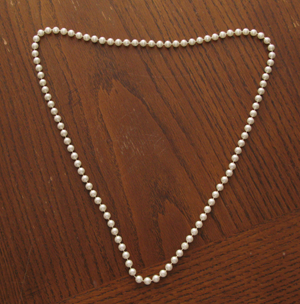
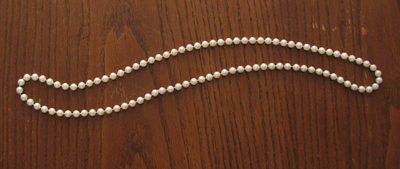
    She held the necklace in her hands – one on each side. Just about equal. So the space available for Husband’s head was almost non-existent. Like this:

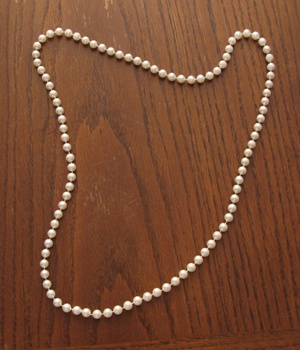
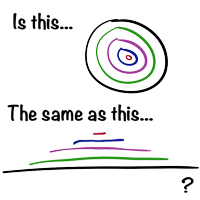
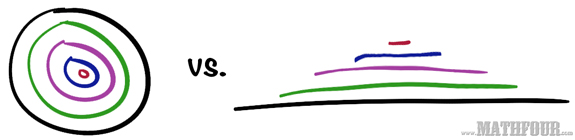
    If she were to hold the necklace at two points that were closer together, she would create a “dip” in the necklace where his head could fit. Like this:

    There’s an extended learning opportunity here!

    This made me think of all the nifty things you can show about the relationship of perimeter to area and how you can have the same perimeter but change the area to all sorts of sizes.

    If you aren’t wearing a necklace, find some mardi-gras beads. Daughter has many strands, so I’m guessing your house might be littered with them as well. If not, join the club. Go buy some.

    Play with them in the bathtub or right before bed. (Make sure they give them up before going to sleep, though – it’s a strangulation hazard!)

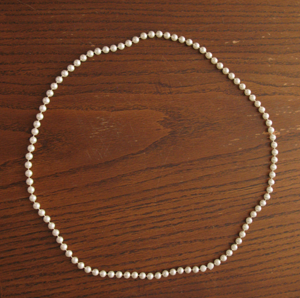
    Move the necklace around on a flat surface (or on the bed) and let your child experiment with the ways the area changes. Ask questions like:

    • How much “stuff” can you fit inside the shape? (If there are blocks or other toys to act as “stuff,” use them.)
    • How much “stuff” can you fit inside the shape after you move it around?
    • Is that more or less “stuff” than you could fit inside it before?
    • Did the distance around the necklace change? (You can introduce the words perimeter and circumference.)
    • Can you make it into a square? A triangle?

    Be careful how much you do.

    Don’t forget, activities like this should be fun. For your child as well as you. So don’t get too in depth talking the math talk if it feels weird. Go with the flow.

    And let me know how that flow goes, would you? Share your thoughts in the comments.

    Related articles