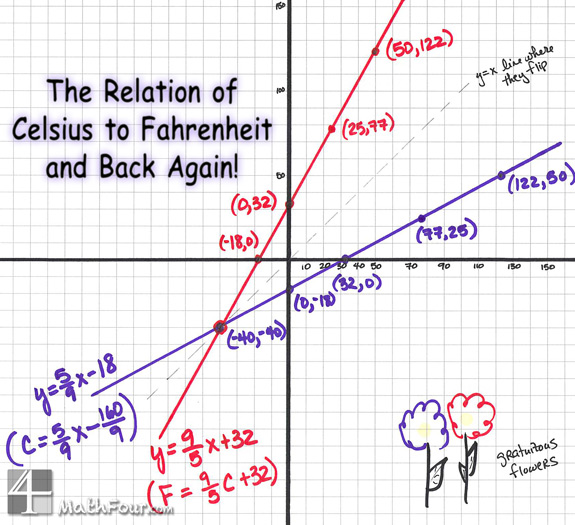
It inspired me to draw the graphs of Celsius in terms of Fahrenheit and Fahrenheit in terms of Celsius.
The conversion from Celsius to Fahrenheit and back again can be strange. One way to understand it is on a graph. And you can use this to teach some linear algebra too!
Notice these two intersect at (-40, -40). Which means that -40°F is -40°C!
Use it to convert temperatures.
The x values on the red line are Celsius – so find the °C you have and then look at the y-value to convert to °F.
It’s just the opposite on the purple line.
Okay, fine. This isn’t the greatest way to convert – but it’s exciting to see it graphically. And it might be easier to convert this way for someone who’s more visual.
Use it to teach math!
These two lines are inverses of each other. So the coordinates of one are switched to make the other.
Also, they mirror image across that 45° line. I marked the line with dashes and wrote $latex y=x$ on it.
And if you’re into this, their functional composition (both ways) is… x! (not factorial)
Compare and Contrast…
Take a look at the way J.D.Roth did it and then look at the graphs I have. Let your students find the way they like the best. And encourage them to create new ways!
Oh, yeah – and share what happens in the comments!
I mailed out the bulk of the thank you notes for Daughter’s 2nd birthday party gifts. And wouldn’t you know it, it involved algebra!
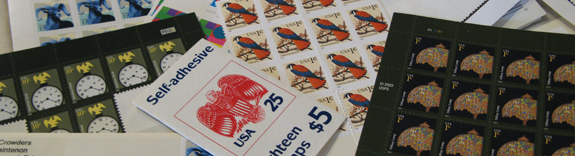
I have so many stamps from the last 20 years, in every denomination you can imagine. I’m trying to use them up because I only save full sheets of stamps. (I’m a bit of a stamp collecting snob.)
Rule #1: No more than the required postage on any letter.
It has to be exact.
As of this writing, postage in the US is $.44 per letter.
I have $.33 stamps, $.37 stamps, $.41 stamps, etc. And I’ve purchased $.01, $.02, $.03, and on up to supplement and make my postage exact.
Rule #2: No more than 2 stamps of the same kind on a letter.
I like variety.
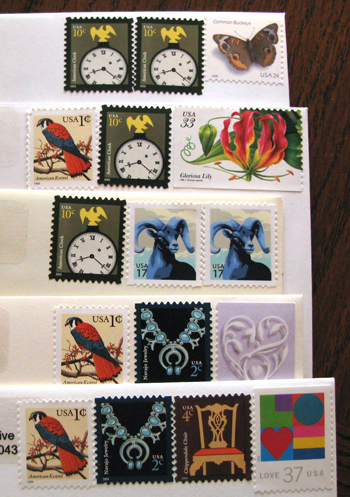
With these requirements, here are some of the combinations that I’ve come up with:
So how is this algebra?
Here is an algebra equation from the stamps in the picture:
10x + 17y = 44
The equation means x number of 10 cent stamps plus y number of 17 cent stamps will give me the exact total of 44 cents! So x=1 and y=2.
And here’s another:
10x + 24y = 44
The equation means x number of 10 cent stamps plus y number of 24 cent stamps will give me the exact total of 44 cents! So x=2 and y=1.
It would make it a better set of algebra problems if I allowed more than two types of stamps. But I’m sticking with my variety rule. 😀
How about it – will it make writing thank you notes with your kids more fun? More challenging? More annoying? Share your thoughts in the comments!
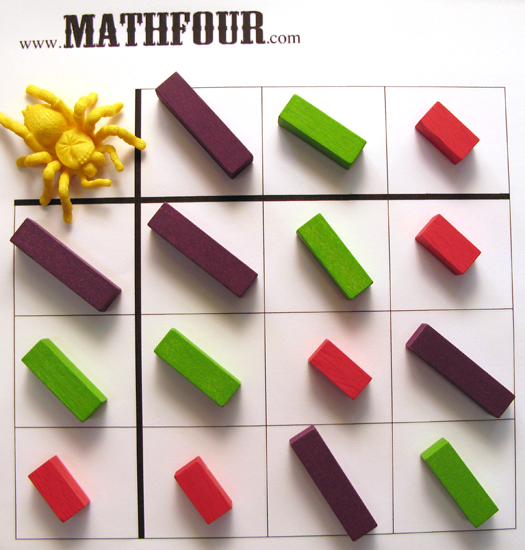
I’ve been itching to get into some basic abstract algebra goodies. With the help of the Cuisenaire Rods, Simply Fun Sumology number tiles and the Discovery Toys Busy Bugs, I’m able to do that.
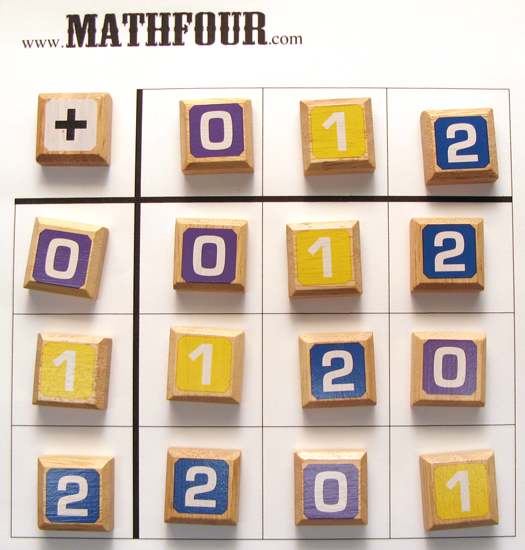
Start with wrap around addition.
This type of math is officially called “modular arithmetic.” We are only going to use the numbers 0, 1 and 2.
It begins as regular addition. And since we are only using those three numbers, all our answers have to be either 0, 1 or 2. So when we add 1+2, we wrap around.
If we were to count in our system, we’d say: “0, 1, 2, 0, 1, 2, 0, 1, 2, 0, 1, …”
The addition table looks like this:
(Notice you could do this with numbers from 1- 12 and it would be clock addition!)
Now things get buggy.
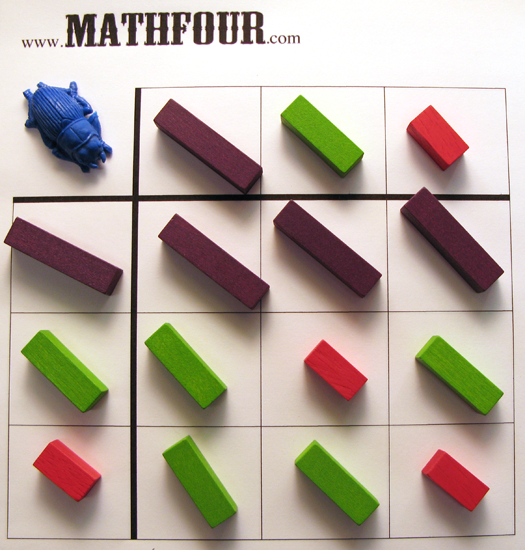
Switch out all the number tiles with some pretty color Cuisenaire Rods. They don’t have to be the “right” rods. We’re only looking at the colors. Here’s the progression I did:
The end result is a very abstract chart!
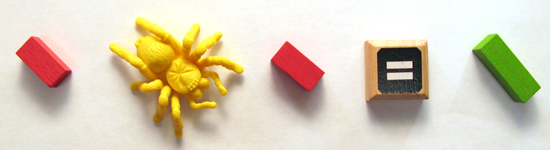
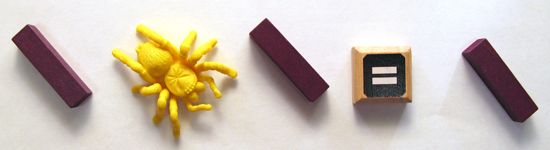
You can “bug” two things together.
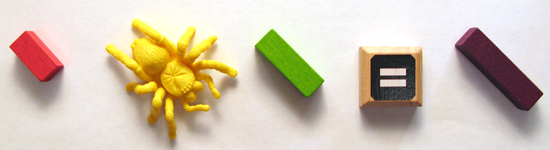
Like this:
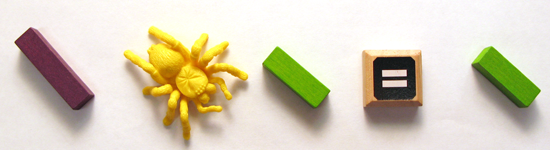
(I know – a spider isn’t a bug. But run with me on this, okay?)
Notice that each of these are directly from the “spider table” above.
You can read this as, “Purple spider green equals green,” just like you would say, “Zero plus one equals one.”
Last week’s article on the order of operations included a quick mention that division is the same as multiplication – but different. Now’s the time to explain that a bit.
The only thing mathematicians like to do more than create, is destroy. That’s how we get imaginary numbers, dividing by zero and raising things to infinity.
Once we create with multiplication, we want to know what happens when we destroy with the opposite of multiplication.
Enter Division, stage right.
Multiplication is created from the need to quickly add a bunch of numbers that are all the same. They each must be equal to make this work:
6 + 6 + 6 + 6 + 6 is shortcutted to 5 X 6.
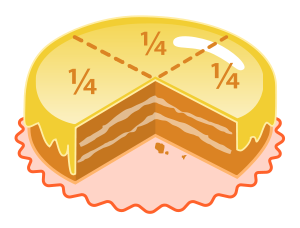
Division is the breaking up into pieces that are all equal.
Technically we can break 30 up into these 5 pieces: 4, 8, 7, 6 and 5. But “division” requires (or implies) that we are dividing equally. So 30 would have to be broken up into 5 equal pieces of 6 each.
Of course this is in a purely mathematical world. When you get into a toddler world, things will be different.
How division is the same as multiplication.
We represents multiplication with little x‘s or dots or stars. Like this:
3 X 5 or 3 • 5 or 3 * 5
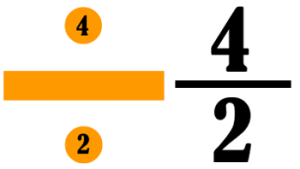
We represent division with this cute little symbol:
But we can write it in many more ways. Notice the cute symbol looks like a fraction with dots on the top and bottom. That’s not a coincidence. A fraction means division.
is the same as .
Remember the poem:
When dividing fractions Don’t bat an eye Just flip the last And multiply!
Well, you can change this to:
When dividing numbers Don’t bat an eye Just flip the last And multiply!
And “flipping” the last just means taking the “assumed 1” that’s underneath it and putting it on the top.
Now go forth and divide…
So when you’re teaching the MD in PEMDAS, the order of operations, remember that D is the same as M. And if things get a little confusing, demand some parenthesis before doing the problem.
The Order of Operations can be boiled down into three “real” operations.
Parenthesis are merely a way to group things – they aren’t a real operation. So they doesn’t count as a real operation.
Since division is really just multiplication turned upside down, we don’t need to include it separately, either. Likewise, subtraction is addition on its ear. So we throw him out, too.
Now we have only three: exponents, multiplication and addition.
You see that 3 x 3 x 3 x 3 is 34. The exponent is the shortcut for multiplication.
Multiplication is the shortcut for addition.
Likewise, when we get overwhelmed with adding up the same numbers over and over, like in the video, 4 + 4 + 4 + 4 + 4, we can use multiplication to shortcut it: 5 x 4.
Follow the shortcut evolution.
The shortcut evolution is like this
Addition came first.
Then we created multiplication to make addition easier.
Then we created exponents to make multiplication easier.
So when you do arithmetic, we should do the “recent” shortcuts first (exponents) and then the “older” shortcuts (multiplication) and then the “regular” arithmetic (addition). Remember that subtraction is addition and division is multiplication.
And keep in mind that we need to watch the grouping or anything isolated with parenthesis, absolute value bars or in a fraction. The grouping/isolation tools always trump the other operation rules.
What if your answer isn’t the same as the back of the book?
Some textbooks actually have multiplication done before division. This means that the problem 9 ÷ 3 x 2 will show a different answer (3/2) in that textbook’s solution pages than what you would get following the OoO I’m describing here (6). These texts are rare, but I’ve seen them. So keep your eyes peeled.
The Order of Operations is a set of rules that we’ve agreed on. Which means that as long as a textbook clearly defines their order that they will follow, they can do things like this.
If you get confused as to which to do first, demand parenthesis. (Yes, you can do that.) Or put parenthesis into your child’s textbook to help them out.
The problem sets should be there to enforce, not confuse.
What do you think? Does this help or hinder the way you’ve always viewed the Order of Operations? Share your thoughts in the comments.
Would you like to teach math everywhere you go? Well, here’s one from the table!
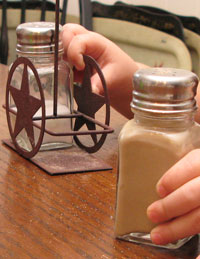
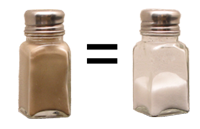
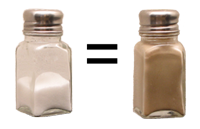
Daughter enjoys playing with our salt-and-pepper shaker holder at dinner. She takes out the salt, then takes out the pepper, then replaces the salt, then replaces the pepper.
The order in which she does these four operations vary. Including switching the salt and pepper.
She’s slowly putting together the pieces that will one day become the commutative property.
She’s also practicing substitution…
She’s learning that the salt and pepper can be switched (commutative). And she’s learning that one can be interchanged for the other (substitution).
…and the associative property!
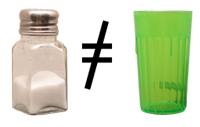
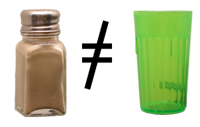
She attempted to put her small milk cup into the holder. It fit, but only with pushing. She then removed the milk cup and attempted to put it in the other side. (At her age the things grown-ups understand are not obvious to her.)
Although non-equality isn’t part of the associative property (which is if a=b, b=c then a=c), the comparison of three things is.
Here are the things she’s learning from this dinner session:
This fact she discovers from interchanging them in the holder.By putting them in the holder in a different order, she learns that the equality is commutative.Since the milk cup won’t fit into the spot the salt was just in, she learns this.And trying to shove the milk cup in the other side yields this fact.
So pull out the stops – give the children everything. And let them explore. If they have the gift of language, you can hint at some of these properties, but be careful not to go into a full “lesson” at dinner. Teaching math at the dinner table should be fun.
Where have you seen math properties in your world? Share your stories in the comments – or link back to your story on your blog!
In the order of operations, the “Exponents” rule represents a bunch more than just superscripts or tiny numbers flying up and to the right of things.
Roots are exponents, too!
Tree Roots by Linda Allardice
Not the ones from trees, but things like square roots and cube roots. Consider . You do the square root first because it qualified as an “exponent.”
But if you had , the 9 + 2 is under the radical sign (the square root sign) so it’s bound together in the “Parenthesis” rule.
This one isn’t that hard with arithmetic, but when you come to algebra and start “undoing” these things – it’s important to remember that roots fall into this category.
Fractional exponents are exponents.
This one seems pretty “duh” so it’s easy to see how they fall into the “E” of the order of operations. But what are fractional exponents really?
So fractional exponents are the same as roots.
Note that some fractional exponents are roots and “plain” exponents all mixed up. Like this one:
This is a big fat full concept that needs a little more explaining. I’ll write more on these in another article.
Logs fall under the E.
Axe In Stump by caroline steinhauer
As my algebra and computer math teacher in high school, Mrs. Kelley, used to tell us – logarithms are exponents. It took me a long time to figure out what the heck she meant. But when I did, I thought it was brilliant.
Notice who the exponent is in this: 32 = 9: 2 is the exponent. And 2 is the same as because the equals sign in means “is the same as.” So the logarithm is the exponent 2.
Still with me? Either way, it’s okay. It’s a weird concept that I can go into detail in a video soon.
The thing to remember here is that logarithms fall into the “Exponents” rule of the order of operations.
So if you have , you have to do the first and then add the 7 after.
Want more on exponents?
In the meantime, you can check out more than everything you always wanted to know about exponents on the Wikipedia Exponents page. Rebecca Zook created a great video on logarithms. And check out this explanation and problems to work on fractional exponents.
And let me know what you think. Did I miss something?
I mentioned in the introductory article for this series that “the order of operations isn’t best practice for expressions involving variables.”
When you involve a variable, you can’t just “do” the arithmetic. Like in the case of 2(3x + 4)=11. You can’t add 3x and 4 to get a result before moving on. You have to use the distributive property.
And even the distributive property won’t work sometimes – as in the case of absolute values shown below.
Parenthesis mean isolation.
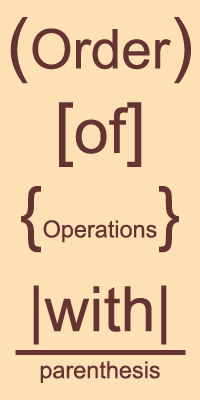
When we say “parenthesis” in the Order of Operations (OoO for short), we mean anything that’s grouped together and isolated. This could mean with actual parenthesis. This could mean [square brackets] or {curly brackets}.
Although grownups seem to know that square and curly brackets are the equivalent of parenthesis, children don’t. This has to be said out loud.
“Parenthesis” in the OoO can also mean |absolute value bars|. This one’s not so clear.
When you try to solve the equation 4|2x+3|=20, you have to start with dividing by 4 to isolate the absolute value chunk. There’s not a “rule” for distributing the 4.
(Although, it would be worth it, and fun, to see if your children can come up with some rules for distributing within absolute value bars. This would be some real mathematics at work for them – experimenting and discovering.)
Tops and bottoms of fractions are implied parenthesis.
It’s also the case that the numerator (top) and denominator (bottom) of a fraction are isolated places. These fall under the OoO as parenthesis.
Check out this older video I did. It shows how this works with fractions:
Parenthesis are for deviation from the other rules.
David Chandler of Math without Borders commented this in the previous article of this series:
The rule is to do higher level operations first. Use parentheses whenever your intention is to deviate from this rule.
If you can focus on this instead of a mnemonic device, you can get students to internalize what’s going on with the OoO. It’s important, however, to make sure they remember about other bracket shapes as well as isolation.
Let us know your tips and thoughts on the P in PEMDAS!
The Order of Operations (OoO for short) is used everywhere in mathematics because it encompasses many of the foundational rules that we’ve agreed to follow.
Alas, students have been given the cheap and dirty version of it for years. “Here, memorize this thing about your Dear Aunt Sally!” What the heck?!
There are subtleties in the Order of Operations that every person over the age of seven should know.
The series begins today.
The order of operations is a set of rules – like the drivers’ handbook for math. If everyone follows the rules, we’ll all be safe. But if someone makes a bad turn, we could be looking at a crash.
But the Order of Operations is only a set of rules for arithmetic! It isn’t even the best practice when it comes to expressions involving a variable like x. I’ll cover what I mean in this weekly series.
Here are the proposed articles:
Intro and mnemonics
Parenthesis
Exponents
Exponents, Multiplication and Addition
Multiplication and Division
Addition, Subtraction and Conclusions
Exponents of Negative Numbers
Another Reason to Ban PEMDAS (aka parenthesis aren’t an operation)
Mnemonics for PEMDAS
Well, there’s one: PEMDAS (pronounced just like it looks). That’s what the cool kids in high school always said. It was the same kids who said “soh-cah-toa” – which I thought sounded really goofy.
And then there’s “Please Excuse My Dear Aunt Sally.” And of course “Piranhas Eat Mostly Decayed Antelope Skin.”
Do you struggle explaining to your students what “simplify” means? Do you wonder why they won’t reduce fractions to their lowest terms?
Here’s how to explain and teach some of the top confusing terms in mathematics – without throwing you or your students into a tizzy!
Where
Really! “Where.”
As in “Where do the lines intersect?” or “Where is the highest point of the graph?”
“Where” in math almost always means “at what x-value?” Every now and then “where” can mean “at what point?” In the first case, “Where do the lines intersect?” can be just as easily satisfied by a point (x, y) as the x-value only.
When you get into calculus, the word “where” is used everywhere (pardon the pun). “Where is the slope of the tangent line equal to zero?” and “Where are there discontinuities?” among others.
Keep your eyes peeled in the textbooks for this tricky term.
Reduce
Typically this means to reduce to lowest terms. Which isn’t really helpful, since you still need the definition of “terms.”
Numerators and denominators (tops and bottoms of fractions) that have one or more common factors are not officially “reduced.” Once they have no common factors at all (except 1), they are said to be reduced or reduced to lowest terms.
A reduced fraction helps in many ways. You can “feel” the value more easily: 2/5 is a lot easier to picture than 14/35. Also, when you add fractions, starting out with all the numbers in their reduced form will often help to find common denominators.
Zeros, Real Zeros and Roots
Zeros, real zeros and roots all mean the same thing. It is where a graph passes through the x-axis. We can write “where are the zeros” meaning at what x-value (“where” from above) does the graph pass through the x-axis? We also will write “what are the zeros” and mean the same thing.
To find the zeros or roots, we set a function (or any equation solved for y that involves x) equal to zero. Then we solve for x. This will give the result that we want – the x-values where the graph will go through the x-axis.
We call them zeros because they are where y = 0. We call them real zeros because there can be complex or imaginary zeros that don’t exist on the graph.
Finding the zeros or roots of a function help when graphing it. If you know all the places it goes through the x-axis, you can then determine where it’s above or below the x-axis. Then you can roughly sketch the graph.
Simplify
Of all the terms in mathematics, this one is the most slippery. This meaning of this term is always in context to the book or situation. What it means is “manipulate the expression.” The end result may or may not be “simpler” than the starting expression.
Better textbooks use phrases that are clearer, like “multiply the polynomials” and “combine like terms.”
If “simplify” is the instruction to a problem set in a textbook, consult the examples to see what type of manipulation to do.
In later courses, students have to recognize when a situation requires a different form of the expression. Practicing various forms of manipulation (or “simplifying”) gives them tools to manipulate the expression to satisfy their needs.
Do you run into other terms in mathematics that are hard to explain to students? Hard to understand yourself? Share them in the comments!