Every parent is concerned that their children will not get what they need to be successful. Especially in math.
Instead of worrying, you can take action. And it’s not hard.
Use “big” math words.
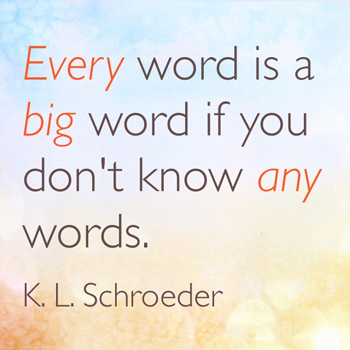
Don’t refrain from teaching your child math words just because they’re big or seem complicated to you.
This sentence, “May I have milk, please,” has five simple words. To a grown-up.
But to a child, a five word sentence is no different than a five syllable word. Like, “parallelogram.”
In fact, if you teach your child to count to 10, it’s the same as teaching your child an eleven syllable word. (Seven has two syllables.)
To put this in perspective, the word overintellectualization has only ten syllables!
O – ver – in – tel – lec – tu – a – li – za – tion
One – two – three – four – five – six – seven – eight – nine – ten
In fact, overintellectualization is easier to say when you look at it like this.
Try some words!
Give these math words a shot with your little ones:
Parallelogram (pear-uh-lell-uh-gram)
A parallelogram is a shape. It has four sides. The sides that are across from each other are parallel to each other. Which means a square is a type of parallelogram. And so is a rectangle.
So the next time you see a square or a rectangle, say to your child, “Hey, there’s a rectangle. It’s also a parallelogram. Can you say parallelogram?”
Hypotenuse (hi-pot-uh-news)
The hypotenuse is any diagonal that you take instead of walking first to the left and then to the right (or vice versa). So the next time you walk across the street at a diagonal, say to your child, “Were walking the hypotenuse. Can you say hypotenuse?”
Coplanar (co-plane-er)
Any two things that are on the same flat surface are coplanar. Like two people standing on the floor together.
When you’re around stairs, stand on a different step than your child. Say, “Look, we are not coplanar.”
Then move to the same step as your child and say, “Now we are coplanar. We are on the same flat surface. Can you say coplanar?”
Go do it. Have fun!
You don’t have to know the formal definitions of your math words. Just know a place or two where you can demonstrate them in your own world.
This is an open letter, please feel free to share onTwitter, via a printed copy or on your favorite social media site.
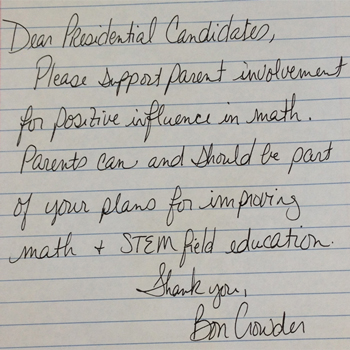
Dear Mr. President and Mr. Romney,
Thank you for supporting education and for being dedicated to improving the math learning in the United States. Americans all know that we may be in trouble when it comes to competing with the world in STEM fields — now and in the foreseeable future.
I am not writing to give my method of how to fix the schools. We have plenty of those — both in theory and in action.
Instead, I am writing to ask that you direct some of your considerable support towards a mission that is in great need of it: parent involvement for positive influence in math.
WHAT’S MISSING
Consider the influence that math-anxious grownups, such as parents, grandparents, aunts and uncles, have on young children. Research has shown that social modeling — parents saying, “I was bad at math too, honey” — has a significant impact on the attitudes and level of engagement kids have when going into a math classroom.
All the money invested in and all the programs that we currently use are ineffective if our children see their role models openly announcing that they don’t like or do math.
What if we could get parents to notice the math that they do effortlessly all day, every day, and announce THAT to their children? Children would then see that math is something done daily — not just in a classroom with pencil and paper. Children would enter their math lessons excited to engage in the next math-related discussion. And research bears out that this engagement is what facilitates true learning.
WILL IT WORK?
We have seen this work in the literacy movement of the past decades. Reading is Fundamental, and its competitive and companion programs, have created a society where parents not only read to their children on a daily basis, but also read to their children in utero!
How ridiculous to consider that reading to a child at such a young age will help them learn to read! But what it does do — and why the practice is effective and encouraged — is turn parents into positive reading role models. We have turned a society that was once comfortable with illiteracy into a society of readers. All from positive social modeling!
And what is lacking in our STEM education, nationwide, is this positive influence from adults towards children regarding math. But it CAN be done!
WE NEED YOUR HELP
Please integrate a parent involvement element in your education programs to help parents learn to to be a positive influence in math. We’re working at a grass roots level but we can enact this change much more quickly if we have your help. We can stop leaving the children behind if we get the parents to start exerting educational influence early.
With kindest regards, Bon Crowder, Writer & Publisher, Math Mom & Education Advocate
This is an open letter, please feel free to share onTwitter/X, via a printed copy or on your favorite social media site.
The Prime Directive in Star Trek is to not interfere with other cultures.
The Prime Directive in medicine is do no harm.
The Prime Directive in parenting is to keep the child alive.
There’s a Prime Directive in Education too!
Through all my suggestions, recommendations and ideas about math education, the one thing that trumps everything else is the Prime Directive in education:
If it works for your child, do it.
If a method, book, course or person helps your child do better in math, then stick with it!
Everyone has an idea of what great teaching looks like.
Proponents of Khan Academy like that lectures can be available to everyone, everywhere for free. Opponents say that Khan Academy is still just lectures.
Proponents of education methods popularized by Dan Meyer say that children need to connect with the math. They need to see it in action.
Opponents (and there aren’t many) say that sometimes kids just want to do the steps.
It’s not about great teaching, though — it’s about great learning.
Only your child knows what great learning looks like.
Children know how they learn best. They can’t always articulate it, thought, so they need us to watch them and figure it out for them.
If your child needs more of a top-down understanding of what’s going on in math, then the teacher (you or the classroom teacher) should work to give him that.
If he needs a to thoroughly practice the basics in math before moving on to something more — then that’s what he should have.
Even alternative learning methods can be used.
A friend of mine told me her child needs to practice his cursive writing. Because he thinks cussing and swearing is fun, she’s entertaining the idea of having him write sentences using a swear word. She worried that it might make her a bad parent.
Enter the Prime Directive in Education. If he improves with his cursive writing, and she explains that swearing is still not appropriate out loud, why shouldn’t he write the bad words?
If it works for your child, do it!
Some kids need rote memorization before understanding. Some need understanding first. And some need bizarre means to connect with the task at hand.
So if you find something that works — by golly, do it!
What does your child need? How can you make sure he or she gets it?
In Chapter 1 of What’s Your Math Problem?, Linda Gojak gives some initial thoughts on learning and teaching problem solving.
She introduces the concepts of routine problems and non-routine problems.
Routine problems are what you typically see at the end of a problem set in a traditional textbook. “In solving routine problems, the learner reproduces and applies a new procedure,” Gojak writes.
Non-routine problems, or rich problems, are the way of the world. They are the things grown-ups solve everyday effortlessly, and often don’t think of them as math problems.
Is solving non-routine problems teachable?
There is a divergence between the way traditional word problems are taught to kids and how grown-ups handle the rich problems in their lives. What’s Your Math Problem? attempts to distill and label each strategy of what grown-ups naturally do, so that we can teach these strategies to our children.
To make this work, knowledge of the various strategies is important. So Gojak labels, defines and gives examples of each strategy throughout the book.
This method of teaching problem solving to children will work if an instructor is careful not to force the use of a particular strategy.
Offer a strategy, but don’t force it.
The idea is to label and clarify each problem solving strategy so it can be one of the options in the toolbox of problem-solving for each child.
As students learn a strategy, teachers shouldn’t require it be used “so they can practice it.” Instead it should be offered and encouraged, but allowed to be tossed aside if the student prefers another method.
And caution should be used to ensure problem solving using these various strategies NOT turn into another algorithm.
Read more about it…
Don’t forget to check out Math Coach’s Corner for some other thoughts on Chapter 1 of What’s Your Math Problem? Make sure to scroll to the bottom, because others are linking up their thoughts and opinions!
Our world is struggling with education of all sorts. We know that STEM fields are in trouble. Not enough people are excited about taking the science and math classes needed to jump into them.
But there’s another piece of the education puzzle that’s missing — writing.
I talked to a primary school teacher at a social function today. She was telling me how students these days were often taught the algorithms of writing. One of which is the classic intro-supporting paragraphs-conclusion that I remember.
I said, “Oh, so they don’t get taught to write in their own voice, and stuff like that?”
“That’s just it,” she said. “They naturally write in their voice. But with the systematic methods we push on them it destroys it!”
That sounds familiar!
It pulled on my heartstrings — there was another basic subject that was competing with the almighty and all-powerful queen of subjects — reading.
Seems writing has the same challenges as math — people think there’s a formula to it when really it’s about voice, personal preference, beauty and art.
And writing, like math, is something people always do when they have to but rarely do just for fun.
What do we learn — really?
It made me really think about learning and teaching. All learning can be boiled down into one of three categories:
Learning information (historical facts, spelling, times tables)
Learning how to get information (reading, researching, googling)
Learning how to give information (writing, speaking)
Reading clearly has its place in #2, as does writing in #3.
But where is math?
When you teach math, are you only teaching facts (like in #1)? Or are you teaching children how to get or discover information (#2)? Or are you teaching them how to give or share information (#3)?
I’ll leave my answers for next time. Until then — what do you teach?
I love how Linda Gojak calls juicy, meaty problems “rich problems.” A good, fun thinkable is indeed a math word problem rich with problem solving challenges.
But getting started on a rich problem can leave you feeling rather poor. So Chapter 3 gives, and is called, “Getting Started Strategies.”
What’s that problem about anyway?
The first question you (or your child) should ask when given a problem is, “What’s it all about, anyway?” This is the strategy of “Restate the Problem in Your Own Words.”
Ask
What’s happening — what does it look like?
What bits of this problem are useless to me?
If a normal person were to ask the question, how would it be written?
Now what the heck does it really say?
Restating the question in your own words means understanding what’s being asked and what’s happening.
Is this a trick question?
Sometimes textbooks (and even life) give you problems without giving you all the required information. This is grownup-talk for what kids call a trick question.
If there’s missing information, call that bluff! What info do you need to calculate the final answer?
Is that information contained in the problem?
Can you find that information online or in a library?
Can you figure out that information using other stuff in the problem?
Is it just a flat-out trick question — there can’t be an answer because there’s no way to get the information needed?
Calculate the information, if you can.
Now it’s time to do a little pre-work. Gojak calls it “identifying a subgoal.”
If you’re missing some numbers in the problem but you can get these from others, then start calculating.
I walked 30 feet and then walked another 24 inches. How many feet did I walk?
The subgoal here — figure out how many feet I walked the second time.
Figure out how to show your work — or not?
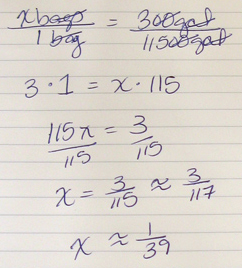
One of the strategies in chapter 3 is “Select Appropriate Notation” — which means determine how you’ll show your work.
But first ask the question, “Do you want to show your work?”
Here’s the big place where classroom schoolers and homeschoolers will diverge. It isn’t really necessary to show your work. Ever. And in homeschool, children don’t have to.
If you want to show your work that’s great. If you want to share your work, you have to show your work. If you want to be a famous mathematician or even a run-of-the-mill engineer, you have to show your work.
It doesn’t hurt to learn to show your work. But it’s not required to be a great problem solver.
In fact, if your child struggles with notation, and you push this too hard, their developing problem-solving strategies could be stunted.
But should you show your work for other reasons?
Gojak writes:
“…you use notation to help you reach a solution.”
This is not necessarily true. Some people do. I don’t. The problem-solving strategy that works for me is doodling pictures and trial and error, strategies covered later in the book.
I rarely solve a problem using x and y — or even crude representations of x and y like question marks or blanks.
If you feel the need to verify that your child is thinking properly, ask them to explain it out loud. Or give them another rich problem. Don’t force them to show their work because you want to see it.
Read more about it…
Don’t forget to check out Math Coach’s Corner for some other thoughts on Chapter 3 of What’s Your Math Problem? Make sure to scroll to the bottom, because others are linking up their thoughts and opinions!
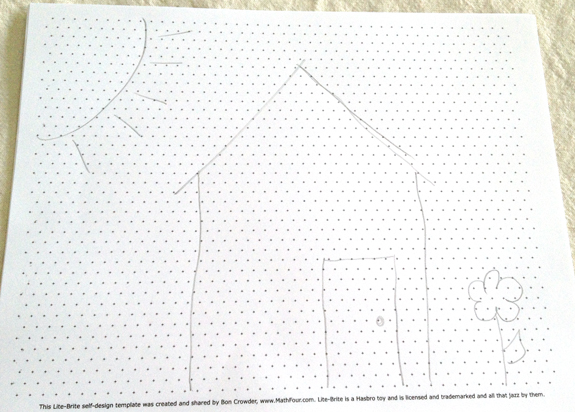
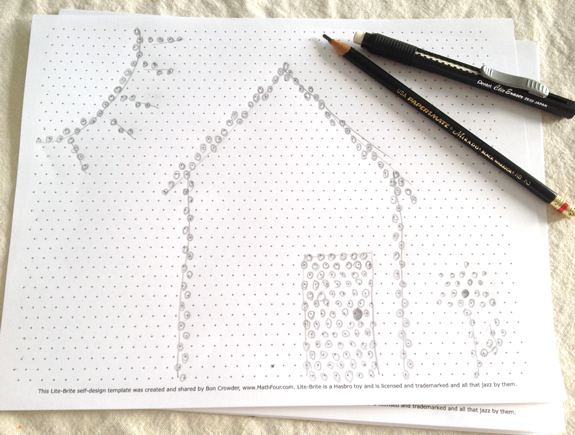
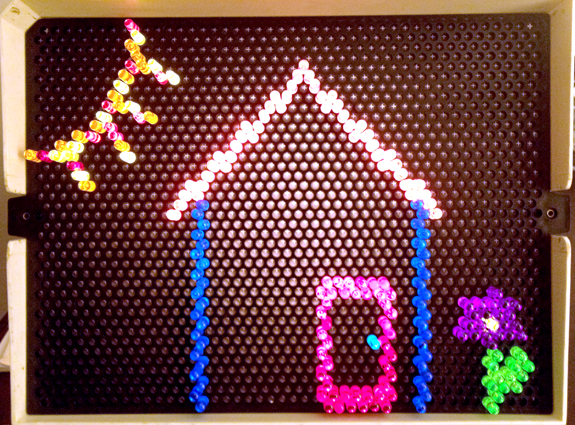
Or… click to get the online Lite-Brite simulator(the technology these days!). And get ready — because that old classic is about to become your child’s favorite graphing lesson!
Rough sketches don’t quite work with the peg placement. So draw the peg holes on the template as close to your lines as possible. Start noticing patterns.
3. Use colors!
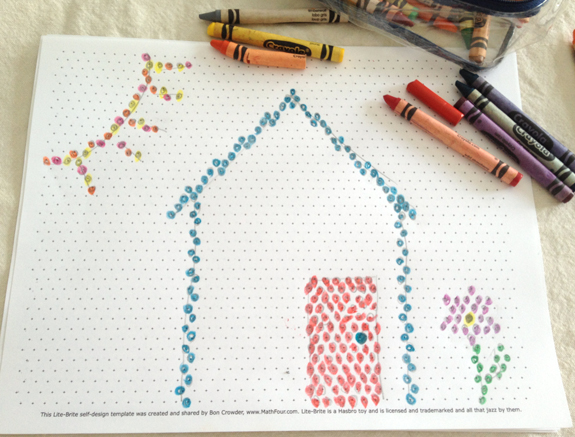
Pick some good colors you’ll want to use when you’re graphing your picture. Unless you and your kids know the exact number of Lite-Brite pegs you have, in which colors, you’ll probably have to tweak this in the next few steps.
4. Figure out where to start
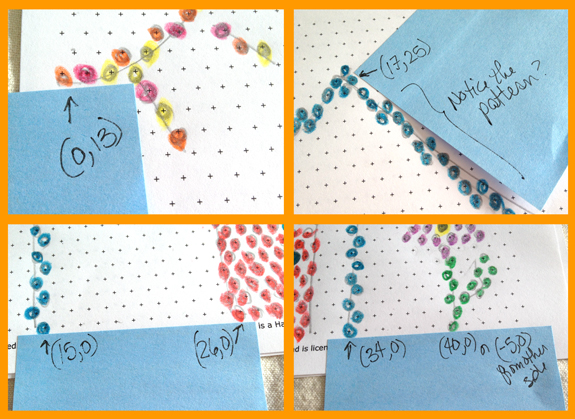
Here’s where things get very interesting. The peg holes are NOT lined up in what you would call a Cartesian coordinate plane. They’re not really in any kind of coordinate plane system. At least not that I know of.
The crazy structure in the grid doesn’t really matter. The fact that you can still count over and up to get where you want to go is what matters.
You and your children get to devise the way you count over and up.
5. Count and push!
Your child can follow the pattern on the template and push the pegs in the Lite-Brite. This offers practice for the skills they’ll use when graphing and working with the slope of a line. This is the precursor of calculus!
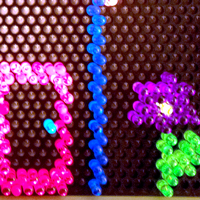
Notice that when I was graphing my drawing, I had to change the door from solid to hollow. I ran out of pegs. #ARG
Try it!
Find your Lite-Brite and download the template: classic or square. Post a link to your finished work in the comments and tell me how it went!
There’s a lot of talk about making sure kids understand what they are learning — instead of just practicing some arbitrary set of steps. I’m a proponent of this myself.
I copied and laminated this back in 1998!
But how well a child grasps a concept is based on how well he or she connects with it.
The learning style and interests a child has has an impact on if (or how well) he or she will understand a concept. And, as far as I know, there’s no rule on figuring that out.
You keep explaining it in different ways until you see the “aha moment.”
Except there are some times when understanding is too far out of reach. Or the child’s way of learning requires a deeper understanding than what’s available or possible at that point.
So what do you do in those cases?
Do you delay teaching that piece for understanding? Do you go on to something else and skip it altogether? Can you go on to something else?
Before making that decision, consider three points.
1. Nobody understands everything.
The way all the pieces of math work together is amazing. Nobody knows how they all fit — even the most famous of mathematicians. Everyone has something missing. Some of us have much missing.
So if your child is lacking in understanding for a few things — or even many things — that’s okay.
2. There’s more than one way to “understand” something.
Take any math concept and you’ll find that the applications of it are vast. It’s likely that you can use it in business, in fashion, in your yard and kitchen and in the toy box. So you can explain the concept — and inspire understanding — with any of the applications.
You can also explain a concept with metaphors to other math concepts and even metaphors to non-math concepts.
3. But they’ll get it, eventually.
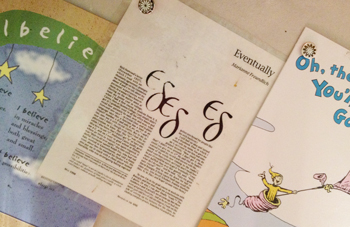
Back in 1998 I photocopied an article from an AMS Notices journal called “Eventually” by Marianne Freundlich. I laminated it and hung it on my office wall.
It’s moved offices a dozen times at least, but has remained an important reminder: “When learning something new, you may not get it now, but eventually you will. Just stick with it.”
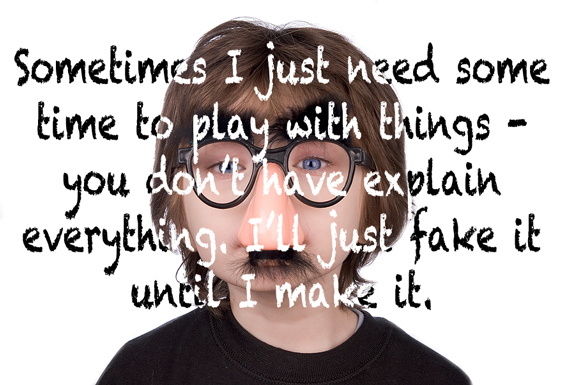
The “fake it ’til you make it” principle works in math too. It’s okay for them to practice something that they don’t understand.
But kids need you to know they’re faking it.
Often kids fake their learning. But they’re also trying to fake out the instructor. It turns into a big dirty secret that they keep inside. Like this:
“Mr. Smith, I don’t understand this. I think I can do the problems, though.”
“Well, Joan, let me explain it this way…”
Mr. Smith explains another way. Joan feels uncomfortable because he’s spent so much time on her and she still doesn’t get it.
“Okay, I think I understand now.”
“I’m glad. It’s important for you to understand before we move on.”
Joan thinks she’ll just keep practicing and hope that something clicks before the test. She doesn’t want to ask for more explanation.
Fake it like Fermat!
(That’s supposed to be a play on “Bend It Like Beckham” — I’m not sure it works.)
A well known phrase in math graduate school is, “Okay, I don’t understand that, but I’ll go with it for now.”
Mathematicians fake it all the time. They come back later to see if they can work out the details (and don’t publish or approve of something until they do). But they announce out loud that they’re faking it.
And kids should be allowed this too.
“Mr. Smith, I don’t understand this. I think I can do the problems, though.”
“Okay, Joan, that’s fine. Perhaps after you do it a while, you’ll get it. “
“It’s possible.”
“No problem, if you don’t get it now, you’ll get it eventually. As we move forward, when you come to something like this, just keep doing the steps. That might help you understand, too.”
“That works for me. Thanks, Mr. Smith.”
“Feel free to ask me any questions about it and we’ll continue the conversation until you do get it.”
Not understanding is totally okay — but the child must know it. And, more importantly, they must know that you know it!
So let them fake it!
When understanding is too far out of reach, encourage some rote practicing of the steps. And let them admit, out loud, that understanding isn’t there — even be happy for it.
Anticipate the understanding and be excited that someday it will come.
And if your child wants to move on, do it. They’ll get that other stuff eventually.
Forget it. If they don’t want to pay attention and learn, so be it.
Perhaps you’ve heard others say this, or felt it yourself. It can be extremely frustrating trying to teach a child something who just doesn’t get it, doesn’t pay attention, doesn’t seem to care or who doesn’t seem to want to learn.
There is an alternative.
However, if we consider the bigger picture, we see another possibility. Much of a student’s behavior can be a protective front to keep them from feeling like a failure – after all, who likes that?
Perhaps they act this way because the material is unfamiliar and therefore they don’t know if they can understand it. The uncertainty is a bit scary.
“Well they don’t have to be scared,” we say.
But they are. So… if they pretend they don’t care, and if they don’t try or if they hold back on really applying themselves, they can’t fail. Problem solved.
What does this have to do with me?
Those students who experience these negative feelings can exhibit behavior that can make it seem as if they don’t care. And then we take it personally. “They’re just really ungrateful of everything I do.”
It’s our job to meet them where they are — in their distraction, interest, frustration, intimidated state, excitement, fear, wonderment, avoidance, etc. But if we are burned-out, frustrated, or feel unappreciated, it’s hard to do that.
So how do I get there?
Adjusting just a few assumptions can put us in a more relaxed, sustainable place to offer reassurance and hope to kids who feel this uncertainty. Doing this is just as much for our self-care as it is for their education.
Use these statements to reset your assumptions.
These guidelines are designed to help us “reset” our assumptions in the service of positively impacting our approach to students.
1. It’s about them, not us.
When kids avoid or check-out, most of the time they aren’t doing it to “get back” at us. They do it to avoid the concern they feel about whether they’ll be able to meet a challenge. Or because they’re worried about looking incompetent in front of their peers.
They may even act out to divert attention away from their academic ability. This is another protective feature — again, not about us.
Adjusting this assumption can free up the compulsion to defend ourselves. It can also allow for more time and energy for them.
2. Kids have different levels of abilities. Period.
If we assume this, all of a sudden we aren’t expecting Joe to perform as well as Roger, or vice versa. This allows us to determine, without judgment, where Joe and Roger are with their abilities and to ask independent, non-comparative questions.
“What does Joe need to further his learning and education.”
And completely separately…
“What does Roger need to further his learning and education.”
3. They ARE trying.
There’s an assumption that all students CAN understand “if they just try” hard enough.
When we take this into the classroom, it’s easy to become frustrated (All they have to do is…), become resentful (I am so tired of busting my tail and they’re not caring) or even retaliate (If they don’t want to work in class, I’m just gonna load them up with a ton of homework. That’ll teach ’em!).
Assume that they ARE trying and ARE understanding as much as they possibly can. Doing this rids us of the temptation of doing things such as shaming and scolding — which has been shown to be counterproductive to learning.
It also puts us in a “glass half full” position of recognizing what they DO learn, rather than focusing on what they don’t. (Half cup of motivational praise, anyone?)
Keep these statements handy.
Write the above sentences down and keep them nearby. Read them at the beginning of every day, or every lesson or class even. It helps to have brief, yet constant reminders.
After a couple of weeks, see if you can tell a difference in how you feel, your stress level, and the reaction of your students.
Try them out and share know how it goes in the comments or on twitter/x. Did you come up with some of your own assumption adjustments?
Who said it first? Maybe Jerry Mortensen. Maybe George Phillips.
But hundreds, maybe thousands, of math teachers have said it and put it on their syllabus.
Because it’s true.
But does this mean that students have to “practice, practice, practice”?
And what exactly does that mean?
Say to me “practice, practice, practice,” and I’ll growl at you.
You’d might as well say to me, “I don’t know squat about your learning style and aren’t interested in finding out. But I know that you’d better do all 50 problems or you’ll lose points on your homework grade.”
So I prefer to think of this triad mantra in three phases: Practice Phase 1, Practice Phase 2 and Practice Phase 3…
Practice Phase 1 is isolated practice.
When a student learns a new math concept, he or she should apply it a few times, by itself. This is what’s offered in the problem sets of textbooks: isolated practice of the new math skill.
This practice is also an assessment phase. At many points here, the student can ask, “Can I do this? Do I understand this?”
Regardless of the answer, the student can proceed to Practice 2.
Why “regardless of the answer”?
Practice phase 1 is what’s commonly referred to when grownups say “practice, practice, practice.” But over practicing can be detrimental.
Some kids need to nail the isolated practice before moving on.
Some kids.
And some kids will become annoyed with it and need to move on to see the value of the skill.
Refrain from giving 50 problems just because “practice makes perfect.” It doesn’t. Practice sometimes makes frustration.
Let your child move on to practice phase 2. You can even let them skip assigned problems. She or he may return to the isolated practice in phase 1 later or mentally isolate the skill within the “bigger picture” in phase 2 or 3.
Practice Phase 2 is “big picture” practice.
This practice phase helps solidify the math skill. It should teach the integration of the skill into the full toolbox of math skills.
The math skills ancillary to the main skill being practiced, are themselves being practiced (hopefully in phase 2 or 3). How fluent a student is in these ancillary skills has an impact on his or her perception of achievement of the main skill.
Textbooks offer a problem set for this phase, but it’s often disguised. It just looks like harder problems.
It’s helpful to point out the ancillary skills being practiced. This helps affirm how much a child is learning and aids in building confidence.
Practice Phase 3 is ongoing.
Real skill is realized when it’s integrated without thought. For me this was always at least six months after first learning a skill. Sometimes it happened years later.
And there are some things I didn’t “get” until decades later.
Which means that practicing a skill must be continuous – even if a student doesn’t fully understand the logic underlying the process.
Of course this phase is subtle if not completely invisible. But instructors can point out when the “old skills” come into play long after they are learned.
Example: Factoring
Skill: Use the distributive property to remove a common factor from an expression.
Practice Phase 1 – Isolated
\(3x + 3y = 3(x + y)\)
Or with letters:
\(xy + xz = x(y + z)\)
Practice Phase 2 – Big Picture
Here the skill is integrated with factoring numbers:
At some point a student might notice that combining like terms is equivalent to factoring the common term then combining the numbers, like this:
\(3x + 5x = (3 + 5)x = (8)x = 8x\)
So, really – how much practice and when?
A student should practice in phase 1 until he or she is comfortable. Remember, over practice can be annoying and seem punitive.
And punitive math is never effective.
A student should practice in phase 2 based on his or her comfort level. This is a great time for parents/instructors to notice weaknesses in other skills, too.
Practice phase 3 is, well, ongoing.
It’s really helpful to note, out loud, where old math skills come into play. Instructors should always be on the lookout for ways to do this.
Even things like long division show up in the more advanced skill of polynomial division.
Pay attention to your student.
Some kids may respond to the “practice, practice, practice” mantra. Some may get annoyed at it (like me). If your child needs and wants more top-down learning, allow it.
Don’t force phase 1 practice – offer it.
And if you see a deficiency in an ancillary skill in phase 2, bring them back to phase 1 on that one.
Math really isn’t a spectator sport. But that doesn’t mean you have to drill like crazy on it. Adjust the teaching and practicing according to the child.