Tag: simply fun

  • Why Engineers Make Bad Math Tutors

    Why Engineers Make Bad Math Tutors

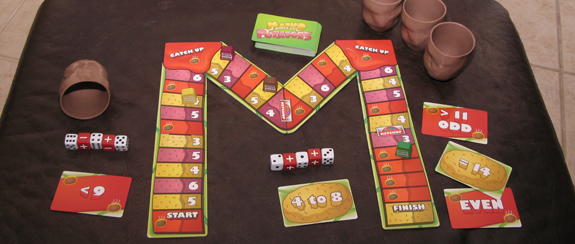
    I was at my dad’s house the other day and decided to pull out my new Math’d Potatoes game to see how my super-gaming family liked it.

    The kids in the house were too young to play, so my sister and I asked Aunt Linda and our stepmom to play with us.

    They quickly claimed they were “math Neanderthals” but agreed to play anyway. My dad, an engineer, was asleep.

    The game has simple rules.

    You play Math’d Potatoes by drawing a card, rolling five dice and making an expression that “satisfies” the card.
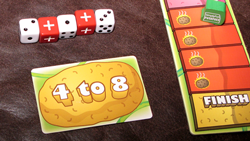
    The card requests various types of “answers”:

    • Even or odd
    • Equal to a certain number
    • Between two numbers
    • Less than/greater than a certain number

    Everybody got into it.

    Aunt Linda and Louise (my pet name for my stepmom) both agreed that it was a fun math game. This is in spite of the fact that neither one of them like math, and Aunt Linda doesn’t even like to play games at all!

    My dad saw the game the next morning.

    I had intentionally not waken up my father to play with us the night before. My decision was validated the next morning.

    My dad is an engineer, and as such tends to use the phrase “all you have to do is,” and the word “just.” He’s a very smart man, and I’ve learned lots from him through the years. And one of those lessons is: “Keep an engineer away from sensitive math learners.”

    Sure enough, when he saw the game, he eagerly said, “What’s this? Are we going to play it?”

    When I explained we played the night before he responded with, “Why didn’t you wake me? I totally would’ve won.”

    Math learning is slowly build, and quickly destroyed.

    When we were playing, Aunt Linda and Louise were both starting to warm to the idea of math. They were enjoying the game. My sister and I were holding back just a little to give them an opportunity to discovery their own skills. (We both experienced the engineer–math–dad super push growing up.)
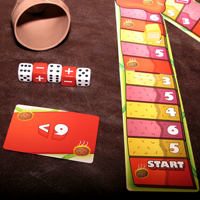
    So by the end of the game that night, they were excited, confident, and enjoying themselves.

    Had I woken up my father to play the game, he certainly would have won. He might’ve turned it into a competition, or he might have tried to help a little too much.

    Either way they would’ve lost interest. Their confidence would have been destroyed. And two beautiful, smart and happy women would have their, “I’m a math Neanderthal” thoughts validated.

    You can use this with your children.

    If you or your spouse are in a math related field, or was “always good at math,” be aware of your potential intimidation factor. Hold back. Don’t help. Allow discovery and confidence to come at its own slow and natural pace. Your children will learn math, in their own time.

    Don’t force it, or you might destroy it.

    Note: They sent me this game for free. This is not a review, per se, but still – you should know how I got it.
    Related articles
  • Playing with Algebra Concepts

    Playing with Algebra Concepts

    I’ve been itching to get into some basic abstract algebra goodies. With the help of the Cuisenaire Rods, Simply Fun Sumology number tiles and the Discovery Toys Busy Bugs, I’m able to do that.

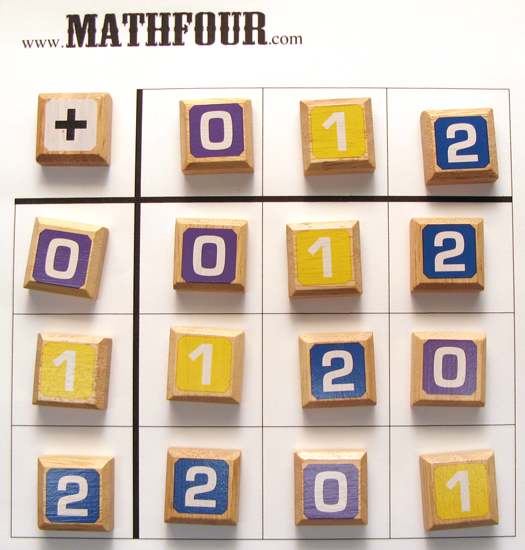
    Start with wrap around addition.

    This type of math is officially called “modular arithmetic.”  We are only going to use the numbers 0, 1 and 2.

    It begins as regular addition. And since we are only using those three numbers, all our answers have to be either 0, 1 or 2. So when we add 1+2, we wrap around.

    If we were to count in our system, we’d say: “0, 1, 2, 0, 1, 2, 0, 1, 2, 0, 1, …”

    The addition table looks like this:

    (Notice you could do this with numbers from 1- 12 and it would be clock addition!)

    Now things get buggy.

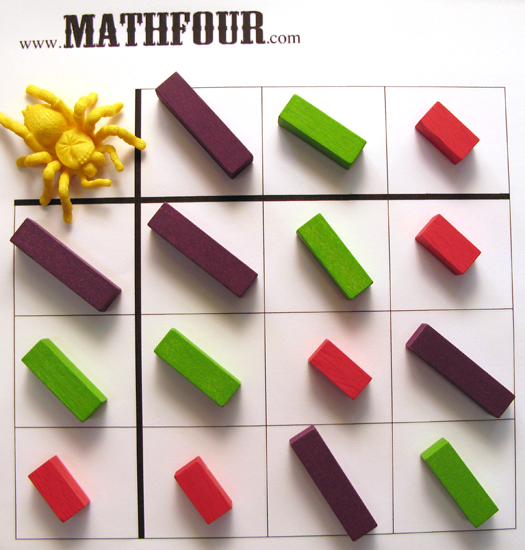
    Switch out all the number tiles with some pretty color Cuisenaire Rods. They don’t have to be the “right” rods. We’re only looking at the colors. Here’s the progression I did:

    The end result is a very abstract chart!

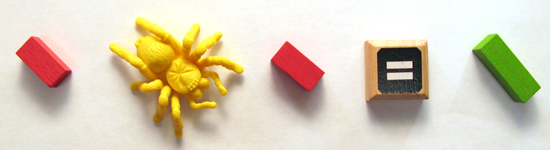
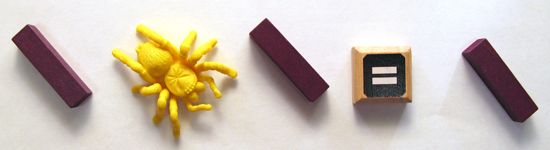
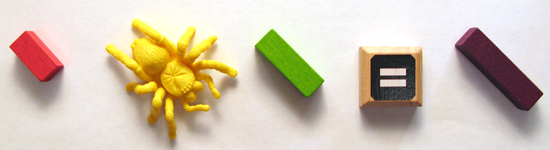
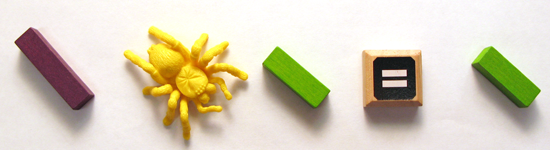
    You can “bug” two things together.

    Like this:

    (I know – a spider isn’t a bug. But run with me on this, okay?)

    Notice that each of these are directly from the “spider table” above.

    You can read this as, “Purple spider green equals green,” just like you would say, “Zero plus one equals one.”

    And then turn your child loose!

    First make a chart, or download this one.

    You can, but don’t have to, start out with numbers. The rules are this:

    • You can only use three colors.
    • All three colors must go across the top.
    • All three colors must go down the left.
    • Fill in the 9 spaces however you want, as long as it’s only those three colors.

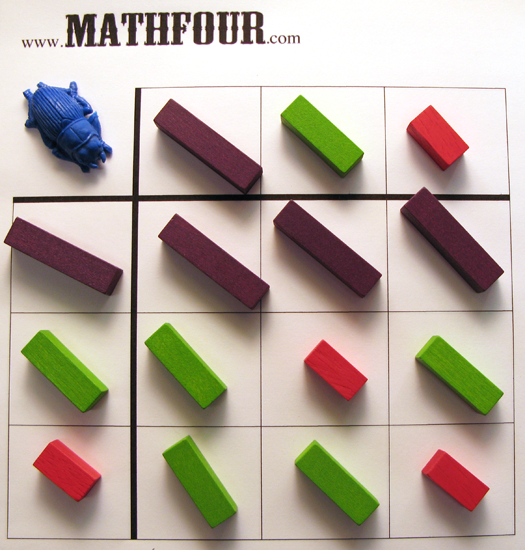
    I did this one with the blue beetle as the “addition” piece:

    So what can you do with a goofy “blue beetle table”?

    Let your child play, for one. And experiment.

    You can also talk about commutativity and associativity, identities, inverses… but I’ll leave that for another article!

    What do you think? Does your child want to play like this? What else can you do? Share your thoughts in the comments.

    Related articles
  • Long Division with Sumology Number Tiles

    Long Division with Sumology Number Tiles

    A few articles back, I published a video called Long Division with Playing Cards.  I did it super-fast in response to a comment at  Living Math Forum.

    I’ve pondered this a bunch since then and decided I like the idea, but the playing cards are too cumbersome. I ran across a game called Sumology (from Simply Fun) at the Texas Home School Coalition Convention. The heavens parted and angels sang.

    Or at least my heart started beating and my head started spinning.

    So here’s the same teaching method, but with a little more pizzazz and a couple of free downloads:

    What do you think? Will your child like it? Please share your thoughts in the comments.

    Related articles