Tag: downloadable

  • How to Create a Maze

    How to Create a Maze

    I just finished Dan Pink’s book A Whole New Mind in which he discusses the difference between a maze and a labyrinth. It made me think of this wonderful video of dissecting a maze into two walls to solve it:

    I learned about this method from David Chandler of www.MathWithoutBorders.com in the Math Future Google Group.

    Creating a maze becomes easy do-able!

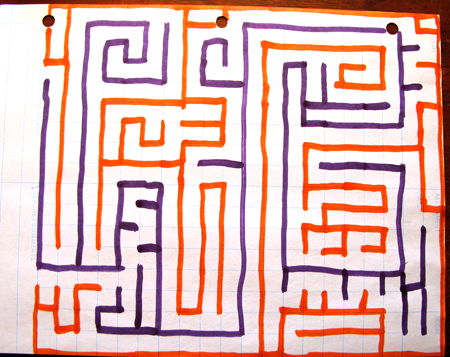
    From the discovery that David and his class of Math Explorers made, I learned that you can take two colors and create a maze. So off I went…

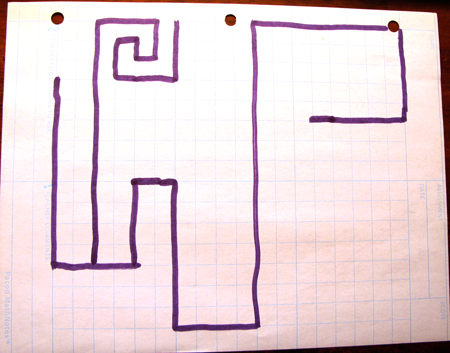
    I’ve been dying to use this elementary school graph paper I got the other day so out it came. I grabbed a purple marker and started:

    I immediately began creating the “rules” of what would be good maze design. And almost as quickly I began seeing that I was all wrong.

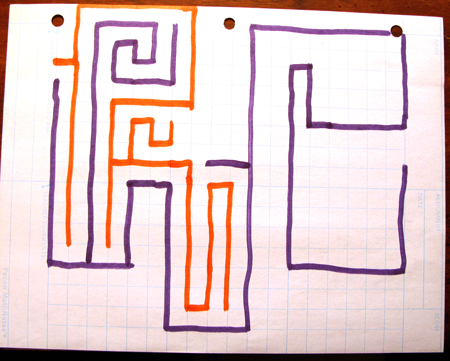
    After a while I got out the orange marker:

    More rules… more “…no, that’s not really a requirement” thoughts from me.

    After a while I just gave up on making rules and decided to make sure that my purple and orange would come out at some point together.

    Then with a little photoshop magic, I made it all black. You can download it here and play it!

    Okay, your turn!

    This might not be something to teach, but rather something to do at home together. It’ll be a learning experience for the whole family.

    Grab anything with lines or a grid on it and two different color pens or markers and give it a shot. Let me know how it goes. You can even post a link to the pictures of them in the comments!

    Check out the interview with David Chandler here.

    This article was previously part of a We Are That Family “Works for Me Wednesday” post.

    Related articles

  • How to Quit Saying “I Hate Math”

    How to Quit Saying “I Hate Math”

    Is changing how you feel about math like changing who you are?

    My Little Brother is a licensed professional counselor. He often tells me that you can change your attitude by changing your behavior.

    Apparently the behavior-attitude door swings both ways. If you don’t want to do something because you feel frustrated, do it anyway and that will clear up the frustration.

    So that’s how you can get your attitude and your child’s attitude aligned with positive feelings of math.

    Stop saying angry math things.

    I’ve pointed out that the real place kids learn math is at home. And I’ve discussed why grown-ups should quit talking about hating math. But until now, I’ve never said how to do this.

    Because it’s easier said than done right? When you’re frustrated, or your children are frustrated, you’ve gotta say something. So you can’t “just stop.”

    HOW do you quit saying “I hate math” (when you really do hate math)?

    First, make a list of all the math things you do (download the handy helper here). Here’s a starter list for both you and your children:

    • I know how long it takes to get dressed and so I can calculate when I have to wake up in the morning.
    • I can figure out if our car is getting good gas mileage.
    • I can figure out if I have enough money saved to by a nice toy.
    • I know what I have in savings and if that’s enough to buy the fancy shoes I want.
    • I know how many minutes it takes me to walk to my friend’s house.
    • I know that riding my bike to my friend’s house is faster than walking.
    • I know that in the past I couldn’t reach the middle of the dinner table, and now I can – because my arms are longer.
    • I can figure out how much I’ve grown in the past year by looking at my growth chart.

    Copy your list and put it on the refrigerator, in the bathrooms, on the front door and next to your bed. When you find your child or yourself wanting to say, “I hate math,” instead say, “I can do math because __” and fill in the blank with something from the list. If you need to, continue like this:

    This particular math problem I’m working on is more challenging than what I already know, but it isn’t hard. I just have to figure it out. And since I’m smart enough to do all that other math, I can figure this out!

    The behavior of changing what you say will have a positive affect on how you and your children feel about math!

    Try it. Let me know how it goes!

    This article was previously part of a We Are That Family “Works for Me Wednesday” post.

    Related articles
  • Teaching Patterns with Playful Bath Shapes

    Teaching Patterns with Playful Bath Shapes

    Do you get “why” questions often from kids?

    Differentiation is the foundation of learning. Curiosity comes in the form of “Why is that different?” And right behind it is “Why is that the same?”

    So patterns – and the lack of patterns – are essential in the development of a child.

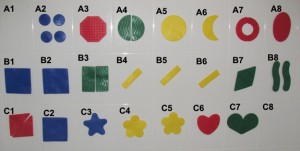
    The picture below is a collection of Discovery Toys (not all of them because they live in a house with a 19mo child).

    While in the tub, I encourage Daughter to see which ones are the same color. You can label the bathtub tiles with soap crayons so you can discuss the patterns more easily. Use the Cartesian Coordinate plane or Excel cell names like I did in Photoshop.

    Here are some things to talk about to encourage pattern discovery and learning. Or click here to download this as a printable MSWord Document.

    • Which shapes are similar? Which are congruent?
    • Which shapes are kind of the same (similar, but not in the official math sense of “similar”)
    • Put shapes together that “go together” – these could be same shape, color, “feel” (like B6 and B7 are both angled).
    • Compare shape A5 to the shapes A3, A4, A6, A7 and A8.
    • What do cells B3 and B8 have in common?
    • How are C3 and C4 different?
    • What’s in common in cells A2 and B2?
    • How are shapes C1 and C2 different?
    • How are C2 and B3 similar?

    And then look at the world!

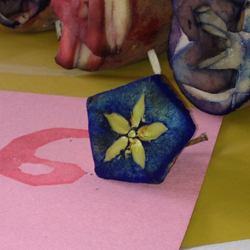
    When you’re out of the tub, make sure to encourage observations – of everything. For something like the gate trim in the picture you can ask questions like:

    • What is similar?
    • What pieces are different?
    • Do you see spots that are kind of the same but mirror imaged?
    • If you were to make this symmetric, what other parts would you have to add to it?

    Have fun. See patterns. Enjoy the discovery!

    Download the activity questions here.