Tag: circle

  • Math with the Short Order Dad — And His Handy-Pal Pan Scraper!

    Math with the Short Order Dad — And His Handy-Pal Pan Scraper!

    The Short Order Dad's Business Card – and the math behind it!

    While at Dad 2.0 last weekend I intersected with Rob Rosenthal, the . His cook-off competition jersey had the number pi on the back. So you can imagine how I knocked everyone over to get to him.

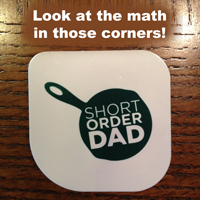
    I was instantly impressed with his “business card.” It was a Handy-Pal Pan Scraper. The perfect tool for any kitchen and a great way to make your mark if you write about kitchen things.

    The Handy-Pal Pan Scraper is a square. Mostly.

    When showing it to Husband, I noted that the Handy-Pal Pan Scraper’s corners were different.

    My inner (comedic sidekick) voice said, “How different are they?”

    (I ignored the invitation to create a goofy math joke.)

    I looked at the Handy-Pal Pan Scraper more closely. All four corners were different.

    My inner (smart) voice said, “What’s the angle on each corner?”

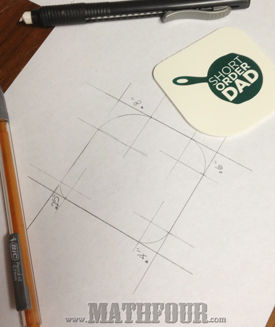
    I ripped the thing from its package and traced it. I ran for the protractor.

    Immediately after slapping the protractor down on my sketch I thought, “Duh – all angles are 90°.”

    I needed a better question.

    Clearly the question, “what’s the angle,” was not going to help me differentiate between the corners. And that’s what I really wanted — the legitimate answer to the question, “How different are the corners?”

    I tried a few questions out, to see what would work:

    • How are the corners different? (too vague)
    • What’s the rounding difference? (what does that mean?)
    • What does it mean to be rounded differently? (attempting to clarify the previous question)
    • Round means a piece of a curve – like maybe a circle. Is each corner a piece of a circle? (this is starting to feel better)
    • Hey, it looks like each corner may be one fourth of a circle. So what’s the radius of each corner’s “quarter circle”? (gotcha!)

    I had my question.

    So it finally seemed, after all this internal conversation, that I had a question with a “non-duh” answer.

    What is the radii of the corners?

    I got out the ruler and started playing.
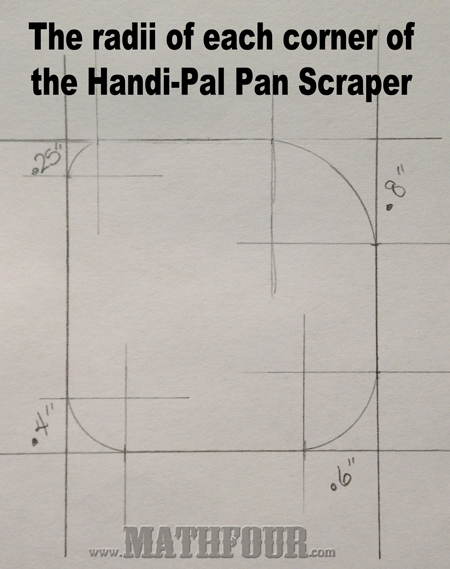
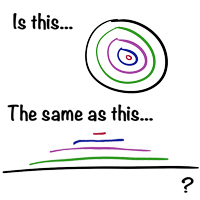
    Each corner of the Handi-Pal Scraper is different - and that's math!

    Turns out that each corner is indeed different than the others. My measurements are approximate. And close enough. 🙂

    Say it out loud.

    Do you have a Handy-Pal Pan Scraper in your kitchen? Take the opportunity next time you’re scrubbing a pan to point out that the corners have different radii.

    Because, you know, just saying it helps!

    Share your thoughts in the comments or on twitter/x. And don’t forget to pin this on Pinterest!

    You might also like:
  • Area of a Circle vs. Area of a Triangle

    Area of a Circle vs. Area of a Triangle

    Inspire your kids to think about how circles relate to triangles!

    I first saw this video over at MathFail. It’s cute, and I have to admit, kind of cool.

    But anything this simplistic always sends me into skeptical mode.

    Before we go any further, check it out:

    Do you believe it?

    This might be the question to start a discussion with a student. It’s certainly the first question that comes to my mind.

    If it were really this simple, wouldn’t we have used it to “prove” the formula for the area of a circle much earlier?

    What’s wrong with it?

    For the “proof” in the video to work, you have to assume (or believe) that the circumference is 2πr. This seems a bit cheesy to me, since that formula is as complex as the one we’re trying to prove. Not to mention quite closely related. But I’ll let this one go.

    The thing that really bothers me is that they use only a few chains — each of which has thickness.

    If you filled the inside of a circle (a disk) with concentric circles, none of those circles would have a thickness. In fact there’s an infinite number of those circles.

    Is it realistic to take each of those circles and fold them out and get a triangle?

    Can you use it to teach?

    I believe the makers of the video intended this to be a fun way to remember the area formula of a circle.

    But the video would be better used to allow students to ponder the relationship of a circle to an isosceles triangle.

    What do you think?

    Are you okay with this video? Are you as skeptical as I am, or am I a little too sensitive?

    Share your thoughts in the comments or on twitter/x!

    You might also like:
  • GeoGebra – Overcoming the Fear

    GeoGebra – Overcoming the Fear

    This is the 5th in the draft purge series where I’m throwing stuff out over a three week period.
    One month after starting MathFour.com, I came across an article about GeoGebra. I was quite taken by the software, but a little overwhelmed.

    I’m not much into technology — at least when it comes to math. So the power of the tool was much more inhibiting for me than it was empowering.

    So the review of it stalled.

    Indeed this article was first “drafted” back in March of 2011 — more than a year ago. It only had the link to that article in it. Not much of a draft.

    Lucky for us, math is math. It doesn’t change much over a year (or even a few hundred years).

    So GeoGebra is pretty much as useful (and as scary) as it was a year ago.

    But like all good heros, leaders and people stupid enough to think they might be either, I’m diving in. Regardless of my fear.

    First: Get out the users’ manual.

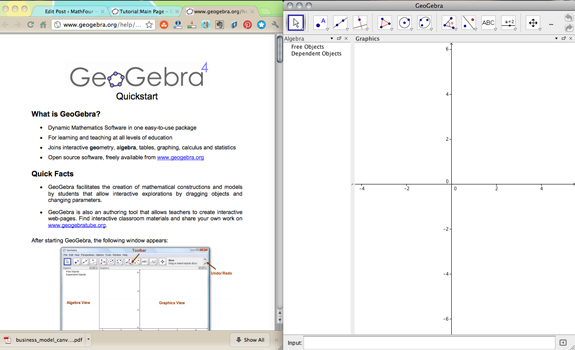
    So I found the GeoGebra Quickstart guide and started reading. I downloaded GeoGebra and cranked it up.

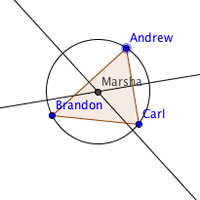
    The Quickstart has three examples to try. The first one is un-intimidating — merely involving a triangle and a circle.

    So I did it.

    And I can share it, too!

    Turns out you can “share” your work on GeoGebra — those guys are pretty clever, I must say!

    Click here to see my first ever attempt at GeoGebra goodies. Notice I named my triangle vertices and the center of the circle with real names — fun!

    The Circle Triangle Dance

    Following the directions, I learned about the Move Tool. Which means you can move just about anything — the whole triangle, the circle or any of the vertices!

    Check out the “dance” I did with my circle and triangle:

    I’m looking forward to playing some more. But I still have my concerns.

    I’ll share those tomorrow. For now, I’m just going to enjoy the tool!

    How about you?

    Have you played with GeoGebra? Will you? How do you use it? Tell us in the comments.

    Don’t forget to tweet it out, too!

    You might also like:
  • [50 Word Friday] Cars Driving in Circles

    [50 Word Friday] Cars Driving in Circles

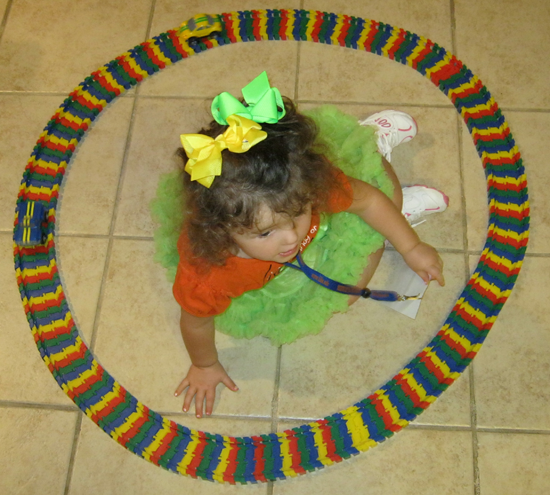
    Daughter wanted to play. I wanted her to learn. We did both.

    She learned:

    • You can sit in the center of a circle.
    • Cars drive on the circumference of the circle.
    • Cars driving at the same speed can continue to be diametrically opposed.

    Learn and play – the best way!

    Learn more about 50 Word Friday here.

    Related articles