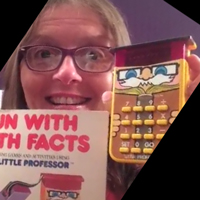
I do #KnickKnackYack in the #MathShack live every weekday morning at 6am EST on Periscope. I share the random knickknacks accumulated through years of math blogging. Sometimes on a math object. Sometimes on something totally random. Always with wit, humor and a little math. Follow @MathFour on Periscope or Twitter to get notifications of when it broadcasts.
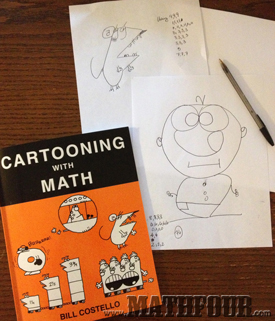
The Cartooning with Math book showed up in my mailbox this morning (not surprisingly, since I ordered it a week ago, but still…)
I was so excited to play — and for good reason. I’m generally a terrible artist. So I welcome step-by-step instructions to draw fun things.
And how much more fun could you possibly get than cartooning with math!?
The drawings work!
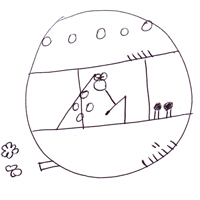
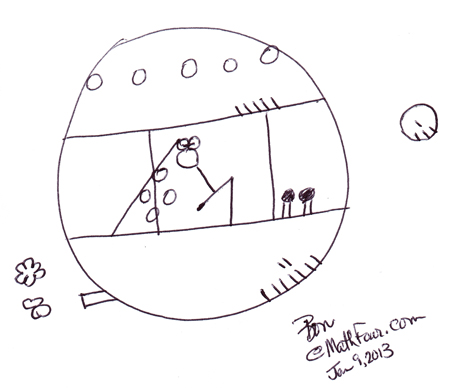
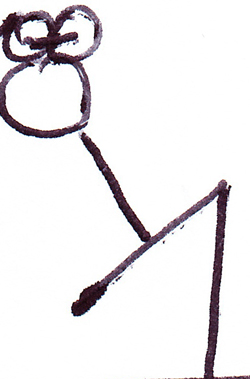
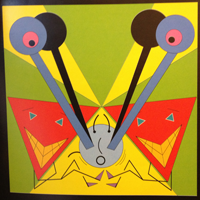
I followed the instructions and did a pretty good job:
Notice the numbers in the detail below. From top to bottom — 8 (sideways), 1 (sideways), 0, 1, 7.
The problems are fun.
He offers a word problem at the end of each of the drawings based on the numbers used in the drawings.
It’s only one, so it isn’t too much that it takes away from the drawing fun.
I want more!
The book gives you just enough drawings (a dozen or so) to get a feel for cartooning with math. It’s great for getting your kids to start creating drawings and word problems of their own.
It’s only $8.95, so if you have interest in math or the fine art of cartooning — get Cartooning with Math now. You’ll love it!
And don’t forget to share your drawings — link to them in the comments!
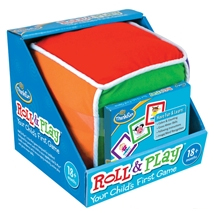
Billed as “Your Child’s First Game,” this helps the little ones understand game play. Non-competitive, but fun. All activities are marked on the cards with pictures as well as words, so they are easily deciphered by the non-readers of the family.
Moving pawns or putting up fences. Deceptively simple. Ridiculously challenging after you and a friend have played 5 times. Which will your strategy be?
Ages: Ages 8 and up Players: 2 to 4 Review: Coming soon! Cost: $29.95 on Amazon
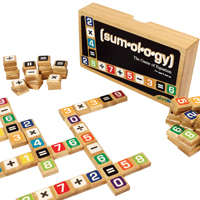
Helps children build equations and do advanced math using the basic operators. Players place their tiles in crossword fashion either horizontally or vertically to create valid equations.
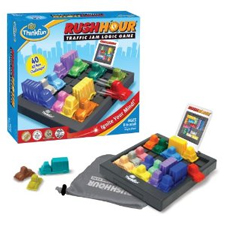
Playing Rush Hour helps build sequential thinking, reasoning and planning skills. Challenges range from beginner to expert, so everyone in the family will enjoy it! Rush Hour can be played at home or on-the-go — perfect for on road trips, airplane rides or physician waiting rooms.
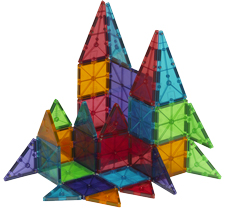
These tactile, colorful translucent Magna-Tiles stick to each other for fun 3D exploration or practicing basic shapes and colors. Magna-Tiles develops patterning, shape recognition, building and motor skills. They store nicely on the refrigerator too!
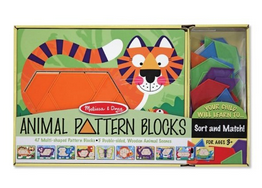
Complete the colorful animal pictures with geometric shapes. The 47 geometric shapes come in a rainbow of bright colors, and can also be used outside of the boards for counting, sorting and original designs. Great for developing shape and color recognition, fine motor skills and language skills!
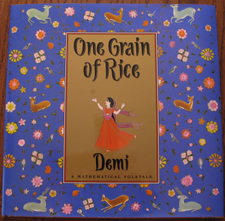
Exotic, beautiful, and instructive, this “mathematical folktale” by author-illustrator Demi emerged from her love of India. This retelling of the classing “doubling” story is about Rani, a clever girl who outsmarts a very selfish raja and saves her village. When offered a reward for a good deed, she asks only for one grain of rice, doubled each day for 30 days.
This special counting book visually explores the concepts of factoring and the role of prime and composite numbers. The playful and colorful monsters are designed to give children (and even older audiences) an intuitive understanding of the building blocks of numbers and the basics of multiplication.
I’m at the Domestic Estate Manager’s Association Convention this weekend with Husband and I’ve discovered a marvelous math tool. It’s called “The Butler Stick” and it’s used by butlers and other domestic service personel — mostly.
But there’s a lot of math in it — enough to integrate The Butler Stick into your world as another learning tool.
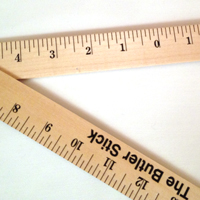
On one side it’s a yardstick.
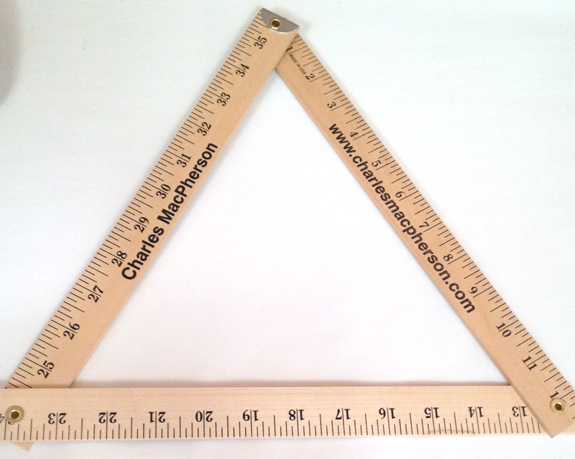
The Butler Stick has thirty six fun inches to measure just about anything. It’s foldable, though, so you can store it like a standard ruler.
You can show an equilateral triangle with it, as well play with various angles.
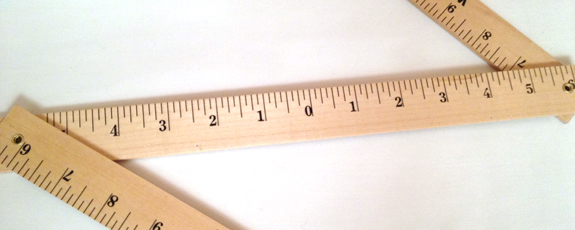
On the other side it’s a number line!
Okay, so it’s missing the negative signs on the left, but those are easily added with a sharpie.
The Butler Stick is typically used to set a table. The plate is centered at zero, and from there you can symmetrically lay out the flatware and other bits.
You can use it to teach proper place setting (something every child should know) and inject some math into dinnertime!
You can also use it to create other things of symmetry. Use it to have fun with math during art lessons.
Treat your family to one!
They sell The Butler Stick at Charles MacPhearson’s site, but you have to call to order it (416-369-1146). It’s not cheap, at $24.95, but it’s well made and looks like it would take a beating from a few children. (But not give a beating!)
Or you could try it out for a while by making your own. Use some some cardboard and rivets and you’ll be able to see the value of it. It’s a crude version, but the math’s the same.
Once you see how cool it is, you’ll be calling them up — just like me!
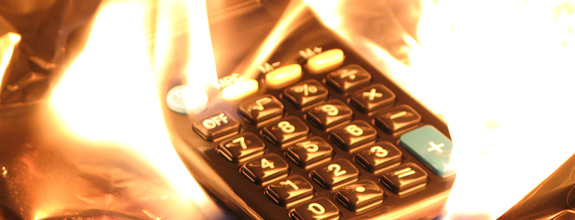
It’s no secret that I’m an opponent of calculators. In fact, I recently suggested to readers of 12Most.com that they burn their calculators!
But there is one calculator that isn’t burn-worthy.
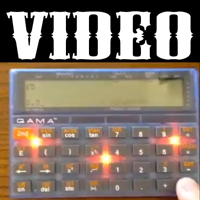
The QAMA Calculator requires the user to input a reasonable approximation before it churns out an exact answer.
So if you asked your QAMA Calculator to find the square root of 5, it would ask you first what \(\sqrt{5}\) is really close to. Like this:
That’s annoying!
Okay, maybe. If you need the calculator to do some quick work (the real reason to use a calculator), then you don’t need the darn thing quizzing you about an approximation.
But the QAMA Calculator people thought of everything. You can turn off that feature!
But then the kids will cheat!
Ah! You would think so. But check out what it does when you turn the feature off:
So what do you think? Will you get a QAMA Calculator? (It’s only about $25 after shipping & handling.) Will you let your kids use it?
P.S. I paid full price for it — it’s not expensive and it’s a crazy brilliant idea, so I went for it.
I walked away with so much knowledge and quite a few great products – and Wil ended up with some too. Here are our fun finds and great product choices – look for more information on each soon!
The MathRack
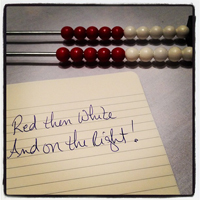
The MathRack is an amazing product built by even more amazing folks. They started in their own home, and they still assemble the MathRack by hand in their garage.
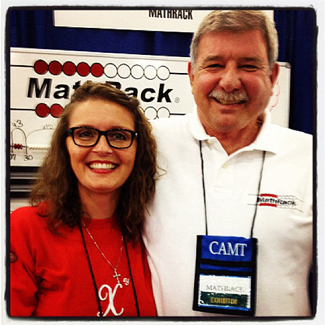
I know I should share a photo of the product, but Scott Rule, owner, founder, chief cook and bottle washer of MathRack, is such a sweetheart – and has worked so hard on the product – I couldn’t resist including this fun photo of us!
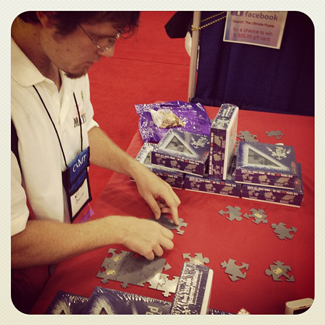
The Ultimate Puzzle
Anette offered a free Ultimate Puzzle to anyone who could solve it in less than 5 minutes. Both Wil and I tried our hand at this puzzle developed in Estonia.
There are over a bazillion million hundred billion ways this thing can go together – and only 200 of them will work!
Alas, I ended up buying one of them.
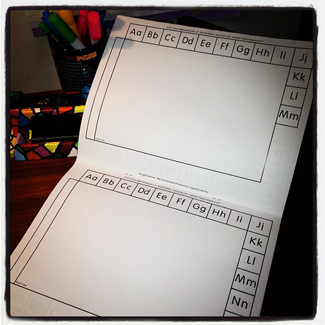
Dinah Zike’s Alphabet Tabbed WrapAround
Last week I put alphabet tabs on a Moleskine book to help me teach K8 to read. Then I found Dinah Zike’s Alphabet Tabbed WrapAround. It’s amazing and I can’t wait to use it!
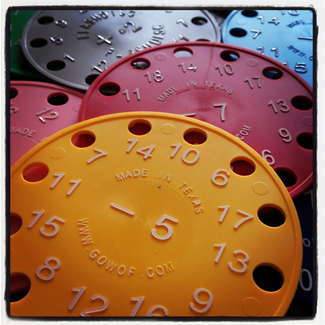
Flashdisc – Wheel of Facts
The Flashdiscs are a nifty little self-checking set of fact helpers. They come in both addition/subtraction and multiplication/division.
Luckily Wil could actually use a set of these with his tutoring clients — I got him to pay for it!
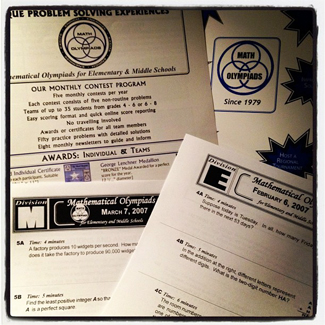
Math Olympiads
Math Olympiads is a monthly competitive math fun for classroom schoolers and homeschoolers. Seems very cost effective and lots of fun for kids of all ages.
Tons of ideas!
We learned about numeracy and using “Number of the Day” exercises from two fabulous teachers from Conroe ISD. We learned great ways to use the MathRack from the beautiful and awesome Christina Tondevold.
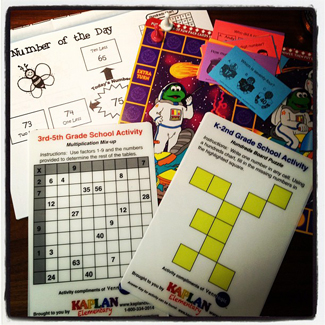
We even got some great giveaways from Kaplan Elementary and Frog Publications that we’ll be dissecting so you can use them at home (they’re currently only priced for full classrooms).
So look for detailed articles on these and other great math learning ideas coming soon. I’m kinda bubbly inside from all I have to write on.