
I had the privilege of substitute teaching fifth graders last week. In that experience I was introduced to the D.E.A.R. program — Drop Everything And Read.
Imagine my horror!
Okay, I’m a little sensitive to how obsessed with reading to children grownups are (and how much they ignore building logic and reasoning skills like math). But this D.E.A.R. thing makes it clear to me that I’m right.
Do you see a “drop everything and do a puzzle” program? Nope.
Reading is passive.
We’ve been brainwashed that reading is the most important thing in learning. But it has some serious downfalls.
Reading is a passive activity. Granted, you can learn a great deal of grammar and vocabulary through reading. So it’s not without its merit.
But stressing reading to the exclusion of other, more active, activities is doing your children a disservice.
Math and writing are active.
Math and writing are the active ones in the three categories of learning. You can’t passively do math — one of the reasons we often say math is not a spectator sport.
And writing, well, that would be interesting to see someone do that passively, I’ll tell you!
Math and writing both require logic and reasoning skills — thinking skills.
So how about a Reading, Writing And Math Kit?
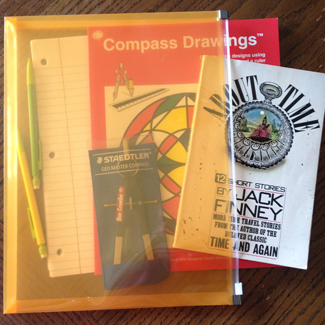
Teach your children to carry a “RWAM kit” everywhere they go (pronounced “ram”).
Pick up a cheap zipper pouch (mine was $2.59 at Office Max) and let them decorate it.
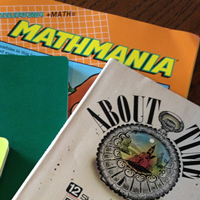
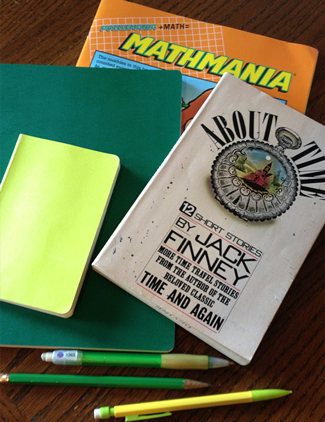
It should always have a pencil or pen and a blank book or loose paper. They can also carry a book for reading and a drawing or puzzle book (like sudoku, Mathmania or GAMES Book for Kids).
Reading — they can practice this necessary and helpful skill with the book or some of the instructions in the puzzle book.
Writing — they can write journal entries or stories in the blank book. They can also play, “what will happen next” after each chapter or segment in the reading book.
Writing this out is a fun and active exercise that provides children with a reading break, as well as a different way to practice logic and reasoning skills.
Math — the puzzles provide the math skills here. If they’re doing a puzzle, they’re practicing the same logic and reasoning skills required for math. In fact, if a child does puzzles, he or she will get much better in textbook math than by using the textbook alone.
What if they draw instead?
Drawing can encompass any or all of the above three.
Students can illustrate a part of the reading book. Or they can illustrate their own writing.
And they can create tessellations or other geometric drawings. In fact, even if they draw racecars, they’re still practicing shapes, ratios and perspective — all math things!
So don’t drop everything.
Don’t fall prey to the brainwashing Drop Everything And Read campaign. Because you just might be depriving your children of actively growing their logic and reasoning skills!
Help your child build his or her RWAM Kit today — and don’t let them leave home without it!
P.S. You should do it too. Not only is it a great habit, but you’ll also be a good example.
Share your thoughts in the comments or on twitter/x.