Tag: rules

  • We Use Math and Grammar Rules – They Don’t Use Us!

    We Use Math and Grammar Rules – They Don’t Use Us!

    I got engaged in a twitter fight about grammar with Chiew from @aClilToClimb (now @Chiew_Pang). Yes, I’m the math mom, but my college minor is English. And I tend to be a sharpie carrying, sign correcting, grammar vigilante.

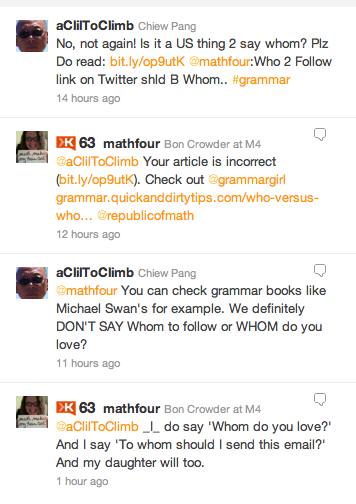
    I complained that Twitter has the link “Who To Follow” when it should be “Whom To Follow.” Here’s an excerpt from the fight:

    The fight raged on.

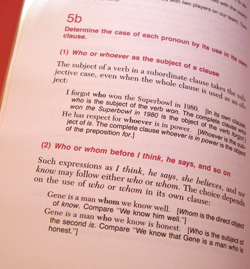
    This guy was so adamant that you could use “who” as the object in a sentence (clearly wrong), and just wouldn’t let it go. After quite a few tweets I got curious. “What’s this guy’s deal? All he has to do is pull out the Little Brown Handbook and read it in plain black and white.”

    So I went and looked at his site. Holy cow! He’s a grammar blogger!

    I couldn’t find his “About” page, but from what I could gather in his fervor in our twitter fight, he’s trying to do for grammar what I’m trying to do for math. Demystify, take away the “have to” rules, and make it accessible, acceptable and appreciated by everyone.

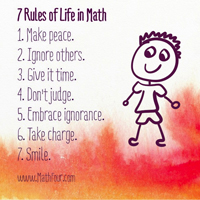
    We make the rules!

    The rules of grammar, like the rules of math, are created by humans and used by humans. They are changeable.

    Of course the difference is that, in grammar, if you deviate slightly from the rules that others follow, you’ll most likely be understood. In math, you really have to define how you’re using things before you begin to work.

    For instance, if I wanted to have a conversation with someone about a new way of adding fractions I was inventing, I could totally do it. As long as I started the conversation with, “Here’s how we are going to talk about adding fractions for the next hour…”

    Make it your own!

    Teaching math and teaching grammar are two of the fundamental things we do for our children. And neither should be hard, creepy or frustrating. They should be a normal, natural flow of who we are as people.

    Another great math mom says, “Make math your own, to make your own math.” I’d bet Chiew would say something similar for grammar.

    And for this, I respect him. </fight>

    Related articles
  • How to Teach a Weird Math Rule: Negative Times a positive Is a Negative

    How to Teach a Weird Math Rule: Negative Times a positive Is a Negative

    Thanks to Molly for this question she left in the comments, “Why is a negative times a positive, a negative?”

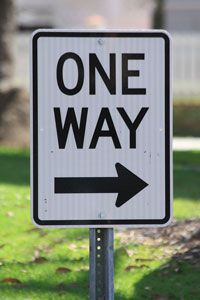
    “Sign – One Way” by Andrew Schmidt

    It’s common to hear a child say, “They created this rule just to make me mad.”

    And on the heels of that usually comes a frustrated teacher’s comment of, “No, this has a purpose.”

    When then faced with, “Okay… so what’s the purpose?” a teacher or parent might become more frustrated. It’s not always clear the purpose of things like the rules for multiplying differently signed numbers.

    It may also be that the grown-up secretly believes that this was all created just to make us mad. After all, when the last time you had to multiply a negative number times a positive number in the real world?

    I, personally, can’t ever remember a time when that case has come up outside of a math class or tutoring session.

    Then why create the rules at all?

    The truth is that many math rules are created because we need a rule to continue working – something to agree on among peers working on the same project. We need everyone on the same page.

    This agreement somehow gets filtered down to the kiddos as “this is the absolute way it is – do it because we said.”

    So it very much looks like we created rules to make them mad.

    Good deduction, kids.

    How do they pick the rules?

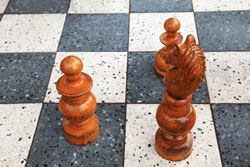
    “Street Chess” by Petr Kratochvil

    Some math rules are created arbitrarily just so we have something (anything) to agree to. Like the rules of a game. The order of operations is one such situation.

    There is no natural reason why we’ve chosen to do multiplication and division before we do addition and subtraction. No more so than the people in the US have decided to drive on one side of the road whereas the people in England, Australia and the Bahamas drive on the other.

    We’ve agreed to it.

    It keeps us from crashing.

    Sometimes, we agree to a rule because it is “less bad” than any of the other possible rules we can think of. The result of any number raised to the zero power is one of these. 30 feels like it should result in either zero or 3. But if you mess with all the other rules (in particular the one about subtracting exponents here 3737\frac{3^7}{3^7}) you’ll see that 30 really needs to be 1. If it were anything else, it would mess up the rule of anythinganything=1\frac{\text{anything}}{\text{anything}}=1.

    How do we teach crazy math rules?

    Why is a negative times a positive equal to a negative? Is it because it messes other things up or is it an arbitrary rule? Instead of explaining the reasoning to a child, allow them discover it.

    Have a “King for a Day” day where the students get to rewrite a particular math rule. Allow them to sit as a class or family and decide on the rules for multiplying signs numbers.

    Give them plenty of time to experiment and see if the new rule messes anything up. (If your administrators or math curriculum specialists fret about you allowing students this time, note to them that the students are behaving like real mathematicians. They are inventing a concept or rule and testing it out to see what happens.)

    If the students discover that the new rule has dire consequences when applied to the rest of our number system, they then see the reason for the rule. And they’ve learned through experience and solidified the rule in their minds!

    If the students discover that there are no consequences of the new rule, they can then determine that the rule was created arbitrarily and agreed upon for convenience. It is a rule for rules’ sake.

    You can discuss with them how things would be different if they kept the new rule and everyone else in the world followed the old rule. Again experience and discussion will solidify the “real” rule.

    So the next time you’re faced with “why?” regarding a math rule, give it a shot. Let the children be the rulers of their own math world!

    Will it work? Did it work? Share your thoughts in the comments!

    Related articles